

Ohio real estate leads start with a number the county just mailed
The best Ohio real estate leads are not bought. They arrive on a schedule the state publishes years ahead of time.
Every Ohio county revalues its property under a fixed statutory cycle, a full reappraisal every six years with an update three years between. Forty-one counties were in a valuation year for tax year 2026, which put a new official number for someone’s home into several hundred thousand mailboxes across the state.
That number is not what the home would sell for. Butler County‘s auditor puts the office’s values at roughly 90% of full market value, and a six-year figure absorbs six years of movement in a single step rather than showing one year of appreciation. It does not move a tax bill one for one either.
The owner opens the envelope and gets a question instead of an answer. What is this place worth?
The county will never give a selling valuation, even though the law calls its assessment an appraisal. That gap is a trigger event, and a wise agent can build a year of listing conversations around it. Most agents and brokers miss it. What follows is how to work it, county by county, across Ohio.
Ohio’s housing market is steady, priced unevenly, and growing again
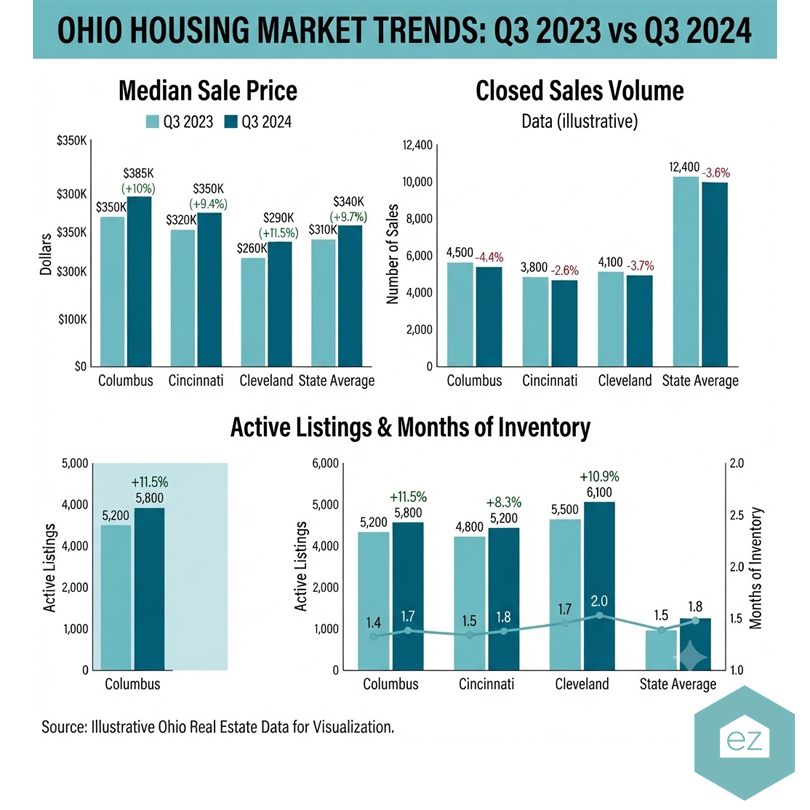
Ohio closed 126,015 homes in 2025, and statewide volume has sat in a steady band for three years running. Ohio REALTORS® recorded those closings against 124,446 in 2024, a gain of 1%. On the association’s prior reporting basis, a separate count that does not line up with the current one, 2024 finished at 131,716 against 129,064 the year before, a gain of 2.1%. The two measuring sticks give the same answer. Volume is flat to slightly up.
That answer matters because the 2021 peak of 169,585 sales still shapes how people talk about this market. It was a low-rate anomaly. A comparison to that peak invents a decline the longer record does not support. The pre-pandemic years ran about 153,000 to 155,000 sales on the association’s older count, so today’s level sits modestly below a normal pre-pandemic year and nowhere near the 2021 high.
Prices have climbed steadily rather than sharply. The statewide median reached $263,000 in March 2026, up 6.5% from $247,000 a year earlier, and the 2025 average sales price finished at $256,775, up 6% over 2024.
Inventory is expanding from a low base. Active listings reached 31,489 in March 2026 against 26,868 two years earlier, and supply sits near three months where six is treated as balanced. Read that second figure carefully. Months of supply counts what is sitting on the market at a single moment, and it says nothing about how many homes close over a year. Ohio’s closings have been steady while its shelf has been thin.
The price spread inside the state is wider than the statewide median suggests. Central Ohio’s median hit $350,000 in May 2026, up 4.3%, on 2,618 single-family closings, per Columbus REALTORS®. Greater Cincinnati‘s median sold price reached $300,000 in January 2026, up 10%, with active inventory up 32.1%, per the REALTOR® Alliance of Greater Cincinnati. An agent working a $350,000 Central Ohio median and one working a county at half that price are running different businesses.
Ohio is also gaining people again, which cuts against how the state usually gets described. Census figures show a net gain of 11,926 residents between 2024 and 2025, the highest in-migration in 25 years, and Ohio was one of only four states to post more births, fewer deaths, and improved domestic migration at once. Keep that in proportion. Against a population near 11.9 million and 126,015 annual closings, migration moves a fraction of a percent and is a minor driver of transaction volume next to the owners already here. It runs both directions too, and both directions are business: arrivals are buyers, departures are listings.
The job base underneath all of this is broad rather than concentrated. Manufacturing employs more than 680,000 people and produces 17.5% of state GDP. More than 640 aerospace companies operate here, and federal and military installations support over 400,000 jobs and nearly $55 billion in gross regional product, per JobsOhio, alongside healthcare and life sciences, logistics and distribution, financial services, and food and agribusiness.
The capital projects deserve an honest timeline. Intel’s Ohio One campus in New Albany, Licking County, represents more than $28 billion and roughly 3,000 manufacturing and 7,000 construction jobs, but the two initial fabs have slipped to 2030 and 2031 from an earlier end-of-2026 target. The Honda and LG battery plant runs about $3.5 billion, Anduril is building its Arsenal-1 campus, and an AWS data-center buildout approaches $10 billion. Agents farming for these should plan in years, not quarters.
Growth is not spread evenly either. JobsOhio projects employment growth of 8% in Central Ohio, 6% in the Southwest, 4.1% in West Ohio, 4% in the Southeast, 3% in the Northeast, and 2.7% in the Northwest. Ohio was named CNBC’s top state for business in 2026 and has ranked first in infrastructure three years running.
| County | Population (2025) | County seat | Note |
|---|---|---|---|
| Franklin | 1,361,536 | Columbus | State capital; added 8,880 residents, the largest county gain in Ohio |
| Cuyahoga | 1,232,925 | Cleveland | |
| Hamilton | 838,418 | Cincinnati | |
| Montgomery | 539,598 | Dayton | Added 2,668 residents |
| Summit | 538,376 | Akron | |
| Lucas | 423,347 | Toledo | |
| Butler | 400,128 | Hamilton | Hamilton is both the seat and the largest city, at 64,817 |
| Stark | 373,771 | Canton | Canton population 69,211 |
| Lorain | 323,219 | Elyria | Elyria is the seat at 53,604; Lorain is the larger city at 65,435 |
| Warren | 257,181 | Lebanon | Lebanon is the seat; Mason is the larger city at 36,088 |
Ohio’s ten most populous counties. County populations are US Census Bureau estimates for July 1, 2025; city populations are Ohio Department of Development 2024 estimates.
Two of those rows carry a distinction worth holding onto. Lorain County is run from Elyria but its largest city is Lorain, and Warren County is run from Lebanon while Mason carries more people. A county campaign addressed to the wrong one reads as outside work to the owners who live there.
Most Ohio buyers are also sellers, and the seller-only playbook misses four in five of them

About four in five buyers are carrying a house they have to sell in order to buy the next one, so an agent who markets only to sellers is competing hard for a fifth of the opportunity and ignoring the rest.
Start with the mistake, because most lead strategies contain some version of it. One campaign says list with me. A separate budget buys cold buyer leads. The two halves of a single move get handled as two different customers in two different systems, and the person doing both at once falls straight between them.
The National Association of Realtors put numbers on it in the 2025 Profile of Home Buyers and Sellers. First-time buyers fell to 21% of purchases nationally, a record low since tracking began in 1981, and the median first-time buyer reached age 40. Before 2008 that share ran near 40%. Ohio does not publish a clean state equivalent, so treat the 21% as the national anchor it is.
Be precise about what it means. Any individual sale still has two parties standing on opposite sides of it. The point is that the same person is usually both across their own move, and they almost always begin on the buy side. They look at what their money buys long before they call anyone about listing. An agent waiting for a listing signal meets that person late, after another agent has already earned the relationship and, with it, the listing.
Three groups come out of that math. First-time buyers, the one in five, have no existing home behind them and need affordability and a plain explanation of how the process works, not equity math. The much larger group trading up, down, or across has to solve three things at once: what the current house frees up, how the two closings line up, and what the next purchase costs. Estates and exiting landlords, the owners with no purchase waiting on the other side, are the smallest group of the three.
Ohio has an unusually deep pool for this. The state’s homeownership rate reached 70.3% in 2025, up from 69.6% a year earlier and 5.1 points above the national rate, which means roughly five in seven Ohio households own. Set that against 126,015 closings and the picture is clear: the owners who did not transact this year are next year’s move, already living in the county.
ez Home Search is built to work the person rather than the side. A valuation check, an equity question, or a visit to a home-value page opens the seller conversation. Saved searches, alerts opened, and a tour request show the buyer side coming to life. Most people run both in sequence, and the platform follows the shift instead of guessing. The automated valuation model, an AVM, keeps a partner present through the quiet stretch when someone is only wondering, which is exactly when the relationship gets decided.
Only one partner holds an Ohio county at a time, so the first practical step is checking whether yours is still open.
What Ohio agents use for leads now, and the point each channel stops working

Every method Ohio agents use to find business works, which is exactly why the limits are worth naming plainly rather than pretending one channel replaces all of them.
Start with the arithmetic, because it explains the pressure. Ohio REALTORS® has more than 35,000 members and the state closed just over 126,000 homes in 2025. Spread evenly, that is fewer than four closings per member per year. Nobody is evenly spread, and volume has been steady rather than growing, so the agents who grow are taking share from the agents who do not. That is the game in Ohio, and every lead decision an agent makes is a decision about share.
Shared leads from legacy portals give an agent volume immediately with nothing to build, which is a genuine advantage when a pipeline is empty. The trade sits in the structure. One name lands with several agents simultaneously, the consumer picked none of them, the cost repeats with every lead, and the conversation opens cold because the person has no reason to prefer whoever dials first.
An IDX site solves the ownership problem. The site is an asset that compounds, and the agents who commit to one for years are usually glad they did. The trade is time and depth. The site takes quarters rather than weeks to rank, the content and technical upkeep never stop, and the data behind accurate valuations, school detail, and property-tax comparisons costs more than any single team or brokerage can reach on its own. Initial traction can arrive in months. The agents and local brokers I have watched build a real market position this way spent three to five years and millions of dollars getting there. That can be a wise investment when it is implemented well, and it asks for more time, more money, and more sustained focus than most will put in.
Disciplined operators still produce with cold calls, for-sale-by-owner outreach, and expired listings, and a good caller will outperform a mediocre ad budget every time. Two limits apply. The output stops the day the calling stops, since nothing compounds, and phone and text prospecting puts an agent inside the consent rules whether or not they realize it. If a recipient disputes consent, the burden sits with the caller to produce proof for every number dialed.
Predictive-seller software narrows a database to the names likeliest to move, which beats working a list alphabetically. A score is still not a relationship. Someone has to earn the trust that carries a name from a probability to a signature, and that work stays with the agent.
Generic all-in-one platforms consolidate the stack into one bill and one login, and that consolidation is worth real money. The cost shows up as administration. The agent becomes the person configuring, maintaining, and troubleshooting the system, and none of it gives a past client a reason to return on their own. A CRM is a place the agent goes, and the client has no reason to open it.
Do-it-yourself content and paid advertising keep control in the agent’s hands. Both stop the moment attention or spend stops, and content quality is the first thing to slip in a month with three closings and a family in contract.
None of these choices is a mistake. They share one limit: each works on the small share of people transacting right now, and none holds the far larger group who will transact in a year or three. Those owners are already living in the county, watching their value, and moving toward a decision without announcing it. The harder problem is reaching them early, and that is the one worth solving.
Ohio’s reappraisal calendar is a listing conversation with a date on it
Ohio publishes, county by county and often community by community, exactly when hundreds of thousands of owners will be handed an official number about their own home, which makes it the most predictable home-value conversation available anywhere in the state.
The mechanism is statutory. Each county runs a full reappraisal every six years, with a lighter update three years in between, and 41 counties sat in a valuation year for tax year 2026, per Ideastream Public Media. The schedule is published in advance, so an agent can know which counties are in play and roughly when the mail lands.
The 2026 figures show how much the answer varies. Butler County’s median residential and agricultural values rose 19%, with commercial and industrial up 20%, on an abstract the Ohio Department of Tax Equalization approved on June 25, 2026, per Auditor Nancy Nix. Montgomery County came in near 19% as well, lifting total county value from about $39 billion to nearly $46 billion, with more than 150,000 notices mailed starting July 13, 2026, per Auditor Karl Keith. Franklin County‘s triennial update ran lighter, at a tentative average near 9% residential per the county Auditor’s Office, with values mailed from June 9, 2026 and informal review open from July through September. Summit County‘s fiscal office reported 18%. Ashtabula County‘s auditor reported about 30%. Mahoning County‘s auditor reported average residential property taxes up about 24%.
Two other counties are worth knowing about precisely because they are on a different clock. Cuyahoga County‘s 2024 reappraisal averaged 32% countywide, ranging from 15% in Hunting Valley to 67% in East Cleveland, and Lucas County‘s 2024 revaluation ran 29.6% with its next one now moved to 2028. Owners there are living with those numbers without a fresh letter to explain them.
Butler County published its results down to the jurisdiction, which is where the useful detail sits.
| Jurisdiction, Butler County | Median residential value change |
|---|---|
| Lemon Township | 39% |
| New Miami | 32% |
| Middletown | 30% |
| Hamilton | 27% |
| Sharonville | 24% |
| Trenton | 22% |
| Butler County overall | 19% |
| West Chester Township | 18% |
| Fairfield Township | 15% |
| Oxford | 15% |
| Fairfield | 12% |
Selected jurisdictions from the Butler County Auditor’s 2026 reappraisal, June 30, 2026. The full published set runs to 23 jurisdictions.
A 27-point spread inside one county is the whole point. Two owners in the same county opened envelopes describing different realities, and no statewide average would have told either of them anything useful about their own house.
Most owners get the next part wrong, and it is where an agent becomes genuinely useful. A value change is not a tax change. Ohio House Bill 920, on the books since 1976, keeps many property taxes from rising in step with values, and Mahoning County Auditor Ralph Meacham gave the cleanest illustration of it: at the prior revaluation, an average 38% valuation increase produced about a 7% increase in property taxes. Butler County’s auditor adds that bills track voted levies more closely than value changes, and puts dollar figures on them. Mills are the unit a levy rate is set in, and because only a portion of a home’s value is taxed, the auditor publishes what each one costs per $100,000 of home value. A countywide two-mill developmental disabilities levy runs roughly $70. A Fairfield Township fire levy at 4.49 mills runs about $157. A two-mill Fire and EMS levy in Milford Township runs about $70.
A value change is not a market price either. Butler County’s auditor states that the office’s values run at roughly 90% of full market value across all taxing districts, by design. A six-year number also compresses six years of movement into one line, so it reads like a sudden jump when it is a delayed accounting.
Put those together and the opportunity is obvious. An owner is holding a number that is not their market value, attached to a bill that will not move the way they fear, on a date the agent could have known months in advance. They want a real number and a straight explanation. Whoever provides both is the person they call when they eventually sell.
Ohio’s regions do not behave alike
Ohio’s six regions diverge enough that a statewide number describes almost none of them accurately, and the gap between the highest and lowest regional job-growth projections is nearly three to one.

Central Ohio is the growth engine. JobsOhio projects 8% employment growth there, the highest in the state, and the housing numbers follow: a $350,000 median in May 2026, up 4.3%, on 2,618 single-family closings, per Columbus REALTORS®. Licking County carries the Intel campus, and Delaware and Union counties are absorbing the spillover. An agent here is working the highest prices and the most competition in Ohio at the same time.
Southwest Ohio is close behind at 6% projected growth. Greater Cincinnati’s median sold price reached $300,000 in January 2026, up 10%, and the more interesting number is inventory: active listings up 32.1% year over year, per the REALTOR® Alliance of Greater Cincinnati. More listings and rising prices at the same time is what a market getting healthier looks like. Butler and Warren counties sit inside this region and both are in the middle of valuation cycles.
Northeast Ohio is where the 2026 valuation wave landed hardest. Summit came in at 18% and Ashtabula near 30%, and Cuyahoga’s owners are still absorbing a 32% average from 2024. Projected job growth is 3%, the second lowest in the state, which makes the region a reminder that a slow labor market and an active housing market can sit in the same place. Cuyahoga, Summit, Lorain, Stark, Medina, Portage, Geauga, Lake and Trumbull counties together hold more people than any other region in Ohio, and every one of those owners has a home value they are curious about.
Northwest Ohio carries the state’s slowest projection at 2.7%. Lucas County’s 2024 revaluation ran 29.6% and its next one moved to 2028, so owners around Toledo are working from a number that is already aging. Wood, Ottawa, Sandusky, Hancock and Allen counties round out a region where the recognized local name still decides most listings.
Southeast and Appalachian Ohio is the largest and least understood piece of the state, a run of 32 contiguous counties with no major metro among them, and JobsOhio projects 4% job growth there. Buyers in those counties shop against the $263,000 statewide median rather than Central Ohio’s $350,000. Thin population is usually read as thin opportunity. It also means a single recognized agent can hold a genuine position across a whole county in a way that is impossible in Franklin.
West Ohio and the Miami Valley sit at 4.1% projected growth, anchored by an aerospace and defense base that JobsOhio ties to more than 400,000 jobs statewide. Montgomery County’s 2026 reappraisal came in near 19%, and Greene, Miami, Clark, Darke and Preble counties surround it.
| Region | Projected job growth | A current market fact |
|---|---|---|
| Central Ohio | 8.0% | Median price $350,000 in May 2026, up 4.3%, on 2,618 single-family closings (Columbus REALTORS®) |
| Southwest Ohio | 6.0% | Greater Cincinnati median $300,000 in January 2026, up 10%, active inventory up 32.1% (REALTOR® Alliance of Greater Cincinnati) |
| West Ohio and the Miami Valley | 4.1% | Montgomery County’s 2026 reappraisal averaged about 19% (Montgomery County Auditor) |
| Southeast and Appalachian Ohio | 4.0% | 32 contiguous counties with no major metro; buyers shop against the $263,000 statewide median of March 2026, not Central Ohio’s $350,000 (Ohio REALTORS®; Columbus REALTORS®) |
| Northeast Ohio | 3.0% | Summit County values up 18% and Ashtabula about 30% in the 2026 cycle (county offices) |
| Northwest Ohio | 2.7% | Lucas County’s 2024 revaluation ran 29.6%; next revaluation moved to 2028 |
Job-growth projections are JobsOhio figures. Market facts are dated to their sources.
The practical read is that a lead strategy tuned to Columbus prices will misfire in Ashtabula, and one built for a rural county will leave money on the table in Delaware. Whatever an agent uses has to work at the county level, because the county is the level at which Ohio differs. The fastest way to find out what that looks like in a particular market is to check whether that county is still open.
Ohio counties beyond the big metros
Ohio has 88 counties and only a handful of them contain a major metro, which means most of the state is made up of places where one recognized agent can still own the whole conversation.
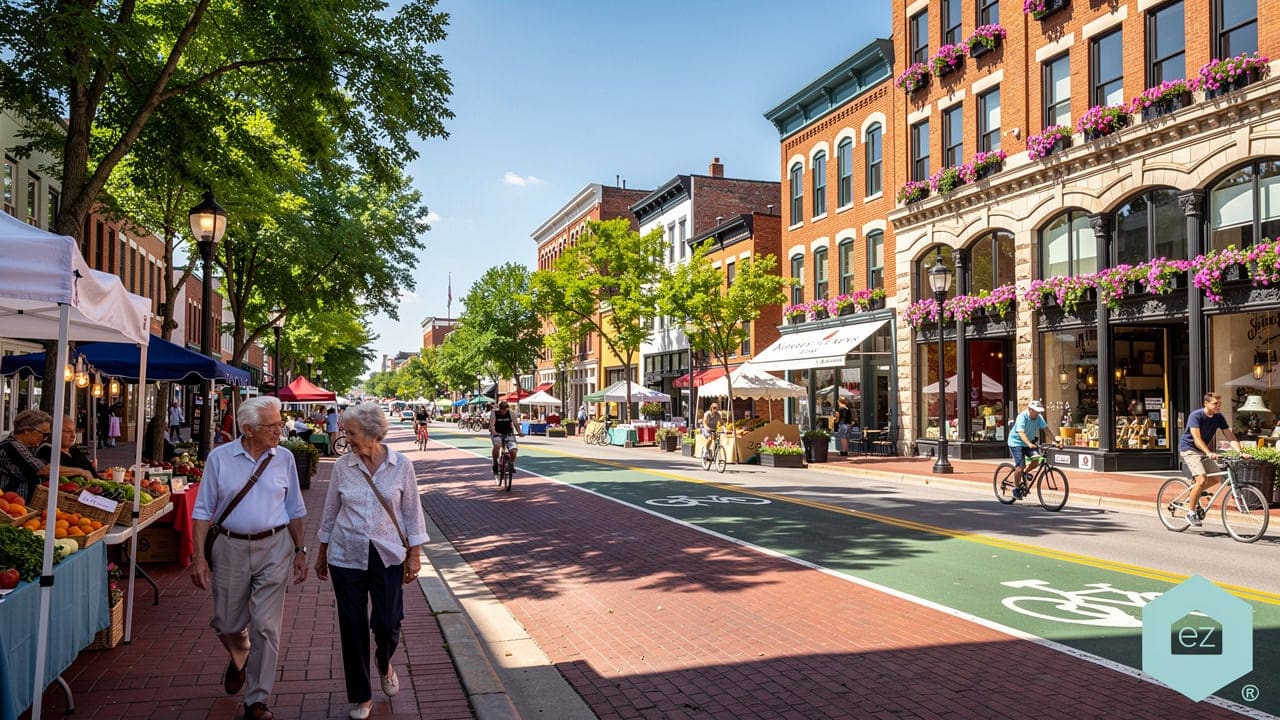
The economics favor the smaller county in a way that gets overlooked. In Franklin County an agent is one voice among thousands, competing for attention in a market where a $350,000 median attracts every national marketing budget in the business. In Wayne County or Ashtabula County the same effort buys a position that competitors cannot copy from outside, because local recognition there is built on being present rather than on outspending anyone.
The reappraisal cycle reaches these counties on exactly the same schedule as the metros. Wayne County ran a full sexennial reappraisal in 2026. Geauga County ran a triennial update, and Ashtabula County was revalued in the same 2026 cycle at an average near 30%. Owners in a county of 40,000 people get the same envelope, ask the same question, and have far fewer places to take it.
| County | Region | Communities | What is happening there |
|---|---|---|---|
| Delaware | Central Ohio | Delaware, Powell, Sunbury, Genoa Township | 254 closings in May 2026 at a $539,000 median, up 10.5% (Columbus REALTORS®) |
| Union | Central Ohio | Marysville, Plain City, Richwood, Jerome Township | 118 closings in May 2026, up 34.1%, at a $487,500 median (Columbus REALTORS®) |
| Licking | Central Ohio | Newark, Pataskala, Heath, Granville | Home to the Intel campus, with the first two fabs now targeted for 2030 and 2031 |
| Medina | Northeast Ohio | Medina, Brunswick, Wadsworth | Sits between the Cleveland and Akron job markets without belonging to either |
| Portage | Northeast Ohio | Ravenna, Kent, Streetsboro, Aurora | A university county with a commuter base pointed at both Akron and Cleveland |
| Wayne | Northeast Ohio | Wooster, Orrville, Rittman | Completed a full sexennial reappraisal in the 2026 cycle |
| Geauga | Northeast Ohio | Chardon, Middlefield, Burton, Chesterland | Ran a triennial update in the 2026 cycle |
| Ashtabula | Northeast Ohio | Jefferson, Ashtabula, Conneaut, Geneva | Values up about 30% in the 2026 revaluation, after about 32% three years earlier |
County seats are Delaware, Marysville, Newark, Medina, Ravenna, Wooster, Chardon and Jefferson. Community lists are drawn from county government sources.
None of these counties will produce Franklin County’s volume, and none of them needs to. A partner who holds one of them owns the whole market rather than a slice of it, for as long as they hold the position, and the owners there open the same envelope on the same schedule as everyone else in Ohio.
Remote and hybrid work still decides which Ohio counties buyers want
Remote work did not go away. Agents who take the headlines at face value are handing an advantage to the ones who went and read the data.
The decline story rests on a single measurement choice: comparing today against May 2020, when roughly 61% of paid workdays happened at home. No economist treats that emergency peak as an equilibrium. Measured against the pre-pandemic baseline of about 5% to 8% of paid workdays, the picture is a structural tripling that has held steady since 2023.
The federal data says the same thing. Nationally, 36.7 million people teleworked for at least part of their week during the last quarter of 2024, up on 32.5 million a year prior, which moved the national rate from 20.7% to 23.4%. Those are Bureau of Labor Statistics figures. Employers report the same stability: across roughly 150,000 firms canvassed from November 2024 into January 2025, 31.2% had someone putting in a full workday at home, and the same employers forecast essentially that share five years ahead. The source there is the Census Bureau, in its Business Trends and Outlook Survey. They are planning for this to continue.
That matters for Ohio geography specifically. Rural America reversed more than a decade of population decline starting in 2020, gaining 974,000 net migrants through 2024, and the USDA Economic Research Service finds the gain concentrated among working-age adults between 25 and 44 rather than retirees. Those national findings land somewhere, and in Ohio they land in the places where the math works: the Appalachian counties across the southeast, the exurban ring beyond Delaware and Union, and the mid-size counties around Wooster, Chardon and Ravenna. A household earning a Columbus or Cleveland salary and shopping against a $263,000 statewide median rather than a $350,000 Central Ohio one is making an obvious trade.
Ohio’s own migration turnaround is consistent with that. The state posted its highest in-migration in 25 years between 2024 and 2025.
The practical use is in showings. A remote or hybrid buyer needs an office that shuts, and a corner of the dining table does not qualify. They ask about a detached structure or an accessory dwelling unit before they ask about the primary suite. They want square footage that a hybrid schedule justifies, and they will walk from a house whose broadband cannot carry a full day of video calls. An agent who leads with those four features in a mid-size Ohio county is speaking directly to the buyer everyone else assumes stopped existing.
What an Ohio partner gets from holding the whole county
The territory in an Exclusive County Partnership is a whole Ohio county, held by a single agent, team, or brokerage. Their brand runs across the consumer experience, no rival partner works the same ground, nothing is billed per lead, and no piece of the commission goes anywhere at closing.

That last part changes the arithmetic. A strong month costs the same as a slow one, so a partner who works the county harder keeps the upside instead of paying it back in per-lead fees. The fee is predictable, and the flow does not spike with a campaign and disappear when the budget does.
Start with the answer to that envelope. The automated valuation model, home-value pages, and monthly value updates carry the partner’s brand, which means the Summit County owner staring at an 18% increase and the owner in Hamilton looking at 27% both have somewhere to get a real number. That is the moment the relationship gets decided, and it arrives on a schedule the partner can plan around rather than one they have to chase.
The bigger opportunity is the contact list a partner already has. Ohio’s 70.3% homeownership rate means most of a county is made up of owners, and most agents let their past clients go cold. Repeat business and referrals make up roughly 41% of production across all agents, and while the share of buyers who say they would hire their agent a second time runs from 88% to 92%, only about 18% do. That gap is business already earned and then lost. On the ez Home Search platform that gap narrows sharply: past clients come back to a partner, buying again or sending someone, at between 2.5 and 5 times the market rate. The reason is plain: the home search they keep going back to has that partner’s name on it. The platform also holds the list together. Every year a meaningful share of email addresses stop working, on the order of 15% to 22%, while up to one person in ten changes a phone number, and ongoing engagement captures the new details as they change.
Relocation is the second leak, and Ohio’s two-sided movement makes it live. Census figures put interstate moves at roughly 2.1% of Americans a year, with about another 3% crossing a county line inside their own state. Put together, that is roughly one American in twenty each year moving past whatever territory a single agent covers. When a past client starts searching Arizona on the partner’s own co-branded platform, that search surfaces as a signal. The agent cannot sell in Arizona, but the house that client owns in Medina County is a listing in play, and the agent now knows about it before it lists with someone else.
The recognized county name is what compounds all of it. The National Association of Realtors puts numbers on that in its Profile of Home Buyers and Sellers: 81% of sellers reach out to a single agent and stop there, 77% of repeat buyers interview exactly one, and reputation is the single most important factor for 35% of sellers. For most people there is no comparison shopping at all. The recognized name wins before the conversation starts, and in an Ohio county of 60,000 people that position is achievable in a way it never will be in Franklin County.
The compliance layer sits underneath the outreach. An agent working an ez Home Search opportunity gets the consent question answered before they dial. ezVerify.ai captures the opt-in and the recording behind it, checks each number against a known-litigator database, suppresses every number listed on the national Do Not Call registry, and rounds out the contact record so nobody has to go looking for a missing phone or email. All of that is documentation, which is what matters if someone disputes consent and the burden of proof falls on the caller.
None of it produces a closing next week. Partners generally see the first conversions land in 30 to 60 days, and the reactivation and recognition effects build over quarters rather than weeks. That is the honest shape of it.
One partner per Ohio county, and the position does not reopen often

Ohio has 88 counties, one partner holds each one at a time, and a county that is taken stays taken for as long as that partner keeps it.
Counties come off the board steadily rather than all at once, and more get claimed every month. There is no way to know from the outside which Ohio counties are open at any given moment, and the honest answer for any specific one is that it takes a conversation to find out. What is worth understanding before that conversation is why a county is worth holding in the first place.
The reason sits underneath the whole platform. Legacy real estate portals earn their money by taking a person’s contact details, budget, and sometimes their relationship status and passing all of it to a long list of businesses: an agent, a loan officer, a title company, an insurance agent, sometimes a data broker. The consumer rarely learns who received it. ez Home Search runs on the opposite arrangement, and that structural difference is what the umbrella line “A Better Way To Discover Real Estate” describes.
The Only Confidential Home Search is how ez Home Search delivers that better way. Nobody sells, resells, recycles, or broadcasts a person’s contact details and budget to businesses that person never chose. One vetted local expert who knows their area takes it from there, picked as the right fit rather than as the highest bidder, and the rest of the vetted network, from loan officers to roofers, is theirs to call on when they want it. That is the Single Local Expert, and in an Exclusive County Partnership, that expert is the partner.
Ohio consumers are primed for this whether or not they can name it. Pew Research Center found that 81% of US adults are concerned about how companies use the data collected about them, and that more than four in ten have already switched to a browser or search engine that does not track them. People have spent a decade taking their privacy back everywhere else online. Apple built it into a product line. DuckDuckGo and Brave each reached around 100 million users on it. Proton, 1Password, and Bitwarden built their products so that the company holding the data cannot open it, and they sell that as the feature.
Real estate got there late, and ez Home Search is what brought the shift into it. For a partner, the practical consequence is that people engage more honestly with a platform they trust, which is why a connection through ez Home Search arrives warm, with real activity behind it, instead of as a cold name several agents are dialing at once.
Deciding whether an Ohio county partnership fits your business
An Ohio agent looking at lead generation has three real options, and the right one depends less on budget than on whether they intend to work a database.
One option is to keep buying shared leads. Volume arrives immediately, several agents work the same name, the cost repeats with every lead, and the flow stops when the spending does. Plenty of good agents run this way and always will.
Another is to build the equivalent alone: an IDX site that takes quarters to rank, a valuation product, a content operation that never stops, a compliance layer for consent, and a CRM to hold it together. Any single piece is achievable. The combination costs more than a team or a brokerage can reasonably spend, and the property data underneath accurate valuations is the part that stays out of reach no matter the budget.
The third option sits between them: hold one Ohio county on a platform where all of that is already built, already running, and carrying your name. That one carries no charge per lead, no split at closing, and one partner in the territory.
The trade-off is worth stating plainly. A county partnership is a fixed commitment that rewards consistency, and it pays back most to the agent who works the database that comes with it. An agent who wants leads delivered and nothing else asked of them will not get their money’s worth. The partnership is built around follow-up, and follow-up is work.
One proof point outweighs the rest. A partner’s own past clients return at between 2.5 and 5 times the market rate, buying again or referring someone who does. That is business already earned once and normally lost, coming back.
That returns to the envelope. Somewhere in an Ohio county this month, a homeowner is holding a valuation notice with a number on it that is not what their house would sell for, attached to a tax bill that will not move the way they fear. They want a straight answer from someone local. The agent who is already in front of them, with their name on the home search that owner has been using for two years, gets to be that person. Everyone else finds out when the sign goes up.
Ohio has 88 counties. Check whether yours is still open.
Frequently asked questions
My clients just got county reappraisal letters with double-digit increases. How do I turn that into listing conversations instead of tax complaints?
Answer the question they are asking before the one you want to ask. Most owners open that letter believing their taxes are about to rise by the same percentage, and they are wrong about that, so the first useful thing an agent can do is explain the difference and point them to their county’s informal review window.
The listing conversation follows on its own. Once someone understands the county’s number is not a market number, the obvious next question is what the house would bring on the open market, and that is a comparative market analysis. Partners who run a co-branded home-value page and monthly value updates are already in that conversation, because the owner has been checking their value there for months.
Does a higher county valuation mean my Ohio clients’ property taxes go up by the same amount?
No, and Ohio has a statute that is the reason. House Bill 920 has been law since 1976, and it holds many property taxes back when values climb. Mahoning County’s auditor gave the clearest recent example: at the prior revaluation, an average 38% valuation increase produced roughly a 7% increase in taxes.
Voted levies matter more than the reappraisal in most bills. Butler County’s auditor quantified its 2026 additions, with a countywide two-mill developmental disabilities levy costing about $70 per $100,000 of value and a Fairfield Township fire levy at 4.49 mills costing about $157. An agent who can explain that distinction is useful to an owner long before that owner needs anyone to sell anything.
Ohio’s property tax laws changed in 2026. What should I tell owners weighing a sale now?
Tell them the relief is real and the timing is staged. Four bills, House Bills 186, 335, 129 and 309, were signed into law, with estimated relief of more than $3 billion. House Bill 186 took effect in December 2025 and the others on March 18, 2026, while the general reductions reach owners with their 2027 tax bills. Changes to the owner-occupancy credit are projected to return more than $800 million to Ohio homeowners over four years.
For a seller, none of that changes what the house is worth. It changes the carrying cost a buyer has to absorb, which is one of the less obvious inputs into what a home can sell for.
Intel’s New Albany fabs slipped to 2030 and 2031. Should agents in Licking County still be farming for that growth?
Yes, though the clock is longer than the original one. The investment is still more than $28 billion for a campus sized to hold up to eight factories, with roughly 3,000 manufacturing and 7,000 construction jobs attached, and the site is not moving. What changed is the timeline.
Plan for it the way you would plan any long-cycle farm. Newark, Pataskala, Heath and Granville will absorb demand as construction ramps, and the agent who has spent those years building recognition in Licking County will be the name people know. An agent expecting a 2026 boom will be disappointed. An agent building a database through 2030 will not be.
Central Ohio’s median runs near $350,000 while the statewide median is closer to $263,000. How do I build a lead strategy that works in a lower-priced Ohio county?
Stop paying per lead. In a county where the median is well under the state figure, a per-lead cost eats a much larger share of a commission than it does in Delaware County, which is exactly why cost-per-lead models get painful outside the expensive metros.
That is the structural argument for a county partnership in lower-priced Ohio markets. The fee does not scale with your price point or your volume, so a strong month in Ashtabula County costs the same as a slow one. Recognition also comes faster where fewer competitors are spending, which means the position is cheaper to hold than the equivalent position in Franklin County.
Ohio recorded its highest in-migration in 25 years. How do I reach those buyers before they choose an agent?
Reach them while they are still searching from somewhere else. Census figures show Ohio gained 11,926 residents on net between 2024 and 2025, and Ohio was one of only four states to post more births, fewer deaths, and improved domestic migration at once. Those people research a market for months before they ever contact anyone local.
National coverage is what makes that visible. ez Home Search covers every state, so someone researching Medina or Delaware County from outside Ohio is doing it on a platform where a local partner is already the named expert. The same coverage protects the other direction: when your own past client starts searching Arizona, you learn about the move in time to win the listing on the house they are leaving.
How does a county exclusivity model work in a county like Lorain, where the county seat and the largest city are two different cities?
The partnership is drawn on the county line, so it covers both. Lorain County is administered from Elyria while its largest city is Lorain, and a partner holds all of it, along with Amherst, Avon, North Ridgeville and the rest.
That is an advantage rather than a complication. A campaign organized around a single city misses half the county in places like Lorain and Warren, where the seat and the largest city diverge. County-level exclusivity matches the way Ohio owners think about where they live, and it matches the way the county auditor mails valuation notices, which is one envelope to every parcel in the county on the same schedule.















Kurt Uhlir is a recognized leader in marketing, growth, and innovation, having helped scale companies and technologies used by millions every day—including at brands like eXp Realty, Sideqik, Vitrue, Oracle, Garmin, Facebook, Meta, Apple, and more. He’s trained tens of thousands of professionals on how to build trust, lead with service, and help clients make wise, informed decisions. At ez Home Search and Sure Send, his focus is on helping high-performing business owners, team leaders, and individual sales leaders grow their businesses through exclusive market access, privacy-first lead systems, and conversion-focused enablement tools.