

For the better part of a decade, Colorado handed agents appreciation and called it a business. Between 2020 and 2025 the state added residents, drove prices up across nearly every county, and rewarded almost anyone who could open a door. That market is gone. As of early 2026, the statewide median sale price sits around $545,000 and is essentially flat year over year, homes are taking roughly 70 days to sell, and inventory has rebuilt to multi-year highs. For the first time in years, more people are leaving Colorado for other states than arriving from them. If you are searching for Colorado real estate leads the way you did in 2021, you have already noticed that the leads no longer fall out of the sky.
Here is the part most coverage misses. Colorado is not one market that slowed down. It is at least six markets moving in different directions at once, and the agents winning right now are the ones who picked a piece of the state, learned it cold, and built a system that keeps producing whether or not prices are rising.

The Colorado market reset: what actually changed under every agent in the state
The conditions every Colorado agent now sells into are slower, more expensive, and more complicated than they were two years ago, and the change runs across price, inventory, migration, demographics, and two structural shocks unique to the state. The Colorado Association of REALTORS described 2025 as the market trading volatility for a more sustainable balance heading into 2026. Read plainly, that means the appreciation that once covered for thin prospecting is no longer there to lean on.
Prices flattened while inventory came back. As of the first quarter of 2026, the statewide median sale price ran roughly $545,000 to $550,000, about 0.9% lower than a year earlier, with active inventory near 4.3 months of supply and average days on market around 70, up from about 66 the year before (Colorado Association of REALTORS, 2025 recap and 2026 outlook, January 13, 2026). A market with more listings and longer selling times is a market where the agent who follows up wins and the agent who waits for the phone to ring does not.
Migration reversed direction and slowed sharply. The Colorado State Demography Office reported that, between July 2024 and June 2025, the state recorded a net domestic migration loss of about 12,100 people, offset by a net international migration gain near 15,356, leaving only small overall growth (Colorado State Demography Office, March 2026 estimates; Colorado Sun, January 29, 2026). Statewide net migration is down roughly 52.5% relative to 2015, and annual population growth of about 0.4% is the lowest in decades. Colorado crossed 6 million residents in the 2025 estimates, but it is now growing through births and international arrivals more than through people moving in from other states.
The owner base is aging and staying put. Colorado’s 65-and-older population rose about 58% between 2010 and 2020, one of the fastest aging rates in the country, and the State Demography Office projects that group to keep expanding by roughly 30% to 35% over the coming decade (Colorado Sun, May 20, 2025; Axios Denver, October 2, 2025). About one in seven Coloradans is 65 or older today. Older owners move less often, and many are sitting on a decade or more of equity in homes they bought before the run-up. That combination, low turnover plus high equity, points the opportunity toward the database an agent already has rather than the trickle of new shoppers.
Two Colorado-specific overlays now sit in nearly every listing conversation. After voters repealed the 1982 Gallagher Amendment in 2020, a spike in assessed values pushed the state into emergency relief and then the bipartisan SB24-233 property-tax overhaul. For the 2025 tax year, the residential assessment rate stepped down to 6.4%, with a permanent partial-value exemption phasing in for following years (Colorado General Assembly, SB24-233; Bell Policy Center, 2024). The second overlay is insurance. Colorado State University research notes more than 321,000 Colorado homes face moderate-or-higher wildfire risk, and homeowners across the state’s wildfire-and-hail zones face premiums well above the national average along with rising non-renewals, which is why Colorado opened a state FAIR Plan to residential applicants in spring 2025 as an insurer of last resort (Colorado State University wildfire-insurance research; Bankrate FAIR Plan explainer, 2025). Buyers and sellers ask about both constantly, and the agent who can speak to them with authority holds an advantage over the one who cannot.
None of this means Colorado is a bad market. It means the easy version of the market is over, and the way agents generate leads has to change with it. Before you spend another dollar on the old playbook, it is worth knowing whether your county is even available to hold. You can check your county in a minute, and the rest of this piece explains why that question matters more than it used to.
Six Colorado markets, not one: where demand actually lives
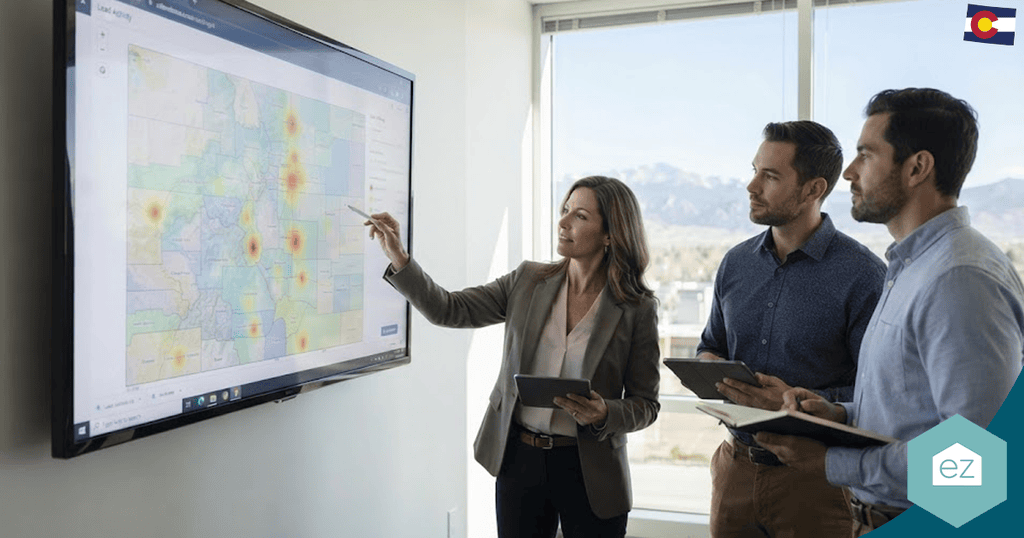
Colorado’s regions diverge enough that a lead strategy built for one of them will misfire in the others, so the first move is to see the state as the collection of distinct demand engines it actually is. The table below sets out six regions and the trend defining each as of early 2026. Notice that the employment story is not one anchor but several, with each region running on a different sector, which is exactly why the buyers and sellers behave differently from one to the next.
| Region | Representative counties | Sourced trend (dated) |
|---|---|---|
| Denver metro / Front Range core | Denver, Arapahoe County, Jefferson County, Adams County, Douglas County, Broomfield | Median sale price held roughly flat near $575,000 in Q1 2026, with single-family edging up while condos and townhomes softened, and about 3.5 months of supply. (Colorado Association of REALTORS, Q1 2026) |
| Northern Colorado | Larimer County, Weld County | Strongest net in-migration and the most new residential construction in the state; Fort Collins and CSU plus Greeley and Weld’s energy economy drive demand. (Colorado State Demography Office, March 2026) |
| Pikes Peak region | El Paso County, Teller County | Colorado Springs remains a relocation magnet for military and cost-conscious buyers from Denver and out of state; sales rose even as the market stayed broadly flat into 2026. (Colorado Springs Gazette, January 2026) |
| Western Slope / mountain resorts | Eagle County, Pitkin, Summit County, Routt County, San Miguel, Garfield County | Resort-county median prices rose roughly 71% to 111% from 2020 to 2025, deepening a workforce-housing crisis; a state middle-income housing pilot is funded for 2026 to 2029. (Common Sense Institute; Aspen Times, Summit Daily, 2025 to 2026) |
| Southern Colorado / Pueblo | Pueblo County, Fremont County | Pueblo’s median runs about 40% below Denver’s and near half the state average, the Front Range’s affordability outlet, with flatter price growth around 1% year over year in 2025. (Grand Junction Sentinel, 2025) |
| Grand Valley / Mesa | Mesa County, Delta County, Montrose County | Grand Junction‘s median sat around $447,000, up about 2.9% year over year, against a measured housing deficit and steady out-of-state in-migration since the pandemic. (Common Sense Institute Grand Junction report, 2025) |
The Denver metro and Front Range core held roughly flat near $575,000 in the first quarter of 2026, but the average hides a split. Single-family sales edged up while condos and townhomes softened, which means the lead a Denver agent works depends heavily on price point and property type (Colorado Association of REALTORS, Q1 2026). Buyers priced out of the core are not leaving real estate; they are moving outward to exurbs like Parker, Castle Rock, and Highlands Ranch, and the agent who can follow that buyer keeps the relationship instead of handing it off.
Northern Colorado, meaning Larimer and Weld counties, carries the strongest net in-migration and the most new residential construction in the state (Colorado State Demography Office, March 2026). Fort Collins runs on Colorado State University and a deep services economy, while Greeley and the rest of Weld run on energy. Weld County produced more than 80% of Colorado’s oil and roughly half its natural gas in 2024, anchoring the state’s place among the top oil-producing states in the country, and the county streamlined its local permitting with a code effective October 2025 (BizWest, October 3, 2025). New construction and energy paychecks make this the region where listing leads and first-time-buyer demand are growing fastest.
The Pikes Peak region, El Paso and Teller counties, runs on one of the nation’s largest aerospace and defense economies, concentrated in and around Colorado Springs. The Springs hosts hundreds of defense, satellite, cybersecurity, and GPS firms, and expansions continue to add defense jobs across what locals call Aerospace Alley (Colorado Office of Economic Development and International Trade; Governor’s Office, 2025). The buyer here is often a military or defense-industry relocation, frequently on a tight timeline, plus a steady flow of cost-conscious buyers leaving Denver for a lower price point. Springs home sales rose even as the broader market stayed flat into 2026 (Colorado Springs Gazette, January 24, 2026).
The Western Slope and mountain resorts, including Eagle, Pitkin, Summit, Routt, San Miguel, and Garfield, are a different business entirely. From 2020 to 2025, median prices rose about 111% in Eagle County, 98% in Routt, 80% in Pitkin, and roughly 71% in Summit and San Miguel, and across the seven Western Slope resort counties prices have more than doubled since 2012 (Common Sense Institute; Aspen Times, Summit Daily, 2025 to 2026). As of 2025, Aspen-area medians run into the multi-millions and Vail and Steamboat Springs medians exceed roughly $1.2 million. These economies run on tourism and outdoor recreation, the buyer is largely high-net-worth and second-home, and the local workforce-housing crisis is acute enough that the state created a middle-income housing tax-credit pilot funded toward roughly $10 million a year for 2026 to 2029.

Southern Colorado and the Grand Valley are the affordability outlets. Pueblo’s median runs about 40% below Denver’s and near half the state average, with flatter price growth around 1% year over year in 2025 (Grand Junction Sentinel, 2025). On the Western Slope’s Grand Valley, Grand Junction’s median sat around $447,000, up about 2.9% year over year, against a documented housing deficit and steady out-of-state in-migration since the pandemic (Common Sense Institute Grand Junction report, 2025). These are the markets a priced-out Front Range buyer studies, and the agent positioned in them inherits demand from the more expensive metros.
The Eastern Plains round out the picture: agricultural, slower-turning, seat-town markets like Sterling, Fort Morgan, and Lamar, where turnover is lower and the recognized local name matters even more because there are fewer agents competing for it.

Why getting Colorado real estate leads is harder than it was
Colorado real estate leads are harder to generate now because the market stopped doing the agent’s job for them, and the usual places agents go for leads are exactly the ones that struggle in a flat, slower-turning market. When prices climbed every quarter, a thin lead could still close and still pay, because appreciation forgave a slow follow-up and a stale database. Today an agent competes for fewer transactions over longer cycles, and the property-tax and insurance questions above stretch each buyer and seller decision out further still. The margin for a weak lead source has narrowed.
That matters because of where most agents turn first. Shared leads from legacy real estate portals deliver volume, but they arrive cold, with the person’s contact details and budget already captured and sold to whoever paid for them, and no proof the person agreed to be contacted. A self-funded IDX website is a slow-to-rank asset that an individual agent has to pay for and feed for months before it produces, and even then it is not the place millions of people already go to search. Both of those are the approaches most exposed when appreciation stops covering for them, because both depend on either buying volume or waiting out time, and a flat market punishes both.
The agents pulling ahead in Colorado are not working harder versions of the old playbook. They are working a different one, and the next section lays out the honest version of how today’s approaches stack up.
How Colorado agents try to win leads today, and where each one runs out
Most Colorado agents are using one of five approaches to generate leads right now, each with real value and each with a ceiling that the current market makes harder to ignore. Name them honestly, and where ez Home Search fits becomes clear.
Shared portal leads. Bought leads from legacy portals come fast and in volume, which is why so many teams start there. The limit is structural: the lead is a cold name whose contact details and budget were captured and sold to whoever paid the most for them, with no record that the person ever consented to a call or text. You are working a name that was sold rather than one who chose you, and that may not want to hear from you at all.
Building and maintaining an IDX website. A good IDX site is a real asset, and some agents rank well with one. The honest trade-off is that it is slow to rank, expensive to keep current, and entirely self-funded, and a single agent’s site is rarely the source a buyer reaches for when they sit down to search seriously.
Cold calling and door-knocking. Phone and in-person prospecting still works, and Denver-metro coverage is full of teams that grew on it. The cost is time, and there is a second cost most agents underestimate: the law treats an agent as a telemarketer the moment they prospect by phone or text, and without documented consent for each number, every call carries TCPA and Do Not Call exposure. That risk is not theoretical; consumer lawsuits over consent more than doubled in 2025.
Predictive-seller tools. Software that scores a database and guesses who might sell can point an agent in a direction. The trouble is that a high score is not a relationship. The agent still has to build and keep the relationship that turns a guess into a listing, and the tool does not do that part.
Generic all-in-one CRMs, DIY content, and paid ads. These are capable systems, and a disciplined team can run them well. The catch is that the agent configures each one, runs each one, and pays for each one, and the paid-ad output competes with the same ads every other local agent is running in the same county.
Each of these chases the small slice of the market that is active this month. The mechanism behind ez Home Search is different, and it is worth naming plainly. ez Home Search is the consumer-first, privacy-first real estate platform built around two pillars: The Only Confidential Home Search, which keeps a person’s contact details and budget from being sold off, recycled, or pushed out to a crowd of businesses they never chose, and the Single Local Expert, meaning each buyer or seller is matched with one vetted local partner who knows their area. Because the search is confidential and genuinely useful, people trust it, engage more deeply, and come back over years, and that engagement surfaces real intent through real activity. The result for the partner is a warm, chosen connection rather than a shared cold name, which is the difference that decides whether a lead in a flat market is worth working at all.
Winning the seller side in a flat, equity-rich Colorado
The largest seller opportunity in Colorado right now is not finding new listings but reactivating the equity-rich owners an agent already knows, because a flat market and an aging owner base have shifted where the money is. With prices no longer climbing on their own and turnover low, the agent who waits for new sellers to surface is fishing a shrinking pond. The agent who systematically works their own database is fishing where the fish already are.
Start with what a seller wants to know first: what is my home worth, and is now the time. ez Home Search answers the first with an automated valuation model (AVM) built to be the most accurate available, covering any of the more than 80 million US residential properties in its valuation universe, and it lets an owner follow that value month to month and see the equity available. The harder question, the timing, is where the Single Local Expert earns the relationship. A vetted local partner turns the AVM into a full comparative market analysis and gives an honest read on whether the local market favors listing now or waiting, weighed against the family’s own situation. In a flat market, that judgment is worth more than a number on a screen.
The reactivation itself is the part most agents know they should do and rarely do well, because they lack the time and the material. Good reactivation needs a steady stream of content people actually want to open and a home search good enough that past clients return to it on their own, not a generic newsletter that goes to the trash. ez Home Search builds and runs all of it for the partner, co-branded: the listing alerts, the property-value updates, the newsletters, and the search experience itself, at a quality no single agent could produce while also serving clients. Then the outreach fires on real activity, a value run again, a search picked back up, a saved home revisited, rather than a cold guess. The county exclusivity partners ez Home Search works with bring past clients back, through repeat deals or referrals, to 2.5 to 5 times the market rate, and often beyond it.
The property-tax and insurance overlays come back here as a seller-conversation reality the agent can get ahead of. An owner weighing a sale wants to understand how a rising tax bill or a coverage non-renewal affects what their home will fetch and what their next one will cost, and the property-tax depth in ez Home Search lets the partner walk through it with real numbers instead of guesses. The rate-locked owner who has been sitting on a low mortgage is exactly the person who needs that full picture before they will move, and the agent who provides it is the agent who gets the listing.
Winning the buyer side across a state on the move
Buyer leads in Colorado are increasingly about following internal migration, because the buyer priced out of one market is becoming someone else’s client in the next one over. Denver buyers are moving to Colorado Springs, to Northern Colorado, to Pueblo, and to the exurbs, and the agent who can see that movement coming, and follow it, holds an advantage the agent stuck in a single county does not. The table below maps the ten most populous counties and their principal cities, the places where the largest share of Colorado’s buyers are searching and settling.
| Rank | County | Population (2024 ACS 5-yr) | Principal city |
|---|---|---|---|
| 1 | El Paso | 742,999 | Colorado Springs |
| 2 | Denver | 718,877 | Denver |
| 3 | Arapahoe | 659,844 | Aurora |
| 4 | Jefferson | 579,377 | Lakewood |
| 5 | Adams | 530,225 | Thornton |
| 6 | Douglas | 377,150 | Castle Rock |
| 7 | Larimer | 367,368 | Fort Collins |
| 8 | Weld | 350,396 | Greeley |
| 9 | Boulder County | 328,961 | Boulder |
| 10 | Pueblo | 169,356 | Pueblo |
Population figures: U.S. Census Bureau, 2024 American Community Survey 5-Year Estimates (via Colorado Demographics, updated February 2026). Douglas County’s seat is Castle Rock; its largest community is the unincorporated Highlands Ranch.
Affordability sorts the buyer pool by region, and the agent who understands that can read intent faster. A first-time buyer working a Front Range budget is increasingly looking at Aurora, Thornton, the Douglas County exurbs around Castle Rock and Highlands Ranch, or out to Colorado Springs and Greeley, where the same money buys more. An upgrader inside Denver is weighing single-family inventory while the condo and townhome market softens beneath them. A relocation buyer coming into the Pikes Peak region for a defense job is moving on a clock. Each of those buyers leaves a different trail of activity, and reading that trail is where leads turn into closings.
That is the second half of the mechanism. On the co-branded ez Home Search platform, a contact’s behavior shows where they stand. A saved search picked back up, a home saved and revisited, a second valuation run, an alert opened the day it arrives: ez Home Search tracks all of it and surfaces which contacts are getting close, so the agent calls the person whose activity shows it rather than working a list in order. Automated follow-up through ezNurture keeps the relationship warm in between, inside whatever system the team already uses. The connection runs fullest in Follow Up Boss, the biggest CRM in real estate, while it goes deepest of all in Sure Send™. When the agent does reach out, the buyer is not a cold name; the agent already knows the neighborhoods they searched, the price they kept landing on, and the home they kept opening.
Colorado beyond the metros: the whole state is a territory
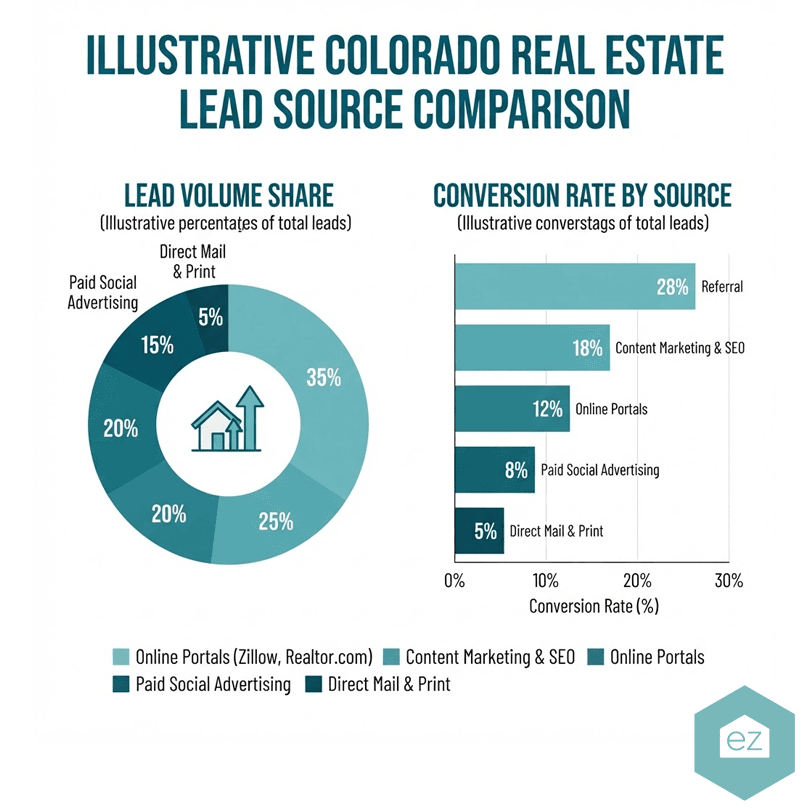
Most agents and teams chase the biggest counties and the Front Range metros. The wiser ones know the smaller and mid-sized Colorado counties are where the opportunity is hiding: real communities with steady turnover, far less competition for the recognized position, and a market small enough that once you earn its loyalty, you become the name people call for years. Where you are the obvious choice rather than one of many, a single county can turn into life-changing income. ez Home Search covers the entire state, not just the Front Range, so the county you own outright could be any of these. The table below names eight to ten of them, with the real communities inside each.
| County | Region | Communities |
|---|---|---|
| Mesa | Grand Valley / Western Slope | Grand Junction, Fruita, Palisade, Clifton |
| Garfield | Western Slope | Glenwood Springs, Rifle, Carbondale, Silt |
| La Plata County | Southwest | Durango, Bayfield, Ignacio |
| Eagle | Mountain resort | Eagle, Vail, Avon, Edwards, Gypsum |
| Routt | Mountain / Northwest | Steamboat Springs, Hayden, Oak Creek, Yampa |
| Summit | Mountain resort | Breckenridge, Frisco, Dillon, Silverthorne |
| Fremont | Southern / Arkansas Valley | Cañon City, Florence, Penrose, Coal Creek |
| Montrose | Western Slope | Montrose, Olathe, Naturita, Nucla |
| Chaffee County | Upper Arkansas Valley | Salida, Buena Vista, Poncha Springs |
| Montezuma | Four Corners / Southwest | Cortez, Mancos, Dolores |
A partner who holds Mesa County owns Grand Junction, Fruita, and Palisade as the recognized name, in a market with a documented housing deficit and steady in-migration. A partner in Eagle or Summit County serves Vail, Avon, Breckenridge, and Frisco, where the high-net-worth and second-home demand is concentrated. A partner in La Plata County holds Durango and the Four Corners gateway. The point is the same in every case: a large metro, a mid-sized market, and a rural county all run on the identical model, because the value is exclusivity and recognition, and those are not a function of population.

What an Exclusive County Partner actually gets in Colorado
An Exclusive County Partner holds one Colorado county outright, with no competing partner inside it, no charge per lead, and no share of the commission when a deal closes, and that structure is the foundation everything else is built on. One agent, team, or brokerage owns the co-branded position across the consumer experience for that county. A strong month of leads is a strong month for the agent, not a bigger invoice, because the model runs on one predictable fee rather than a per-lead meter that punishes success.
The reason those leads and relationships convert comes back to the mechanism named earlier. A partner connected to a person through ez Home Search is not buying a cold name from a list. They are meeting someone who already trusts the platform, has shown real intent through real activity, and arrives with a history the agent can read before the first call. Relationships that start that way tend to last for years, and in a market where the county exclusivity partners ez Home Search works with see leads convert over a 30-to-60-day window rather than a single phone call, the model is built for the longer cycle Colorado now runs on.
Several of the supporting pieces map directly onto the Colorado pains laid out above. Database reactivation is the largest of them, given a flat market and an aging, equity-rich owner base, and ez Home Search runs it for the partner rather than leaving it as one more system to maintain. Relocation listing retention matters in a state where Denver clients are leaving for Colorado Springs, Northern Colorado, Pueblo, or out of state entirely. Because ez Home Search covers the whole country, a client preparing to move searches the new area on the partner’s own co-branded platform, and that activity surfaces as an early signal. The partner reaches out before the listing on the Colorado home is in play, talks through selling it, and keeps the listing they earned instead of losing it to a stranger the client found on a legacy portal.
Recognition as the county name is the piece that compounds. The Exclusive County Partner’s brand sits on the search, the listing alerts, the value updates, and the local market reports, so local buyers and sellers come to associate them with real estate in the area long before anyone picks up the phone. That recognition is one of the hardest things to build in real estate and one of the most valuable to hold.
Compliance and consent answer the cold-call exposure named earlier directly. ezVerify.ai captures each person’s opt-in and the recording that backs it, runs every number against a known-litigator list, filters out the ones on the Do Not Call registry, and rounds out each contact with detail the agent would otherwise spend time tracking down. It is not a lead score; it is the documentation that turns a consent dispute into a closed question instead of an argument. The riskiest part of prospecting is already handled before the partner ever dials.
The rest the partner never has to build or run. The conversion tools, the AVM widget, the open-house sign-in page behind a QR code, the home-value pages, the instant cash offer, all work the moment they are created because ez Home Search runs everything behind them, included in the one fee. And the partner is not left alone with it: coaching and support, weekly sessions, Shut Up and Dial events, and sales-enablement playbooks put real people behind the partner’s production. The incentive runs one direction, since the partnership pays off for ez Home Search only when the partner is closing.
The privacy edge Colorado buyers already expect
Privacy is not a niche preference along Colorado’s Front Range; it is the default expectation of a buyer base shaped by Denver and Boulder’s tech-and-startup culture, and ez Home Search is the one real estate platform built to meet it. Boulder and Denver concentrate remote-services and technology startups, the kind of professionals who already run privacy-respecting browsers, search engines, and password managers in the rest of their digital lives. When that buyer fills out a form on a legacy portal and the calls start within the hour, they recognize the pattern immediately, and they resent it.
The same conviction that built recognizable companies in other industries built ez Home Search in real estate. Apple treats privacy as one of the pillars its products stand on. DuckDuckGo and Brave each reached roughly 100 million users by making privacy the default rather than an upsell. Proton built email it cannot itself read. 1Password and Bitwarden run on architecture where the company cannot read what a customer stores. Not one of these companies sold privacy on its own; each shipped a product people genuinely wanted, then let privacy become the edge that set it apart. ez Home Search runs that same play in a category where it arrived first and still stands alone.
For the partner, the privacy edge is a conversion advantage, not a slogan. The Colorado buyer matched through ez Home Search is matched with one vetted local expert, their information is not sold or broadcast to a crowd, and because they feel safe, they engage more honestly and share more of what they actually need. That deeper engagement is precisely what makes the connection convert better than a name pulled off a shared list, which is the whole reason the consumer-first model produces a stronger partner business underneath it.
Counties are claimed one at a time
Only one partner holds a Colorado county, and once it is taken, no competing agent can hold the same co-branded position, which is why the question of whether your county is still open is time-sensitive. A good share of Colorado’s counties already belong to a partner, and the open ones get spoken for month after month. The model gives the position to a single partner at a time, in large metros, mid-sized markets, and rural counties alike, and the agents wanting an exclusive territory regularly outnumber the counties left to claim.
The engine behind the position is already built and already running. Millions of people already use the platform; the partner steps onto it with their name on it and it works from day one. There is nothing to set up, no IDX site to fund and wait out, no stack to assemble and keep alive. The slow, expensive part of the business, getting in front of buyers and sellers at scale across an entire county, is done. The only open question is whether the county you want is still available, and you can check your county now before someone else does.
The decision in front of you
The decision facing a Colorado agent right now comes down to three paths, and only one of them fits the market the state actually has in 2026.
The first path is to keep buying shared cold leads and running a self-funded DIY stack, the approach the flat market is punishing hardest. It still produces some volume, but every weakness in it, the cold names, the resale, the missing consent proof, the slow-ranking site, costs more now than it did when appreciation covered for it.
The second path is to hold one Colorado county exclusively, with the engine and the follow-up done for you. The leads are warm and chosen, the database reactivation runs on its own, the relocation signals surface before a listing is lost, the consent proof is built in, and the recognized-name advantage compounds every year you hold the county. This is the reasonable path for a working agent or team.
The third path is to try to build the equivalent yourself: the national data, the valuation modeling, the minute-by-minute listing engine, the privacy architecture, the compliance layer, and the marketing reach. That is a multimillion-dollar build, and the data sourcing alone is out of reach for any single team or brokerage. It is not a realistic option, and naming it makes the second path obvious.
There is one honest trade-off worth stating plainly. One partner per county means that if a competing agent claims your county first, you are out until it opens again, and a relationship-led model rewards the agent who works the warm connection rather than the one racing to dial a cold list fastest. If your instinct is to win on volume of dials, this is not built for you. If your instinct is to own a market and work relationships that last, it is.
Here is the one proof point that matters more than a stack of statistics: across the county exclusivity partners ez Home Search works with, past-client reactivation runs to 2.5 to 5 times the market rate, whether the business comes back as a repeat deal or a referral. In a flat, equity-rich, aging Colorado market, that single number is the difference between a hard year and a strong one. Check your county and find out whether the territory you want is still open.
Frequently asked questions
How do I find seller leads in Colorado’s mountain-resort counties like Eagle and Summit when most owners are second-home buyers who live out of state?
In resort counties like Eagle and Summit, where median prices rose roughly 71% to 111% from 2020 to 2025 and much of the ownership is high-net-worth and second-home, the seller opportunity is about staying connected to owners who do not live locally, not waiting for them to walk into an open house. An owner in Denver, Dallas, or California who bought a place in Vail or Breckenridge still watches its value, and a co-branded ez Home Search experience keeps them returning to track that value and the market around it. When their activity shifts, a second valuation run, a renewed search, the partner sees the signal and reaches out. As an Exclusive County Partner, you own that recognized position across the county, so the out-of-state owner associates you with their resort-market home even though they live somewhere else entirely.
Where are Denver-area buyers relocating in 2026, and how do I keep a client who is moving to Colorado Springs or Northern Colorado instead of losing the listing on their Denver home?
Denver buyers priced out of the metro are moving to Colorado Springs, to Northern Colorado around Fort Collins and Greeley, to Pueblo, and to exurbs like Parker, Castle Rock, and Highlands Ranch, where the same budget buys more. The risk for the Denver agent is losing the listing on the client’s current home the moment they start searching the new area on a legacy portal and connect with a stranger there. National coverage changes that. Because ez Home Search covers the whole country, the relocating client searches Colorado Springs or Fort Collins on your own co-branded platform, and that search surfaces as an early signal. You reach out before the Denver listing is in play, handle the sale of the home they are leaving, and refer them to a trusted agent in the new market for a referral fee, keeping the relationship and the listing you earned.
How is Colorado’s post-Gallagher property-tax change, the SB24-233 schedule, affecting how I price listings and answer buyer affordability questions?
After voters repealed the Gallagher Amendment in 2020 and the legislature passed SB24-233 in 2024, residential assessment rates and exemptions have been shifting year to year, with the residential rate stepping down to 6.4% for the 2025 tax year and a permanent partial-value exemption phasing in afterward (Colorado General Assembly; Bell Policy Center, 2024). For pricing, it means a buyer is weighing the property tax on top of the mortgage and insurance, and prices adjust to make room for that carrying cost, so an honest tax picture leads to a more accurate list price. ez Home Search lets you look up and compare property taxes by state, county, city, and ZIP, so when a buyer asks what a Castle Rock or Fort Collins home will actually cost to own, you answer with real numbers rather than a guess, and that authority is what turns a tax question into trust.
With home-insurance costs and non-renewals rising across Colorado’s wildfire-risk areas, how do I prepare buyers and sellers for the insurance conversation before it kills a deal?
Colorado State University research notes more than 321,000 Colorado homes face moderate-or-higher wildfire risk, premiums sit well above the national average, and non-renewals have risen enough that the state opened a FAIR Plan to residential applicants in spring 2025 as an insurer of last resort (Colorado State University; Bankrate, 2025). The agents who get ahead of this raise insurance early, before a buyer is surprised at closing, and frame it as part of the true cost of owning rather than a last-minute shock. When you know which areas carry the higher risk and what the coverage realities are, you can guide both sides through it. For the partner working ez Home Search leads, the buyer arrives already engaged and trusting, so the harder conversations, insurance among them, happen inside a relationship rather than with a cold name who walks at the first complication.
What are the best lead sources for agents in the Pikes Peak region serving military and defense-industry relocations into Colorado Springs?
The Pikes Peak region runs on one of the nation’s largest aerospace and defense economies, with hundreds of defense, satellite, and cybersecurity firms around Colorado Springs and ongoing expansions adding jobs (Colorado Office of Economic Development and International Trade; Governor’s Office, 2025), so the buyer is frequently a relocation on a tight timeline. Shared portal leads are a poor fit for that buyer, because a relocating professional comparing markets does not want their contact details sold off the moment they start looking; they want one trusted guide who already understands the area. As an Exclusive County Partner in El Paso County, your brand is on the search the relocating buyer uses to study Briargate, downtown, and the rest of the Springs before they arrive, and the activity signals tell you when they are getting serious. You meet a warm, chosen connection at the moment they are ready, not a cold name in a race.
How do I generate listing leads in Weld County and Northern Colorado where energy jobs and new construction are driving the fastest growth in the state?
Northern Colorado carries the strongest net in-migration and the most new residential construction in the state, with Weld County producing more than 80% of Colorado’s oil in 2024 and Greeley and Fort Collins anchoring the demand (Colorado State Demography Office, March 2026; BizWest, October 3, 2025). In a growth market like this, listing leads come from being the recognized name before the seller decides to move, which is exactly what the Exclusive County Partnership builds. Your brand sits on the co-branded search, the value updates, and the listing alerts across the county, so the energy-sector household watching their equity in Windsor or Greeley, or the family in a new Erie or Firestone build deciding whether to trade up, comes back to your platform on their own. When their activity shows they are close, ez Home Search surfaces it, and the affordable-market buyers studying nearby Grand Junction or Pueblo are reachable the same way, through your owned position rather than a cold name bought from a shared portal list.
As Colorado’s homeowners age and stay put longer, how do I reactivate an equity-rich past-client database instead of chasing only today’s active buyers?
With Colorado’s 65-and-older population among the fastest-growing in the country and turnover low, the biggest and cheapest return available is the database you already own, not the trickle of new shoppers. Most agents know this and still let the database sit, because good reactivation needs content people actually open and a home search they return to on their own, and few agents have the time to build either. ez Home Search runs it for you, co-branded: the value updates, the listing alerts, the newsletters, and the search experience, all at a quality you could not produce alone. The outreach fires on real activity rather than a cold guess, and the county exclusivity partners ez Home Search works with see their past clients return, through repeat business or a referral, at a clip of 2.5 to 5 times the market rate. In an aging, equity-rich market, that database is the most dependable business you have.
With statewide inventory at multi-year highs and homes sitting around 70 days on the market in 2026, how do Colorado agents get more leads without leaning on cold calling?
When inventory is high and homes take roughly 70 days to sell (Colorado Association of REALTORS, 2026), the win goes to the agent with warm relationships and a steady pipeline, not the one making the most cold dials, and cold calling carries real TCPA and Do Not Call exposure besides. The alternative is a lead source built on consent and intent rather than volume. ez Home Search delivers people who already trust the platform, have shown real activity, and arrive with a history you can read, and ezVerify.ai confirms each one opted in and keeps the recording that proves it before you ever reach out. That lets you spend your hours on people who are real, expecting to hear from you, and getting close to a decision, instead of dialing a list and hoping. In a slower market, working warm connections is both the safer path and the one that actually produces.









Kurt Uhlir is a recognized leader in marketing, growth, and innovation, having helped scale companies and technologies used by millions every day—including at brands like eXp Realty, Sideqik, Vitrue, Oracle, Garmin, Facebook, Meta, Apple, and more. He’s trained tens of thousands of professionals on how to build trust, lead with service, and help clients make wise, informed decisions. At ez Home Search and Sure Send, his focus is on helping high-performing business owners, team leaders, and individual sales leaders grow their businesses through exclusive market access, privacy-first lead systems, and conversion-focused enablement tools.