California holds the most valuable residential real estate in the country, and for the agent trying to source business, it is one of the hardest places to find leads. The reason is not weak demand. It is that the people an agent needs most are the ones least likely to move. About 77% of California homeowners hold a mortgage rate under 5%, many between 2% and 4% from pandemic-era refinances, against current rates near 6.5% (California Association of Realtors, 2025). A rate-locked owner has every financial reason to stay put, which is why generating California real estate leads on the listing side has become the central problem of this market. The buyer side is no gentler. The statewide median sits near $850,000, affordability is the worst in the nation, and priced-out families are moving inland or leaving the state. And California is not one market. It is a dozen, and they are diverging fast. An agent who understands those differences sources leads where they actually are; an agent who treats the state as one market fights for the same scraps everyone else is buying.
What is actually happening across California’s housing market
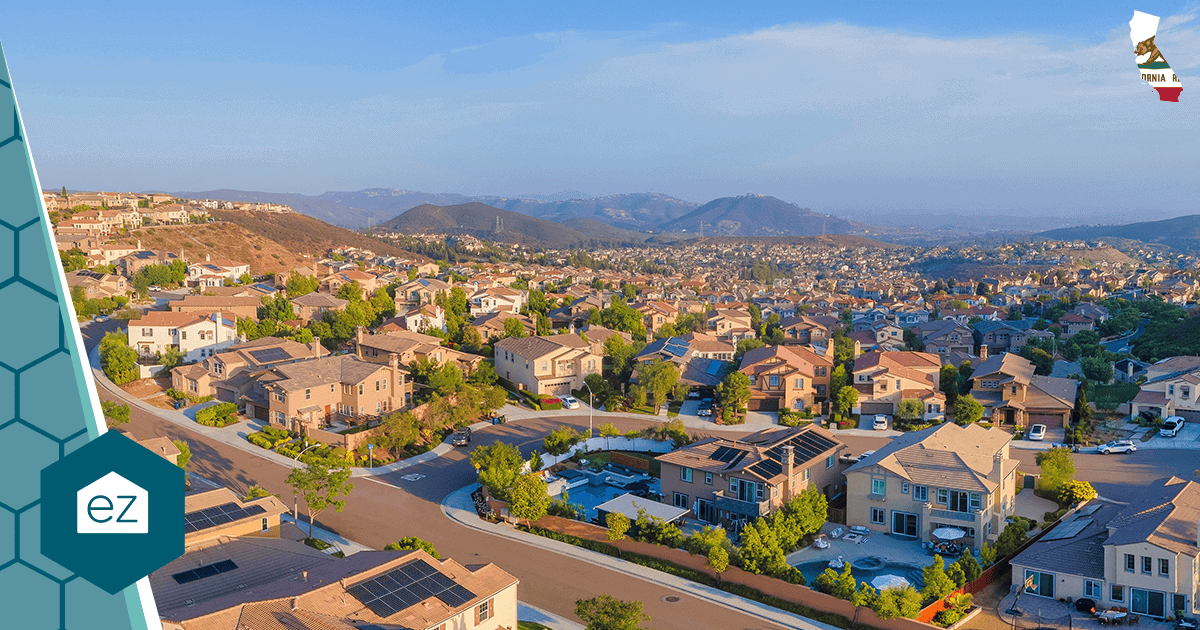
California’s housing market in 2025 is defined by high prices, frozen supply, and a population that keeps growing even as longtime residents leave. Each of those forces changes where an agent’s next listing and next buyer come from, so the lead strategy has to start with the market, not the tactic.

Prices are high and flat, and affordability is the worst in the country
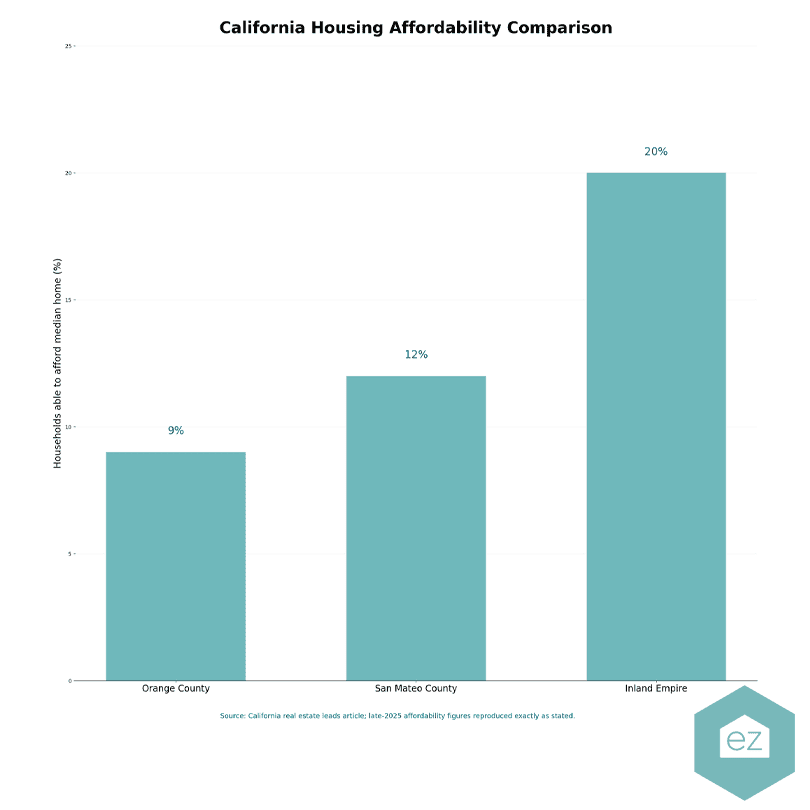
The statewide median price is high and no longer climbing the way it did. C.A.R. reported a statewide median of $852,680 in November 2025, essentially flat from $852,880 a year earlier and down from a summer peak near $899,140 (California Association of Realtors, 2025). The 2025 forecast had called for a 4.6% rise; the year came in softer. Affordability sits at the bottom of the national table. Late-2025 affordability indices showed roughly 9% of households able to afford the median home in Orange County and about 12% in San Mateo County, with the Inland Empire least strained near 20% (California Association of Realtors Housing Affordability Index; Legislative Analyst’s Office, 2025). For an agent, flat-but-high prices mean buyers are cautious and sellers are calculating, so the agent who shows up with real numbers and a real plan wins the conversation.
The lock-in effect has frozen the sellers agents need
The single biggest constraint on California listings is the mortgage rate lock-in effect. With about 77% of owners holding sub-5% mortgages against rates near 6.5%, most have no financial reason to sell unless a life event forces the move (Wolf Street; California Association of Realtors, 2025). Inventory rose through 2024 and the first half of 2025 but stayed below pre-pandemic norms, and C.A.R.’s statewide Unsold Inventory Index was 3.6 months in November 2025, up from 3.3 a year earlier. The listings that will come to market over the next few years are sitting inside databases right now, attached to owners who will move for a job, a divorce, a death, a new baby, or a number that finally makes sense. The agent who is in front of those owners when the life event lands gets the listing. Everyone else hears about it after it sells.
The population is growing on immigration and births, even as residents leave
California is growing again, but not through the moves most agents picture. The state reached about 39,529,000 residents as of January 1, 2025, up roughly 108,000 in calendar 2024, a second straight year of growth (California Department of Finance, 2025). That growth came from net international migration of about 126,000 and natural increase of about 108,300, which together outweighed more than two decades of continued net domestic out-migration. A third of California’s prime-working-age adults are foreign-born, and foreign-born residents make up at least a third of the population in Santa Clara (42.3%), San Mateo (36.1%), Alameda (35.7%), San Francisco (35.1%), and Los Angeles (33.6%) counties (Public Policy Institute of California). In recent years, immigrants accounted for essentially all of California’s rental-housing growth and over half of its growth in owner-occupied homes. The buyer pool is real; it just does not look like the one most lead sources are built to capture.
Buyers are moving inland, and that is where county lines decide who wins
The dominant internal pattern is coastal-to-inland migration driven by affordability. Population rose in 35 of California’s 58 counties, with the largest gains in the Central Valley, the Inland Empire, and select coastal counties; Riverside, Santa Clara, and Sacramento posted the most notable increases since 2022, and Sacramento led the latest year with about 9,000 added residents (California Department of Finance, 2025). A Riverside County median near $427,000 against $735,000-plus in Orange County and roughly $839,000 in Los Angeles County explains the move in one line. When a family sells in Orange County and buys in Riverside or moves from the Bay Area to Sacramento, two agents in two counties touch that transaction. The agent who can see the move coming, and who serves the county the family is heading to, captures business an agent watching only local activity never sees.
Insurance and wildfire risk are now a statewide deal issue
Insurance has moved from a closing detail to a deal-making variable across California. The state’s FAIR Plan more than tripled its residential policies since 2015, topping 500,000 by March 2025, with enrollment up about 43% between September 2024 and December 2025 (CalMatters; Harvard Joint Center for Housing Studies). Seven of the twelve largest insurers limited new policies after 2022, and insurers non-renewed more than 2.8 million homeowner policies in fire-prone ZIP codes between 2020 and 2025 (Taxpayers for Common Sense, 2025). Because lenders will not fund a home the buyer cannot insure, insurability now shapes what sells and what stalls, and not only along the wildfire perimeter. The January 2025 Palisades and Eaton fires destroyed roughly 16,000 structures, about 11,000 of them homes, and as of early 2026 only a fraction had rebuild permits in hand (UCLA Lewis Center; Insurance Journal, 2025). Agents in affected markets are running a different playbook built around insurability, rebuild timelines, and clients who need guidance more than a sales pitch.
How California’s regions diverge, and where the leads are

California is best understood as six regional markets that move on different engines, which means an agent’s lead mix should look different in San Jose than in Bakersfield. The table below pairs each region with the trend shaping its demand, and the prose that follows reads each one through the lens of where business comes from.
| Region | Trend shaping demand (2025) |
|---|---|
| San Francisco Bay Area | AI-driven rebound; San Francisco and San Jose among the fastest-selling markets in the country, with SF pending sales at their highest since 2021 (Smart Cities Dive, 2025). |
| Greater Los Angeles and coastal Southern California | January 2025 Palisades and Eaton fires reshaped affected-market pricing, insurability, and inventory; Southern California median up about 0.6% year over year, December 2025 (UCLA Lewis Center; California Association of Realtors). |
| Inland Empire (Riverside and San Bernardino) | Affordability magnet and one of the state’s strongest growth regions; Riverside median near $427,000, far below coastal metros (California Department of Finance, 2025). |
| Sacramento region | Government, healthcare, and tech employment; median around $525,000, up roughly 4% to 6% year over year; led the state in county population growth (regional market data; California Department of Finance, 2025). |
| Central Valley / San Joaquin Valley | Agriculture base plus Bay Area commuter overflow; median around $480,000, down about 1.4% year over year (California Association of Realtors, 2025). |
| Central Coast (Monterey, San Luis Obispo, Santa Barbara, Ventura) | Lifestyle and second-home demand plus Salinas Valley agriculture; high prices and low affordability (regional market data). |

The Bay Area is the clearest reversal. A wave of high-paying artificial intelligence jobs turned San Francisco and San Jose into two of the fastest-selling home markets in the country, with San Francisco pending sales hitting their highest level since 2021, up about 17% year over year in one autumn 2025 month against under 1% nationally (Smart Cities Dive, 2025). Office leasing in San Francisco reached about 10.2 million square feet in 2025, its strongest since 2019, with AI firms behind much of it. The buyers here are well paid, fast-moving, and privacy-aware, and they reward an agent who reaches them with substance rather than a cold call.

Greater Los Angeles and the coast are running on a different clock. The fires reset whole submarkets, and across Southern California the median ticked up only about 0.6% year over year by late 2025 (California Association of Realtors). An agent in Pacific Palisades or Altadena is fielding questions about insurability and rebuild permits before price ever comes up. The Inland Empire, by contrast, is where the coast’s priced-out buyers land, which makes Riverside and San Bernardino among the most active counties for buyer leads in the state. Sacramento rides government, healthcare, and tech and keeps drawing Bay Area exiles into Roseville, Rocklin, and the surrounding exurbs. The Central Valley blends agriculture with a growing Bay Area commuter belt in Stockton, Tracy, and Manteca, where a sub-$500,000 median pulls families east. The Central Coast sells lifestyle and second homes from Monterey to Santa Barbara, at prices that keep affordability low and the buyer pool specific. Six regions mean six lead strategies, and one clear reason never to treat California as a single market.
California’s counties and communities, beyond the headline metros
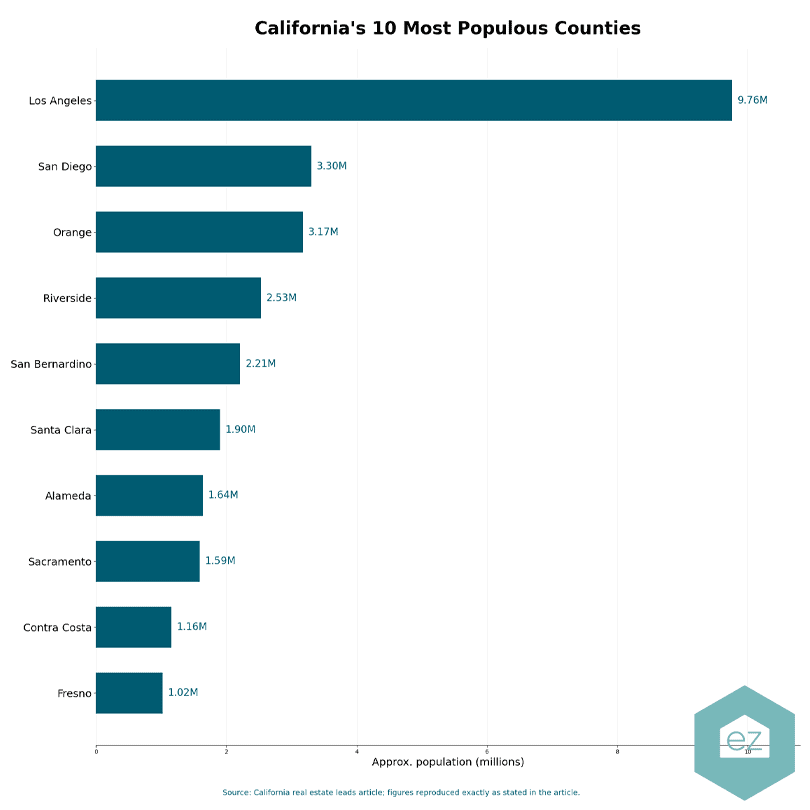
California’s opportunity is statewide, spread across 58 counties, not concentrated in Los Angeles and San Francisco alone. The ten most populous counties, with their principal cities, anchor the map.
| County | Approx. population | Principal city |
|---|---|---|
| Los Angeles | 9.76M | Los Angeles |
| San Diego | 3.30M | San Diego |
| Orange | 3.17M | Anaheim (county seat: Santa Ana) |
| Riverside | 2.53M | Riverside |
| San Bernardino | 2.21M | San Bernardino |
| Santa Clara | 1.90M | San Jose |
| Alameda | 1.64M | Oakland |
| Sacramento | 1.59M | Sacramento |
| Contra Costa | 1.16M | Concord (county seat: Martinez) |
| Fresno | 1.02M | Fresno |
Most of the state’s growth, and a large share of its winnable listings, sit outside those ten. The counties below carry real communities where agents build durable local businesses, and where a recognized name still decides who gets the call.
| County | Region | Communities |
|---|---|---|
| Kern | Southern San Joaquin Valley | Bakersfield, Delano, Ridgecrest, Tehachapi |
| San Joaquin | Northern San Joaquin Valley | Stockton, Tracy, Lodi, Manteca |
| Stanislaus | Central Valley | Modesto, Turlock, Ceres, Oakdale |
| Sonoma | North Bay / Wine Country | Santa Rosa, Petaluma, Rohnert Park, Healdsburg |
| Ventura | Coastal Southern California | Oxnard, Thousand Oaks, Simi Valley, Ventura |
| Monterey | Central Coast | Salinas, Seaside, Marina, Monterey |
| Placer | Sacramento metro / Sierra foothills | Roseville, Rocklin, Lincoln, Auburn |
| San Luis Obispo | Central Coast | San Luis Obispo, Paso Robles, Atascadero, Pismo Beach |
| Solano | Bay Area / Sacramento corridor | Vallejo, Fairfield, Vacaville, Benicia |
| Santa Barbara | Central Coast | Santa Maria, Santa Barbara, Lompoc, Goleta |

Those twenty counties are only the start; the list runs longer through San Mateo, Marin, Tulare, Butte, and Shasta. The point for an agent is that California rewards depth in a defined territory more than thin reach across the whole state. If you are weighing where to plant that depth, you can check whether your county is still available.
How California agents generate leads now, and where each approach falls short

Most California agents already use several lead sources, and each delivers something real before it runs into the same wall: the lead is shared, cold, or disconnected from where clients actually spend their attention. An honest look at the common approaches is the fastest way to see what a different model has to fix.
California agents have no shortage of places to buy leads. The large national search portals, Zillow, Realtor.com, and Redfin among them, sell agent advertising and shared buyer inquiries, and nearly every team has tried them. The structural issue with shared leads from any legacy portal is the word shared. The same inquiry is sold to several agents at once, so the agent is racing strangers to a name that has shown interest but no relationship, and paying somewhere between $50 and $300 for the chance. Speed-to-contact decides most of these, and reaching a new lead within five minutes can lift conversion five to ten times over a thirty-minute response, which is exactly the discipline a busy agent struggles to hold (Tom Ferry, 2025). The economics reward the platform, not the agent.
The other approaches each solve a piece and leave a gap. An IDX website is a real asset, but it takes time to build, costs money to keep current, and refreshes its home-search data far more slowly than the portals it competes with. The traditional plays, whether cold-calling expired listings and for-sale-by-owner sellers, circle prospecting, or farming a neighborhood, all work, but they are low-yield, time-intensive, and carry real consent and compliance exposure under California’s litigation climate. Predictive-seller software ranks a database by who looks likely to list, but a probability is not a relationship, and converting that guess into a signed listing still falls to the agent who has to earn the trust behind it. All-in-one CRMs and done-for-you content fill a calendar and an inbox, yet they are another subscription to administer, sitting apart from any place a past client chooses to return on their own. Paid social leads, often $5 to $30 each on platforms like Facebook, fill the top of the funnel with names that need months of nurture. None of these is a place a client comes back to on their own, which is the gap that decides whether a lead source compounds or drains.
Finding listing leads in a locked-in California market
The listing problem in California is a follow-up problem, because the future sellers already exist; they are simply not ready yet. With most owners rate-locked, the listings of the next few years are attached to people who will move only when a life event arrives, and the agent who stays genuinely useful to those owners in the meantime is the one who gets the call. That is where ez Home Search changes the math for an Exclusive County Partner.
Every owner in a partner’s database gets a co-branded home-search experience, paired with an automated valuation model (AVM) engineered to rank as the most accurate available, so they can track their home’s value month to month and watch the equity they have built. An owner watching their equity climb is an owner thinking about what that equity could buy, and the platform surfaces the moment that interest turns active. Property-tax detail and home-value pages give the agent a reason to stay in front of owners with information they want rather than a monthly nudge they delete. The listing-alert newsletters and market updates carry the partner’s brand, so the relationship stays warm without the agent inventing something to say. When the life event lands, whether a new job, a growing family, or a parent’s estate, the partner is already the trusted local name, and the comparative market analysis they run is built on data that refreshes every minute rather than a stale guess.
This is the part most agents underuse. Across the county exclusivity partners we work with, past clients come back, whether through repeat deals or referrals, at 2.5 to 5 times the market rate, because the home search keeps those clients engaged long after the closing instead of letting the relationship decay. In a market where new listings are scarce, the database an agent already owns is the most dependable source of listings they have, and ez Home Search is built to keep it producing. If that is the listing engine your team is missing, you can check whether your California county is open.
Reaching California’s buyers as they move inland and arrive from abroad
California’s buyers are moving, both within the state and into it, and the agent who can follow that movement across county lines reaches buyers other agents lose. The coastal-to-inland shift and the steady arrival of international buyers mean the buyer pool is larger than local activity suggests; it is just spread across more places. National coverage is what lets a single partner serve a Bay Area family searching in Sacramento, or an Orange County seller shopping Riverside, on one co-branded platform rather than handing them to a stranger on a legacy portal.

ez Match, the AI-enhanced search at the center of the experience, lets a buyer describe what they want in plain words and find the best matches anywhere in the state, which fits how priced-out and first-time buyers actually shop. Saved searches and real activity, whether a search picked back up, a home revisited, or an alert opened the day it arrives, show the partner who is getting close, and ezNurture handles the automated follow-up inside the platform so no warm buyer goes quiet. For the large share of California demand that is foreign-born, and for the dreamers watching a market they cannot enter yet, the model treats them as real users rather than leads that failed to convert. They explore confidentially, they stay engaged for years, and they come back to the partner when they are ready. An agent serving buyers this way is not buying the same cold name as everyone else; they are meeting people who already trust the platform and have shown real intent.
The Exclusive County Partnership: owning your California county
Under the Exclusive County Partnership, a single agent, team, or brokerage holds one California county outright, co-branded across the consumer experience, with no rival partner working the same territory. The partner pays nothing per lead and gives up none of the commission at closing, so a busy month lands as income rather than a bigger bill. In a state of 58 counties with sharply different markets, a defined territory and a recognized name are worth more than thin reach everywhere, and that maps directly to how Californians choose an agent: most contact only one before deciding, and reputation is the factor they weigh most.
Two structural advantages matter most in California specifically. The first is relocation listing retention. California loses residents to other states and to other counties every year, and when a past client starts planning a move, the usual result is that the agent loses both the new purchase, which they cannot serve, and the listing on the home being left behind, which they could. National coverage changes that. A client weighing a move from Los Angeles to Texas, or the Bay Area to Sacramento, runs the new search inside the partner’s own co-branded experience, and that activity reaches the partner as an early signal. They make contact while the departing home is still theirs to list, and the property they helped the client buy stays the property they sell. The second is consent and compliance. California ranks among the busiest states for private consent litigation, and an agent who picks up the phone or sends a text to prospect is, in the eyes of the law, a telemarketer from that first attempt. ezVerify.ai records the opt-in and stores the proof of it, runs every number against a known-litigator database ahead of the first dial, filters out Do Not Call registrations, and fills in the contact detail an agent would otherwise track down by hand. That is consent infrastructure rather than a lead score, and the legacy portals and most CRMs supply nothing comparable.
The reason these leads and relationships convert comes down to two promises that run through the whole platform: The Only Confidential Home Search and the Single Local Expert. A person on ez Home Search is matched with a single vetted local partner suited to what they need, and their contact details and budget stay off the resale market instead of being passed around to a crowd of companies they never picked. That is the opposite of the shared-lead model, and it is why a connection that begins here is warm and chosen rather than cold and contested. The conversion tools that turn that interest into closings, whether the AVM widget, the open-house sign-in, the home-value page, or the instant cash offer, all run on the same platform, co-branded to the partner, with nothing to build or operate. The partner steps onto a platform millions of people already use, with their name on it, and it works from day one. Weekly coaching sessions and sales-enablement support put real people behind the partner’s results, because ez Home Search does well only when the partner does.
Why California’s privacy-first buyers convert better
California sets the country’s privacy expectations, which makes a confidential home search a genuine advantage with buyers here rather than a nice-to-have. This is the state that wrote the nation’s strongest consumer-privacy law and the state where the AI industry lives, so its buyers are unusually aware of who is collecting their information and why. They have spent years taking their privacy back across the rest of their digital lives, choosing browsers and search engines that do not track them, paying to scrub their names from data brokers, and rewarding companies that protect them. Apple built privacy into a core pillar of the largest consumer-technology company in the world; DuckDuckGo and Brave grew to roughly 100 million users each by blocking the tracking the dominant search engine and browser are built to perform; Proton, 1Password, and Bitwarden built real businesses on architecture where the company itself cannot read what a customer stores. Each led with a product people wanted, then made privacy the difference.
ez Home Search brought that same model to real estate first, and it remains the one portal or app built around the confidentiality of the person searching. For a California agent, that is a conversion advantage, not a slogan. A buyer who trusts that their search stays confidential engages more honestly, shares what is really going on, and stays with the platform longer, which is exactly the deeper engagement that turns into a closing for the partner who serves them. Privacy here is not a compliance checkbox; it is the reason the relationship holds.
Securing your California county before it is taken
Only one partner holds a California county, and demand for exclusivity often runs ahead of the counties available. Across the 58 counties, a good number are already spoken for, with fresh ones claimed every month, so whether the territory an agent has in mind remains open is worth checking right now. The model works the same in a large metro like Los Angeles or Santa Clara as it does in a growing inland county like Placer or Stanislaus, because the recognized local name matters as much in a smaller market as in a larger one. Once a county is held, no competing agent can take the same co-branded position, and the recognition only deepens with time.
The engine behind it is ready the day a partner steps in. There is nothing to configure and nothing to operate. The search, the valuations, the listing alerts, the follow-up, and the compliance layer all run as one platform on one record of activity, co-branded to the partner. An agent who tried to assemble the equivalent alone would spend millions on technology and data sourcing and months on setup, and the data behind the valuations and the minute-by-minute search would still sit out of reach. For the partner, it simply runs.
Your next move in California real estate leads
The choice in front of a California agent comes down to three paths. The first is to keep buying shared, cold leads from the legacy portals, racing other agents to the same names and renting a pipeline that resets to zero every month it is not funded. The other extreme is to build the whole stack alone, the IDX site, the valuations, the data, the compliance layer, the follow-up, which costs millions and takes years and still leaves the agent renting attention from the portals to fill it. The middle path is the Exclusive County Partnership: own a California county outright, put your brand on a platform millions already use, pay one predictable fee with no charge per lead and no commission split, and let the engine reactivate the database you already have while it brings you new business the portals never surface.
The honest trade-off is real. County exclusivity means one partner per county, so the model is not available everywhere, and the county you want will not stay open forever. The payoff also builds from relationships rather than an overnight spike: with consistent follow-up, leads convert in 30 to 60 days, and the database pays off more the longer the county is held. That scarcity and that patience are the cost of owning a territory instead of sharing it. The proof that it works is the number that matters most in a locked-in market: among the county exclusivity partners we work with, past-client reactivation runs at 2.5 to 5 times the market rate, turning the database they already own into the steadiest listing source they have.
If you want to know whether your California county is still open, apply to become an Exclusive County Partner and find out. It is the one question that decides whether you spend the next few years renting leads or owning your market.
Frequently asked questions
How do I find listing leads in California when most owners are locked into low mortgage rates?
The future sellers already exist; they are rate-locked, not gone. With about 77% of California owners holding sub-5% mortgages, most will move only when a life event arrives, so the winning approach is to stay genuinely useful to those owners until it does. A co-branded home search, monthly home-value and equity updates, and market alerts keep an agent in front of owners with information they want, and the platform flags the moment an owner’s interest turns active. In a thin-inventory market, the database an agent already owns is the most dependable listing source they have.
How do I generate real estate leads in California’s fire-affected markets like Pacific Palisades and Altadena?
In burn-zone markets, the conversation starts with insurability and rebuild timelines, not price, so leads come from being the trusted local resource through a long recovery. The January 2025 fires destroyed roughly 16,000 structures, and as of early 2026 only a fraction had rebuild permits, which means owners, buyers, and investors all need guidance over years rather than a single transaction. An agent who serves that market with honest information and stays connected across the rebuild earns both the eventual listings and the referrals that come with being the name people trust.
How is the California insurance crisis affecting deals, and how do I keep leads moving?
Insurance has become a deal-making variable statewide, because lenders will not fund a home the buyer cannot insure. The FAIR Plan topped 500,000 residential policies by March 2025, and insurers non-renewed more than 2.8 million policies in fire-prone ZIP codes between 2020 and 2025, so insurability now affects what sells well beyond the wildfire perimeter. Agents keep leads moving by guiding clients early on coverage and carrying capacity, and by staying connected to owners whose plans stall, so the agent is there when the deal becomes possible.
California buyers keep leaving the coast for the Inland Empire and Central Valley. How do I capture those relocation leads?
Coastal-to-inland moves touch two counties, and the agent who can serve both, or see the move coming, captures business others lose. A Riverside median near $427,000 against $735,000-plus in Orange County is pulling families east, and Sacramento and the Central Valley keep drawing Bay Area exiles. On a national, co-branded platform, a client researching a new market does it inside the agent’s own search rather than a legacy portal, and that activity reaches the agent early enough to win the departing home as a listing before some stranger does.
San Francisco and San Jose are suddenly among the fastest-selling markets in the country. How do Bay Area agents reach these AI-boom buyers?
Bay Area buyers in 2025 are well paid, fast-moving, and privacy-aware, so they reward substance and confidentiality over cold outreach. The AI hiring wave pushed San Francisco pending sales to their highest level since 2021, and these buyers research carefully before they ever talk to an agent. A confidential home search that lets them explore on their own terms, paired with fast, informed follow-up when their activity shows real intent, reaches them in a way a shared portal lead cannot.
How do I keep a past client’s listing when they relocate out of California?
Relocation is a silent, total loss without national coverage, and an early signal with it. California loses residents to other states every year, and the usual outcome is that the agent forfeits both the purchase they cannot serve in the new market and the listing on the departing home, which they could. Because ez Home Search spans the whole country, a client getting ready to move runs the new search on the agent’s co-branded platform, the agent watches the move take shape, and they secure the local listing before it ever reaches a portal.
A third of California buyers are foreign-born. How do I reach international and immigrant buyers without buying cold leads?
Foreign-born residents make up at least a third of the population in several of California’s largest counties and have driven most of its recent housing growth, so this is a core buyer pool, not a niche. The way to reach them well is to meet them inside an experience they trust and can explore confidentially, in plain language through AI-enhanced search, rather than to capture a form and sell the name onward. An agent connected to these buyers through a confidential platform meets people with real intent who chose to engage, which converts far better than a shared, cold lead.