06.26.2025

All About LinkedIn’s Social Selling Index: What Real Estate Agents Need to Know

Why LinkedIn’s Social Selling Index is Changing Real Estate Lead Generation

Social Selling Index is LinkedIn’s 0-100 scoring system that measures how effectively you use social media for sales. Here’s what real estate professionals need to know:

  • Score Range: 0-100 points across four key pillars
  • Four Pillars: Professional brand, finding prospects, engaging with insights, building relationships
  • Impact: High SSI scores create 45% more opportunities and achieve 51% higher quota attainment
  • Access: Free at linkedin.com/sales/ssi for all LinkedIn users
  • Update Frequency: Scores refresh daily based on your last 90 days of activity

The real estate industry is experiencing a massive shift in how buyers and sellers research agents. With 75% of buyers now researching online before talking to sellers, your digital presence directly impacts your pipeline. Traditional cold calling and door-knocking are giving way to strategic social selling – and the Social Selling Index helps you measure your success.

Social sellers generate 78% more opportunities than peers who skip social media altogether. For real estate agents competing in crowded markets, a strong SSI score means better visibility, more qualified leads, and higher conversion rates.

The beauty of tracking your Social Selling Index lies in its simplicity. Instead of guessing which LinkedIn activities drive results, you get concrete data on what’s working. This matters especially for real estate professionals who need to balance prospecting with client service, marketing with compliance, and local expertise with broader market knowledge.

I’m Preston Guyton, founder of ez Home Search with over 20 years of real estate leadership experience helping teams scale through technology and lead generation strategies. Throughout my work with Digital Maverick and Reside Platform, I’ve seen how tracking metrics like the Social Selling Index transforms agent productivity and revenue growth.

Infographic showing the four pillars of Social Selling Index: Professional Brand (profile completeness, thought leadership content), Finding Right People (advanced search, prospect targeting), Engaging with Insights (content sharing, meaningful comments), and Building Relationships (connection requests, follow-up messaging) - Social Selling Index infographic

Understanding the Social Selling Index (SSI)

Back in 2014, LinkedIn recognized that the sales world was changing. Traditional cold calling wasn’t cutting it anymore, and successful salespeople were building relationships online long before picking up the phone. So they created the Social Selling Index – a way to measure how well you’re actually using social media to generate real business results.

The SSI scoring system is refreshingly straightforward. You get a score from 0-100, with four key pillars each contributing up to 25 points. LinkedIn’s algorithm analyzes over 50 different activities on your profile, from how complete your information is to how meaningfully you engage with others’ content.

Here’s what makes the Social Selling Index particularly compelling: LinkedIn built it by studying approximately 5,000 top-performing sales professionals. They found that SSI leaders create 45% more opportunities per quarter and are 51% more likely to hit their sales quotas compared to their lower-scoring peers. That’s not just correlation – it’s a clear connection between social selling activity and revenue generation.

For real estate agents, this data is especially relevant because our industry runs on relationships and trust. When someone’s buying or selling a home, they’re making one of the biggest financial decisions of their lives. They want to work with someone who demonstrates expertise, professionalism, and local market knowledge – all things your SSI score reflects.

The timing couldn’t be better. Modern buyers complete 57-70% of their research independently before ever contacting an agent. They’re scrolling through your LinkedIn profile, reading your posts about market trends, and evaluating your credibility long before they pick up the phone. The latest research on SSI importance shows that high-performing social sellers understand this shift and position themselves as trusted advisors throughout the entire research phase.

LinkedIn Social Selling Index dashboard displaying a total SSI score of 57 out of 100, complete with detailed component scores and ranking percentiles within your industry and network.

Why the Social Selling Index Matters for Real Estate Pros

Real estate has always been about relationships, trust, and local expertise – but now you need to demonstrate these qualities online, not just in person. Your Social Selling Index score becomes a direct reflection of how effectively you’re communicating your strengths to potential clients who are researching you digitally.

Professional branding in real estate isn’t about flashy logos or catchy slogans. It’s about consistently showing up as the knowledgeable, reliable expert in your market. When you share insights about interest rate trends, neighborhood developments, or seasonal market shifts, you’re building your brand as someone who truly understands the local landscape.

Trust building happens in the small moments – the thoughtful comment you leave on a first-time buyer’s question, the helpful resource you share about the home inspection process, or the way you celebrate a client’s successful closing. These interactions create multiple touchpoints that build confidence in your abilities before someone ever calls you.

Hyper-local expertise is where real estate agents can truly shine on LinkedIn. Unlike generic sales professionals, your success depends on demonstrating deep knowledge of specific neighborhoods, school districts, market conditions, and community dynamics. The Social Selling Index rewards exactly this type of targeted, valuable content sharing.

The Four Pillars of SSI

Think of the Social Selling Index as having four distinct areas where you can earn points, each contributing up to 25 points toward your total score.

Professional Brand measures how well you present yourself online. This includes profile completeness, professional presentation, and thought leadership content. For real estate agents, this means crafting a headline that includes location-specific keywords, maintaining a complete profile with client testimonials and market insights, and regularly sharing your expertise about local market conditions.

Finding the Right People tracks how effectively you identify and connect with potential prospects. Real estate professionals can excel here by using LinkedIn’s advanced search filters to find homeowners in specific ZIP codes, people who’ve recently relocated for work, or individuals experiencing life events that often trigger housing needs.

Engaging with Insights evaluates your content sharing, commenting activity, and overall engagement with your network’s posts. Quality definitely trumps quantity here – comments over 15 words generate twice the engagement impact of shorter responses. This is where you can demonstrate your expertise by adding meaningful insights to conversations about market trends, home buying tips, or local community developments.

Building Relationships measures connection requests, InMail responses, and ongoing relationship nurturing. For agents, this includes maintaining relationships with past clients who might refer friends, connecting with other industry professionals who can provide warm introductions, and following up consistently with prospects who aren’t quite ready to buy or sell yet.

How the Social Selling Index Is Measured

LinkedIn’s SSI algorithm analyzes dozens of behavioral signals to calculate your score. Profile completeness contributes significantly – agents with fully optimized profiles including professional photos, detailed experience sections, and multimedia content consistently score higher.

Engagement rates play a crucial role in scoring. The algorithm tracks not just how often you post, but how your network responds. High-quality content that generates meaningful discussions boosts your score more than frequent posting with low engagement.

InMail response rates and connection acceptance rates are key quality indicators. The algorithm rewards personalized outreach that recipients find valuable. Generic connection requests and sales pitches typically hurt your score.

VP+ connections and decision-maker relationships factor into the scoring. For real estate agents, this might include connections with mortgage brokers, home inspectors, contractors, and other industry professionals who can provide referrals.

Saved leads and prospect research activities demonstrate proactive prospecting behavior. LinkedIn tracks how often you save potential clients, research their profiles, and engage with their content before reaching out.

Daily activity consistency matters more than sporadic bursts. The algorithm favors steady, ongoing engagement over irregular high-volume activity. Your score reflects the last 90 days of activity, updating daily based on recent performance.

Infographic showing SSI scoring breakdown: Professional Brand 0-25 points (profile optimization, content publishing), Find Right People 0-25 points (advanced search, prospect identification), Engage with Insights 0-25 points (content sharing, meaningful comments), Build Relationships 0-25 points (connection requests, follow-up messaging) - Social Selling Index infographic

Accessing Your SSI Dashboard

The simplest way to view your Social Selling Index is by visiting linkedin.com/sales/ssi while logged into your LinkedIn account. This free tool displays your overall score, individual pillar breakdown, and comparisons to your industry and network averages.

Sales Navigator subscribers can access additional SSI insights through their dashboard. The premium version provides more detailed analytics, including daily score changes and specific activity recommendations for improvement.

Your SSI dashboard shows three key comparisons: your score versus your industry average, your score versus your network average, and your historical performance trends. These benchmarks help identify areas for improvement and track progress over time.

Social Selling Index Benchmarks by Industry and Role

Industry benchmarks vary significantly across sectors. Technology and software professionals typically achieve the highest average SSI scores around 28 points, while retail and consumer products lag at approximately 12 points. Real estate falls somewhere in the middle, with successful agents often scoring in the 60-80 range.

Role orientation significantly impacts SSI performance. “Hunter” sales roles (focused on new business development) score 44% higher on average than “farmer” roles (focused on account management). Real estate agents function as both hunters and farmers, requiring balanced SSI strategies.

LinkedIn recommends targeting SSI scores above 75 to stand out as an industry thought leader. Only about 5% of professionals achieve scores above 80, making this a competitive differentiator for real estate agents willing to invest in social selling.

Boosting Your Social Selling Index: Actionable Tactics

The secret to improving your Social Selling Index isn’t about gaming the system—it’s about becoming genuinely helpful to your network. Think of it this way: LinkedIn’s algorithm rewards the same behaviors that make you successful in real estate. Be authentic, provide value, and build real relationships.

Profile optimization serves as your digital storefront. Your headline deserves the same attention you’d give to a listing description. Instead of the generic “Real Estate Agent,” try something like “Helping Growing Families Find Their Perfect Home in Downtown Denver | Market Expert Since 2018.” This approach immediately tells visitors what you do, who you serve, and where you operate.

Your profile photo and banner work together to create that crucial first impression. Upload a professional headshot that looks approachable—remember, people buy homes from agents they trust and like. Size your custom banner to 1,584×396 pixels and showcase your market area. Maybe include a beautiful shot of your city skyline or a neighborhood you specialize in.

Thought leadership content significantly boosts your professional brand pillar, but it doesn’t require you to become the next real estate guru overnight. Share weekly market updates that matter to your community. Did home prices shift in a particular neighborhood? Are interest rates affecting buyer behavior? Your local insights are exactly what potential clients are searching for online.

The beauty of LinkedIn’s advanced search capabilities lies in finding people who actually need your services. Use filters to identify recent job relocations, company transfers, or life events that often trigger housing decisions. Set up saved searches for homeowners in your target ZIP codes—you’ll receive notifications when new prospects match your criteria.

Here’s where most agents stumble: personalized outreach. Generic connection requests like “I’d like to add you to my professional network” achieve terrible acceptance rates and hurt your Social Selling Index. Instead, reference something specific: a mutual connection, recent content they posted, or a shared community interest. “Hi Sarah, I noticed you recently moved to Austin for your new role at Dell. I help tech professionals find homes in the best school districts here—would love to connect!”

Daily engagement through meaningful comments builds your relationship scores faster than any other activity. Focus on “streaks”, not perfection. If you miss a day, that is okay. Just “never miss two in a row”. Restart your streak.

Focus on posts from potential clients, referral partners like mortgage brokers, and other industry professionals. Comments over 15 words generate twice the engagement impact of shorter responses, so skip the “Great post!” reactions and share thoughtful insights instead.

Quality consistently trumps quantity across all SSI activities. Ten meaningful interactions with the right people outperform fifty generic ones every time. LinkedIn’s algorithm increasingly prioritizes authentic engagement over high-volume activity, which actually makes life easier for busy agents.

Social Selling Index Quick Wins for Each Pillar

Professional Brand improvements start with completing every profile section. Add your certifications, volunteer work, and client testimonials. Publish one long-form article monthly about local market trends—even a simple “What I’m Seeing in the [Your City] Market This Month” post demonstrates expertise.

Finding the Right People becomes easier with Boolean search techniques. Try searching for “first-time homebuyer” or “downsizing” combined with your city name. Look for connections of your existing clients—they often know others in similar life situations who might need housing services.

Engaging with Insights means sharing valuable third-party content with your own commentary 3-5 times weekly. Don’t just repost an article about rising interest rates—add your perspective on how this affects local buyers. Join local business groups and participate in discussions where your expertise adds value.

Building Relationships requires consistent follow-through. Send personalized connection requests, then follow up within 48 hours with something helpful—maybe a neighborhood guide or market report. Keep engaging with past clients’ posts to maintain those relationships long after closing.

Common Mistakes That Lower Your Social Selling Index

The fastest way to damage your Social Selling Index is sending spammy pitches immediately after connecting. LinkedIn’s algorithm tracks how quickly recipients block or ignore your messages. If someone accepts your connection request, they’re not automatically ready to list their house—focus on providing value first.

Inconsistent activity actually hurts your scores more than steady, moderate engagement. Posting daily for a week then disappearing for a month signals poor commitment to social selling. Your score reflects the last 90 days of activity, so maintain sustainable activity levels you can stick with long-term.

Many agents ignore their SSI dashboard analytics, missing crucial improvement opportunities. Your score breakdown shows which activities drive results and which fall flat. If your “Engaging with Insights” pillar is low, you might need to comment more thoughtfully on others’ posts.

Generic content sharing without personal commentary provides minimal SSI value. Simply reposting industry articles doesn’t demonstrate your expertise. Always add your professional perspective—what does this trend mean for your local market? How should your clients respond?

Finally, neglecting profile maintenance as your business evolves can hurt your professional brand score. Update your experience, skills, and contact information regularly. A stale profile suggests an inactive professional, which doesn’t inspire confidence in potential clients browsing your information.

Leveraging a High Social Selling Index for Revenue Growth

When your Social Selling Index climbs into the 70s and 80s, something remarkable happens to your real estate business. The leads start coming to you instead of the other way around. High-performing agents consistently report that strong SSI scores create a snowball effect – better visibility leads to more qualified prospects, which leads to higher conversion rates and ultimately more commission income.

The pipeline impact becomes obvious within 90 days of SSI improvement. Agents who focus on building their social selling presence find themselves with fuller calendars and warmer leads. Instead of chasing cold prospects who might be talking to five other agents, you’re connecting with people who already see you as the trusted expert in your area.

Team coaching transforms when you have concrete SSI data to work with. Travis McClure, Chief Operating Officer at ez Home Search, has seen how tracking individual agent SSI scores helps identify training opportunities before they become performance problems. “When we see an agent’s SSI dropping, we know their pipeline is going to suffer in 60-90 days. It’s like having a crystal ball for coaching conversations.”

Professional real estate agent using LinkedIn on laptop with analytics dashboard visible - Social Selling Index

CRM integration amplifies everything your high SSI score accomplishes. When your LinkedIn insights flow directly into your customer relationship management system, you can track the complete journey from that first thoughtful comment to the closing table. This visibility helps you understand which social selling activities actually drive revenue, not just engagement.

AI recommendations become incredibly powerful once your Social Selling Index reaches higher levels. LinkedIn’s algorithm learns from your successful interactions and starts suggesting prospects who match your ideal client profile. It’s like having a personal assistant who knows exactly what kind of leads convert best for your business.

Linking Social Selling Index to Other Performance Metrics

Your Social Selling Index doesn’t exist in a vacuum – it connects directly to the metrics that matter most in real estate. Lead-to-close conversion rates typically jump when agents invest in social selling because you’re building trust before the first phone call. When someone reaches out to you after following your content for months, they’re already half-sold on working with you.

Average deal size often increases alongside SSI scores. Agents who establish themselves as thought leaders through consistent social selling attract clients who value expertise over price. These prospects aren’t shopping for the cheapest commission – they want the agent who clearly knows the market inside and out.

Days on market can drop significantly when your social selling game is strong. Your expanded network means more eyes on every listing, more potential buyers in your sphere, and more referral opportunities from other professionals who trust your expertise.

Social Selling Index in Real Estate: County-Based Exclusivity Edge

Here’s where real estate agents have a massive advantage over generic sales professionals.

Your Social Selling Index benefits from hyper-local content that actually helps people make life-changing decisions. When you share insights about school district changes, new development projects, or neighborhood market trends, you’re providing information that directly impacts where families choose to live.

Neighborhood expertise becomes your secret weapon for SSI growth. While software salespeople struggle to find unique angles for their content, you have endless opportunities to showcase local knowledge that convey value, not trying to “sell”.

That new coffee shop opening on Main Street? Perfect content. The road construction affecting commute times? Your audience needs to know. Local high school winning the state championship? Community pride content that builds connections.

Curated reviews of real estate agents and local market areas provide incredible value for your social selling efforts. When you share testimonials from satisfied buyers and sellers, you’re not just bragging – you’re helping future clients understand what great service looks like. Your curated insights about different neighborhoods help families make informed decisions about where to invest their life savings.

County-based exclusivity amplifies every aspect of your social selling strategy. At ez Home Search, we’ve designed our platform specifically to support agents who understand this advantage. When you’re the designated expert for your territory, every piece of content you share carries more weight.

This focused approach means your social selling efforts generate higher-quality leads and better conversion rates. Instead of fighting for attention in a crowded market, you’re building relationships with people who know you’re their local expert. That’s the kind of positioning that turns a good SSI score into serious revenue growth.

Frequently Asked Questions about the Social Selling Index

What is a good Social Selling Index score?

LinkedIn recommends targeting scores above 75 to establish thought leadership in your industry. Here’s the reality though – only about 5% of professionals achieve scores above 80, making this a genuine competitive advantage if you can reach it.

For real estate agents specifically, Social Selling Index scores in the 60-80 range typically indicate strong social selling performance. Don’t get discouraged if you’re starting lower – even small improvements can drive meaningful results in your lead generation and client relationships.

Industry context matters more than you might think. A score of 65 might be excellent for retail professionals but just average for technology sales. Real estate agents should benchmark against both their local market competitors and the broader real estate industry to get a realistic picture of where they stand.

How often should I check my Social Selling Index?

Weekly monitoring provides the right balance between staying informed and avoiding obsession. Your Social Selling Index updates daily, but meaningful changes typically occur over longer periods. Weekly reviews let you spot trends and adjust your strategies without getting caught up in daily fluctuations.

Monthly deep dives into your SSI dashboard help identify specific improvement opportunities. This is when you should review which pillars are strongest, where you’re falling behind industry averages, and what activities drive the most score improvement.

Your score reflects the last 90 days of activity, so changes won’t happen overnight. Patience and consistency beat sporadic bursts of activity every time.

Does paying for Sales Navigator automatically raise my Social Selling Index?

Sales Navigator provides powerful tools that can improve your Social Selling Index, but the subscription itself doesn’t automatically increase scores. Think of it like buying a gym membership – having access to better equipment doesn’t make you stronger unless you actually use it.

Research shows Sales Navigator users see an average 29% SSI increase within three months of activation, but this requires actively using the platform’s features. Simply subscribing without changing your behavior won’t impact your score at all.

The real value comes from leveraging Sales Navigator’s advanced features for more effective prospecting, better-targeted outreach, and improved relationship building. Features like advanced search filters, InMail credits, and improved analytics make it easier to execute the high-impact activities that naturally boost your SSI performance.

For real estate agents, Sales Navigator’s ability to identify homeowners in specific ZIP codes, track job relocations, and monitor life events that trigger housing needs can significantly improve your “Finding the Right People” pillar scores. But you have to actually use these features consistently to see results.

Conclusion

Your Social Selling Index is more than just another LinkedIn metric—it’s your roadmap to thriving in today’s relationship-driven real estate market. With social sellers consistently outperforming traditional prospecting methods, mastering your SSI has become essential for sustainable business growth.

The challenge many agents face isn’t understanding the importance of social selling, but making their efforts count in an increasingly crowded digital landscape. When multiple agents compete for the same prospects on LinkedIn, even excellent social selling can get diluted by the noise.

This is where territory focus transforms everything. At ez Home Search, we’ve built our entire platform around the principle that exclusive market access amplifies social selling effectiveness. When you’re the only agent in your county using our system, your Social Selling Index activities reach prospects who aren’t simultaneously engaging with your competitors.

“The agents who succeed in today’s market understand that social selling isn’t about selling at all,” explains Kurt UHlir, our Chief Marketing Officer. “It’s about providing genuine value, building authentic trust, and positioning yourself as the obvious choice when prospects are ready to move. Your Social Selling Index measures how well you’re executing this relationship-building strategy.”

Our platform seamlessly integrates with your social selling efforts. When LinkedIn connections transition from engagement to action, they land on your branded tools—high-conversion pages, automated home valuations, and CRM-integrated nurture flows that maintain the relationship momentum you’ve built through social selling.

The future belongs to agents who combine strategic social selling with exclusive market positioning. Your Social Selling Index provides the measurement framework, while county-based exclusivity ensures your efforts reach the right audience without competition interference.

Privacy-first lead generation, behavioral tracking, and territory protection create the perfect foundation for social selling success. When prospects know you’re their designated local expert, every LinkedIn interaction carries more weight and generates better results.

Ready to amplify your social selling strategy with exclusive county access? Find how ez Home Search’s territory exclusivity model can eliminate the competition that dilutes your LinkedIn efforts and turn your high Social Selling Index into predictable revenue growth.


06.26.2025

9 Real Estate Client Appreciation Event Ideas for Beginners

Why Client Appreciation Events Drive Real Estate Success

Real estate client appreciation event ideas are essential for building lasting relationships that generate referrals and repeat business. Here are the top beginner-friendly options:

Quick Reference Event Ideas:

  • Pop-Up Ice Cream Social – Summer family gathering with branded treats
  • DIY Home Workshop – Partner with home improvement stores for hands-on value
  • Movie Night in Park – Family-friendly outdoor screening with concessions
  • Charity Drive-Through – Community goodwill with donation collection
  • Coffee & Neighborhood Crawl – Local café tour for new homeowners
  • Fall Pie Pickup Party – Seasonal treats with bakery partnerships
  • Shred Day Event – Mobile document disposal service for privacy-conscious clients
  • Sunset Wine Tasting – Evening open house with sommelier experience
  • Virtual Trivia Night – Remote engagement with branded prizes

Too many agents spend countless nights alone responding to emails, not realizing client events are the key to building referral relationships.

The data backs this up: it costs 5 to 25 times more to find new customers than retain existing ones, while 86% of loyal customers recommend brands to friends and family.

Research shows that 80% of people trust in-person events as the most reliable marketing channel. More importantly, personalized events can improve client perception by 83%, and the ROI from just one referral generated at an appreciation event can reach thousands of dollars.

I’m Preston Guyton, and over my 20+ years in real estate leadership, I’ve helped teams nationwide develop effective real estate client appreciation event ideas that build genuine relationships and drive sustainable growth. Through my work with ez Home Search and coaching hundreds of agents, I’ve seen how the right appreciation strategy transforms one-time transactions into lifelong client partnerships.
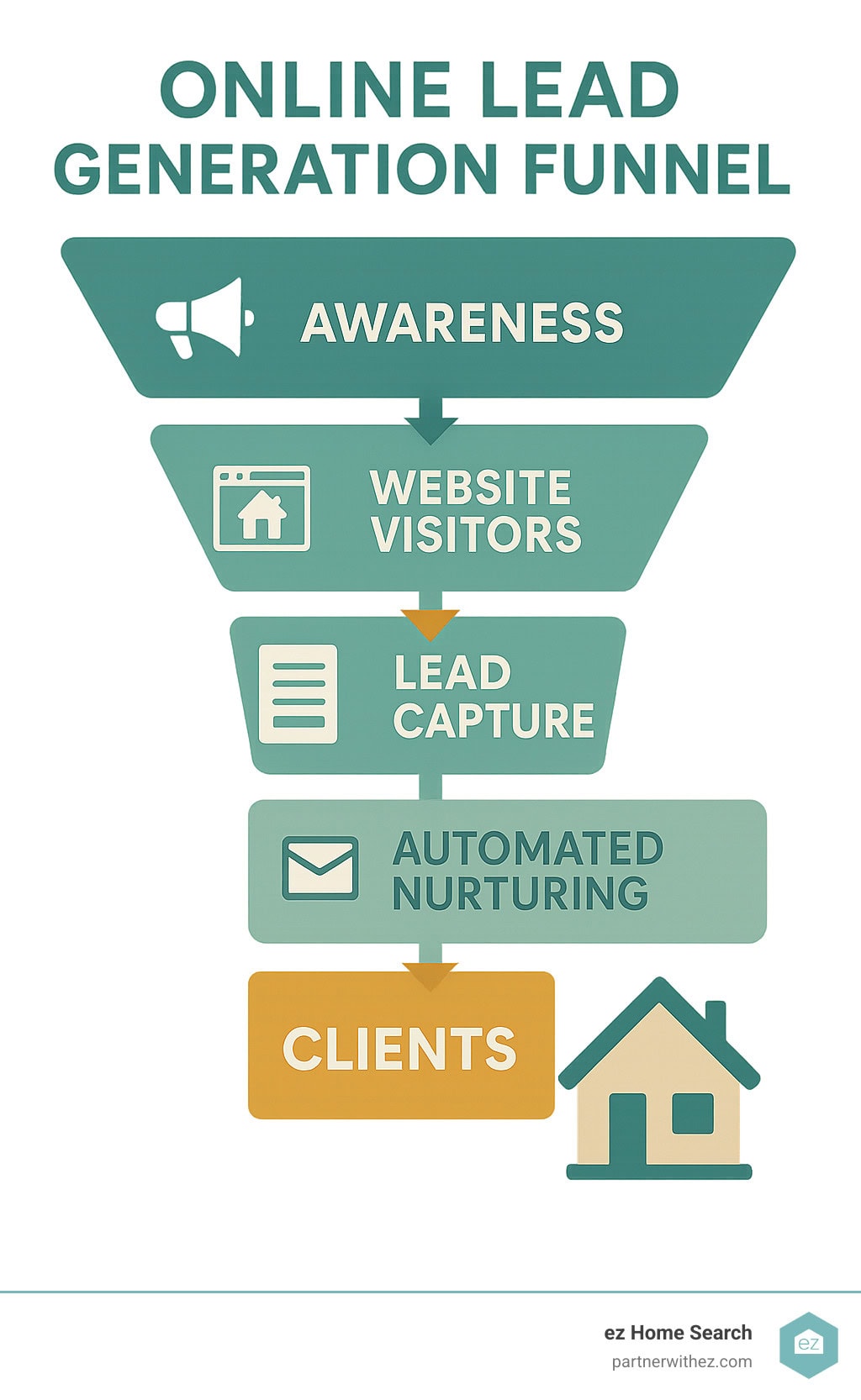
Infographic showing cost comparison between acquiring new clients versus retaining existing ones, featuring the 5-to-25x multiplier statistic, 86% referral rate from loyal customers, 80% trust rate for in-person events, and 83% improvement in client perception from personalized events - real estate client appreciation event ideas infographic

Why Client Appreciation Events Matter for New Agents

When you’re starting out in real estate, every relationship counts. That’s why real estate client appreciation event ideas become so crucial for new agents—they’re not just nice gestures, they’re strategic investments in your future success.

The numbers tell a compelling story. According to Freeman’s 2024 Event Report, 80% of people trust in-person events as the most reliable marketing channel. For new agents who haven’t built their reputation yet, this trust factor is invaluable.

Think about it this way: when clients attend your appreciation event, they’re not just enjoying free food or entertainment. They’re experiencing your commitment to relationships beyond the closing table. This demonstrates the law of reciprocity in action—show genuine appreciation, and clients naturally want to reciprocate through referrals and repeat business.

Building authentic relationships becomes your competitive advantage. Face-to-face interactions create connections that emails and phone calls simply can’t match. When clients see you investing time and effort into bringing people together, they perceive higher value in your services—and they remember you when friends mention needing a real estate agent.

As our Chief Operating Officer Travis McClure often tells our partner agents, “The strongest client relationships are built on consistent appreciation, not just successful transactions.” This philosophy transforms how new agents approach their business model.

Word-of-mouth marketing happens naturally at appreciation events. Picture this: your past clients are chatting with neighbors over ice cream at your summer social, sharing their positive home-buying experience. Those conversations generate warm leads that cost you nothing but create everything.

The beauty lies in the paradox—the less you focus on direct sales and the more you focus on genuine gratitude, the more referrals flow your way. New agents who accept this approach often find themselves building sustainable businesses faster than those relying solely on cold calling or expensive advertising.

For beginners especially, appreciation events level the playing field. You might not have decades of experience, but you can absolutely create memorable experiences that established agents overlook. Your enthusiasm and personal attention often outshine competitors who’ve become too busy for relationship-building.

9 Real Estate Client Appreciation Event Ideas for Beginners

These nine real estate client appreciation event ideas are designed with new agents in mind—each one balances meaningful client engagement with manageable costs and simple execution.

Whether you’re working with families, empty nesters, or busy professionals, these events can be customized to match your local market and personal style while building the genuine relationships that drive referral business.

Real Estate Client Appreciation Event Idea #1: Pop-Up Ice Cream Social

Nothing says summer appreciation quite like a neighborhood ice cream social. This family-friendly event creates instant joy while bringing together clients from different neighborhoods in a relaxed, no-pressure environment.

The magic happens when you partner with a local ice cream truck or frozen yogurt shop to create a branded experience without breaking your budget. Contact vendors 2-3 weeks ahead to negotiate group rates, and consider creating custom napkins or small branded items that stay well under RESPA’s gift limits.

Choose a central park or community center that’s accessible to multiple client neighborhoods, and schedule for those golden family hours—typically 3-6 PM on weekends when parents are looking for fun activities with their kids.

Budget-smart tip: Split costs by partnering with a mortgage broker or home inspector who can co-sponsor the event. You’ll share networking benefits while keeping individual expenses manageable.

ice cream social event with families and children - real estate client appreciation event ideas

#2 DIY Home-Improvement Workshop

Educational events position you as more than just a transaction facilitator—they establish you as a trusted advisor for all aspects of homeownership. DIY workshops provide tangible value while demonstrating your expertise in ways that traditional marketing simply can’t match.

Partner with local home improvement stores like Lowe’s or Home Depot, which often provide free classroom space, expert instructors, and materials for community workshops. This partnership approach dramatically reduces your costs while adding professional credibility to the event.

Popular workshop topics include seasonal home maintenance checklists, basic painting techniques and color selection, simple landscaping for curb appeal, and energy efficiency improvements. Holiday decorating safety tips work particularly well during seasonal transitions.

#3 Movie Night in the Park

Family-friendly outdoor movie screenings create those magical experiences that clients remember long after the credits roll. These events work exceptionally well in suburban markets with young families who are always looking for quality entertainment options.

Licensing considerations are important here—obtain proper public performance rights through companies like Swank Motion Pictures or Movie Licensing USA. While there’s an upfront cost, the community goodwill and client engagement make it worthwhile.

Your setup should include a large outdoor screen and projector (often available for rent and a manageable cost to buy if you think you will repeat the event), plenty of blankets or encouragement for families to bring their own, and a concession stand with popcorn, candy, and drinks. String lights or lanterns create beautiful ambient lighting that makes the whole experience feel special.

#4 Charity Drive-Through Donation Day

Community service events demonstrate your commitment to the local area while making charitable giving convenient for busy clients. The drive-through format removes barriers to participation while still creating valuable face-to-face interaction opportunities.

Partner with established local charities like food banks, animal shelters, or seasonal toy drives. Choose a high-visibility location such as a shopping center parking lot, and create clear signage listing needed items and donation guidelines.

Year-round opportunities keep you visible throughout different seasons—back-to-school supply drives in August, holiday toy and food collections during November and December, spring cleaning clothing donations in March and April, or disaster relief collections as community needs arise.

#5 Coffee & Crawl for New Homeowners

Neighborhood coffee crawls serve double duty by helping new homeowners find local businesses while building connections with other residents. This approach works particularly well in walkable communities with multiple coffee shops or cafés.

Map out a route visiting 3-4 local coffee establishments, negotiate group discounts or special menu items at each location, and create a “passport” that participants get stamped at each stop. End at a central location for group discussion and networking.

The real value comes from your curated insights about neighborhoods—sharing expertise about different areas, school districts, and ZIP codes that help participants understand their new community better. Focus on practical information like commute times, local amenities, and community events that influence both quality of life and property values.

#6 Fall Pie Pickup Party

Seasonal events tap into the emotional connections people have with holidays and traditions. Fall pie parties combine the comfort of homemade treats with the convenience of professional preparation, creating warm associations with your brand during a naturally nostalgic time of year.

Partner with a local bakery to provide seasonal favorites like pumpkin, apple, and pecan pies. Host the pickup at your office or a community center with decorated stations that feel festive and welcoming.

#7 Shred Day — Secure Document Disposal Event

Privacy-conscious clients genuinely appreciate secure document disposal services, making shred days both practical and valuable. Mobile shredding companies provide professional document destruction while you facilitate community convenience at a fraction of the cost of many other appreciation events.

The service benefits are immediately clear—secure destruction of sensitive financial documents, convenient neighborhood location, professional certificates of destruction, environmentally responsible recycling, and protection against identity theft.

Our CMO, Kurt Uhlir, started recommending this one when he was an executive at eXp Realty. He said about them, “These were consistently some of the highest attended client events and were the only event that would consistently have past clients actively reaching out to tell their friends and family about the agent’s event. Just think about the giant stack (or boxes) of papers that almost everyone has building up to shred.”

mobile shredding truck at community event - real estate client appreciation event ideas

#8 Sunset Open-House & Wine Tasting

Evening open houses with wine tastings create sophisticated experiences that appeal to adult clients while showcasing properties in unique lighting conditions. This works particularly well for luxury listings or homes with scenic views that shine during golden hour.

Schedule during optimal lighting for ambiance, partner with local wineries or wine shops for curated selections, and always provide substantial food offerings alongside small pours and non-alcoholic alternatives.

#9 Real Estate Client Appreciation Event Idea: Virtual Trivia Night

Remote events serve clients who can’t attend in-person gatherings while expanding your reach beyond geographic limitations. Virtual trivia nights combine entertainment with brand engagement through digital platforms that many people became comfortable with in recent years.

Use platforms like Zoom or Microsoft Teams with breakout room capabilities to create team interactions. Prepare branded backgrounds and presentation slides, mix real estate-themed questions with general trivia, and offer digital prizes like gift cards to local businesses.

Planning, Budgeting & Compliance Essentials

The difference between a memorable client appreciation event and a costly mistake often comes down to thoughtful planning. Over my years coaching agents through ez Home Search, I’ve seen too many well-intentioned events fall short because of overlooked details or compliance issues.

Getting your guest count right starts with a reliable RSVP system. I recommend simple tools like Google Forms or Eventbrite for smaller events, though your CRM system works perfectly if it has event tracking features. The key is making RSVPs easy for clients while giving you accurate headcounts.

Send reminder messages 48 hours before your event with final details and a gentle request to confirm attendance. This simple step dramatically improves your planning accuracy and shows clients you’re organized and professional.

Strategic partnerships can cut your event costs in half while expanding your networking opportunities. Mortgage brokers, home inspectors, insurance agents, and local businesses often welcome chances to co-sponsor events and meet potential clients. The key is clearly defining partnership terms upfront—who pays for what, how you’ll split promotional responsibilities, and whether you’ll share contact information afterward.

Travis McClure, our Chief Operating Officer, always reminds partner agents that compliance isn’t optional—it’s essential. The National Association of Realtors (NAR) RESPA rules require careful attention to gift values and event structures. Keep individual gifts under the federal limit, focus on providing meals and entertainment rather than tangible takeaways, and always consult your broker about specific compliance questions.

Every successful event needs a backup plan. Weather can force outdoor events inside, vendors sometimes cancel last-minute, and attendance can exceed expectations. I always tell agents to secure indoor alternatives for outdoor events, maintain backup vendor contact lists, and prepare 20% more materials than expected attendance suggests.

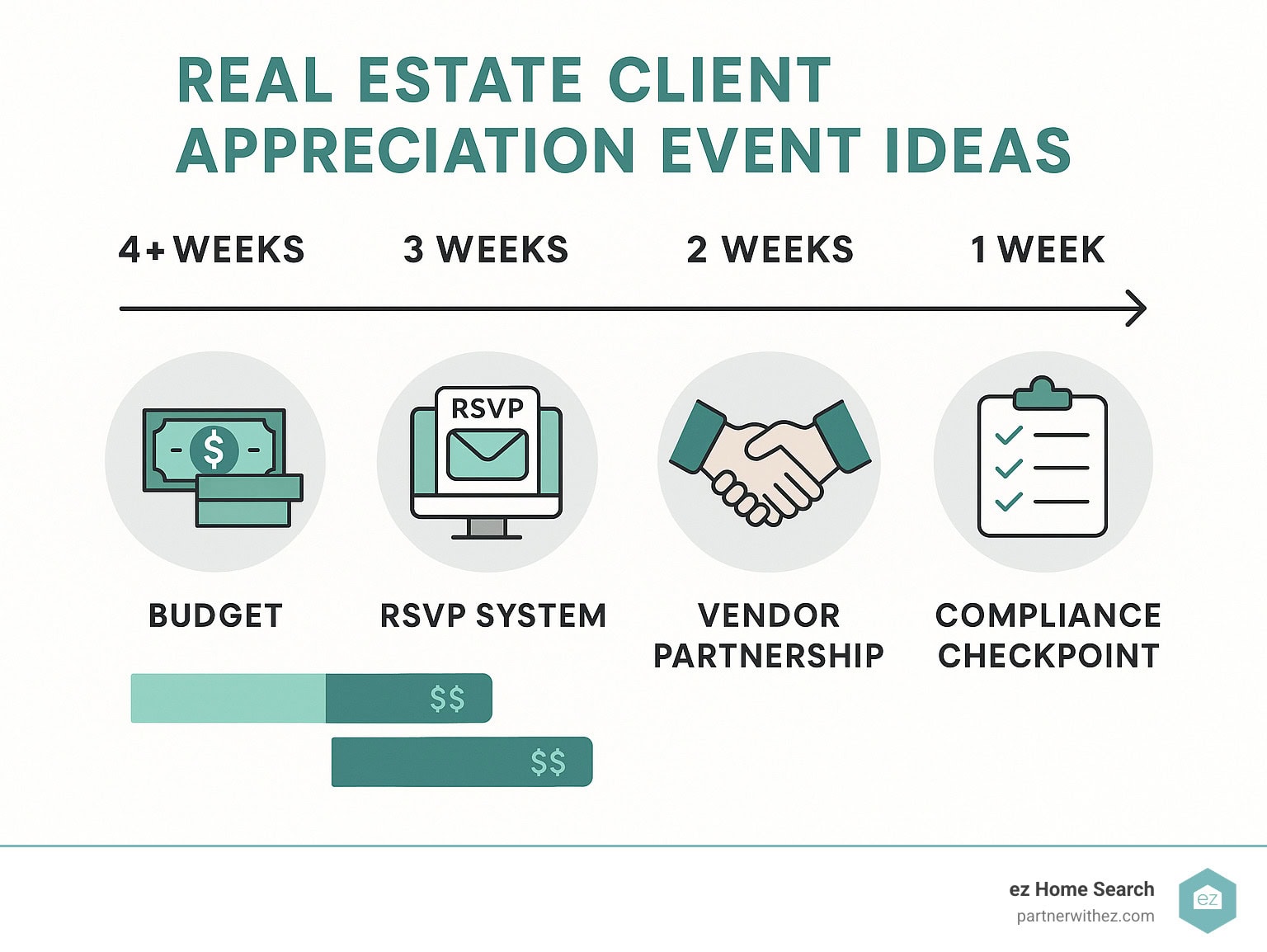
Infographic showing event planning timeline with budget ranges, RSVP systems, vendor partnerships, and compliance checkpoints for different types of client appreciation events - real estate client appreciation event ideas infographic

Understanding the investment and return potential helps you choose the right events for your market and budget. Here’s how the nine real estate client appreciation event ideas compare:

Event TypeAverage CostPrep TimePotential ROI
Ice Cream Social$300-8001-2 weeksHigh – Family appeal
DIY Workshop$200-5002-3 weeksVery High – Educational value
Movie Night$400-9003-4 weeksHigh – Memorable experience
Charity Drive$100-3001-2 weeksHigh – Community goodwill
Coffee Crawl$200-4002 weeksMedium – Local networking
Pie Pickup$300-6001-2 weeksMedium – Seasonal appeal
Shred Day$100-3001 weekHigh – Practical value
Wine Tasting$500-1,2002-3 weeksHigh – Sophisticated appeal
Virtual Trivia$50-2001-2 weeksMedium – Broad reach

The most cost-effective events often provide the highest ROI because they focus on genuine value rather than expensive impressions. A well-executed shred day or charity drive can generate more referrals than a costly wine tasting if it better matches your clients’ needs and values.

Promotion timing makes or breaks attendance. Start marketing your event 3-4 weeks in advance through multiple channels—email newsletters, social media posts, and personal phone calls to key clients work best. Create anticipation by sharing behind-the-scenes preparation photos and highlighting partner businesses you’re working with.

Common Mistakes to Avoid

After working with thousands of real estate agents through ez Home Search, I’ve watched talented professionals make the same costly mistakes with their real estate client appreciation event ideas. These missteps can turn promising events into missed opportunities—or worse, damage the very relationships you’re trying to strengthen.

Poor promotion and timing tops the list of event killers. I’ve seen agents send invitations just one week before their event, then wonder why only three people showed up. Your clients have busy lives filled with soccer practices, work commitments, and family obligations. They need at least three to four weeks’ notice to plan around your event.

Equally important is checking your local calendar before setting dates. Scheduling your ice cream social during the high school homecoming weekend or your wine tasting on Super Bowl Sunday practically guarantees poor attendance, no matter how great your event sounds.

Ignoring dietary needs and accessibility has become a major oversight in today’s diverse communities. When you collect RSVPs, always ask about food allergies, dietary restrictions, and mobility considerations. Nothing ruins an appreciation event faster than a client having an allergic reaction to your carefully chosen refreshments or being unable to access your venue.

Travis McClure, our Chief Operating Officer, often reminds our partner agents: “The details you overlook become the memories your clients take home.” Provide clearly labeled options for common dietary needs and ensure your venue accommodates everyone who wants to attend.

Over-budgeting without tracking results can quickly drain your marketing budget without generating meaningful returns. Enthusiasm for client appreciation sometimes leads to elaborate events that impress but don’t convert. A simple coffee crawl that costs a few hundred dollars and generates two solid referrals provides better ROI than an expensive gala that everyone talks about but no one acts on.

Set realistic budgets based on your current business income and track your results carefully. Which events generate the most referrals? Which ones create the strongest client relationships? Let the data guide your future event planning.

The biggest mistake, though, is skipping follow-up communications after your event ends. The appreciation event itself is just the beginning—the real relationship building happens in the days and weeks that follow. Agents who fail to follow up within 48 hours miss the golden opportunity to reinforce positive emotions and convert appreciation into actionable referrals.

Send personalized thank-you messages that reference specific conversations from the event. Share photos that capture the fun moments. Include relevant market updates that provide ongoing value. This follow-up sequence transforms a single event into an ongoing relationship-building strategy.

Lack of curated location insights represents a particularly missed opportunity when hosting events for new homeowners or potential relocators. Your clients value insider knowledge about different neighborhoods, school districts, commute patterns, and community characteristics that influence both lifestyle and property values.

When you’re hosting a coffee crawl through different areas or welcoming new residents to the community, share your expertise about what makes each location special. Which ZIP codes offer the best value? Which school districts are trending upward? Which neighborhoods provide the shortest commute to major employers? This kind of curated insight positions you as the local expert who understands markets beyond just buying and selling.

Finally, resist the temptation to mix business pitches with genuine appreciation. Clients can instantly sense when gratitude is merely a pretext for sales presentations. The agents who see the strongest results from appreciation events focus genuinely on relationship building and let referrals follow naturally.

Frequently Asked Questions about Client Appreciation Events

How do I choose who to invite?

Your invitation list should start with the foundation of your business: recent buyers and sellers from the past year, along with past clients who’ve remained in touch. These are your most likely referral sources since they’ve experienced your service and understand your value.

Don’t limit yourself to just the homeowners—include family members and plus-ones when space allows. Spouses, adult children, and close friends often become unexpected referral sources. I’ve seen agents receive referrals from a client’s college-age daughter who recommended them to her professor looking to relocate.

For newer agents with smaller client databases, expand your thinking to include your sphere of influence: neighbors, former colleagues, community members, and professional contacts. These relationships may not have resulted in transactions yet, but they represent future opportunities and referral potential.

Consider inviting complementary professionals like mortgage brokers, home inspectors, and contractors. They can help share event costs while expanding networking opportunities for everyone involved. Just ensure the professional-to-client ratio stays balanced so the event doesn’t feel like a business networking mixer.

What’s the best follow-up sequence after an event?

The magic happens in the follow-up, and timing is everything. Within 24-48 hours, send personalized thank-you messages that reference specific conversations or moments from the event. Generic “thanks for coming” messages miss the opportunity to reinforce the personal connection you built.

Share professional photos from the event within the first week through email and social media. Tag attendees when appropriate and encourage them to share their own photos with a branded hashtag. This extends the event’s reach beyond those who attended.

Your follow-up sequence should create ongoing touchpoints without being pushy. Send a relevant market update or local community information 2-3 weeks after the event, then establish quarterly check-ins with past attendees. When planning your next appreciation event, these previous attendees become your first invitation list.

As our Chief Operating Officer Travis McClure often reminds our partner agents, “The follow-up is where relationships deepen into referrals. The event creates the emotion, but consistent follow-up creates the action.”

How can I measure ROI without a big marketing team?

Measuring real estate client appreciation event ideas ROI doesn’t require sophisticated analytics—just consistent tracking of metrics that matter. Start with attendance rates, direct referrals generated within 90 days of events, and repeat business from event attendees.

Use your existing CRM system to tag event attendees and monitor their referral activity over time. Create a simple spreadsheet tracking event costs, attendance, and subsequent business generated. Even one referral from a modest event can generate thousands in commission, making the ROI calculation straightforward.

Track social media engagement from event content, including shares, comments, and new followers gained. This indicates brand awareness growth that may not generate immediate business but builds long-term value in your market.

Don’t overlook qualitative measures that are harder to quantify but equally important: strengthened relationships with existing clients, increased visibility in your community, and positioning as an agent who cares about relationships beyond transactions. These factors contribute to your reputation and referral potential in ways that compound over time.

Consider the lifetime value perspective—a client who attends your appreciation events and feels genuinely valued is more likely to refer friends, use your services for future transactions, and provide positive online reviews that attract new business.

Conclusion & Next Steps

Building meaningful relationships through real estate client appreciation event ideas creates the foundation for long-term business success that goes far beyond individual transactions. The nine beginner-friendly events we’ve explored—from summer ice cream socials to virtual trivia nights—offer practical ways to show genuine gratitude while strengthening the connections that naturally lead to referrals and repeat business.

The most successful agents understand that effective appreciation isn’t about impressing clients with expensive gestures. Instead, it’s about consistent, thoughtful actions that demonstrate you value the relationship itself, not just the commission it generated. When clients feel genuinely appreciated, they become enthusiastic advocates who refer friends and family without being asked.

What separates thriving agents from those who struggle isn’t necessarily talent or market knowledge—it’s the systems and support that make relationship building sustainable and scalable. That’s where having exclusive territory and proper marketing support becomes essential.

At ez Home Search, we’ve designed our county-based exclusivity program specifically to support relationship-focused agents like you. When you’re not competing with multiple agents for the same leads, you can invest time and energy into the appreciation events and follow-up strategies that build lasting client relationships. Our platform provides the automated nurture flows, behavioral tracking, and marketing support that keeps you connected with clients between events.

The combination of exclusive buyer and seller opportunities, advanced CRM integration, and ongoing coaching creates the perfect environment for turning client appreciation into predictable business growth. You get the leads, the tools, and the territory protection needed to focus on what matters most—building relationships that generate referrals for years to come.
Ready to stop competing for leads and start building a referral-driven business through genuine client appreciation? Find how county exclusivity and comprehensive marketing support can transform your approach to client relationships. Our team is standing by to help you secure your protected territory and implement the systems that turn appreciation events into sustainable business growth.

For agents looking to expand their professional networking capabilities alongside client appreciation efforts, ez Connect accounts provide additional tools for building the relationships that support long-term success in real estate.

06.26.2025

An Essential Guide to Curated Reviews and Trustworthy Recommendations

Why Curated Reviews Are Changing Real Estate Decisions

Curated reviews are changing how home buyers and sellers make their most important decisions – from choosing the right agent to selecting the perfect neighborhood. Unlike random testimonials, curated reviews are carefully selected, verified, and organized to provide meaningful insights that actually help people take action.

What are curated reviews in real estate?

  • Agent Selection: Verified testimonials that highlight specific strengths like negotiation skills, market knowledge, and client communication
  • Location Insights: Organized feedback about neighborhoods, school districts, commute times, and lifestyle factors from actual residents
  • Quality Control: Reviews that are filtered for authenticity, relevance, and helpfulness rather than just quantity
  • Context-Rich: Information that goes beyond star ratings to include specific details about outcomes and experiences

The research shows this approach works. According to industry data, 95% of buyers read online reviews before making a purchase, and properties with at least 5 reviews are 270% more likely to be purchased. But in real estate, the stakes are much higher than typical online shopping.

When someone is relocating to a new city or choosing between agents for a $500,000 transaction, they need more than generic star ratings. They need curated insights that match their specific situation – whether that’s finding a family-friendly neighborhood with great schools or an agent who excels at luxury home negotiations.

The real estate industry has a trust problem. Traditional platforms create bidding wars where multiple agents compete for the same lead. Buyers get overwhelmed with options, and top-performing agents waste time on unqualified prospects.

Curated reviews solve this by creating deeper trust signals that help the right buyers connect with the right professionals in the right locations.

I’m Preston Guyton, and over my 20+ years in real estate, I’ve seen how curated reviews can transform lead quality and conversion rates when implemented strategically. Through ez Home Search and our other platforms, we’ve helped teams leverage authentic testimonials and location insights to build exclusive, high-converting client relationships.

Infographic showing the real estate decision journey with curated reviews at each stage: initial location research, agent selection, neighborhood evaluation, and final purchase decision, with trust indicators and conversion improvements at each step - curated reviews infographic

Why Curated Reviews Matter in Real Estate

When someone is choosing a real estate agent or deciding where to move their family, they’re making decisions that will impact their lives for years to come. That’s why curated reviews have become so crucial in real estate – they provide the depth and context that generic star ratings simply can’t deliver.

The science backs this up. 84% of people trust online reviews as much as personal recommendations, according to research on social proof. But here’s what makes real estate different: a disappointing restaurant meal costs you one evening, while choosing the wrong agent or neighborhood can cost you thousands of dollars and years of frustration.

Curated reviews solve this by going beyond surface-level feedback. Instead of seeing “Sarah was amazing! 5 stars,” potential clients read detailed accounts like “Sarah helped us steer the competitive Denver market and closed our home in 21 days. Her knowledge of the Cherry Creek school district was invaluable since we were relocating from out of state.”

This level of detail helps buyers and sellers make informed decisions about both their agent choice and location preferences. For real estate professionals, it creates opportunities to showcase specific expertise rather than getting lost in a sea of generic testimonials.

The impact on relocation decisions is particularly significant. When families are considering a move to a new city or county, curated reviews from actual residents provide insights that you can’t get from demographic data alone.

The Psychology Behind Curated Reviews

The psychology behind curated reviews taps into how our brains actually make complex decisions. When people are overwhelmed with choices – whether that’s selecting from dozens of agents or comparing different neighborhoods – they rely on social proof to cut through the noise.

Traditional review platforms often create what psychologists call “choice paralysis.” Seeing 30 agents with similar star ratings doesn’t help buyers decide – it overwhelms them. Curated reviews work differently by highlighting the most relevant experiences for each person’s specific situation.

Our behavioral research shows that home buyers spend significantly more time reading detailed, story-driven reviews compared to simple star ratings. They’re looking for narratives that match their circumstances. First-time homebuyers want to see how an agent guided other newcomers through the process, while luxury buyers seek evidence of high-end market expertise.

The most effective curated reviews balance positive outcomes with authentic details about challenges overcome. Reviews that mention specific obstacles like “The inspection revealed plumbing issues, but Mike connected us with trusted contractors and helped renegotiate the price” actually build more trust than generic praise.

Economic Impact on Home Values

Curated reviews don’t just influence individual decisions – they create measurable impacts on local real estate markets. Areas with comprehensive, well-curated review profiles consistently see faster sales and higher average prices.

This happens because detailed location reviews reduce buyer uncertainty. When someone can read specific insights about school performance, walkability, commute times, and neighborhood culture from actual residents, they develop confidence in their decision. That confidence translates into willingness to pay market premiums for areas that clearly align with their lifestyle needs.

For real estate professionals, this creates a powerful competitive advantage. Agents who systematically collect and curate both their own client testimonials and neighborhood insights become the recognized experts for their territories. They can demonstrate unique value that generic listing platforms simply can’t match.

Curated Reviews for Real-Estate Professionals

The strongest real-estate teams rise on trust and social proof. Curated reviews let top performers prove their value while guiding buyers toward confident decisions.

agent profile with verified reviews and specialization badges - curated reviews

At ez Home Search we combine county-based exclusivity with curated reviews so a single local specialist stands out—no bidding wars, no lead resale. When consumers see verified stories tied to one clear expert, conversion rates soar.

What Makes Curated Reviews Different?

Unlike raw testimonials, curated reviews pass four quick gates:

  • Verification – we confirm the reviewer closed a real transaction or lived in the neighborhood.
  • Context tags – price range, home type, timeline, and service provided make each story searchable.
  • Balanced tone – feedback that mentions problems (inspection issues, appraisal gaps) is kept; fluffy hype is filtered out.
  • Outcome focus – days on market, negotiation savings, or relocation success are front-and-center.

Selecting Your Next Agent Through Curated Reviews

Smart buyers scan for patterns:

  1. Response times noted by past clients
  2. Concrete negotiation wins (e.g., “saved us $14k in repairs”)
  3. Hyper-local market knowledge (“knew every new build in Horry County”)
  4. Communication style that matches their preference
  5. Problem-solving examples when surprises arose

Turning Past Clients into Review Ambassadors

Timing and simplicity are key. The sweet spot is 30–60 days post-closing; an automated ezNurture email or SMS with two specific prompts (“What challenge did we solve?” and “What outcome meant the most to you?”) yields far richer stories than a generic “please review us.” Offering a post-move checklist or vendor list as a thank-you keeps goodwill high and response rates strong.

Building Location-Based Curated Reviews (Cities, Counties, ZIPs & Neighborhoods)

Families relocating need more than stats—they want lived experience. Location-based curated reviews deliver that insider view, turning anonymous census numbers into real-world stories about schools, commute times, and weekend culture.

When you compile these insights, you become the local authority—and your listings move faster because buyers feel certain before they ever book a flight.

Review SourceInformation TypeReliabilityDepth of Insight
Public DataDemographics, crime stats, property valuesHighSurface
Curated ReviewsLifestyle fit, hidden costs, community cultureHighDeep
Random Online ReviewsMixed experiences, often extremeVariableInconsistent
Word-of-MouthPersonal stories from friendsHighNarrow

Data Sources Worth Aggregating

  • County records for tax and permit trends
  • MLS stats for days-on-market and price movement
  • Census shifts to spot demographic changes
  • Community forums (Facebook, Nextdoor) for day-to-day concerns
  • School reports plus parent feedback for education reality checks

Crafting Relocation Guides

Great relocation guides merge those sources into three practical sections:

  1. Move-in costs – taxes, HOA fees, utilities
  2. Cultural vibe – events, neighbor interaction, nightlife
  3. Local amenities – dining, parks, healthcare, broadband

Our ez Home Search partners routinely see higher-quality leads after publishing these guides because prospects arrive already convinced the area matches their lifestyle.

review carousel showing neighborhood insights on a property listing page - curated reviews

Publishing & Amplifying Your Curated Reviews

The best curated reviews in the world won’t help your business if no one sees them. Strategic publishing and amplification turn your review collection into a lead generation engine.

SEO Best Practices for Curated Review Pages

Keyword Clusters: Organize reviews around search terms your ideal clients use. “Best neighborhoods for families in [City]” or “Top real estate agents for luxury homes in [County]” capture high-intent traffic.

Internal Linking: Connect review pages to relevant property listings, area guides, and agent profiles. This creates topic clusters that search engines reward with higher rankings.

Page Speed: Optimize images and minimize code to ensure review pages load quickly on mobile devices. Slow pages lose 40% of visitors within 3 seconds.

Schema Markup: Use structured review data to help search engines understand your reviews and display rich snippets with star ratings in search results.

Our technical team has found that curated review pages with proper SEO optimization generate 3-4x more organic traffic than standard testimonial pages.

Multi-channel Promotion Strategy

Email Newsletters: Include featured reviews in your regular client communications. Highlight different neighborhoods or agent specialties each month.

Social Media: Create visual content from your best reviews – quote graphics, video testimonials, and neighborhood highlight reels perform well on Instagram and Facebook.

QR Codes at Open Houses: Let visitors instantly access neighborhood reviews and agent testimonials while they’re touring properties.

IDX Integration: Display relevant curated reviews on property listing pages to provide context about the area and agent expertise.

The key is matching review content to the buyer’s journey stage. Early-stage buyers want neighborhood insights, while ready-to-purchase buyers need agent credibility and negotiation track records.

Advanced Tactics: AI & Video for Next-Level Curated Reviews

The next wave of curated reviews marries AI with quick-hit video. A 60-second clip of a past client describing how their agent rescued a deal communicates more trust than paragraphs of text, and machine learning makes collecting, sorting, and publishing those clips nearly effortless.

Infographic showing AI-powered review curation workflow: collection, verification, categorization, and distribution across multiple channels - curated reviews infographic

Automating Review Quality Control

Our ezVerify.ai system screens out spam, duplicates, and compliance risks while tagging key themes—so the authentic stories rise to the top without hours of manual work.

Measuring ROI

Track three metrics to prove impact:

  • Click-through rate on listings that feature reviews
  • Lead-to-close percentage for consumers who watched at least one testimonial
  • Customer lifetime value from clients who first engaged through curated content

Partners typically see 25-35 % higher conversion and noticeably shorter sales cycles once AI-curated and video-rich reviews go live.

Frequently Asked Questions about Curated Reviews in Real Estate

How do curated reviews stay unbiased?

Verification plus context. We publish only stories tied to real transactions or confirmed residents and encourage balanced details—wins and problems—so readers get a full picture.

Can agent and neighborhood reviews appear in one dashboard?

Yes. The ez Home Search interface lets buyers compare area insights and agent track records side-by-side, a huge advantage when relocating to a county they’ve never visited.

Fastest way to gather video reviews?

Book a brief call or send a mobile upload link within two weeks of closing, prompt with two questions, and keep the clip under 90 seconds. Consistency—one video per month—quickly builds a compelling library.

Conclusion

The real estate industry is changing, and curated reviews are leading that change. While generic platforms flood agents with unqualified leads and overwhelm buyers with endless options, curated reviews create meaningful connections based on verified expertise and authentic experiences.

Think about it – when someone is choosing an agent for a $400,000 home purchase or relocating their family to a new county, they need more than star ratings. They need detailed insights from people who’ve walked the same path. Curated reviews provide exactly that context, whether it’s understanding which agent excels at luxury negotiations or learning about school districts from actual parents in the neighborhood.

At ez Home Search, we’ve built our entire platform around this principle of trust through transparency. Our county-based exclusivity means buyers connect with a single local expert who truly knows their market – backed by verified success stories and comprehensive location insights. No bidding wars between agents, no lead competition, just authentic relationships built on proven expertise.

The difference is remarkable. When agents have access to curated reviews that showcase their specific strengths – whether it’s first-time buyer guidance, luxury market knowledge, or relocation expertise – they attract clients who are genuinely ready to work with them. Meanwhile, buyers feel confident in their decisions because they can see exactly how other families found success in similar situations.

Our Chief Marketing Officer Kurt Uhlir puts it perfectly: “The future isn’t about generating more leads – it’s about generating better connections.” Curated reviews make those connections possible by cutting through the noise and highlighting what really matters.

Whether you’re evaluating neighborhoods for your next move or looking for an agent who understands your specific needs, curated reviews provide the insider knowledge that generic platforms simply can’t match. The technology exists, the consumer demand is proven, and the competitive advantage is clear.

Ready to experience the power of curated reviews in your real estate journey? Find how ez Home Search’s exclusive approach can connect you with verified local experts at ezconnect.info. Our team specializes in matching buyers and sellers with agents who have proven track records in their specific markets.

The real estate industry is moving toward deeper trust and better matches. Curated reviews aren’t just part of that future – they’re the foundation that makes it possible.

06.25.2025

7 Things I Wish I Knew Before I Started Real Estate Lead Generation

Why Real Estate Lead Generation Success Starts with the Right Foundation

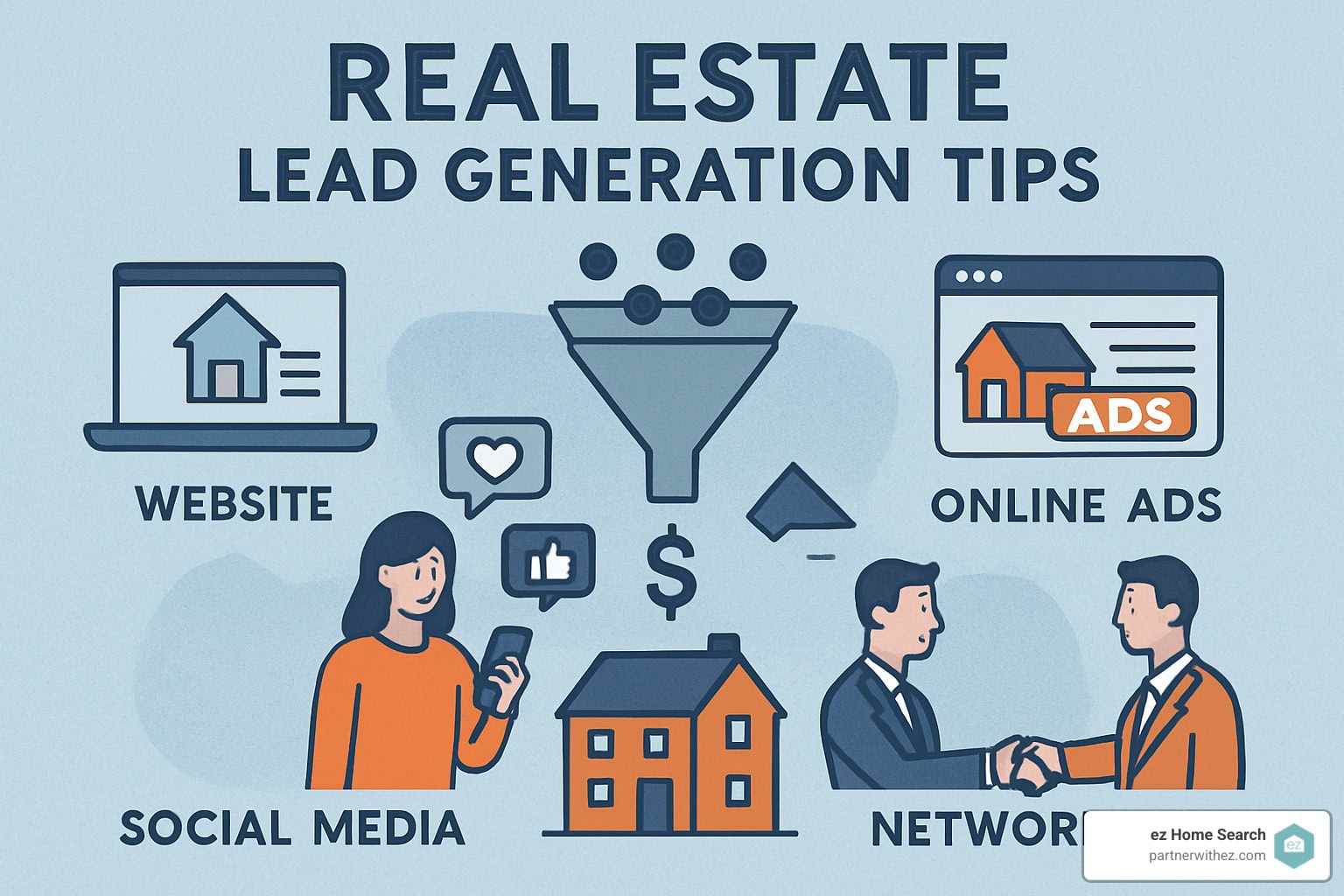
Real estate lead generation tips can make or break your business, but most agents learn the hard way through trial and expensive error. The truth is, generating consistent, high-quality leads isn’t about chasing every shiny new platform or spreading yourself across dozens of tactics.

Top Real Estate Lead Generation Tips:

  • Focus on 2-3 channels instead of trying everything at once
  • Respond to new leads within 5 minutes for 100× better conversion rates
  • Combine digital strategies (SEO, PPC, social media) with relationship-building
  • Prioritize seller leads – they often convert faster than buyer leads
  • Use automation for follow-up but keep initial contact personal
  • Track cost-per-closing, not just cost-per-lead
  • Build referral systems since 64% of sellers find agents through referrals

According to the National Association of REALTORS®, 64% of sellers found their agent through a referral from someone they knew or used an agent they had worked with before. Yet most agents still chase cold leads instead of building systems that generate warm referrals consistently.

The challenge isn’t finding leads – it’s finding the right leads without wasting time on platforms that send the same prospect to five different agents. Nearly 90% of home buyers use online resources during their search, but agents who respond to new online leads within 5 minutes are 100 times more likely to connect and convert them than those who wait 30 minutes.

I’m Preston Guyton, and over my 20+ years in real estate, I’ve helped thousands of agents and teams build sustainable lead generation systems that focus on quality over quantity. Through ez Home Search and our exclusive county partnerships, I’ve learned which real estate lead generation tips actually move the needle versus which ones just burn through your marketing budget.

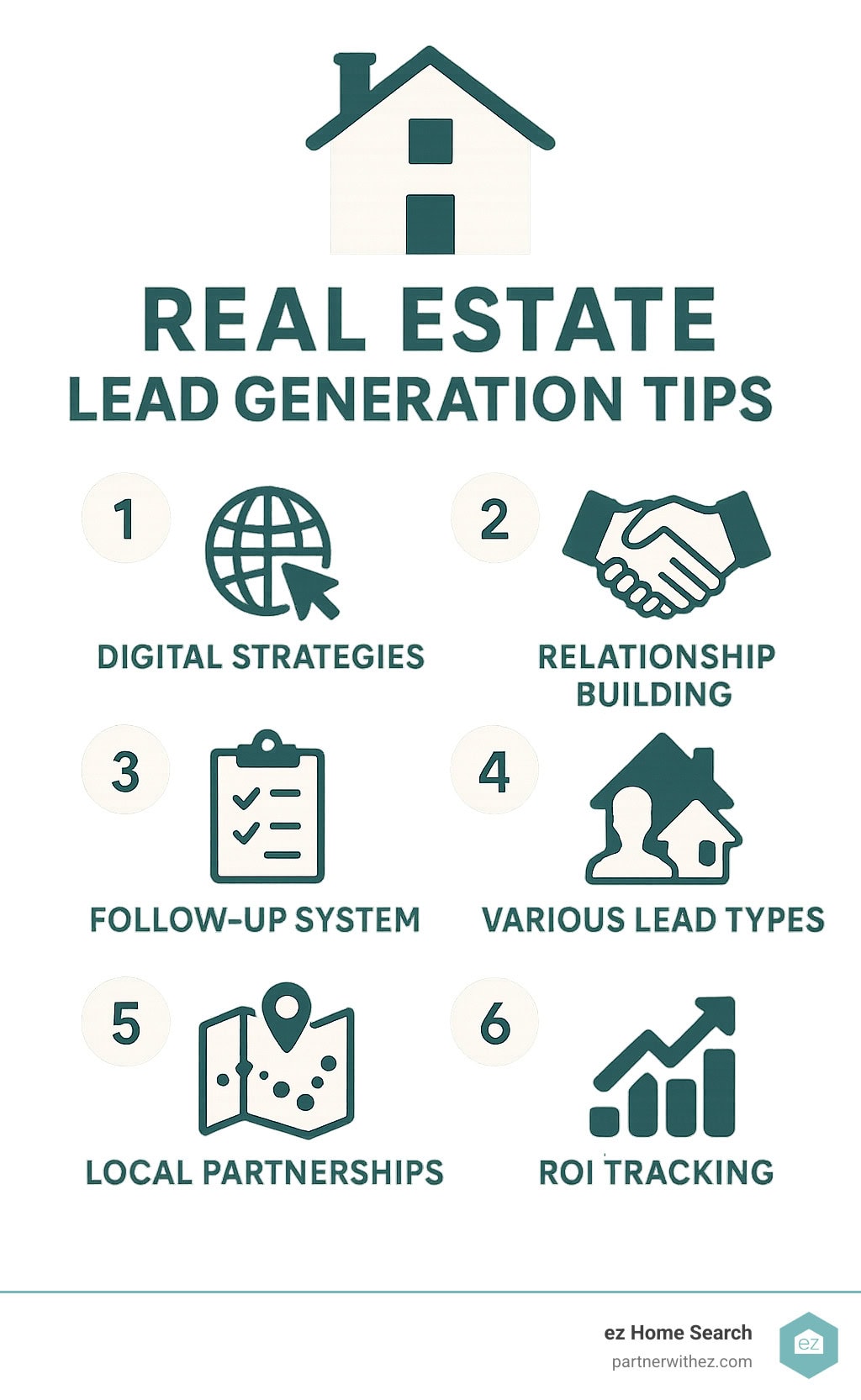
Infographic showing the 7 essential real estate lead generation tips with icons for digital strategies, relationship building, follow-up systems, lead types, local partnerships, automation tools, and ROI tracking - real estate lead generation tips infographic

Real Estate Lead Fundamentals & real estate lead generation tips

Let’s get one thing straight: not all leads are created equal. A casual “Sunday browser” is very different from a seller who must relocate in 60 days. Knowing which is which keeps you from spinning your wheels.

A lead is anyone who has shown interest in buying or selling, yet the details matter. Buyer leads often browse for 6–12 months, while seller leads usually carry more urgency because life events push them to act sooner.

Lead Type Average Timeline Conversion Rate Best Follow-Up Method
Referral Buyer 3–6 months 35–40% Personal call + email
Online Buyer 6–12 months 8–12% Automated drip + periodic calls
Referral Seller 1–3 months 45–50% Immediate consultation
Online Seller 2–4 months 15–20% Quick response + market analysis

Why Knowing Your Lead Types Saves Time

Qualified leads check three boxes: financial capability, a clear timeline, and strong motivation. Devote your highest energy to them. Potential leads meet only one or two of those criteria and require long-term nurturing, not high-pressure tactics.

Segmenting your database—buyers vs. sellers, hot vs. warm—lets you send the right message at the right moment and protects your calendar from being hijacked by low-intent prospects.

The Economics of Lead Velocity

When someone requests a home valuation or more details on a listing, interest peaks immediately. Research shows that contacting online leads within five minutes yields dramatically higher connection rates than waiting half an hour. You might not always be free to respond that fast, but your systems can be.

Our ezVerify.ai platform delivers TCPA-compliant verification and instant routing so new opportunities never sit idle. Faster response equals higher conversion, which lowers your cost-per-closing and lets you reinvest in better lead sources.

Digital Domination in 2025

A basic website isn’t enough anymore. Top producers operate an entire digital ecosystem that captures, nurtures, and converts prospects around the clock.

Modern requirements:

  • Mobile-optimized, lightning-fast pages with clear calls-to-action
  • SEO content aimed at hyper-local search terms
  • PPC campaigns with tight keyword and geographic targeting
  • Individual IDX listings not on a subdomain, instant home valuations, and chatbots for 24/7 engagement
  • Predictive analytics plus TCPA-compliant lead verification

Build a High-Conversion Website First

Think of your site as a 24-hour salesperson. To convert, it needs:

  1. Mobile-first design—over 60% of searches happen on phones
  2. Clear value statements—why should someone choose you?
  3. Automated valuations for homeowners
  4. IDX search so buyers stay on your turf
  5. Trust signals like reviews and recent sales

As an example, our 2,000,000+ pages load in under two seconds, use schema markup for better local SEO, and integrate with Follow Up Boss so every visitor automatically joins the correct nurture sequence.

Layer PPC & AI for Instant Exposure

SEO builds sustainable traffic, but PPC provides immediate visibility. Success hinges on precision:

  • Single-keyword ad groups (SKAGs) for relevancy
  • Negative keywords to block tire-kickers
  • Geo-targeting to your service areas only
  • Retargeting ads that follow visitors until they convert

ezVerify.ai plugs into these campaigns, confirming contact data in real time so your ad budget goes toward real, reachable people—not bots or bad phone numbers.

Social & Content Engines

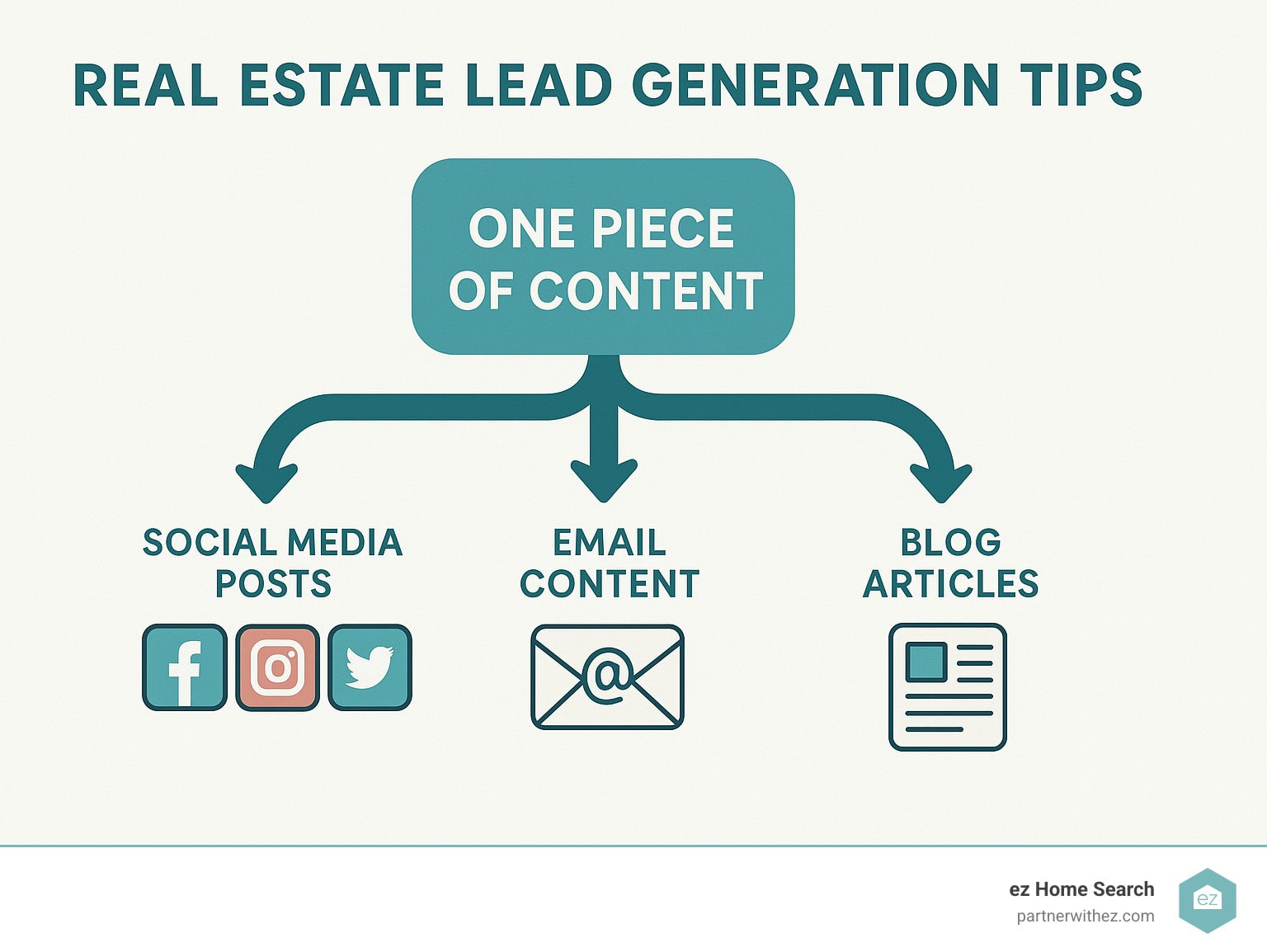
Social media isn’t just for sharing listing photos anymore. It’s become a sophisticated lead generation engine when used strategically. The research shows that agents who use video marketing receive 403% more inquiries than those who don’t, and social media is cited as the top source for generating high-quality leads by 47% of real estate agents.

Video content that generates leads:

  • Property tours and neighborhood spotlights
  • Market update videos explaining local trends
  • Client testimonials and success stories
  • Educational content about the buying/selling process
  • Behind-the-scenes content that builds personal connections

The key is consistency and value. Don’t just post when you have a new listing – create a content calendar that positions you as the local market expert.

Turn Social Engagement into Leads

Social platforms offer sophisticated advertising options that can target prospects with laser precision. Facebook and Instagram carousel ads allow you to showcase multiple properties or highlight different aspects of your services in a single ad.

Effective social media lead generation tactics:

  • Facebook Groups – join and contribute to local community groups
  • LinkedIn articles – establish thought leadership with market insights
  • Instagram Stories – use polls and questions to engage followers
  • Live Q&A sessions – answer real estate questions in real-time
  • Lead generation forms – capture contact information directly within social platforms

The beauty of social media is that it allows for two-way communication. You’re not just broadcasting messages – you’re building relationships and trust over time.

Nurture with Email & Drip Campaigns

Email marketing has an average ROI of $42 for every $1 spent, making it one of the most cost-effective lead nurturing strategies for real estate professionals. But generic, one-size-fits-all email campaigns won’t cut it anymore.

Successful email campaigns require:

  • Segmentation – different messages for buyers, sellers, and past clients
  • Personalization – use names, property preferences, and location data
  • Value-driven content – market reports, neighborhood guides, and buying/selling tips
  • Automated sequences – welcome series, follow-up campaigns, and anniversary messages
  • Mobile optimization – most emails are opened on mobile devices

Our ezNurture system integrates with popular CRMs like Follow Up Boss to create sophisticated drip campaigns that adapt based on recipient behavior. If someone clicks on a listing, they automatically receive similar properties. If they download a seller’s guide, they enter a seller-focused nurture sequence.

Infographic showing content repurposing strategy with one piece of content becoming multiple social media posts, email content, and blog articles - real estate lead generation tips infographic

Offline & Community Superpowers

Traditional tactics still pull serious weight—especially when everyone else is distracted by the latest social trend.

Direct mail remains powerful when it’s hyper-local and personalized. Strategic geographic farming turns you into the neighborhood resource instead of just another postcard.

Open houses serve double duty: they showcase a property while introducing you to neighbors who may list soon. Each visitor is a future client or referral source.

Door knocking, when done respectfully and with valuable market data in hand, can spark conversations few online ads ever will.

handwritten postcard for direct mail campaign - real estate lead generation tips

Blend Traditional & Event-Based Tactics

Educational or social events create memorable touchpoints without feeling salesy. Consider:

  • First-time buyer seminars co-hosted with a lender
  • “Coffee with the Market Expert” drop-in sessions at a local café
  • Neighborhood BBQs tied to a charity your audience cares about
  • HUD program workshops that attract motivated buyers seeking guidance

Partner Locally for Mutual Referrals

Align with businesses that already serve your ideal clientele:

  • Mortgage lenders for faster approvals and smooth closings
  • HR departments at companies that relocate staff
  • Corporate relocation firms needing trusted local experts

Consistency and reciprocation keep these alliances thriving. Our county exclusivity ensures the community relationships you cultivate aren’t undercut by competing agents.

Ready to pair proven offline strategies with territory protection? Partner with ez Home Search to secure your county before someone else does.

Follow-Up, Curated Reviews & ROI

Here’s the truth about real estate lead generation: generating leads is actually the easy part. The real challenge—and where most agents lose money—is in the follow-up and conversion process. You can have the best website, the smartest PPC campaigns, and the most engaging social media presence, but if you don’t have systems to nurture those leads effectively, you’re essentially throwing money away.

The difference between successful agents and those who struggle isn’t usually about lead volume. It’s about what happens after someone raises their hand and shows interest. Effective follow-up requires speed, persistence, value, personalization, and automation—all working together to guide prospects from initial interest to signed contracts.

Our CRM-integrated nurture flows through ezNurture ensure that every lead receives timely, relevant communication based on their specific interests and behavior patterns. This isn’t about bombarding people with generic messages—it’s about providing value at each touchpoint while staying top-of-mind throughout their decision-making process.

Master Speed-to-Lead & Multi-Channel Touches

Speed alone isn’t enough. You need a multi-channel approach that reaches prospects through their preferred communication methods.

Think about your own behavior as a consumer. When you submit a form online, you might check your email, glance at your phone for texts, and scroll through social media—all within minutes. Your prospects are doing the same thing, which means you need to meet them where they are.

Your multi-channel follow-up strategy should include immediate phone calls or texts, followed by detailed email information, social media connections on LinkedIn or Facebook, physical direct mail pieces that stand out, and retargeting ads that keep you visible throughout their digital journey.

The key is having systems that automate these touchpoints while maintaining a personal feel. Our platform includes SMS capabilities, ringless voicemail, and automated email sequences that adapt based on recipient engagement. When someone clicks on a particular property type in your email, they automatically receive similar listings. If they download a market report, they enter a sequence focused on market insights and trends.

This isn’t about being pushy—it’s about being helpful and staying connected throughout what can be a months-long decision process.

Curate Reviews & Ask for Referrals

Reviews and referrals are the lifeblood of successful real estate businesses, but most agents approach them completely wrong. They wait passively, hoping satisfied clients will naturally refer others, instead of building systematic approaches to generate and leverage reviews strategically.

Curated reviews in real estate serve multiple purposes beyond just showcasing your services. They help prospective clients choose which agent or brokerage to work with, obviously, but they also provide valuable insights about locations, neighborhoods, school districts, and communities that guide major relocation and investment decisions.

When you curate reviews about specific ZIP codes, highlight school district advantages, or showcase neighborhood amenities, you’re not just building credibility—you’re providing the location-specific insights that help families make confident decisions about where to live. These curated location reviews become powerful content that attracts prospects researching specific areas.

36% of buyers use an agent referred by someone they know, and this statistic represents a massive opportunity that most agents leave on the table. Your past clients are your best source of future business, but only if you stay connected and make it easy for them to refer others.

Systematic referral generation means asking at the right time during the closing process when satisfaction is highest, making it easy by providing specific language clients can use, staying in touch with regular market updates and home maintenance tips, providing ongoing value that keeps you top-of-mind, and showing genuine appreciation for successful introductions.

The agents who master this process don’t just get occasional referrals—they build referral machines that generate consistent business year after year.

Measure, Iterate, Focus

Here’s one of the most important real estate lead generation tips we can share: stop trying to do everything at once. The research consistently shows that agents who focus on mastering one or two lead sources outperform those who spread their efforts across multiple channels.

It’s tempting to chase every new platform or strategy, especially when you see other agents posting about their latest success. But the most successful agents we work with have learned to focus obsessively on what works and double down on those channels.

The key metrics you should track include cost per lead to understand your acquisition costs, cost per closing to measure total marketing investment per transaction, conversion rates showing the percentage of leads that become clients, response times indicating how quickly you engage new prospects, and channel performance revealing which sources generate the best ROI.

Our platform provides detailed analytics that help you understand which strategies are working and which need adjustment. This data-driven approach ensures you’re investing time and money in the most effective tactics rather than guessing or following what seems to work for others.

A/B testing becomes crucial for continuous improvement. Test email subject lines and content, landing page designs and calls-to-action, social media ad copy and images, direct mail designs and messaging, and phone scripts and follow-up sequences. Small optimizations compound over time, leading to significantly better results.

The goal isn’t perfection—it’s progress. Every month, you should be slightly better at converting leads than the month before.

Frequently Asked Questions about real estate lead generation tips

How many strategies should I run at once?
Focus on mastering 2-3 channels rather than spreading yourself thin across many. The research shows that agents who concentrate their efforts on fewer channels achieve better results than those who try everything at once. Pick the channels that align with your strengths and target market, then optimize them relentlessly.

What are the cheapest lead generation ideas?
The most cost-effective strategies are often relationship-based: referrals from past clients, sphere of influence outreach, and strategic partnerships with local businesses. These require time investment but minimal financial cost. The key is building systems that make these relationships productive and sustainable.

What’s the best follow-up cadence?
The ideal follow-up sequence includes immediate response, then touches at 1 hour, 1 day, 3 days, 1 week, 2 weeks, and monthly thereafter. The key is providing value with each interaction, not just checking in. Each touchpoint should offer market insights, property recommendations, or helpful resources that move the relationship forward.

Ready to eliminate lead competition and focus on conversion instead of generation? Partner with ez Home Search for exclusive county opportunities that deliver qualified prospects directly to your pipeline without the competition.

Conclusion

The real estate industry is changing rapidly, and the agents who thrive are those who combine proven relationship-building strategies with cutting-edge technology and exclusive lead sources. The real estate lead generation tips we’ve shared aren’t just theoretical concepts – they’re battle-tested strategies that successful agents implement every single day to build thriving businesses.

Here’s what we’ve learned after working with thousands of real estate professionals: it’s not about generating more leads – it’s about generating better leads and converting them more effectively. The research consistently shows that quality trumps quantity every time, and the agents who focus on building systematic, sustainable processes consistently outperform those who chase every new platform or tactic.

The challenge most agents face isn’t a lack of lead generation options. It’s the overwhelming number of choices and the constant competition for the same prospects. When five different agents are calling the same lead within minutes of their inquiry, conversion rates plummet and marketing costs skyrocket.

That’s exactly why we built ez Home Search around a fundamentally different approach. Our county-based exclusivity ensures you’re not competing with other agents for the same prospects. When a homeowner submits their information through our platform, they’re matched with a single local expert – you – rather than being sold as a lead to multiple agents.

Our privacy-first approach builds genuine consumer trust because people know their information isn’t being shared with dozens of agents. This trust translates directly into higher conversion rates and more meaningful client relationships.

The integrated tools we’ve developed – from ezNurture for automated follow-up sequences to ezVerify.ai for TCPA-compliant verification – handle the technical aspects so you can focus on what you do best: building relationships and closing deals.

Whether you’re a real estate team leader looking for predictable lead flow, a loan officer seeking warm handoffs, or a local vendor wanting targeted exposure without ad waste, our ecosystem delivers the technology, trust, and territory protection you need to convert at scale.

ez Home Search team collaborating on lead generation strategies - real estate lead generation tips

The agents who will dominate their markets in the coming years understand that sustainable success comes from building systematic processes, not chasing the latest marketing fad. They know that speed-to-lead matters, that referrals are gold, and that automation enables personalization at scale.

Most importantly, they recognize that exclusive leads – prospects who aren’t being contacted by multiple agents simultaneously – convert at dramatically higher rates than shared leads. When you’re the only agent calling, you’re not competing on price or availability. You’re having a genuine conversation with someone who actually wants to hear from you.

Ready to transform your lead generation strategy and eliminate the competition for your prospects? Partner with ez Home Search for exclusive county opportunities that deliver real, intent-driven consumers directly to your pipeline. No more competing with multiple agents for the same leads. No more wasted ad spend on prospects who aren’t serious about buying or selling.

For additional resources and team scaling support, explore our ez Connect accounts designed specifically for growing real estate professionals who want to leverage our proven systems and ongoing coaching support.

The future of real estate lead generation is here, and it’s built on exclusivity, privacy, and genuine consumer relationships. The question isn’t whether this approach works – the question is whether you’ll be part of it.

06.19.2025

How to Generate Leads as a New Real Estate Agent in 5 Simple Steps

real estate agent generating leads - how to generate leads as a new real estate agent

How to generate leads as a new real estate agent can feel overwhelming when you’re just starting out. To help you get started quickly, here’s a simple 5-step framework:

  1. Activate your sphere of influence – Tell friends, family, and social circles you’re in real estate
  2. Build an online presence – Create a website, social profiles, and content that attracts leads
  3. Use traditional outreach – Host open houses, send direct mail, and connect with FSBOs
  4. Leverage technology – Implement lead capture tools, AI chatbots, and targeted ads
  5. Follow up consistently – Respond quickly and nurture leads with a regular cadence

According to the National Association of REALTORS®, 36% of real estate agents consider lead generation their biggest challenge. This isn’t surprising – without a steady stream of potential clients, your commission-based income will quickly stall.

The good news? You don’t need to try every strategy at once. In fact, spreading yourself too thin across multiple lead sources is a common mistake new agents make. Instead, focusing on mastering a few key strategies will yield better results.

“It takes time for new agents to find more people to talk to about real estate. Whether you’re starting out or starting over, that can be frustrating.”

My name is Preston Guyton, and with over 20 years in real estate and as founder of ez Home Search, I’ve helped countless new agents master how to generate leads as a new real estate agent through proven systems that convert prospects into clients.

Infographic detailing how to generate leads as a new real estate agent, outlining five key steps with timelines and estimated lead yields for each stage.

How to Generate Leads as a New Real Estate Agent: 5-Step Framework

Not all leads are equal. Knowing whether someone is casually browsing or ready to move tomorrow helps you decide how much time and money to invest in each prospect.

Lead TypeCharacteristicsConversion TimelineBest Approach
High-FunnelResearching, 6+ months out6-12+ monthsEducational content, market updates, low-pressure nurturing
Mid-FunnelActively looking, 3-6 months out3-6 monthsProperty alerts, neighborhood guides, showing availability
Low-FunnelReady to buy/sell now0-3 monthsRespond in <5 min, personal calls, direct service

Kurt Uhlir, our CMO, reminds new agents: “Build four prospecting pillars—each strong enough to support your business on its own.” Master a few channels rather than dabbling in dozens.

Step 1 – Activate Your Sphere of Influence

Your sphere—friends, family, past colleagues—can account for 70-plus % of early deals. Compile at least 100 contacts, announce your new career through calls, emails, and social posts, and log everyone in a simple CRM or spreadsheet. Host small appreciation events to spark introductions.

Step 2 – Build a Magnetic Online Presence

With 90%+ of buyers starting online, a mobile-friendly IDX website is mandatory. Keep lead-capture forms short (3-5 fields) and publish local blog posts or market snapshots that drive traffic from Google. Social profiles should funnel visitors back to your site.

Step 3 – Master Traditional High-Touch Outreach

Open houses, direct-mail postcards, and FSBO outreach still work because they create human connection. Use QR sign-ins to feed contacts straight into your CRM and follow up the same day.

Step 4 – Scale with Paid Ads, AI & Predictive Data

Once organic methods produce steady conversations, layer on targeted Facebook, Instagram, and Google ads. Pair them with an AI chatbot that captures information 24/7 and scores lead intent so you spend time only where it matters.

Step 5 – Nurture, Measure & Convert for the Long Haul

Speed-to-lead is critical—respond within five minutes. Then maintain a multi-channel cadence (calls, texts, emails) until a prospect buys, sells, or opts out. Track cost-per-lead and conversion rate for every source so you can double down on what works.

Travis McClure, our COO, sums it up: “The agents who win aren’t the ones with the most leads—they’re the ones who follow up the best.”

Building Your Digital Home Base

Your website isn’t just a digital business card—it’s the heartbeat of your online presence and often the first impression potential clients will have of you. According to 2023 Member Profile, 66% of real estate agents have a website, which means having one is no longer a competitive advantage—it’s a basic expectation. Although, the vast majority of these sites are on their broker’s website and/or are a subdomain of their broker’s website.

mobile-friendly real estate agent website with IDX integration - how to generate leads as a new real estate agent

Think of your website as your digital home base—a place where all your marketing efforts ultimately lead. When I work with new agents, I always emphasize that a truly effective website doesn’t just look pretty—it actively generates leads while you sleep.

The foundation of a lead-generating website starts with mobile-responsive design. With more than half of web traffic coming from smartphones and tablets, your site needs to look and function flawlessly on all devices. Nothing sends potential clients running faster than pinching and zooming their way through a desktop-only site on their phone.

IDX integration is your secret weapon for keeping visitors engaged. This technology allows house hunters to search MLS listings directly on your site, creating opportunities to capture their information when they save searches or favorite properties. It’s like having an open house that never closes.

Every page of your site should feature clear calls-to-action that guide visitors toward lead-generating activities. Whether it’s requesting a home valuation, downloading a neighborhood guide, or scheduling a buyer consultation, make these actions impossible to miss.

“Your website should be a lead-generating machine, not just a digital business card,” says Kurt Uhlir of ez Home Search. “Every element should be designed with conversion in mind.”

Build trust instantly by showcasing testimonials and social proof from happy clients. In a business built on relationships, nothing sells your services better than the words of satisfied customers.

Local SEO & Content That Ranks

When potential clients Google “real estate agent in [your city],” will they find you or your competition? Local SEO can tip those scales in your favor.

The cornerstone of effective local SEO is using location-specific keywords throughout your site. Naturally incorporate your city, neighborhood names, and even ZIP codes in page titles, headings, and content. Think like your clients—they’re searching for “homes for sale in Riverdale,” not generic “real estate listings.”

Neighborhood guides are perhaps the most valuable content you can create. These in-depth resources should cover everything from school ratings and commute times to local restaurants and annual events. Not only do these guides attract search traffic, but they also showcase your local knowledge in a way that national websites simply can’t match.

Social Media Engines That Never Sleep

Social media platforms offer powerful tools for building your brand 24/7, but the key is choosing the right platforms and approaching each with intention.

Facebook remains the workhorse for real estate agents. Beyond sharing listings and market updates on your business page, consider creating a local real estate group where you can establish yourself as a community resource. Facebook’s targeting capabilities also make it ideal for running hyper-local ads to specific demographics.

Instagram thrives on visual storytelling, making it perfect for property photos, video tours, and behind-the-scenes glimpses of your work. Use local hashtags and location tags to increase visibility, and don’t be afraid to show your personality—clients hire people, not profiles.

For building professional connections, LinkedIn is best. Share market insights, connect with relocation specialists, and build relationships with potential referral partners like mortgage lenders, attorneys, and home inspectors.

TikTok has emerged as a surprising powerhouse for real estate. Short, authentic videos about local market conditions, home buying tips, or day-in-the-life content can quickly build a following. The platform’s algorithm favors consistent creators, so commit to a regular posting schedule if you dive in.

“Social media isn’t just about posting content—it’s about building relationships,” says Travis Halverson of ez Home Search. “The agents who engage authentically and consistently see the best results.”

High-Touch Traditional Prospecting Tactics

It’s easy to forget the power of face-to-face connections. Yet traditional prospecting methods remain some of the most effective ways to build genuine relationships and generate quality leads. These high-touch approaches help you create personal connections that digital channels simply can’t replicate.

real estate agent at community event networking with potential clients - how to generate leads as a new real estate agent

Turning Open Houses Into Lead Factories

Open houses are gold mines for new agents when approached strategically. They’re not just about selling that particular home – they’re opportunities to meet dozens of potential clients in a single afternoon.

“Open houses aren’t just about selling that particular property,” explains Travis McClure of ez Home Search. “They’re about building your database and establishing yourself as the neighborhood expert.”

To transform your next open house into a lead-generating machine, focus on creating an experience that stands out. Most open houses feature nothing more than a cheese plate, a few nosy neighbors, and a bored agent scrolling through their phone. Be different.

Consider using QR codes instead of paper sign-in sheets – this allows for immediate data capture and seamless integration with your CRM. Bring neighborhood guides, recent sales data, and mortgage calculators to provide genuine value to attendees.

One often-overlooked strategy is inviting the neighbors. Drop personalized invitations to surrounding homes a few days before the event. Current homeowners frequently know people looking to move into their neighborhood, and they’ll appreciate being included.

Geo-Farming & Hand-Written Notes

Imagine becoming the go-to real estate expert for a specific neighborhood or community. That’s the power of geo-farming – a focused approach to building your reputation in a defined geographic area.

Successful geo-farming combines several traditional tactics into a cohesive strategy. Direct mail campaigns remain surprisingly effective in our digital age. According to the Data & Marketing Association, direct mail boasts a 4.4% response rate compared to email’s modest 0.12%. Monthly mailers with market updates, recent sales, and your contact information keep you top-of-mind.

Hand-written notes create an impression in today’s world of automated messages. A personal card after meeting someone or to acknowledge a special occasion stands out dramatically. As one client told me, “I kept your thank-you note on my refrigerator for months – it was the only personal mail I received all year.”

Door-knocking might feel intimidating at first, but it’s incredibly effective when done with genuine intention to help. Bring something of value – perhaps a quick market update or information about a recent sale – rather than just your business card.

“Consistency is key with geo-farming,” notes Nikki Pais from ez Home Search. “It typically takes 6-12 months of regular contact before you start seeing significant results, but the ROI can be substantial once you’ve established yourself.”

Smart Scaling with Paid, AI & Automation

AI chatbot on smartphone helping real estate agent capture leads - how to generate leads as a new real estate agent

Digital ads and automation let you grow beyond what manual prospecting can handle.

When & How to Invest in Paid Leads

Start small—$300-$500 per month—then scale once you hit a 5:1 return. Ask every vendor, “Are these leads exclusive?” ez Home Search’s county-based territories ensure you’re the only local expert reaching each consumer. Fewer, higher-intent leads routinely beat large lists of lookers.

Consider the lifetime value of a client (repeat business + referrals) when judging acquisition cost. One great client can more than cover an entire year’s budget.

AI Tools That Work While You Sleep

Modern chatbots greet visitors instantly, answer common questions, and book appointments—boosting website conversion rates by up to 40%. Smart lead-scoring tools, like our ezNurture and ezVerify.ai, surface prospects who demonstrate real intent (multiple property views, mortgage-calculator use, etc.).

“As tech handles routine tasks, you stay free to build relationships,” says Travis Halverson of ez Home Search. Combine automation with authentic follow-up and you’ll convert more leads without working longer hours.

Nurture, Track & Convert Like a Pro

Generating leads is just the beginning of your real estate journey. The real magic happens when you transform those prospects into clients through thoughtful follow-up and relationship building. Industry research shows it typically takes about 8 meaningful touchpoints before a lead converts to a client—a number that surprises many new agents.

dashboard showing real estate lead tracking metrics and KPIs - how to generate leads as a new real estate agent

Metrics That Matter for “How to Generate Leads as a New Real Estate Agent”

Success leaves clues, and those clues are in your numbers. When I talk with new agents about how to generate leads as a new real estate agent, I always emphasize the importance of tracking key performance indicators (KPIs).

Cost per lead (CPL) gives you clarity on how much you’re investing to acquire each prospect from different channels. This helps you determine which methods give you the most bang for your buck. For instance, you might find your Facebook ads cost $25 per lead while your Google Ads cost $45—valuable information for budget decisions.

Your conversion rate tells the real story about lead quality. I’ve seen agents chase hundreds of cheap leads with a 1% conversion rate when they could focus on fewer, higher-quality leads converting at 10-15%. Break this down by lead source to identify your golden geese.

Perhaps the most critical metric is response time. The difference between responding in 5 minutes versus 30 minutes can literally halve your conversion rates. As Travis McClure often reminds our partners, “In real estate, the early bird doesn’t just get the worm—it gets the commission.”

Follow-Up Workflows for “How to Generate Leads as a New Real Estate Agent”

The fortune truly is in the follow-up. I’ve watched countless agents generate plenty of leads only to watch them go cold from neglect. Here’s how to avoid that fate:

Speed-to-lead should be your mantra. When that notification pings, drop everything if possible. Research shows that responding within 5 minutes makes you 21 times more likely to qualify that lead than waiting even one hour. The first agent to make meaningful contact often wins the business.

Accept a multi-channel approach rather than relying solely on email or calls. Some clients prefer text messages, while others respond best to a phone conversation or even social media outreach. Meeting people where they are shows you’re attentive to their preferences.

Personalization is what separates forgettable agents from memorable ones. Reference specific properties they viewed, mention their timeline or neighborhood preferences, or acknowledge personal details they’ve shared. This shows you’re listening, not just selling.

Finally, adopt a value-first approach in all communications. Rather than asking “Are you ready to buy yet?” share a new listing that matches their criteria, send market updates for their target neighborhood, or offer a helpful resource about mortgage pre-approval. This positions you as a trusted advisor rather than just another salesperson.

“Most agents give up too soon,” Nikki Pais of ez Home Search often reminds our partners. “The difference between average and exceptional income usually comes down to having systematic, value-driven follow-up that converts leads into clients and clients into referrals.”

Frequently Asked Questions about How to Generate Leads as a New Real Estate Agent

How long until I see results from each strategy?

One of the most common questions I hear from new agents is about timing expectations. The truth is, different lead generation methods have different timelines for success:

Your sphere of influence can start producing referrals relatively quickly—often within 1-3 months of consistently letting people know you’re in real estate. This is why I always recommend starting here.

Social media typically takes 3-6 months of regular posting and engagement before you’ll see a steady stream of organic leads. It’s about building relationships, not just collecting followers.

Content marketing and SEO require patience. Expect to wait 6-12 months before your blog posts and neighborhood guides start ranking well and generating consistent leads. The good news? Once they do, they continue working for you 24/7.

For direct mail, plan on 6-12 months of consistent mailings before homeowners in your farm area recognize your name and brand enough to reach out. As Kurt Uhlir often reminds our partners, “Lead generation is a marathon, not a sprint. Consistency over time is what builds a sustainable pipeline.”

Paid advertising delivers the quickest results—often within 1-4 weeks—but requires 3+ months of testing and optimization to maximize your return on investment.

What’s the ideal follow-up timeline for new leads?

Your follow-up strategy should match the temperature of your leads:

For hot leads (active inquiries), respond within 5 minutes—this is non-negotiable. Follow up again the same day, then every 2-3 days until you make contact. These leads are actively looking and will quickly move on to another agent if you’re not responsive.

With warm leads showing some interest but not quite ready to act, respond within an hour, follow up within 24 hours, then every 3-5 days for two weeks before moving to a weekly cadence.

“Text messages have significantly higher open rates than emails,” Travis Halverson points out. “Use a mix of communication channels for the best results.” I’ve found that alternating between calls, texts, and emails shows persistence without feeling overbearing.

Should I buy leads or focus on organic methods first?

This question depends on your personal situation, but here’s my honest take:

Start with organic methods if you have more time than money, possess strong networking skills, can wait 3-6 months for consistent results, or want to build a sustainable referral-based business. These methods cost less upfront but require more patience and consistent effort.

Consider buying leads if you need to generate income quickly, have marketing budget available, have strong follow-up systems already in place, or excel at converting leads through phone and email. Paid leads can jumpstart your business but require disciplined follow-up to be worth the investment.

“The most successful agents combine both approaches,” says Travis McClure. “Start with your sphere and free methods while gradually adding paid strategies as your budget allows.”

real estate agent celebrating first closing with clients - how to generate leads as a new real estate agent

Conclusion

How to generate leads as a new real estate agent doesn’t have to be overwhelming. By following our 5-step framework and focusing on consistency rather than trying to do everything at once, you can build a sustainable lead generation system that grows your business over time.

Remember these key principles:

  1. Start with your sphere – Your existing relationships are your most valuable asset.
  2. Focus on a few strategies – Master 3-4 lead sources rather than dabbling in dozens.
  3. Combine digital and traditional – The most successful agents leverage both online and offline tactics.
  4. Invest in follow-up – Converting leads is just as important as generating them.
  5. Track and optimize – Use data to refine your approach over time.

The agents who succeed aren’t necessarily the ones with the most leads—they’re the ones who nurture their leads most effectively.

At ez Home Search, we’re committed to helping new agents succeed through our exclusive territory model, which ensures you receive high-quality, intent-driven leads without competing against multiple agents for the same prospects. Our privacy-first platform combines high-conversion landing pages, real-time behavioral tracking, CRM integration, and TCPA-compliant verification—all working together to help you convert at scale.

To learn more about how ez Home Search can support your lead generation efforts, visit our ez Connect platform or reach out to our team for a personalized consultation.

Lead generation isn’t just about finding potential clients—it’s about building relationships that will sustain your business for years to come. Stay consistent, provide value, and the results will follow.

06.19.2025

7 Simple Steps to Find Buyer Leads for Real Estate Agents

Buyer Leads: The Engine of Real Estate Growth

If you’re looking for buyer leads for real estate agents, here’s a quick overview of the most effective methods. Buying real estate leads is one of the fastest ways to build a new business or revitalize an existing one.

  1. Build an IDX website that captures search behavior
  2. Run targeted digital ads on Google and social platforms
  3. Leverage your sphere and generate referrals
  4. Host community events and open houses
  5. Implement fast follow-up systems with CRM automation
  6. Consider paid lead platforms with exclusivity guarantees
  7. Track performance metrics to optimize your approach

Effective real estate lead generation strategies include building a strong online presence with SEO and social media marketing, hosting open houses and community events, nurturing professional networks through referrals, and creating valuable content like neighborhood guides.

There are plenty of lead generation options available to real estate agents, so you can choose the ones that best fit your business model and goals. Some providers, like Market Leader, offer a guaranteed monthly volume of exclusive leads to agents. Market Leader guarantees exclusive leads delivered monthly to its users, ensuring agents have a steady and reliable source of potential clients. Market Leader claims pricing starts at $189 per month plus $30 to $50 per lead, but many agents say the ROI is not there when looking at how many convert..

Buyer leads for real estate agents are the foundation of a sustainable and profitable business. In today’s competitive market, having a consistent pipeline of qualified prospects isn’t just helpful—it’s essential for survival. With 97% of home searches starting online, agents who master digital lead generation while maintaining human connection create an unbeatable advantage. Finding what works for your business is key to long-term success. Positive client reviews boost local search rankings and help attract potential buyers. Showcasing testimonials and positive feedback prominently builds credibility and aids in converting leads. Using Google Business Profile allows potential clients to find contact information and reviews for real estate agents for free, further enhancing visibility and trust.

The challenge isn’t just finding leads—it’s finding the right leads and converting them efficiently. The answer to how to find buyer leads for real estate agents lies in using a combination of proven strategies, targeted marketing, and consistent follow-up. To maximize results, it’s important to align your lead sources with your specific market and business objectives. Many agents waste thousands of dollars chasing cold prospects or competing with dozens of other professionals for the same contact information. The key difference between struggling agents and top producers often comes down to lead quality, exclusivity, and follow-up systems. Expired listings are a viable source of leads because the homeowners may be frustrated and willing to change agents. These leads come from properties that were on the market but did not sell. Sold.com connects agents with seller leads and only charges referral fees after a deal closes, making it an attractive option for those looking to minimize upfront costs.

With so many options, foundational marketing methods and choosing the right lead sources truly matter, no matter your market or experience level. Building a brand and maintaining visibility is essential for generating real estate leads. A multi-channel approach combining online and offline strategies is essential for attracting potential buyers. The existing network of contacts is often the highest-converting source for new business, emphasizing the importance of nurturing personal and professional relationships.

I’m Preston Guyton, with over 20 years of experience generating and converting buyer leads for real estate agents through my companies ez Home Search and Digital Maverick, where we’ve helped thousands of agents build sustainable lead generation systems that deliver consistent results. Some lead generation platforms offer additional support, such as training resources for agents.

Infographic showing 7 steps for real estate agents to find buyer leads, including building a website, digital marketing, CRM automation, and territory exclusivity.

Before diving into tactics, let’s clarify what we mean by buyer leads for real estate agents. These are potential clients who have shown interest in purchasing property and have shared their contact information. They exist at various stages of readiness – from just browsing listings to actively searching with pre-approval in hand. There are different types of lead generation strategies, and it’s important to diversify the ones you use to maximize your reach and results. Host open houses and community workshops to meet prospective buyers and gather their contact information. Networking with friends, family, and colleagues is a powerful way to generate leads. Referral leads, which come from satisfied clients recommending agents to their friends and family, are another powerful way to generate business.

Understanding the difference between a prospect (someone who might buy) and a qualified lead (someone ready to engage) is crucial for optimizing your time and resources. The most successful agents build systems that not only generate high volumes of prospects but efficiently filter for quality and intent. Completing the qualification process ensures you’re focusing on leads most likely to convert. Producing high-quality articles, videos, and downloadable guides can establish you as an expert in real estate. Sending out emails can also be a low-cost way to generate leads, especially when automated.

With industry conversion rates hovering between 0.4% and 1.2% according to NAR data, volume matters – but so does exclusivity. When multiple agents compete for the same lead, conversion rates plummet. That’s why we focus on creating systems that deliver exclusive opportunities to a single agent per territory. Zillow pricing ranges from $300 to over $1,000 per month plus lead costs.

Let’s explore the seven proven steps to build your buyer lead pipeline. If you’re unsure where to start, expert guidance can point you to the right strategies for your market and business goals.

Types of Real Estate Leads

In the world of real estate, not all leads are created equal. For solo agents and teams alike, understanding the different types of real estate leads—and how to engage each one—can make all the difference in maximizing your ROI and conversion rates. By recognizing the unique characteristics of each lead source, real estate agents can tailor their approach, allocate their energy more efficiently, and ultimately increase their chances of turning prospects into clients.

Here’s a breakdown of the main types of real estate leads and what makes each one valuable:

  1. Online Leads: These are generated through digital channels such as your IDX website, social media, or online real estate marketplaces. Online leads can vary based on the method used—some may come from targeted ads, others from organic content or property search forms. While online leads offer scale and automation, they often require robust lead nurturing to move them through the journey from casual browser to serious buyer.
  2. Referral Leads: Sourced from past clients, friends, or professional connections, referral leads are gold for real estate agents. They come with built-in trust and typically have a much higher conversion rate, making them a powerful tool for maximizing ROI. Many agents report that referrals provide higher conversion rates compared to cold leads. These leads require consistent relationship-building and follow-up to keep the referral pipeline strong.
  3. FSBO Leads (For Sale By Owner): Homeowners selling their properties without an agent can be a challenging but rewarding source. FSBO leads require patience, education, and a consultative approach to help them see the value you bring. When you successfully engage FSBOs, you often gain motivated clients who appreciate your expertise.
  4. Expired Listings: Properties that didn’t sell the first time around represent a unique opportunity. Owners of expired listings may be frustrated and more open to new methods or a fresh perspective. By demonstrating your ability to help where others have not, you can quickly build trust and increase your chances of securing the listing.
  5. Direct Mail Leads: Responses to mailers—like postcards, newsletters, or property brochures—can be highly targeted to specific neighborhoods or demographics. While this method can be time consuming and require upfront costs, it allows you to reach prospects who may not be active online. Consistent, value-driven mailers help keep your name top-of-mind and can yield a steady stream of leads.
  6. Event or Open House Leads: Meeting potential buyers or sellers at open houses or community events gives you the advantage of face-to-face engagement. These leads are often further along in their property journey and can be easier to qualify. The key is to capture their contact info and follow up promptly to maximize your conversion rate.
  7. Investor Leads: Real estate investors are always on the lookout for properties that fit their criteria. These clients often move quickly and can provide repeat business if you prove your value. Working with real estate investors requires a deep understanding of the market and the ability to source properties that meet their investment goals.
  8. AI-Generated Leads: Leveraging artificial intelligence and machine learning, AI-generated leads help agents identify potential clients and properties based on predictive analytics. This method can uncover opportunities that traditional prospectors might miss, enabling you to scale your lead gen efforts and improve conversion rates with less manual work.

Beyond the source, it’s essential to recognize where each lead is in their buying or selling journey:

  • Top-of-Funnel Leads are just starting to explore their options and may not be ready to engage immediately. These leads require long-term nurturing and educational content to build trust.
  • Middle-of-Funnel Leads are actively researching properties or seeking advice. They’re more likely to respond to targeted communication and are closer to making a decision.
  • Bottom-of-Funnel Leads are ready to act—these are your hottest prospects and require immediate, personalized follow-up to close the deal.

By understanding the variety of lead types and their readiness, real estate agents can apply the right methods at the right time—whether it’s automation, personal outreach, or specialized content. This strategic approach not only helps maximize your conversion rates and ROI but also ensures you’re spending your time and resources where they’ll have the greatest impact. In a market where choices and competition abound, knowing how to work each lead source to its full potential is what sets top agents apart.

Step 1 – Build an IDX Hub That Attracts “Buyer Leads for Real Estate Agents”

With 97% of real estate searches starting online, your digital presence is your most valuable lead generation asset. An IDX (Internet Data Exchange) website serves as your 24/7 lead capture machine by allowing visitors to search local MLS listings directly on your site. Zillow Premier Agent is still considered as a primary source for high-quality buyer leads, despite their being much better sources of leads that help agents and teams in more ways.

Key elements of a high-converting IDX hub include a mobile-first design (since over 70% of property searches happen on mobile devices), neighborhood landing pages that capture targeted search traffic, and value-driven lead magnets like neighborhood guides or first-time buyer resources that visitors want enough to share their contact information.

Strategic calls-to-action throughout your site – such as options to schedule showings, save searches, or get notified of new listings – create natural conversion points. And don’t forget those retargeting pixels that let you reconnect with visitors who leave without converting!

The most effective IDX sites don’t just display listings – they create an experience that makes visitors want to register. At ez Home Search, we’ve found that websites with neighborhood-specific content convert up to 3x better than generic IDX sites. By creating dedicated pages for local communities, school districts, and lifestyle categories (waterfront, golf course, etc.), you attract highly qualified traffic with specific buying criteria. Consistently sharing a new post on your social media channels—such as Instagram posts or video posts highlighting these neighborhood features—can further boost engagement and attract more leads to your IDX website.

Step 2 – Drive Traffic With Paid & Organic Digital Marketing

Once your IDX hub is built, you need a consistent flow of targeted traffic through both paid and organic channels.

On the paid side, Google PPC campaigns targeting keywords like “homes for sale in [location]” can connect you with active searchers. Facebook and Instagram ads help you reach potential buyers based on demographics and interests, while retargeting campaigns keep you in front of people who’ve already visited your site. YouTube pre-roll videos can also introduce you to relevant audiences watching real estate content. Use platforms like Facebook, Instagram, and LinkedIn to post engaging content and run targeted ads.

For organic growth, focus on SEO-optimized content that answers real buyer questions, engaging social media posts that showcase your local expertise, video marketing that brings properties to life, and email newsletters that keep your audience informed about market conditions.

To maximize conversions, use strong calls-to-action and lead magnets that encourage visitors to sign up or sign in to access exclusive resources, property listings, or market reports.

For maximum effectiveness, your content should solve problems buyers face during their search. Articles like “10 Hidden Costs of Buying in [Your Market]” or “School District Guide for [Your Area]” provide genuine value while positioning you as a trusted local expert.

Different platforms attract buyers at different stages of readiness – Facebook might capture early-stage browsers, while Google PPC often connects with more motivated searchers actively looking for properties.

Step 3 – Activate Sphere, Referrals & Local Events

While digital marketing casts a wide net, your sphere of influence remains one of your most valuable lead sources. According to NAR, 35% of real estate sales originate from referrals – making this channel impossible to ignore.

Nurture your existing relationships through client appreciation events that keep you top-of-mind, and consider offering referral incentives when past clients send new business your way. Building strategic partnerships with lenders, attorneys, and home inspectors creates a referral network that benefits everyone.

Community involvement through sponsorships or volunteer work helps you connect with potential buyers in authentic settings. And don’t underestimate the power of open houses – they’re still one of the most direct ways to meet active buyers face-to-face. Take the opportunity to speak directly with potential clients at these events to build trust and rapport.

The key to sphere marketing is consistency and value. Rather than only reaching out when you need business, create regular touchpoints that provide genuine benefit to your network. Market updates, home maintenance tips, or local business spotlights all show that you care beyond the transaction.

First-time homebuyer seminars remain one of the highest-converting in-person lead generation tactics. By partnering with a local lender, you can educate potential buyers about the purchasing process while collecting contact information from attendees who are actively considering a purchase. Open houses are a traditional and effective lead generation strategy in real estate.

Step 4 – Capture & Convert Fast: CRM Automation for “Buyer Leads for Real Estate Agents”

Generating leads is only half the battle – converting them requires systematic follow-up. Studies show that 78% of buyers work with the first agent who contacts them, making speed-to-lead a critical competitive advantage. Use chatbots on your website for instant responses and leverage marketing automation to manage lead follow-up.

A robust CRM system with automation capabilities helps you deliver immediate responses to new leads, coordinate multi-channel follow-up across email, text, phone and social media, and implement lead scoring to prioritize your hottest prospects. Drip campaigns keep you connected with leads based on their timeline and interests, while activity tracking alerts you when someone is showing increased engagement.

At ez Home Search, our ezNurture™ system integrates with popular CRMs like Follow Up Boss to create behavior-triggered follow-up sequences. When a lead views the same property multiple times or returns to your website after receiving an email, the system alerts you to this high-intent activity.

For teams handling high lead volume, implementing an ISA (Inside Sales Agent) or virtual assistant ensures no lead falls through the cracks. These team members focus exclusively on initial contact and qualification, passing only sales-ready leads to agents for showings.

The most effective lead nurture systems segment contacts into three categories: hot leads ready to act within 30 days (requiring immediate personal contact), warm leads planning to buy within 1-6 months (needing regular value-based touchpoints), and nurture leads on a 6+ month timeline (maintaining awareness with automated content).

By tailoring your communication to each segment’s timeline and needs, you maintain relationships without burning out on manual follow-up.

Step 5 – Evaluate Paid Lead Marketplaces & Costs

While building your own lead generation ecosystem is ideal for long-term sustainability, paid lead sources can supplement your pipeline, especially when entering new markets or scaling quickly.

When evaluating paid lead providers, consider factors like lead exclusivity (are you competing with multiple agents?), cost structure (pay-per-lead vs. subscription), lead quality (how are leads verified?), conversion rates, and replacement policies for bad leads. Some platforms, such as Zillow Premier Agent, have the capacity to deliver a large volume of high-quality leads and offer exclusive ad placements, making them attractive for agents seeking extensive reach. CINC charges start at $899 per month (and go up from there) for solo agents for its end-to-end lead generation and nurturing service, providing a comprehensive solution for those looking to streamline their efforts.

A black real estate agent wearing a light blue polo at a closing table with a family buying their home - buyer leads for real estate agents

According to our research, costs for buyer leads for real estate agents typically range from $20-$60 per lead, with monthly investments varying based on your market. However, these figures can vary dramatically based on lead quality and exclusivity. Some referral programs and lead generation services only charge fees after deal closes, emphasizing a performance-based model where payment is due only upon a successful transaction.

At ez Home Search, we’ve found that exclusive, verified leads cost more upfront but deliver significantly higher ROI due to reduced competition and higher intent. Our county-based exclusivity model ensures that each lead is matched with only one agent, dramatically improving conversion rates compared to shared-lead models.

When calculating ROI for paid leads, consider the average commission in your market, your typical conversion rate, the time investment required for follow-up, and the lifetime value of a client (including referrals).

For new agents with limited budgets, start with a small, targeted paid lead campaign while simultaneously building organic lead systems. As you close transactions and build capital, you can gradually increase your paid lead investment.

Step 6 – Track KPIs, Compliance & Data Hygiene

You can’t improve what you don’t measure. Successful lead generation requires diligent tracking of key performance indicators (KPIs) at each stage of the funnel.

Monitor traffic metrics like website visitors and ad click-through rates, conversion metrics such as lead capture rate and cost per lead, and sales metrics including appointment-to-client conversion and cost per closing.

Beyond performance tracking, maintaining compliance with regulations like TCPA (Telephone Consumer Protection Act) and managing data hygiene are critical for sustainable lead generation. This includes documenting consent, maintaining Do-Not-Call compliance, verifying contact information, and regularly cleaning your database.

At ez Home Search, our ezVerify.ai system automatically validates lead information and ensures TCPA compliance, providing agents with an audit trail for every contact. This protection is increasingly important as privacy regulations become more stringent.

Establish a regular reporting cadence – weekly reviews of leading indicators (new leads, response times) and monthly analysis of lagging indicators (closings, ROI) – to keep your lead generation efforts on track.

Step 7 – Scale With Territory Exclusivity & Partnerships

Once you’ve established a working lead generation system, scaling requires strategic expansion rather than simply increasing ad spend.

Consider geographic expansion by securing exclusive territories in adjacent areas, forming strategic partnerships with lenders and service providers, implementing team specialization with dedicated buyer agents for specific lead sources, adding ancillary services like mortgage or insurance to capture additional revenue, and leveraging technology integration to automate more of your nurture process.

At ez Home Search, our county-based exclusivity model allows agents to secure protected territories where they receive all buyer leads generated in that area. This eliminates competition and creates predictable lead flow that can support team growth.

Strategic partnerships with mortgage professionals can be particularly powerful for scaling. By co-marketing with lenders, you can share marketing costs while creating a seamless experience for buyers. These partnerships often include pre-qualification services that improve lead quality.

Weekly coaching and accountability sessions are crucial during the scaling phase to ensure team members are maximizing lead conversion. These sessions should review KPIs, identify bottlenecks, and refine scripts and processes.

Have all the counties near you been claimed for county exclusivity yet?

Tools & Tech Stack That Boost Lead Conversion

The right technology stack can dramatically improve lead conversion rates by ensuring timely follow-up and personalized communication. Here are the essential components:

  1. IDX Website: The foundation of your digital presence, allowing visitors to search listings
  2. CRM System: Centralized database for lead management and follow-up automation
  3. Marketing Automation: Email and text sequences triggered by lead behavior
  4. Lead Qualification Tools: AI-powered systems that score and prioritize leads
  5. Call Tracking: Phone systems that record calls and integrate with your CRM
  6. Virtual Tour Software: Tools for creating immersive property experiences
  7. Calendar Scheduling: Self-booking systems for appointments and showings
  8. Analytics Dashboards: Visual reporting on lead performance metrics

Research from MIT shows that the odds of qualifying a lead drop by 400% when response time exceeds 5 minutes. This makes automation tools that enable immediate response essential for modern real estate practices.

At ez Home Search, our integrated ecosystem connects these tools through API integrations, creating a seamless flow of data from lead capture through nurturing and conversion. This eliminates manual data entry and ensures no lead falls through the cracks due to system gaps.

The most important consideration when building your tech stack is integration capability. Isolated tools create data silos that hamper follow-up effectiveness. Look for platforms that connect with your core CRM to maintain a single source of truth for all lead data.

Frequently Asked Questions About Finding Buyer Leads

How much should a new agent budget for buyer leads?

Starting out in real estate can feel like trying to fill a bathtub with the drain open if you don’t have a smart lead strategy. For new agents, I recommend a conservative approach – set aside about 10-15% of your anticipated annual commission for lead generation. Experienced agents often spend over $1,000 each month on leads.

Think of it this way: If you’re aiming to make $100,000 in your first year with an average commission of $5,000 per transaction, you’ll need to close 20 deals. A reasonable investment would be $10,000-$15,000 spread across your lead generation efforts.

But here’s the good news – you don’t need to drop thousands right away! Focus first on these budget-friendly methods:

Tap your personal sphere – The people who already know and trust you are golden. Make those calls!

Host open houses for other agents – This is practically free access to active buyers.

Create neighborhood content for your social channels – Become the local expert people turn to.

Join an established team with systems already in place – Learn while you earn.

As those first commission checks start coming in, you can gradually scale up your investment in paid lead sources. The key is tracking every dollar spent against results so you know exactly what’s working.

What’s the average conversion rate for online buyer leads?

Let’s get real about conversion rates. According to NAR data, most agents convert online leads at just 0.4% to 1.2%. That means for every 100 leads, you might get 1 or 2 transactions. Feels discouraging, right?

But these numbers don’t tell the whole story. Your actual results will vary dramatically based on several factors:

Lead quality – A motivated pre-approved buyer beats a casual browser every time.

Exclusivity – When five agents are calling the same lead, nobody wins.

Response time – The difference between 5 minutes and 50 minutes is astronomical.

Follow-up consistency – The fortune is in the follow-up, as they say.

Market conditions – Hot markets mean faster decisions.

At ez Home Search, our exclusive territory model typically delivers conversion rates 2-3 times higher than these industry averages. Why? Because each lead connects with just one agent rather than being sold to multiple competitors who end up fighting over the same prospect.

The single biggest factor I’ve seen affecting conversion? Speed and consistency in follow-up. Agents who reach out within 5 minutes and maintain regular communication convert at rates up to 9 times higher than those who delay or follow up sporadically. The early bird really does get the worm!

Are purchased leads better than organic leads?

This question is a bit like asking whether vegetables or protein is better for your diet – you actually need both for a balanced approach!

Organic leads tend to come with higher trust from the start. They’ve found you through content they valued, a friend’s recommendation, or your social media presence. While they cost less in direct dollars, they require significant time investment. They’re slower to accumulate but build lasting brand equity and tend to be more loyal.

Purchased leads, on the other hand, offer volume and predictability. When you need to fill your pipeline quickly or target specific neighborhoods, paid leads can deliver results faster. They require more upfront investment but potentially offer quicker ROI.

The smartest agents I know use both strategies: building organic systems for long-term sustainability while strategically using purchased leads to accelerate growth or fill immediate gaps in their pipeline.

Quality varies dramatically between lead providers, though. Buyer leads for real estate agents that come with exclusivity and proper verification typically cost more upfront but convert at much higher rates than the bargain-basement leads sold to dozens of agents simultaneously.

At EZ Home Search, we’ve focused on delivering high-quality, exclusive buyer leads for real estate agents through our county-based territories, while featuring that local agent in the marketing materials, drip emails, and other communications we send to local buyers. This approach gives you the volume advantages of purchased leads combined with the higher conversion rates typically associated with organic sources – truly the best of both worlds.

Conclusion

Generating a consistent flow of qualified buyer leads for real estate agents requires a systematic approach combining digital marketing, relationship nurturing, and strategic partnerships. By implementing the seven steps outlined in this guide, you can create a predictable pipeline that supports sustainable business growth.
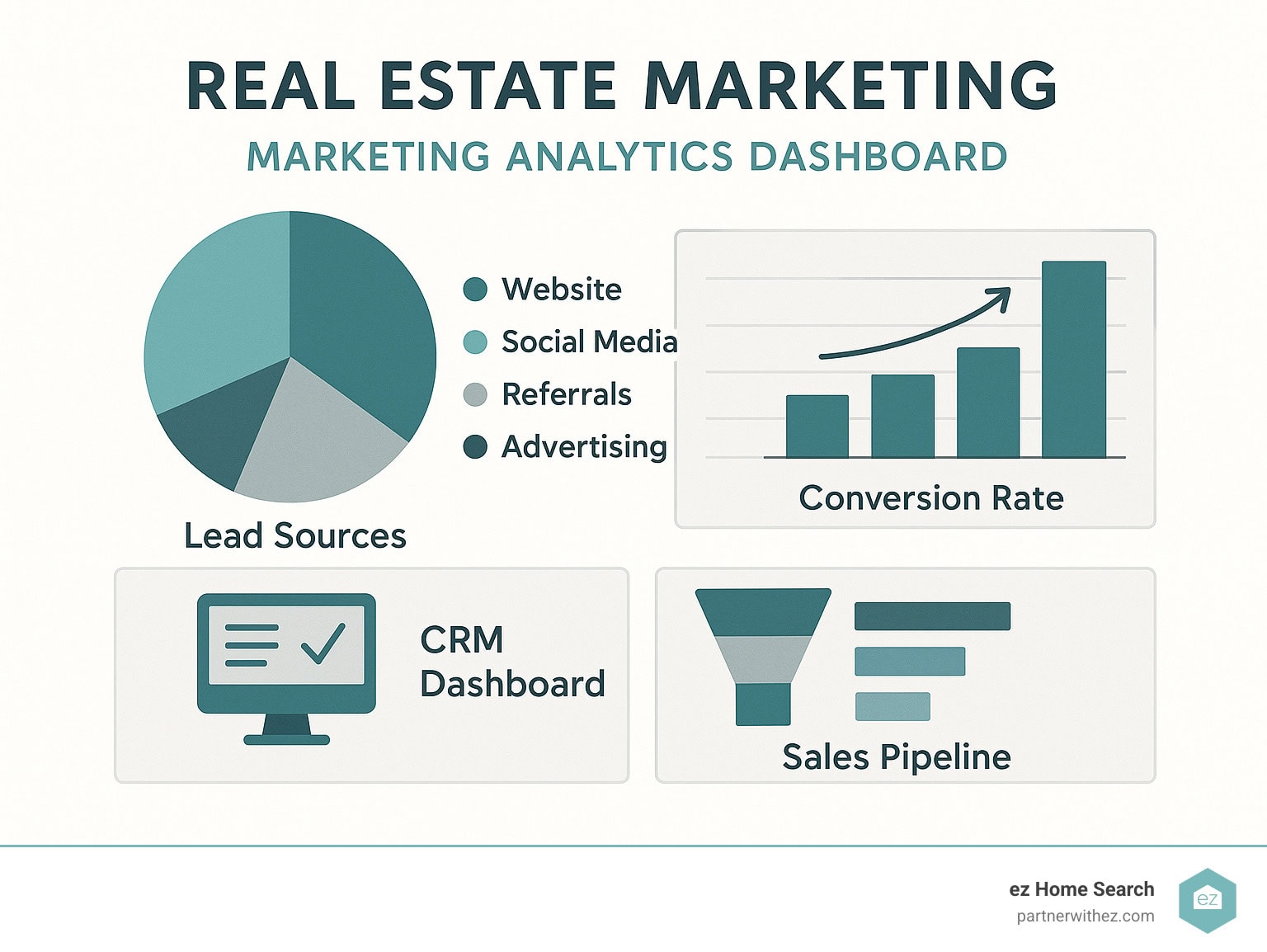
The most successful agents don’t rely on a single lead source but build diversified systems that deliver prospects at various stages of the buying journey. This balanced approach provides both immediate opportunities and long-term stability.

What truly sets top-performing agents apart is their commitment to exclusivity and privacy-first practices. By securing protected territories and respecting consumer data, they build trust while eliminating the competition that plagues traditional lead generation models.

At ez Home Search, we’ve helped thousands of agents transform their businesses through our county-based exclusivity model, which delivers intent-driven buyers to a single local expert rather than selling the same lead to multiple competing agents. Our integrated ecosystem combines high-conversion IDX tools, behavioral tracking, CRM-integrated nurture flows, and TCPA-compliant verification – all under one privacy-first platform.

Whether you’re just starting your real estate career or looking to scale an established team, implementing these seven steps will help you build a more predictable, profitable, and sustainable business based on quality buyer leads for real estate agents.

Ready to secure exclusive buyer leads in your market? with ez Home Search and find how our county-based exclusivity model can transform your lead generation strategy.

06.19.2025

9 Brilliant and Uniquely Ways to Market Real Estate

Looking for unique real estate marketing ideas that actually work? Here are 9 proven strategies that top-producing agents are using today:

  1. Personalized Video Testimonials – Capture authentic client stories that convert 34% better than text reviews
  2. AI Virtual Staging – Use AI tools to instantly transform empty rooms during showings
  3. Community Micro-Events – Host neighborhood-specific gatherings that position you as the local expert
  4. Viral-Ready Memes & Reels – Create shareable content using trending audio and real estate humor
  5. QR-Improved Direct Mail – Bridge offline with online using trackable QR codes on physical mailers
  6. Drone Photography Packages – Showcase properties with aerial views that are 68% more likely to sell
  7. Google Address Sign Riders – Direct drive-by prospects to optimized online property profiles
  8. Interactive Buyer/Seller Presentations – Replace static PDFs with engagement-tracking interactive content
  9. Strategic Local Business Partnerships – Create referral networks with complementary service providers

In today’s attention economy, standing out with unique real estate marketing ideas isn’t just nice—it’s necessary. The real estate landscape has transformed dramatically, with more agents competing for the same eyeballs across increasingly crowded digital channels. What worked even a year ago may already be losing effectiveness.

The key to breaking through in 2025 is implementing strategies that combine cutting-edge technology with authentic human connection. While 51% of millennials prefer agents with strong social media presence, the most successful professionals are those who leverage both innovative digital tools and high-touch personal experiences.

I’m Preston Guyton, founder of ez Home Search with over 20 years of experience developing unique real estate marketing ideas that convert browsers into buyers and generate exclusive listings in competitive markets. Throughout this article, I’ll share battle-tested strategies that have helped our partner agents achieve county-level exclusivity and higher conversion rates.

Comprehensive infographic showing 9 unique real estate marketing ideas including AI virtual staging, video testimonials, drone photography, QR-improved mailers, community events, viral social content, Google sign riders, interactive presentations, and local partnerships with their implementation steps and expected results - unique real estate marketing ideas infographic  - unique real estate marketing ideas infographic

Why “Different” Wins Today

Picture this: Your potential client scrolling through social media, bombarded by an endless stream of “Just Listed” posts that all blend together in a blur of sameness. In today’s attention economy, the average person faces over 10,000 marketing messages daily. With 73% of REALTORS® now maintaining websites and expanding across multiple social platforms, real estate feeds have become more saturated than Times Square on New Year’s Eve.

This is exactly why being different isn’t just a nice strategy—it’s your survival toolkit.

The most successful agents we’ve partnered with across North America have one thing in common: they’ve abandoned the “me too” marketing approach. They’re not just another face on a bench ad or another voice shouting into the void of crowded feeds. Instead, they’ve acceptd unique real estate marketing ideas that create genuine connections and memorable experiences.

What’s fascinating is that standing out doesn’t necessarily require the biggest budget. Our data shows that agents who implement creative, differentiated strategies consistently outperform their bigger-spending competitors who stick to conventional methods. It’s not about outspending—it’s about outsmarting.

Think about it: when everyone zigs, the agents who zag capture attention. When your competitors are all posting the same staged living room photos, what happens when you share the story of how your seller rescued that house from foreclosure and transformed it into their dream home? Which approach do you think potential clients will remember?

The attention economy rewards the different, the authentic, and the brave. As feeds become more saturated, your willingness to try approaches your competitors haven’t yet finded becomes your competitive edge. The question isn’t whether you can afford to be different—it’s whether you can afford not to be.

Craft Magnetic Stories & Personal Brands

The most powerful marketing doesn’t feel like marketing at all. It feels like a story—one where your potential clients can see themselves as the hero, with you as their trusted guide. In 2025, consumers aren’t just buying a home; they’re buying into the agent’s personal brand and the experience they provide.

Creating a magnetic personal brand starts with identifying your core values and crafting an elevator pitch that communicates not just what you do, but why you do it. Our data shows that agents who clearly articulate their “why” connect more deeply with prospects and see conversion rates increase by up to 27%.

Turn Clients into the Heroes of Your Story

One of the most effective unique real estate marketing ideas we’ve implemented with our partners is the strategic use of video testimonials. Unlike written reviews, video testimonials create immediate social proof and emotional connection. They’re also 34% more effective at converting prospects, according to TrustPulse.

The key is making your clients the heroes of these stories—not yourself. When collecting testimonials:

  1. Ask specific questions about challenges they faced before working with you
  2. Have them describe the turning point in their journey
  3. Let them explain how their life improved after the transaction
  4. Keep videos under 60 seconds with a clear verbal call-to-action

Our ezVerify.ai tool helps partners automate the testimonial collection process while ensuring TCPA compliance, but even a simple text message with specific questions can yield powerful results.

Repurpose One Story Across Five Channels

Content creation doesn’t have to be overwhelming. One of the most efficient unique real estate marketing ideas is to create a single powerful client story and repurpose it across multiple channels:

  1. Blog post: Expand the testimonial into a detailed case study
  2. Podcast snippet: Record a 5-minute interview about their experience
  3. Instagram Reel: Create a 30-second highlight with captions
  4. Email drip: Break the story into a 3-part sequence
  5. SlideShare: Transform the journey into a visual presentation

This approach maximizes your return on the time invested while reaching different audience segments where they prefer to consume content.

Infographic listing nine unique real estate marketing ideas for local events, including workshops, tours, fundraisers, cleanups, and block parties—each highlighted with its own icon to inspire agents.

Unique Real Estate Marketing Ideas Powered by AI

The AI revolution isn’t just coming to real estate marketing—it’s already changing how top agents connect with clients. I’ve seen how these tools help our partners create jaw-dropping content and personalized experiences without hiring a tech team. Recent research from McKinsey shows real estate companies are boosting their net income by 10% with smart AI applications. According to McKinsey’s research on generative AI in real estate, companies that adopt these technologies early gain significant competitive advantages.

Virtual Staging That Loads Before the Coffee Brews

Remember when staging a home meant hiring furniture, accessories, and a professional stager? Those days are quickly becoming history. Today’s AI virtual staging tools transform empty spaces into gorgeously furnished rooms in seconds—not just in your listing photos, but live during showings.

Our partners are seeing amazing results using tablets to walk buyers through different design possibilities as they tour properties. Imagine showing a young couple three different nursery designs for that spare bedroom, or helping empty-nesters visualize a home office in the same space.

This approach works wonders for those tricky properties with unusual layouts where buyers struggle to place furniture mentally. It’s also perfect for showcasing renovation potential in fixer-uppers—letting buyers see the “after” before they’ve even made an offer.

The financial advantage is substantial too. Traditional staging typically costs thousands per month for a moderate home, while AI staging tools often run less than $100 monthly for unlimited renderings. That’s money your sellers can put toward repairs or closing costs instead.

Harness Unique Real Estate Marketing Ideas with Chatbots

“Sorry I missed your call about 123 Main Street! I’ll get back to you tomorrow.” That delayed response could cost you the listing. That’s why unique real estate marketing ideas now include strategic chatbot implementation—with text messages boasting an incredible 82% open rate.

Our partners integrate tools like ManyChat with our ezNurture system to create 24/7 response teams that never sleep, never take vacations, and never miss an opportunity. These smart assistants instantly respond to property inquiries, qualify leads based on timeframe and budget, book showings through calendar integration, deliver neighborhood guides, and maintain consistent follow-up—all without manual effort.

The magic happens when these interactions feel genuinely helpful rather than robotic. Modern chatbots create conversational flows that adapt to user responses, making the experience feel more like texting a helpful friend than interacting with a computer.

Turn Events into Lead-Generating Experiences

While digital marketing dominates the conversation, we’ve found that in-person events remain one of the most effective unique real estate marketing ideas for building relationships and generating high-quality leads.

The difference is that successful events are highly targeted, experiential, and designed to create shareable moments that extend their impact beyond those who attend.

Pop-by Gifts That Trigger Referrals

The concept of “pop-by” gifts isn’t new, but the strategic approach our top-performing partners take makes this traditional tactic fresh and effective. Rather than generic items with your logo, consider:

  1. Seasonal gifts tied to home maintenance (spring cleaning kits, fall weatherproofing supplies)
  2. Locally sourced items from neighborhood businesses (reinforcing your community expertise)
  3. Personalized items based on client interests or hobbies
  4. Unexpected deliveries (not just during holidays when everyone else is giving gifts)

The key is creating a moment of genuine delight that prompts recipients to share on social media or mention you to friends—turning a single touchpoint into multiple referral opportunities.

Host Micro-Events with Local Partners

Large open houses and generic seminars have given way to more intimate, targeted micro-events that create deeper connections. Some of the most successful formats our partners have implemented include:

  1. First-time homebuyer workshops co-hosted with mortgage lenders
  2. DIY home improvement demonstrations with local contractors
  3. Neighborhood walking tours highlighting local businesses and amenities
  4. Real estate trivia nights at local venues (with property-related categories)
  5. Historic home walks showcasing architectural features and neighborhood history

These events position you as a community expert while creating natural opportunities for attendees to experience your knowledge and approach firsthand.

Go Viral: Memes, Reels, and Influencer Collabs

Social media isn’t just important for real estate marketing—it’s become the lifeblood of lead generation for top performers. Our data shows that 54% of agents now credit social platforms for delivering their highest-quality prospects. But here’s the thing: simply having profiles isn’t enough anymore. The agents who truly stand out are those who understand how to create content that people actually want to share.

Social media content flywheel showing how to create, distribute, and measure real estate content across platforms for maximum reach and engagement - unique real estate marketing ideas infographic  - unique real estate marketing ideas infographic

30-Second Reels That Answer Burning Questions

Short-form video has completely transformed how people consume content. Whether it’s Instagram Reels, TikTok, or YouTube Shorts, these quick-hit videos deliver exactly what today’s busy consumers want—valuable information in bite-sized chunks.

I’ve watched our most successful partners absolutely crush it with 30-second videos that tackle specific questions buyers and sellers are already Googling. Questions like “What’s happening with interest rates this month?” or “Is spring really the best time to sell?” perform incredibly well because they address real concerns while showcasing your expertise.

The magic happens when you combine genuinely helpful information with your authentic personality. One of our partners in Colorado saw her engagement triple after she started filming quick afternoon live sessions answering questions from her morning showings.

Unique Real Estate Marketing Ideas That Make People Laugh

Let’s be honest—real estate can be stressful for consumers. That’s exactly why humor cuts through the noise so effectively. When you can make someone smile during their home search or selling journey, you become instantly more approachable and memorable.

Some of the most shareable content our partners create includes lighthearted memes about the home buying process or the funny realities of showing homes. One partner in Florida created a series called “Pets Who Crashed My Showings” featuring homeowners’ animals photobombing listing photos—it became her most shared content ever and led to multiple referrals from people who never even met her.

The key to humor that works is making it relevant to your specific market. Inside jokes about local traffic patterns, weather quirks that affect home showings, or neighborhood-specific references create an instant connection with your community. As one of our partners puts it, “When someone tags their spouse saying ‘This is so us!’ on your reel, you know you’ve hit home.”

Micro-influencer collaborations have also proven incredibly effective. Working with local business owners, community figures, or even clients with substantial social followings can extend your reach to entirely new audiences.

Offline Innovations That Still Crush It Today

In a world obsessed with digital everything, you might be surprised to learn that certain offline marketing tactics aren’t just surviving—they’re thriving. The secret? A thoughtful blend of traditional approaches with modern twists that create memorable experiences your competitors simply can’t match.

Hybrid Mailers with Embedded QR Codes

There’s something special about holding a physical piece of mail that cuts through the digital noise we all experience. Your prospects’ email inboxes might be overflowing, but their physical mailboxes? Not so much.

Direct mail campaigns have made a remarkable comeback, especially when they serve as bridges between offline and online worlds. Our partners have finded that unique real estate marketing ideas like QR-improved postcards create tangible touchpoints that digital-only strategies simply can’t replicate.

“I was skeptical about investing in direct mail again,” shares Maria, an ez Home Search partner in Colorado. “But our QR-improved neighborhood market reports have generated more qualified leads than our Facebook ads—at about half the cost per acquisition.”

The beauty of these hybrid campaigns lies in their trackability. Every scan tells you which messages resonate and which neighborhoods yield the highest response rates. Our partners have found particular success with postcards featuring QR codes that open virtual property tours and “Just Listed” mailers with codes connecting directly to scheduling systems.

Drone Footage That Sells the Lifestyle

Remember when drone photography was a luxury marketing extra? Those days are long gone. Today, properties with aerial imagery are 68% more likely to sell than those without—making drone footage one of the most effective unique real estate marketing ideas in your toolkit.

The most successful agents use drone content to tell a complete story about not just the property, but the lifestyle it offers. Imagine showing prospects how close the community pool is, or revealing that the home is just a two-minute walk from the neighborhood park—details that might get lost in written descriptions but become immediately apparent from above.

Beyond capturing just the property itself, savvy agents are using drones to showcase the surrounding neighborhood and amenities, highlight proximity to schools and shopping, demonstrate commute routes, and capture seasonal beauty like fall foliage or spring blooms.

Measure, Optimize, Repeat

Let’s be honest—even the most creative unique real estate marketing ideas fall flat if you can’t tell what’s working and what’s not. The real magic happens when you track your efforts and let the data guide your next move.

In 2025, the agents who dominate their markets aren’t just marketing differently—they’re measuring differently too. They’ve moved beyond vanity metrics like followers and likes to focus on what actually drives business growth: qualified leads, appointments, and closed deals.

From Data to Decisions in Four Steps

I’ve watched our most successful partners transform their businesses by following a straightforward process that turns raw data into actionable insights:

First, they set clear goals before launching any campaign. Instead of vague objectives like “get more business,” they define specific targets: “generate 15 seller leads from the Oakwood neighborhood” or “book 8 buyer consultations this month.” This clarity makes it easier to judge success later.

Next, they track comprehensively across both digital and physical touchpoints. This might mean assigning unique QR codes to different mailers, using dedicated call tracking numbers for various campaigns, or setting up proper UTM parameters for online ads. The goal is creating a complete picture of the customer journey.

Then comes the fun part—they analyze patterns in the data. This isn’t just about counting leads but understanding which messages resonate with which audiences. Maybe your first-time buyer content performs best on Instagram while your investment property advice shines on LinkedIn. These insights help you speak the right language in the right places.

Finally, they iterate quickly, treating marketing as an ongoing experiment rather than a set-and-forget activity. When something works, they amplify it. When something doesn’t, they adjust or abandon it without emotional attachment. This willingness to evolve keeps them ahead of competitors who stick with outdated tactics.

Budget Smarter, Spend Less

One of the most powerful unique real estate marketing ideas isn’t about spending more—it’s about spending smarter. Our partners have finded that strategic optimization often outperforms simply increasing budgets.

AI-powered ad platforms have been game-changers in this regard. Partners using Meta’s Advantage+ campaigns have watched their cost-per-lead drop by up to 19% while actually improving lead quality. The system continuously optimizes delivery to the people most likely to respond, eliminating wasted impressions.

Retargeting previous website visitors has proven particularly effective, with conversion rates 70% higher than cold traffic campaigns. These warm leads already know your brand, making them more receptive to follow-up messaging.

Frequently Asked Questions about Unique Real Estate Marketing Ideas

What’s the Fastest Way to Stand Out in a Crowded Market?

If you’re looking to make an immediate impact, focus on the powerful combination of storytelling and consistency. I’ve found that agents who quickly rise above the competition aren’t trying to be everywhere at once—they’re becoming known for doing a few things exceptionally well.

Choose 2-3 marketing approaches that align with your strengths. Maybe you have a natural talent for creating educational Reels that simplify complex market trends. Perhaps your drone photography captures properties in ways that make listings instantly recognizable as yours. Or you might excel at hosting those neighborhood micro-events we discussed earlier.

The magic happens when you execute these chosen strategies consistently and with excellence. Your market will begin to associate you with that specific approach, making your marketing instantly recognizable in a sea of sameness. It’s better to be known for something specific than to blend in everywhere.

How Can I Measure ROI on Experiential Events?

This is one of my favorite questions because it shows you’re thinking like a business owner, not just a marketer! Measuring the return on experiential marketing requires looking beyond immediate transactions.

The most successful agents in our network track both short-term conversions and long-term relationship value. Start by creating unique tracking for each event—dedicated QR codes or landing pages work beautifully for this. Make sure every attendee is properly tagged in your CRM with detailed source notes.

What makes experiential marketing tricky to measure is the delayed return. Our partners typically see results 6-12 months after hosting events, as relationships develop and referrals begin flowing. That’s why calculating the lifetime value of clients acquired through events is so important—that $500 wine tasting might seem expensive until you realize it generated three transactions over 18 months.

Don’t forget to factor in the brand-building value beyond direct transactions. Being seen as the neighborhood expert creates compound returns that traditional ROI calculations often miss.

Do AI Tools Replace or Improve an Agent’s Expertise?

Let me put this concern to rest: unique real estate marketing ideas powered by AI are designed to improve your expertise, not replace it. The most successful implementation comes when you let technology handle what it does best, freeing you to focus on what only humans can do well.

Think of AI as your personal assistant that never sleeps. It can qualify leads while you’re showing properties, schedule follow-ups while you’re negotiating offers, and create content drafts while you’re building relationships face-to-face. This hybrid approach allows you to serve more clients with greater personalization—not less.

What we’ve consistently seen with our partners is that clients still crave human connection and expert judgment. They want technology to make the process smoother, but they want you to guide them through emotional decisions and complex negotiations. The agents who thrive in 2025 aren’t fighting against AI—they’re leveraging it to amplify their natural strengths.

The real estate professionals who accept these tools often report feeling more fulfilled in their work because they can spend more time on the relationship aspects they enjoy while automation handles the repetitive tasks that used to consume their days.

06.19.2025

A Practical Guide to Real Estate Marketing Services Providers

Comprehensive infographic showing the modern real estate marketing funnel with exclusive lead generation at the top, multi-channel nurturing in the middle, and conversion optimization at the bottom, featuring key metrics and ROI indicators for different real estate marketing services - real estate marketing services infographic

The Ultimate Guide to Real Estate Marketing Services

Real estate marketing services are professional solutions that help agents, brokers, and developers promote properties, build their brand, and generate qualified leads through multiple channels including digital, print, and in-person strategies.

Here’s what you need to know about real estate marketing services:

  • Digital Marketing: Website design, IDX integration, SEO, social media management, email campaigns, PPC advertising
  • Print Marketing: Direct mail, postcards, brochures, property magazines, neighborhood farming
  • Lead Generation: Exclusive buyer/seller leads, AI-powered qualification, CRM integration
  • Brand Development: Logo design, messaging, photography, video production
  • Marketing Automation: Drip campaigns, nurture sequences, AI follow-up

Real estate professionals today face unique marketing challengesfrom standing out in competitive markets to qualifying leads efficiently while maintaining privacy compliance. The right marketing services partner can transform your business by delivering exclusive, high-intent leads rather than sharing the same prospects with multiple agents.

As the real estate landscape evolves, marketing services have become essential tools for agents who want to build sustainable businesses. The most effective providers offer territory exclusivity, sophisticated lead qualification, and seamless integration with existing systemseliminating wasted ad spend and reducing competition for the same consumers.

I’m Preston Guyton, founder of ez Home Search with over 20 years of experience helping real estate professionals implement effective real estate marketing services that generate exclusive leads and maximize conversion through proven systems and strategies.

Detailed breakdown of real estate marketing ROI across different channels, showing cost per lead, conversion rates, and time-to-close metrics for digital, print, and hybrid marketing approaches - real estate marketing services infographic  - real estate marketing services infographic

What Are Real Estate Marketing Services & Why They Matter

Let’s face it – the real estate world has changed dramatically. Gone are the days when a simple yard sign and newspaper ad would bring in a steady stream of clients. Today, success requires a more sophisticated approach. But what exactly are these marketing services everyone’s talking about, and why should you care?

Defining Real Estate Marketing Services

Real estate marketing services are the complete toolkit that helps you showcase properties, build your personal brand, and connect with qualified buyers and sellers. Think of them as your business growth engine – working across multiple channels to keep your pipeline full.

These services aren’t one-size-fits-all. They’re custom approaches that work together to create a cohesive marketing strategy. Whether you’re reaching out through social media, your website, email campaigns, or traditional mailers, effective marketing services ensure your message reaches the right people at the right time.

The best real estate marketing services create meaningful connections with different audiences. They help you speak directly to buyers searching for their dream home, sellers looking for the right agent, and even developers and investors with specialized property needs. Each group requires a unique approach, and professional marketing services help you communicate effectively with all of them.

As one experienced agent put it, “Real estate marketing isn’t just about posting a few property listings and hoping for the best—it requires a multifaceted strategy with tools for branding, lead generation, social media, and content creation.”

Why They’re Critical for Agents, Brokers & Developers

Why invest in professional real estate marketing services instead of doing it yourself? The answer comes down to the rapidly changing market conditions we’re all facing:

Today’s real estate landscape is more competitive than ever. With more agents entering the field every day, standing out requires more than just enthusiasm – it demands a sophisticated, consistent marketing approach that builds recognition and trust.

When inventory shifts (as it often does), having established marketing channels becomes crucial. During low inventory periods, your ability to generate seller leads can make or break your business. Strong marketing systems help you weather these changes.

Pipeline stability is another major benefit. Rather than riding the feast-or-famine rollercoaster, consistent marketing creates predictable lead flow and allows for better business planning. This stability is priceless when building a sustainable real estate practice.

Perhaps most importantly, consumer expectations have evolved dramatically. Today’s clients expect polished, professional marketing materials and seamless digital experiences. Meeting these expectations isn’t optional – it’s essential for credibility.

Recent research confirms what many of us already know: buyers across all age groups now begin their search process online. Without a robust digital presence, you’re essentially invisible to a huge portion of potential clients.

As one top-producing agent shared: “I would attribute 75-80% of my business directly to my marketing program.” This isn’t unusual – the most successful real estate professionals consistently invest in comprehensive marketing rather than piecing together random solutions when business slows down.

In uncertain economic times, strategic marketing becomes even more valuable. It’s not just about spending money on ads – it’s about creating systems that consistently bring in qualified leads, build your reputation, and help you stand out in a crowded marketplace.

Core Types of Real Estate Marketing Services

The world of real estate marketing services is rich and diverse, offering solutions custom to different needs and goals. Understanding these core types will help you build a cohesive strategy rather than a patchwork of disconnected efforts.

Digital Real Estate Marketing Services: Websites, SEO, Social Media

Digital marketing has become the foundation of modern real estate promotion, and for good reason. It’s where most buyers begin their journey.

Your website is your digital storefront, and IDX-enabled sites allow you to showcase MLS listings directly to visitors, and provide them a place to search that is not Zillow. These professional platforms capture leads through smart forms, display beautifully on mobile devices, integrate virtual tours, and provide valuable neighborhood information all in one place.

Search Engine Optimization helps you become visible when local buyers and sellers search online. Good real estate SEO isn’t just about keywords—it’s about appearing in Google’s local 3-Pack, creating content that speaks to your specific market, building your online reputation, and making sure you’re listed in the directories that matter.

Social media marketing has evolved far beyond simple posting. Today’s effective strategies include custom content for each platform, engaging video content (which continues to dominate engagement), targeted paid campaigns, and authentic community interaction. As one marketing professional noted: “Video content that highlights lifestyle and actual owner testimonials can effectively engage potential buyers.”

Email remains incredibly powerful when done right. Modern real estate marketing services offer sophisticated email campaigns that segment your audience, track performance, integrate with your CRM, and deliver personalized content based on behavior. This integration creates a seamless experience as leads move through your pipeline.

Print & Direct Mail Services

Despite our digital world, print marketing continues to deliver impressive results for real estate professionals. In fact, tangible materials often stand out precisely because they’re less common.

Postcards and direct mail campaigns announcing your latest listing or sale help establish your presence in a neighborhood. Market update reports position you as a local expert. Seasonal touchpoints keep you top-of-mind. One agent shared: “I acquired my first listing directly from a postcard campaign.”

The most effective approach combines physical and digital channels—one provider reported exceptional results “combining direct mail and always-on Facebook/SMS ad campaigns.”

Market reports and newsletters deliver value while showcasing your expertise. Property marketing materials like luxury brochures and feature sheets still matter, especially for high-end properties and open houses.

Some innovative providers are now “merging MLS and tax roll data to produce hyper-local homeowner leads” through highly targeted direct mail, showing how traditional methods can be improved with modern data approaches.

Branding & Advisory Services

Beyond tactical marketing, comprehensive real estate marketing services include strategic brand development that sets you apart from the competition.

Your visual identity—including your logo, consistent design elements, professional photography, and video production—creates an immediate impression. But effective branding goes deeper, developing your unique messaging, clarifying your value proposition, defining your ideal clients, and establishing how you differ from competitors.

For those working with investors or developments, specialized services help you create compelling investor presentations, position new development concepts effectively, market pre-construction opportunities, and showcase property amenities in their best light.

As one marketing expert explained: “Effective luxury real estate marketing combines concept, brand development, targeted activations and data-driven sales management.” This holistic approach is particularly valuable in competitive or high-end markets.

The right mix of these core services creates a marketing ecosystem where each element reinforces the others, creating a consistent experience for potential clients no matter where they encounter your brand.

How to Choose the Right Real Estate Marketing Service Provider

Finding the perfect real estate marketing services partner isn’t just about checking boxes—it’s about finding someone who understands your vision and can help bring it to life. This decision will significantly impact how potential clients perceive your brand and, ultimately, your business growth.
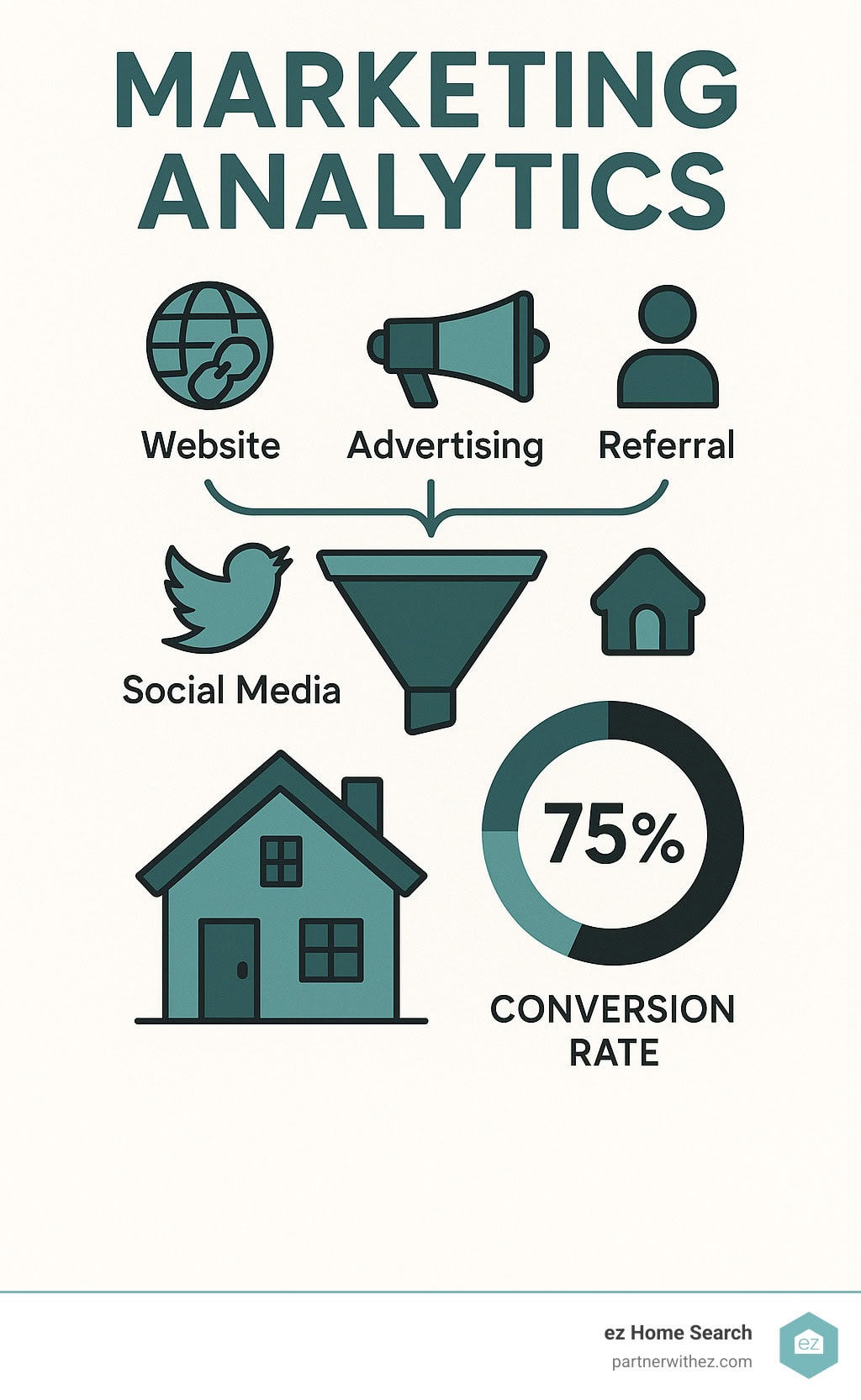
Full-Service vs Specialized Real Estate Marketing Services

When you’re exploring your options, you’ll likely encounter two main types of marketing partners:

Full-Service Agencies feel like having your own marketing department without the overhead. They handle everything from your website to your postcards, ensuring your brand looks consistent across all touchpoints. While they typically require a higher investment, many agents find the comprehensive support and single point of contact well worth it.

Specialized Providers are the experts who live and breathe one particular marketing channel. They might be wizards at social media or direct mail champions, offering deeper expertise in their specific niche. They often come with more competitive pricing for their specialty, but you’ll need to coordinate between multiple vendors.

The right choice really depends on your specific situation. As one marketing expert put it: “Matching marketing providers to an agent’s specific channel need (social, video, print, etc.) yields better ROI than one-size-fits-all platforms.”

Before making your decision, consider your team’s current marketing capabilities, your budget constraints, how everything will technically integrate, and whether you prefer dealing with one partner or many. Many successful teams working with ez Home Search appreciate our comprehensive approach that eliminates the headache of juggling multiple vendors while still delivering specialized expertise across all channels.

Key Metrics & Pricing Models

Understanding how real estate marketing services are priced and measured will help you evaluate what you’re really getting for your investment.

Most providers use one of these pricing approaches: monthly subscriptions that provide ongoing service, pay-per-lead models where you only pay for results, project-based fees for one-time work, or hybrid models that combine a base fee with performance incentives.

When evaluating the value you’re getting, focus on these critical metrics:

Cost Per Lead (CPL) tells you what you’re paying to get each potential client in the door. Cost Per Acquisition (CPA) looks at how much marketing spend it takes to close an actual transaction. Your Lead-to-Client Conversion Rate shows how efficiently you turn prospects into clients, while overall Marketing ROI measures the revenue generated compared to your marketing investment. Tracking Channel Performance helps you understand which marketing efforts are working hardest for you.

Before signing with any provider, have an honest conversation about reporting frequency, how their data will integrate with your existing systems, how they attribute results across different channels, and what performance benchmarks you should expect.

As one industry veteran advised: “Before choosing a marketing company, define your goals, evaluate options, and start with a monthly subscription to test the service’s effectiveness.”

According to research on marketing budgets, most successful real estate professionals invest between 10-15% of their gross revenue back into marketing activities to sustain growth.

At ez Home Search, we believe in complete transparency in our reporting, showing you exactly how our exclusive lead model delivers higher conversion rates compared to traditional services that sell the same prospects to multiple agents. After all, you can’t improve what you can’t measure.

Emerging Trends & Innovations Changing Real Estate Marketing

The world of real estate marketing services is in constant evolution, with exciting new technologies and approaches reshaping how properties are marketed and buyers are found. Let’s explore the game-changers that are changing the industry.

AI-Driven Real Estate Marketing Services

Artificial intelligence isn’t just a buzzword anymore—it’s revolutionizing how real estate professionals connect with clients in meaningful ways:

Predictive Analytics has become the crystal ball of real estate marketing. These smart systems can identify likely sellers before they even think about listing, target buyers who are perfect matches for specific properties, and help you spend your ad dollars where they’ll actually work. One agent told us, “It’s like having a marketing assistant who knows exactly which doors to knock on.”

Conversational AI is changing the lead game completely. Today’s sophisticated chatbots qualify leads 24/7, never sleeping and never missing an opportunity. Voice AI systems can follow up with calls that sound remarkably human, while natural language processing creates personalized responses that make prospects feel understood. For agents serving diverse communities, multilingual capabilities open doors to new markets.

Dynamic Remarketing brings “dead” leads back to life. Rather than letting potential clients slip away, AI systems track behavioral triggers and automatically re-engage prospects with personalized content exactly when they’re most receptive. As one successful broker put it, “The most important asset we have is time. AI allows us to focus on talking to the right people.”

The results speak for themselves. Some AI platforms report reviving 25% of inactive leads into active opportunities through 35+ automated text/call attempts within 90 days. For growing teams, these tools offer scalability without having to hire more staff.

Privacy-First & Exclusive Lead Models

As consumers become more protective of their data and agents tire of competing for the same leads, innovative real estate marketing services are pioneering new approaches:

County-Based Exclusivity is perhaps the most significant shift in lead generation philosophy. Rather than selling the same prospect to multiple agents who then compete against each other, forward-thinking platforms like ez Home Search match consumers with just one agent per geographic area, and we promote that agent (or team) in all of our marketing to local customers. This approach builds stronger consumer trust, eliminates wasteful competition, and dramatically improves conversion rates.

TCPA Compliance & Data Protection have moved from legal requirements to marketing advantages. Smart agencies now highlight their privacy practices as selling points, implementing verification systems for consumer consent and maintaining secure data handling. In an era of increasing privacy concerns, transparency builds trust.

Data Enrichment & Lead Qualification takes basic contact information and transforms it into actionable intelligence. Modern systems add layers of consumer insights, pre-qualify prospects based on subtle intent signals, and provide scores that help you prioritize your follow-up efforts. As one agent noted, “I’m not just getting names anymore—I’m getting stories I can use to make meaningful connections.”

At ez Home Search, the county-based exclusivity model represents what we believe is the future of real estate lead generation. Our approach protects consumer privacy while delivering significantly higher conversion rates for our partners. Industry experts are noticing this shift, with one marketing professional observing that “exclusive buyer leads are delivered to only one agent per area, while seller leads are capped at five agents to limit competition.”

This evolution toward privacy-first, exclusive lead models isn’t just better for agents—it creates a more respectful, efficient experience for consumers too.

Detailed breakdown of real estate marketing ROI across different channels, showing cost per lead, conversion rates, and time-to-close metrics for digital, print, and hybrid marketing approaches - real estate marketing services infographic  - real estate marketing services infographic

Frequently Asked Questions about Real Estate Marketing Services

How much should I budget for real estate marketing services annually?

Money questions are always tricky, aren’t they? The truth is, your ideal marketing budget depends on where you are in your real estate journey and what you’re trying to accomplish.

Industry wisdom suggests some general guidelines:

For those just starting out, allocating 15-20% of your expected commission income makes sense to build initial momentum. If you’ve been in the business a while, established agents typically invest 10-15% of gross commission income to maintain and grow their presence. Larger teams and brokerages can often scale more efficiently, usually budgeting 5-10% of revenue.

But percentages only tell part of the story. What really matters is thinking strategically about:

Your specific growth targets – Are you looking to double your business or maintain current volume?

Your local competition – More competitive markets may require higher investment to stand out.

Your current lead sources – Where are the gaps in your business that marketing could fill?

Potential channel ROI – Different marketing approaches yield different returns.

I’ve seen this firsthand: agents who accept quality digital tools often outperform those who rely solely on experience. Smart marketing isn’t an expense—it’s an investment in your future business.

At ez Home Search, we take time to understand your specific situation before recommending where to allocate your marketing dollars, ensuring every investment drives meaningful growth.

What ROI can I expect from professional marketing support?

Ah, the million-dollar question! Return on investment varies widely, but I can share some patterns we’ve observed across the industry:

Digital marketing initiatives typically deliver 5-10x ROI when properly implemented and measured. This includes everything from your website to paid social campaigns.

Direct mail campaigns in targeted farm areas can generate 3-5x return when deployed consistently—patience is key here!

Exclusive lead generation models often produce 7-12x ROI because you’re not competing with other agents for the same prospects.

Branding and website investments are harder to measure directly but create the foundation that makes all your other marketing more effective.

One success story I love sharing: An agent who invested in a luxury website template with a modern IDX integration generated over $40 million in sales following their digital marketing partnership. Results like this aren’t uncommon when you have the right strategy.

The secret to maximizing your return? Proper tracking and attribution. You need to know which marketing dollars are working hardest for you. As one of our partners said, “Define key performance metrics like lead quality and conversion rate to truly evaluate what’s working.”

At ez Home Search, our partners typically see higher ROI compared to traditional marketing services because our exclusive lead model eliminates the wasteful competition for the same prospects, resulting in higher conversion rates and lower cost per acquisition.

Do luxury, residential & commercial properties require different strategies?

Absolutely! One-size-fits-all marketing is a recipe for mediocre results. Different property types demand custom approaches:

For luxury properties, it’s all about quality over quantity. This market requires stunning photography and videography that captures the lifestyle, not just the property. Your branding needs to be sophisticated and storytelling-focused. The nurture cycles are typically longer, requiring personalized attention to a smaller pool of qualified high-net-worth prospects.

With residential properties, you’re often playing a volume game. Neighborhood farming, geographic targeting, and educational content for first-time buyers become essential. Speed and responsiveness matter tremendously—these buyers expect quick answers and smooth processes.

Commercial properties live in a different world entirely. Here, data-driven market analysis and financial modeling take center stage. You’ll need industry-specific targeting strategies and patience for longer sales cycles involving multiple decision-makers. Your marketing materials should focus heavily on investment potential and financial performance.

I’ve seen this distinction play out countless times. Residential marketing thrives with “IDX-enabled websites paired with CRM-driven drip campaigns,” while luxury marketing demands “minimalist design” with “high-end focus.” Commercial property marketing often requires specialized services focused on investor relations and capital raising.

At ez Home Search, we customize our approach based on property type and price point, ensuring your marketing strategy aligns perfectly with what actually works in each unique segment.

Conclusion & Next Steps

As we’ve journeyed through real estate marketing services together, one thing becomes crystal clear—the landscape is evolving at lightning speed. The most successful real estate professionals aren’t just using random marketing tactics; they’re building cohesive systems that seamlessly generate leads, nurture relationships, and turn opportunities into closings.

Where is real estate marketing headed? The signposts are unmistakable:

The future belongs to marketing that feels personal rather than mass-produced. AI is changing lead qualification from a time-consuming chore into an automated science. Consumer privacy isn’t just a legal requirement—it’s becoming a competitive advantage. And the old model of selling the same leads to multiple agents? That’s rapidly being replaced by exclusive partnerships that respect both agents and consumers.

At ez Home Search, we’re not just watching these trends—we’re nurturing them over the entire home ownership journey. Our comprehensive ecosystem brings together everything you need to thrive in today’s competitive landscape.

Think of it as your complete marketing command center: high-converting landing pages that actually work, real-time consumer tracking that shows you exactly what your prospects care about, and automated nurture flows that keep your pipeline warm without requiring constant attention.

But our real difference-maker? County-based exclusivity.

Instead of selling the same leads to five different agents who then compete for business (often annoying potential clients in the process), we match consumers with a single local expert. This approach isn’t just better for agents—it creates a dramatically better experience for home buyers and sellers too.

Whether you’re leading a growing real estate team searching for predictable lead flow, a loan officer hoping for warm handoffs instead of cold calls, or a local vendor wanting targeted exposure, our platform delivers what matters most: quality connections with real people who need your services.

Our technology was built by leaders whose work powers some of the biggest names in tech—Apple, Microsoft, Meta, and eXp Realty. We’ve taken that expertise and focused it on one mission: redefining how real estate professionals grow their businesses through transparency, smart automation, and territorial protection.

Ready to transform your approach to real estate marketing? Learn more about partnership opportunities and find how our exclusive ecosystem can help you build sustainable, predictable growth—even in today’s increasingly competitive market.

The future of real estate marketing isn’t about more leads—it’s about better connections. And we’d love to show you how to make those connections happen.

06.19.2025

7 Practical Ways to Solve Your Real Estate Listings Problems for Good

The Key to Lasting Success in Real Estate

If you’re wondering how to get more real estate listings, here are seven proven strategies that still work in every market:

  1. Leverage your sphere of influence – Call 10 contacts monthly, host social events, send anniversary cards with home valuations
  2. Target motivated sellers – FSBOs after 2 months, expired or withdrawn listings, divorce/probate leads
  3. Implement geographic farming – Consistent neighborhood mailings every 4-6 weeks
  4. Use digital marketing – Home-valuation landing pages, Facebook ads (as little as $5/day)
  5. Host strategic open houses – Pre-listing “happy hours,” mega open houses as community events
  6. Send “golden letters” – Handwritten, personalized mailers (roughly 1 appointment per 100 letters)
  7. Provide unsolicited value – Market updates, video CMAs, equity reports

Listings aren’t just another transaction—they’re the foundation of a sustainable business. When you control the listings, you control your time, your income, and your market presence. The math is simple: about 10 % of homeowners in your database will sell each year, so a well-nurtured sphere of 400 people can yield roughly 20 listings annually. Each of those listings then becomes its own marketing engine—spinning off referrals, attracting new buyers, and cementing your authority.

At ez Home Search we’ve spent two decades helping agents turn that math into predictable, stress-free growth. Our exclusive territory model and privacy-first tech stack let you focus on winning listings instead of fighting for shared leads.

Comprehensive infographic showing the 7 ways to get more real estate listings, including sphere of influence strategies, targeting motivated sellers, geographic farming techniques, digital marketing approaches, strategic open houses, golden letter campaigns, and providing unsolicited value to homeowners - how to get more real estate listings infographic infographic-line-5-steps-colors

Why Listings Are the Lifeblood of a Real Estate Career

“List to Last” isn’t just a catchy phrase thrown around at real estate conferences—it’s the beating heart of a sustainable business that can weather any market storm. When you control the listings in your market, you control your destiny. I was talking with Travis McClure, our Chief Operating Officer at ez Home Search, last week and he put it perfectly: “If the majority of your business comes from buyers, you’re a real estate salesperson. If it comes from listings, you’re running a real business.”

But why exactly are listings so valuable? Let me break it down in real terms:

First, they create predictable income. With roughly 10% of homeowners in your database selling each year, you can actually forecast your business. Imagine knowing in January approximately how many commission checks you’ll receive by December!

Listings also deliver a higher ROI for your time investment. While buyers might need 10+ showings before making a decision, a well-priced listing often requires just a few hours of prep work and then sells itself.

Perhaps most importantly, listings give you market control. When you’re the listing agent, you’re at the center of the transaction—the gatekeeper other agents must work through.

Each listing becomes a passive lead generation machine, marketing you 24/7 through yard signs, online listings, and open houses while you sleep.

And don’t forget the referral engine effect. A satisfied seller becomes your walking billboard, often generating 2-3 additional opportunities from their friends and family.

Buyers vs. SellersBuyersSellers
Time investmentHighModerate
Lead predictabilityLowHigh
Marketing valueNoneSignificant
Referral potentialGoodExcellent
Control of processLimitedSubstantial
Transaction sides1Often 2

The Compounding Value of One Listing

When you understand that a single listing isn’t just one transaction but a domino that can tip over multiple opportunities, your entire approach to business changes.

That “For Sale” sign in the yard doesn’t just market the house—it markets YOU. Each listing provides marketing leverage with fresh content for your social media, neighborhood mailers, and community events. One listing can fill your content calendar for weeks!

You also establish neighborhood authority with every sign. Homeowners notice which agent seems to have all the listings on their street, and that perception of dominance is powerful when they’re ready to sell.

Listings naturally attract buyer leads too. Some of these buyers will also need to sell their current homes, potentially doubling your opportunity from a single marketing effort.

The referral opportunities from a well-handled listing can multiply for years. I’ve seen agents get calls three years after selling a home because the neighbors finally decided to downsize and remembered that impressive open house.

Your database growth accelerates with each listing as open houses, sign calls, and neighborhood interactions continually feed new contacts into your sphere.

Kurt Uhlir, our Chief Marketing Officer at ez Home Search, puts it this way: “The most successful agents understand that each listing is actually a marketing platform that generates multiple opportunities beyond the immediate transaction.”

When you’re focused on how to get more real estate listings, you’re not just chasing individual deals—you’re building a sustainable business machine that will support you through every market cycle.

Building & Leveraging Your Sphere of Influence

Your sphere of influence (SOI) remains the most cost-effective way to generate listings. These are people who already know, like, and trust you—making them far more likely to work with you or refer business your way.

Here’s how to systematically leverage your SOI for listings:

  1. Build a robust database: Track every contact in your CRM, including past clients, friends, family, and acquaintances.
  2. Call 10 contacts daily: Set aside time each month to check in with key contacts, not to sell but to nurture relationships.
  3. Send a monthly eNewsletter: Share market updates, local news, and a gentle reminder that you welcome referrals.
  4. Host regular social gatherings: Quarterly events bring your sphere together and reinforce your professional identity.
  5. Mail anniversary cards: Send personalized notes with current home valuations to past clients on their purchase anniversary.

“The key to SOI marketing isn’t constant selling—it’s consistent presence,” notes Nikki Pais, Director of Partner Success at ez Home Search. “Your sphere isn’t responsible for remembering you’re in real estate. You’re responsible for staying top of mind when they’re ready to make a move.”

How to Get More Real Estate Listings from a Young SOI

New agents often struggle with a limited sphere of influence. If that’s you, here’s how to build and leverage a young SOI:

  1. Join your local Chamber of Commerce: Attend regular meetings and volunteer for committees to meet local business owners.
  2. Leverage LinkedIn: With a 2.74% conversion rate (three times higher than Facebook or Twitter) and 77% of users over 30, LinkedIn is perfect for connecting with potential sellers.
  3. Host first-time homebuyer seminars: These events attract people who often need to sell before buying.
  4. Volunteer strategically: Choose organizations aligned with homeownership, like Habitat for Humanity or neighborhood associations.
  5. Work open houses for other agents: Use these opportunities to meet neighbors who might be considering selling.

Expanding Your SOI Beyond Friends & Family

To grow beyond your immediate circle:

  1. Join community groups: Participate in local organizations, sports leagues, or parent associations.
  2. Partner with complementary vendors: Build relationships with home inspectors, contractors, and interior designers who can refer business.
  3. Connect with divorce and probate attorneys: Over 31% of people going through a divorce will list their home within 6 months of filing.
  4. Network with financial advisors: They often know when clients are planning life changes that involve real estate.
  5. Become active in Business Networking International (BNI): These structured networking groups focus on referral exchange.

“The most successful agents don’t just wait for their database to produce—they actively cultivate relationships with professionals who regularly encounter motivated sellers,” says Travis Halverson.

How to Get More Real Estate Listings from High-Motivation Niches

When you need listings quickly, targeting motivated seller niches can produce faster results than general marketing. These sellers have clear reasons to sell and often face time pressure.

How to Get More Real Estate Listings with FSBO & Expireds

For Sale By Owner (FSBO) and expired listings represent immediate opportunities:

  1. FSBOs after 2+ months: These sellers have likely finded the challenges of selling without professional help. NAR reports the average FSBO home sold for $380,000 compared to $435,000 for agent-listed properties—a compelling statistic to share.

  2. Expired listings: Focus on properties that expired 2-5 years ago rather than recent expireds. You’ll face less competition, and owners may now be more realistic about pricing.

  3. Withdrawn listings: Many owners of withdrawn listings don’t realize market values have increased. A market update can reignite their interest in selling.

The key to success with these niches is offering value first, not immediately asking for the listing:

  • For FSBOs: “I noticed your home has been on the market for a while. I’ve put together some tips that might help you attract more buyers. Would you like me to email them to you?”

  • For expireds: “I’ve analyzed why your home might not have sold, and I’ve identified three specific marketing approaches that weren’t used. I’d be happy to share these insights with no obligation.”

How to Get More Real Estate Listings Using “Golden Letters”

“Golden letters” are one-page typed letters with handwritten addresses and signatures that invite homeowners to call you about selling. For every 100 golden letters mailed, you can typically expect one listing appointment.

What makes golden letters effective:

  1. Personalization: Hand-addressed envelopes achieve higher open rates.
  2. Specificity: Target homeowners in specific demographics (e.g., those who’ve owned 10+ years).
  3. Consistency: Most agents give up after one or two mailings. Success comes from persistence.
  4. Value proposition: Clearly explain what makes your service unique.

“The magic of golden letters isn’t just in the format—it’s in the follow-through and that no one else actually does these consistently,” explains Kurt Uhlir. “Most agents mail once and quit. The agents who send consistent mailings every 4-7 days stand out because they’re still there when the homeowner is finally ready to consider selling.”

Other high-motivation niches worth targeting:

  • Divorcees: 31% list their homes within six months of filing.
  • Inherited homes: Over 1 million people inherit homes annually.
  • Vacant properties: Often indicate motivated sellers who’ve already moved.
  • Tax-delinquent homeowners: 23% of homes sold annually have back taxes owed.

For more detailed statistics on FSBO sales and market trends, check out the National Association of Realtors Research.

Digital & Direct Marketing That Attracts Sellers

In today’s digital-first world, your online presence and marketing strategy are crucial for attracting listings. The right approach combines targeted digital campaigns with proven direct marketing tactics.

Digital marketing funnel for real estate listings showing traffic sources, landing pages, lead capture, nurture sequences, and conversion to appointments - how to get more real estate listings infographic infographic-line-5-steps-blues-accent_colors

Let’s face it—today’s sellers are doing their homework online long before they ever pick up the phone to call an agent. That’s why your digital presence needs to be both compelling and strategic. The good news? You don’t need a massive budget to make an impact.

Home valuation landing pages have become the bread and butter of listing attraction. These dedicated pages offer homeowners something they genuinely want—insight into their property’s worth—while giving you a warm introduction. The most effective pages include benefit-driven headlines that speak to seller concerns, multi-step forms (which counter-intuitively increase completion rates by breaking the process into digestible chunks), and plenty of social proof from past clients.

Social media advertising delivers remarkable ROI when done right. Facebook ads for as little as $5 per day can target potential sellers based on geography, demographics, and even life events like marriage or retirement. As Kurt Uhlir at ez Home Search often says, “The beauty of Facebook targeting is that you’re reaching people at exactly the moment they’re considering life changes that typically involve real estate. Meta knows much more about their buying intent and stage of life than many platforms, and that information aids targeting ads.”

Instagram Story polls offer a surprisingly effective way to identify potential sellers hiding in plain sight. Simple questions like “Thinking of selling in the next 12 months?” or “Have you thought about what is happening in ____ today will impact what you can sell your home for in the Fall?” can spark conversations with followers who might not have volunteered this information otherwise.

One of the most innovative approaches I’ve seen gain traction is video CMAs. Rather than waiting for valuation requests, proactive agents are creating quick, personalized video market analyses for homeowners in target neighborhoods. One partner agent using this strategy generated over $11 million in listings within just six months—all from people who hadn’t initially expressed interest in selling.

Retargeting technology has revolutionized how we stay visible to potential sellers. Tools like Adwerx ensure that once someone visits your website, they’ll continue seeing your branding as they browse major news sites and social platforms. This consistent visibility builds familiarity and trust before you ever meet.

While digital strategies dominate conversations, traditional direct marketing still delivers powerful results when executed consistently. Just Sold postcards showcasing properties that sold above asking price or with minimal days on market create FOMO (fear of missing out) among neighbors. Market update mailers that share neighborhood-specific data demonstrate your local expertise in a tangible way that digital sometimes can’t match.

Precision Farming for Long-Term Dominance

Geographic farming—consistently marketing to a specific neighborhood—remains one of the most reliable paths to listing dominance. The key is selecting the right farm area using data, not just personal preference.

Start by calculating the turnover rate using this simple formula: (Homes sold in past 12 months ÷ Total homes) × 100. Look for neighborhoods with at least a 5% turnover rate to ensure sufficient listing opportunities. Then check the absorption rate: (Homes sold in past 12 months ÷ Homes currently on market) × 100. Target areas with rates above 20%, indicating strong buyer demand.

Finally, analyze the competition. The ideal farm has no agent capturing more than 20% of the listings. As Travis McClure of ez Home Search notes, “The best farm isn’t always the most prestigious neighborhood—it’s the one where you can realistically become the dominant agent within 12-18 months.”

Once you’ve selected your farm, consistency becomes your competitive advantage. Mail every 4-6 weeks without fail, including hyperlocal statistics, recent sales, and valuable neighborhood information. Make each piece worth keeping rather than immediately recycling.

Tech Stack to Stay Top-of-Mind

The right technology doesn’t replace personal connection—it amplifies it. A robust CRM with automation ensures no potential seller falls through the cracks. Video email tools like BombBomb help you stand out in crowded inboxes with personalized messages that convey your personality and expertise.

Home valuation tools like Homebot deliver monthly updates to homeowners in your database, keeping you connected through valuable information rather than sales pitches. For more sophisticated nurturing, ez Home Search’s ezNurture tool integrates with your CRM to deliver personalized content based on prospect behavior—sending different messages to empty nesters versus growing families.

With privacy regulations tightening, TCPA-compliant verification tools like ezVerify.ai ensure your outreach remains legal while enriching your contact data. As Nikki Pais at ez Home Search emphasizes, “Technology should improve your human connection, not replace it. The most successful agents use tech to scale their personal touch, not substitute for it.”

The agents who master both digital and direct marketing create a powerful ecosystem where potential sellers encounter their expertise across multiple channels. This consistent presence builds the trust and familiarity that ultimately leads homeowners to think of you first when they’re ready to list their most valuable asset.

Converting Leads to Signed Listings

Generating leads is only half the battle—converting them into signed listings requires strategic follow-up and presentation skills.

Leveraging Current Listings to Generate New Ones

Each active listing presents multiple opportunities to secure additional listings:

  1. Pre-listing open house “happy hours”: Invite neighbors before the official listing to create buzz and identify potential sellers.

  2. Door-knocking surrounding homes: Personally invite neighbors to your open house and use the opportunity to gauge their interest in selling.

  3. Just Sold postcards: Mail 200-500 postcards to nearby homes highlighting successful sales statistics.

  4. Neighbor calls: After listing a home, call 10-20 neighbors to share the news and ask if they know anyone else considering selling.

  5. Sign riders with QR codes: Add riders to your yard signs that lead to neighborhood-specific valuation pages.

“Your current listings are your best marketing tool for getting future listings,” explains Kurt Uhlir. “Each listing should generate at least one additional listing opportunity if leveraged correctly.”

Building Instant Trust & Authority

New agents often struggle to build credibility with potential sellers. Here’s how to establish trust quickly:

  1. Create a compelling listing presentation: Include:

    • Market statistics and trends
    • Your marketing plan and differentiators
    • Testimonials from past clients
    • Clear pricing strategy with data
  2. Host educational events: Position yourself as an expert by hosting seminars on topics like:

    • Downsizing strategies
    • 1031 exchanges
    • Renovation ROI
    • Market trends
  3. Develop professional referral relationships: Partner with:

    • Divorce attorneys
    • Estate planners
    • Financial advisors
    • Builders and contractors
  4. Showcase your results: Create case studies of your successful listings, highlighting:

    • Days on market compared to area average
    • Sale price vs. list price
    • Marketing strategies used
    • Seller testimonials

Consistency is key in follow-up. It takes between 5 and 12 points of contact for someone to be interested in doing business with you. Create a systematic follow-up process that includes:

  • Initial response within 5 minutes
  • Personalized video or email within 24 hours
  • Value-add content within 3 days
  • Phone call within 1 week
  • Regular check-ins every 2-3 weeks

Frequently Asked Questions About Getting Listings

Why are listings more profitable than working with buyers?

I often hear this question from newer agents wondering where to focus their energy. The truth is, listings create a foundation for long-term success in ways that buyer transactions simply can’t match.

When you work with sellers, you’re essentially running a business rather than chasing deals. Your time becomes your own again – listing appointments happen when you’re available, not when a buyer suddenly wants to see a home at 8 PM on a Saturday. This predictability allows you to build systems that scale your business.

“The agents who build sustainable careers focus on listings first,” explains Travis McClure from ez Home Search. “It’s not just about the transaction – it’s about the marketing leverage each listing provides.”

That leverage is powerful. Every yard sign, social media post, and open house markets you to potential clients. While your buyer transactions end when the keys are handed over, your listings continue generating opportunities long after closing. Plus, you’ll often capture the buyer side too, effectively doubling your commission without doubling your work.

Perhaps most valuable is the referral potential. Satisfied sellers become walking billboards for your business, often referring friends and family at a higher rate than buyer clients do.

How often should I mail my farm area?

Consistency trumps frequency every time when it comes to farm marketing. The magic number tends to be every 4-6 weeks – frequent enough to stay top of mind, but not so often that homeowners feel bombarded.

“I’d rather see an agent mail reliably every six weeks than sporadically every two weeks,” says Nikki Pais of ez Home Search. “Homeowners remember the agents who show up consistently over time.”

Your mailings should provide genuine value with each touch. Share hyperlocal market statistics that can’t be found on national websites. Highlight recent sales with specific details about marketing strategies that worked. Include neighborhood news that demonstrates your local expertise.

The goal isn’t just name recognition – it’s positioning yourself as the neighborhood authority. When homeowners receive thoughtful, valuable information from you month after month, you become the natural choice when they’re ready to sell.

Farming is a long game. Many agents give up too soon, but the real results typically appear after 12-18 months of consistent contact. Those who persist ultimately dominate their chosen neighborhoods.

What’s the best script for contacting an expired listing?

Expired listings represent immediate opportunities, but they also require a delicate touch. These homeowners are often frustrated, disappointed, and overwhelmed with agent calls. Standing out means leading with empathy rather than sales pressure.

The most effective approach focuses on problem-solving:

“Hi [Name], this is [Your Name] with [Your Brokerage]. I noticed your home at [Address] was recently on the market but didn’t sell. That can be frustrating, and I’m sure you’re getting a lot of calls from agents right now.

Rather than asking for a listing appointment, I’ve prepared an analysis of why your home might not have sold based on my review of the listing. It highlights three specific marketing strategies that weren’t used. I’d be happy to email this to you with no obligation whatsoever. Would that be helpful?”

This script works because it acknowledges their situation, differentiates you from other agents calling, and offers immediate value. You’re positioning yourself as a problem-solver rather than just another agent asking for business.

“The key is genuine curiosity about what happened,” explains Kurt Uhlir from ez Home Search. “When you approach expired listings with a desire to understand and help, rather than just to secure a listing, your conversion rates skyrocket.”

This approach also creates a natural reason for follow-up. After sending your analysis, you can check back to see if they have questions or want to discuss your findings further. Each conversation builds trust that can eventually lead to a listing appointment when the homeowner is ready.

For agents looking to systematize their expired listing approach, tools like ez Connect can help manage the follow-up process while maintaining that personal touch homeowners appreciate.

Conclusion

There’s no magic bullet for getting more real estate listings, but there is something better—a thoughtful, multi-layered approach that builds momentum over time. By implementing the seven strategies we’ve explored, you’ll create not just a temporary surge of listings but a sustainable pipeline that powers your business for years to come.

I’ve seen how agents transform their businesses when they shift from a scattershot approach to a systematic listing attraction strategy. The difference isn’t just in their income—it’s in their confidence, their work-life balance, and their ability to weather market shifts.

At ez Home Search, we built our platform specifically to solve the listings challenge that so many agents face. We recognized early on that the traditional lead model was fundamentally broken. When multiple agents are calling the same prospect who submitted their information on five different websites, nobody wins—not the agents racing to make contact, and certainly not the homeowner fielding a dozen calls.

“The traditional lead model creates a terrible experience for everyone involved,” says Travis Halverson. “We’ve completely reimagined how agents connect with potential sellers by providing exclusive territory rights. When you partner with us, you’re the only agent contacting these homeowners.”

Our county-based exclusivity model means you receive seller opportunities that aren’t being shopped to your competitors. This approach respects consumer privacy while dramatically increasing your conversion rates—because meaningful connections happen when conversations aren’t rushed by competition.

The platform combines everything you need to attract and convert listings: high-performance landing pages, behavior tracking that shows you exactly what properties prospects are viewing, nurture sequences that maintain contact without being pushy, and automated valuations that deliver ongoing value to homeowners.

Perhaps most importantly, we provide weekly coaching to help you implement the strategies we’ve covered in this guide. Because having the right tools is only half the equation—knowing how to use them effectively is what truly drives results.

Whether you’re just starting out or leading an established team, these approaches—paired with the right technology and support—can transform your listings challenge into your greatest opportunity for growth.

Ready to secure exclusive territory in your market and implement these strategies with our support? Visit partnerwithez.com to learn more about how we can help you get more real estate listings without the competition and frustration of traditional lead generation. For more information about our ez Connect accounts, visit ezconnect.info.


06.19.2025

Online Lead Generation Real Estate 101

Comprehensive Online Real Estate Lead Generation Funnel showing the journey from awareness through website visitors, lead capture forms, CRM integration, automated nurturing, and final conversion to clients - online lead generation real estate infographic  - online lead generation real estate infographic

Mastering Online Lead Generation for Real Estate Success

Online lead generation real estate refers to the strategic process of attracting, capturing, and nurturing potential clients through digital channels. In today’s competitive market, digital marketing plays a crucial role in helping real estate professionals reach a wider audience and stay ahead of the competition. For busy real estate professionals seeking to grow their business, understanding this process and implementing effective lead generation strategies is essential. Creating valuable content and engaging activities not only builds authority but also helps attract potential clients who are interested in buying or selling properties. One effective method is creating downloadable guides or lead magnets, which capture leads by providing valuable resources in exchange for contact information.

Quick Guide to Online Real Estate Lead Generation:

  1. Website & IDX Integration – Implement property search tools that capture visitor information
  2. SEO & Content Marketing – Create valuable local content that ranks in search engines
  3. Social Media Marketing – Engage audiences on platforms where buyers and sellers spend time
  4. Paid Advertising – Target specific demographics with Google, Facebook, and Instagram ads
  5. Email Nurturing – Develop automated sequences that build relationships over time
  6. AI & Automation – Deploy chatbots and lead scoring to qualify prospects 24/7
  7. Market Leader Suite – Utilize a complete marketing suite that includes lead capture forms and a built-in CRM to streamline your efforts.

In today’s digital-first market, 90% of home buyers begin their search online, making a robust online lead generation strategy essential for real estate professionals who want to stay competitive. The days of relying solely on referrals and cold calling are behind us. Modern agents need systems that deliver consistent, high-quality leads without requiring them to compete against multiple agents for the same prospects. Creating a Google Business Profile is also essential for increasing visibility in local search results and building trust with potential clients.

For real estate teams and solo producers, the challenge isn’t just generating leads—it’s generating the right leads. Quality trumps quantity every time. A steady stream of exclusive, intent-driven leads that are properly nurtured through automation will outperform hundreds of unqualified contacts shared among multiple agents.

The most successful real estate professionals understand that effective online lead generation real estate strategies combine several key elements:

  • Exclusivity – Territorial control prevents competing for the same leads
  • Quality – Pre-qualification ensures leads are ready to transact
  • Automation – Systems that nurture leads without requiring constant attention
  • Integration – Seamless connection with existing CRM and workflow tools

I’m Preston Guyton, founder of ez Home Search with over 20 years of experience helping real estate teams optimize their online lead generation real estate strategies through our consulting firm that specializes in marketing and sales conversion. Throughout my career, I’ve developed systems that consistently deliver exclusive, high-quality leads to real estate professionals who want to grow their business without wasting time on low-intent prospects. For example, tools like Smartzip, which cost an average of $500 per month, can help agents target homeowners likely to sell within a specific timeframe.

Comprehensive Online Real Estate Lead Generation Funnel showing the journey from awareness through website visitors, lead capture forms, CRM integration, automated nurturing, and final conversion to clients - online lead generation real estate infographic  - online lead generation real estate infographic

Understanding Online Lead Generation in Real Estate

The digital hunt for new clients is more than just a modern convenience—it’s the beating heart of today’s successful real estate business. Online lead generation real estate is fundamentally about connecting with potential buyers and sellers through digital channels, capturing their information, and nurturing these relationships until they’re ready to make a move. Many real estate professionals rely on a variety of methods to collect leads, such as networking, referrals, and online platforms, to maintain a steady flow of business.

For real estate professionals, a consistent lead flow is the difference between thriving and merely surviving. Without it, you’re riding that familiar roller coaster of busy months followed by desperate ones. As one frustrated agent shared on Quora: “I’ve been without leads for three months… should I quit or transfer brokers?” This painfully common situation highlights why systematic lead generation isn’t optional—it’s essential. To generate leads consistently and identify potential leads, agents are increasingly using market analysis and data-driven strategies to prioritize their outreach and marketing efforts.

When we talk about real estate leads, we’re really discussing two distinct categories:

Buyer leads respond to property listings, neighborhood guides, and school information. They’re often earlier in their journey, exploring options and gathering information. Digital tools like high-quality websites and online forms help capture leads by making it easy for buyers to submit their contact information.

Seller leads are drawn to home valuation tools, market reports, and data about recently sold properties. They typically need more nurturing and relationship-building before committing.

Here’s the reality check: the average agent closes less than 3% of their leads. And with 90% of home searches starting online, the digital battlefield is where today’s real estate wars are won and lost.

Success comes from thinking locally while leveraging digital tools globally. Focusing on specific neighborhoods or zip codes positions you as the area expert while making your marketing dollars work harder. This hyper-local approach also helps steer increasingly complex privacy regulations like TCPA compliance that impact how you can communicate with leads.

The online lead generation real estate lifecycle

From first click to closing table, online leads follow a predictable journey:

When a prospect first finds your brand through a Google search or social media post, they’re in the awareness stage. Engaging content and virtual tours can attract prospective buyers early in their journey. As they engage with your property search tools or download your neighborhood guide, they signal interest. During consideration, they’re weighing options and comparing agents. The intent stage is marked by behaviors like requesting showings or asking about selling timelines. In the evaluation phase, they’re determining if you’re the right professional for their needs. Finally, conversion happens when they sign on as a client.

Lead nurturing is essential at every stage of this journey, using personalized communication and follow-up to build trust and move prospects closer to a transaction.

Throughout this journey, various touchpoints keep your name top-of-mind. But here’s the critical factor many agents miss: speed-to-lead. Responding within five minutes makes you 100 times more likely to connect with a lead compared to waiting half an hour. This is precisely why smart automation tools and automated lead systems that instantly engage and qualify new leads have become non-negotiable for top producers. Automating and optimizing email campaigns using AI can further enhance engagement and conversion rates by tailoring messaging to audience preferences.

Why exclusivity beats shared leads

Imagine walking into a store and being swarmed by five different salespeople all trying to help you with the same thing. That’s essentially what happens in the traditional lead generation model, where the same lead gets sold to multiple agents who then compete for business.

This approach creates a lose-lose situation:

Consumers feel overwhelmed and annoyed by multiple calls from different agents. Conversion rates plummet because when five agents chase one lead, four will always fail. Marketing dollars get wasted on leads others are also pursuing. And perhaps most damaging, the entire profession’s reputation suffers as consumers perceive real estate agents as pushy and desperate.

At ez Home Search, we’ve built our entire model around county-based exclusivity. When a lead comes from your territory, it’s yours alone—no competing against other agents for the same prospect.

This exclusivity approach benefits everyone involved. Consumers receive personalized attention from one dedicated professional instead of feeling like a commodity. Agents enjoy higher conversion rates and better ROI on their marketing spend. And teams can build predictable pipelines without wasteful competition.

As one successful agent finded, even splitting exclusive zip-code lead fees with a mortgage partner can yield impressive returns on a modest budget. This partnership approach, combined with territorial exclusivity, transforms how agents convert online interest into closed transactions.

Infographic showing online lead generation for real estate: key metrics on the left and a sales funnel displaying leads, inquiries, showings, and closed sales on the right.

High-Impact Strategies for Today

The landscape of online lead generation real estate continues to change at lightning speed. The most successful agents aren’t just keeping up—they’re staying ahead of the curve by embracing strategies that blend technology with authentic human connection. Lead generation companies and lead gen services now offer specialized solutions to help agents generate real estate leads efficiently, using tools like predictive analytics and targeted outreach. For instance, Catalyze AI offers exclusive leads for inherited properties, targeting motivated sellers before they reach probate court.

Staying ahead of the curve also means that industry professionals and other professionals can collaborate to expand their networks and generate more leads through joint opportunities and referrals. New agents can leverage these high-impact strategies to establish themselves, start generating real estate leads, and build a thriving real estate business from the ground up.

Optimizing your site & IDX for online lead generation real estate

Your website isn’t just digital real estate—it’s your 24/7 salesperson. Real estate websites are essential for building a strong online presence, showcasing your brand, and capturing leads from potential clients. Remember, if you do not have a website that your clients will actually use, I can assure you that another agent will call them after your clients start searching on a different website. When you integrate IDX (Internet Data Exchange) functionality, you transform a simple website into a lead-generating powerhouse that works while you sleep and helps you capture leads around the clock.

Think about it: visitors come to your site specifically to browse listings. When they find what they love, they’re much more likely to reach out to you as their guide. A well-designed real estate website not only helps you stand out but also builds a strong online presence that attracts and converts quality leads. But to make this magic happen, you need a few essential ingredients:

First, speed matters more than you might think. Did you know that 53% of mobile users will abandon your site if it takes longer than 3 seconds to load? That’s right—three tiny seconds can cost you thousands in potential commission.

Schema markup might sound technical, but it’s simply a way to help search engines understand what your content means, not just what it says. Adding this special code can dramatically improve how your listings appear in search results, making them more clickable and attractive to potential clients.

Creating detailed neighborhood pages does double duty—it positions you as the local expert while giving search engines exactly what they crave: rich, location-specific content that answers real questions from real people.

And when it comes to lead capture forms, less is definitely more. Keep them short (3-5 fields maximum) and always offer clear value in return. These forms help you efficiently collect leads by gathering contact information from interested visitors, making it easier to build your pipeline. Nobody wants to fill out a lengthy form just to see a property that might not even be available anymore.

Mobile optimization isn’t just important—it’s essential. With over 60% of real estate searches happening on mobile devices, your site needs to look and function flawlessly whether someone’s browsing on their laptop at work or scrolling on their phone while waiting for coffee.

Social media tactics for online lead generation real estate

Social media has revolutionized how we connect with potential clients. Each platform offers unique opportunities to showcase your personality and expertise while building relationships that eventually turn into transactions.

On Facebook and Instagram, short-form Reels have become gold mines for real estate professionals. These quick, engaging videos let you showcase properties, highlight neighborhood features, or share quick tips in a format that people actually enjoy watching. The best part? They’re perfect for busy schedules—both yours and your potential clients’. Social media ads on these platforms are highly effective for targeting specific demographics and generating leads, allowing you to reach your ideal audience with precision.

Live virtual open houses create urgency and interaction that recorded videos simply can’t match. When viewers can ask questions in real-time and get immediate answers, they feel a connection that makes them more likely to work with you when they’re ready to make a move.

LinkedIn offers something different—a platform where thought leadership truly shines. By sharing market insights and connecting with relocation coordinators, you position yourself as not just an agent but an expert advisor worth trusting with significant life decisions.

YouTube deserves special attention in your online lead generation real estate strategy. Creating virtual property tours, neighborhood guides, and educational blog posts provides valuable insights to your audience and builds a library of resources that continue generating leads long after you’ve created them. One well-produced neighborhood tour can bring in leads for years, making it one of the highest-ROI activities in your marketing arsenal.

Real estate ads can be optimized to target leads that align with your niche or geographic area, helping you stand out from other real estate agents in your market and improve your conversion rates.

Partnering with local influencers has emerged as a particularly effective tactic. When a trusted local voice recommends your services, their credibility transfers to you, opening doors to audiences that might otherwise be difficult to reach.

Building Local Business Partnerships for Lead Generation

In the world of real estate, building strong local business partnerships can be a game-changer for real estate agents looking to generate high quality leads and stand out as trusted experts in their community. By collaborating with complementary local businesses—such as mortgage brokers, home stagers, insurance agents, and contractors—real estate professionals can tap into new networks and gain access to exclusive leads that might otherwise be out of reach.

For example, partnering with a local mortgage broker to co-host educational seminars on the home buying process not only provides valuable information to potential clients but also positions you as the go-to resource for all things real estate. These joint efforts allow you to reach motivated buyers and sellers at the exact moment they’re seeking guidance, while also strengthening your reputation as a knowledgeable and connected real estate agent.

Beyond seminars, consider cross-promoting services with local businesses or creating referral agreements that benefit both parties. When a mortgage broker refers a pre-approved client to you, or a contractor recommends your real estate services to homeowners considering renovations, you’re receiving high quality, exclusive leads that are already primed for action. These strategic alliances help you build a robust pipeline of potential clients and reinforce your standing as a trusted local expert in the real estate industry.

Leveraging community connections for exclusive leads

Community involvement is one of the most effective ways to supercharge your real estate lead generation efforts. By actively participating in local events, joining community organizations, and volunteering for charity functions, real estate professionals can attract leads and build meaningful relationships with potential clients.

Imagine attending a neighborhood festival or sponsoring a local charity run—these are prime opportunities to connect with residents, share your real estate expertise, and offer valuable real estate services. Handing out business cards, providing free home valuations, or simply engaging in conversations about local market trends can help you establish trust and credibility within the community.

The more visible and involved you are, the more likely you are to become the first name that comes to mind when someone needs a real estate agent. These authentic connections not only attract leads but also foster long-term relationships that can lead to repeat business and referrals. By making community engagement a core part of your lead generation strategy, you’ll build a reputation as a real estate professional who truly cares about the people and neighborhoods you serve.

Building Local Business Partnerships for Lead Generation

Building strong local business partnerships can be a huge inflection point for real estate agents looking to generate high quality leads and stand out as trusted experts in their community. By collaborating with complementary local businesses—such as mortgage brokers, home stagers, insurance agents, and contractors—real estate professionals can tap into new networks and gain access to exclusive leads that might otherwise be out of reach.

For example, partnering with a local mortgage broker to co-host educational seminars on the home buying process not only provides valuable information to potential clients but also positions you as the go-to resource for all things real estate. These joint efforts allow you to reach motivated buyers and sellers at the exact moment they’re seeking guidance, while also strengthening your reputation as a knowledgeable and connected real estate agent.

Beyond seminars, consider cross-promoting services with local businesses or creating referral agreements that benefit both parties. When a mortgage broker refers a pre-approved client to you, or a contractor recommends your real estate services to homeowners considering renovations, you’re receiving high quality, exclusive leads that are already primed for action. These strategic alliances help you build a robust pipeline of potential clients and reinforce your standing as a trusted local expert in the real estate industry.

Leveraging community connections for exclusive leads

Community involvement is one of the most effective ways to supercharge your real estate lead generation efforts. By actively participating in local events, joining community organizations, and volunteering for charity functions, real estate professionals can attract leads and build meaningful relationships with potential clients.

Imagine attending a neighborhood festival or sponsoring a local charity run—these are prime opportunities to connect with residents, share your real estate expertise, and offer valuable real estate services. Handing out business cards, providing free home valuations, or simply engaging in conversations about local market trends can help you establish trust and credibility within the community.

The more visible and involved you are, the more likely you are to become the first name that comes to mind when someone needs a real estate agent. These authentic connections not only attract leads but also foster long-term relationships that can lead to repeat business and referrals. By making community engagement a core part of your lead generation strategy, you’ll build a reputation as a real estate professional who truly cares about the people and neighborhoods you serve.

Tech & Tools Stack That Amplifies Results

The right technology stack can dramatically improve your online lead generation real estate results. Automated lead systems streamline the process from capture to conversion, saving time and ensuring no opportunity is missed. By integrating various tools, you can create a seamless pipeline from lead capture to closing, enhance your overall marketing efforts, and implement effective lead nurturing strategies to engage and convert qualified leads.

Websites & landing pages

Your website is the foundation of your online presence. For maximum lead generation, it should include:

  • High-conversion design: Clear calls-to-action, testimonials, and social proof
  • Lead magnets: Valuable resources like market reports, buyer guides, or home valuation tools
  • A/B testing capability: The ability to test different layouts, copy, and offers
  • Mobile optimization: Seamless experience across all devices
  • Fast loading speed: Under 3 seconds for optimal conversion

Additionally, hosting online webinars and workshops can showcase your expertise and provide valuable insights to potential clients, enhancing relationships and generating leads.

  • High-conversion design: Clear calls-to-action, testimonials, and social proof
  • Lead magnets: Valuable resources like market reports, buyer guides, or home valuation tools
  • A/B testing capability: The ability to test different layouts, copy, and offers
  • Mobile optimization: Seamless experience across all devices
  • Fast loading speed: Under 3 seconds for optimal conversion

Landing pages—standalone pages designed for specific campaigns—are particularly effective for real estate lead generation. These pages are specifically built to capture leads and collect leads efficiently by focusing on a single call to action and gathering contact information from potential clients. Each landing page should have a single purpose, whether it’s promoting a new listing, offering a home valuation, or highlighting a neighborhood guide.

Direct mail campaigns can be used as a complementary strategy to drive targeted traffic to your landing pages, increasing your ability to capture leads from specific neighborhoods or demographics.

As one expert noted: “This design provides the highest conversion rates and should not be heavily customized.” Sometimes simplicity outperforms complexity when it comes to converting visitors into leads.

AI, automation & chatbots

Artificial intelligence has revolutionized online lead generation real estate. AI-powered tools can:

  • Engage visitors 24/7 through chatbots
  • Score leads based on behavior and likelihood to transact, helping agents identify warm leads who are more likely to convert
  • Recommend properties based on browsing history
  • Automate follow-up based on prospect actions, with automated lead systems nurturing and managing leads without manual intervention
  • Predict which homeowners are likely to sell soon, and target expired listings for re-engagement through personalized outreach

Ylopo’s AI assistants, for example, “are trained on over 50 million conversations, offering near-human response rates 24/7.” This level of sophistication means prospects receive immediate attention at any hour.

Chatbots have become particularly valuable, with research showing they “can increase lead conversion rates by 40% or more.” They answer common questions instantly, qualify prospects through conversation, and schedule appointments without human intervention.

Predictive analytics represents the cutting edge of real estate lead generation. These tools analyze data patterns to identify likely sellers or buyers before they’ve even decided to enter the market. SmartZip, for instance, uses predictive analytics “to target homeowners likely to sell within 6–12 months,” and can help agents focus on warm leads and expired listings for more effective prospecting.

Integrating everything into a single pipeline

The true power of technology comes from integration—connecting various tools to create a seamless lead management system.

Key integrations include:

  • IDX to CRM: Property search activity flows directly into your contact database
  • Lead capture to email automation: New leads automatically enter nurture sequences
  • CRM to text messaging: Follow-up happens across multiple channels
  • Analytics to ad platforms: Performance data informs advertising decisions

At ez Home Search, we’ve built our proprietary platform around these integrations, ensuring that leads flow smoothly from capture to conversion. Our system combines:

  • High-conversion landing pages and branded IDX tools
  • Real-time behavioral data and consumer tracking
  • CRM-integrated nurture flows via tools like ezNurture™
  • TCPA-compliant verification and data enrichment

Automated lead management and lead nurturing are central to our approach, ensuring every prospect is engaged with timely, personalized communication and no opportunity is missed. This integrated approach means nothing falls through the cracks. Every lead is verified, enriched with additional data, and nurtured through automated sequences while maintaining compliance with privacy regulations.

Nurturing Leads for Long-Term Success

Successful real estate lead generation doesn’t end when you capture a new contact—it’s just the beginning. Nurturing leads is essential for building trust, establishing your reputation, and ensuring that potential clients think of you first when they’re ready to make a move. By implementing a thoughtful mix of personalized and automated follow-up strategies, real estate professionals can keep their pipeline warm and drive consistent business growth.

One of the most effective ways to nurture leads is through targeted email marketing campaigns. By sharing valuable insights—such as local market trends, community news, and tips for buyers and sellers—you position yourself as a knowledgeable resource and keep your real estate services top-of-mind. Regular, relevant communication helps nurture leads over time, turning casual inquiries into loyal clients.

Remember, the goal is to provide ongoing value and build relationships, not just push for a quick sale. By focusing on the long-term needs of your potential clients, you’ll create a steady stream of opportunities and set yourself apart in the competitive real estate industry.

Automated and personalized follow-up strategies

To truly excel at nurturing leads, real estate professionals need to combine the efficiency of automation with the personal touch that builds trust. Using CRM software and automated marketing tools, you can deliver timely, relevant follow-up communications to every potential client—without letting anyone slip through the cracks.

For instance, a well-designed CRM system can automatically send personalized email follow-up campaigns based on a lead’s interests, search behavior, or stage in the buying or selling process. These automated messages might include new property listings, market updates, or helpful tips tailored to each client’s unique needs. At the same time, you can schedule personal check-ins or phone calls at key moments to reinforce your commitment and expertise.

This blend of automation and personalization ensures that every lead feels valued and supported throughout their real estate journey. By consistently nurturing leads with the right information at the right time, you’ll build stronger relationships, earn more referrals, and drive long-term business growth in the real estate market.

Tracking Success, ROI & Common Pitfalls

Let’s talk about measuring what matters in your online lead generation real estate efforts. After all, if you can’t measure it, you can’t improve it – and in this business, improvement equals income.

When evaluating cost per lead, compare the ROI of paid leads and free leads from different sources. Paid leads can boost your lead volume but may vary in quality, while free leads—such as those provided by brokerages or tools—can help new agents grow their client base affordably.

Think of your lead generation system like a garden. You need to know which plants are thriving, which need more attention, and which might need to be replaced altogether. That’s where tracking comes in.

A common pitfall is relying too heavily on buying real estate leads without considering the risks, such as high costs or inconsistent quality. Integrating buying real estate leads into your marketing efforts requires careful nurturing and ongoing optimization to ensure a strong return on investment.

Metrics every real estate agents must watch

The most successful agents I’ve worked with obsess over their numbers – not in a stressful way, but with genuine curiosity. They understand that data tells stories about what’s working and what isn’t.

When it comes to lead generation metrics, start by tracking your cost per lead (CPL) across different channels. Are Facebook leads costing you twice as much as Google leads? That’s valuable information. Similarly, your landing page conversion rates tell you whether your offers are compelling enough to capture information.

For nurturing metrics, email open rates and text response rates reveal whether your communication is resonating. I’ve seen agents dramatically improve results just by changing subject lines or message timing based on these simple metrics.

The real gold, though, is in your conversion metrics. Your lead-to-appointment ratio and appointment-to-client conversion rate show how effectively you’re moving people through your pipeline. Focusing on qualified leads—those who meet specific criteria like intent, budget, and timeline—can significantly increase your conversion rates and overall business success. One agent I worked with found her lead-to-appointment ratio was excellent, but her appointment-to-client conversion was poor – leading her to revamp her presentation and double her business the following quarter.

Pipeline velocity deserves special attention. This measures how quickly leads move through your sales funnel. A slow-moving pipeline often signals bottlenecks that need addressing – maybe your follow-up isn’t consistent, or your qualification process needs refinement.

Understanding attribution models can be game-changing too. When a prospect finds you through a Google search, visits your website, leaves, sees your Facebook ad, and finally converts after getting your email – which channel deserves credit? Multi-touch attribution helps you see the full picture rather than overvaluing the last touchpoint.

Modern homebuyer searching for real estate online on a mobile device - online lead generation real estate - online lead generation real estate

Mistakes to avoid

I’ve seen even the most seasoned real estate pros stumble when it comes to online lead generation real estate. Let me share the pitfalls so you can sidestep them.

Slow response times kill conversion potential faster than almost anything else. The difference between responding in 5 minutes versus 30 minutes isn’t just a little better – it can be the difference between closing a deal and never hearing back. Set up immediate engagement systems, even if they’re automated initially.

Ignoring mobile optimization is like setting up a beautiful open house but blocking the driveway. With most real estate searches happening on phones and tablets, your website and landing pages must look fantastic on smaller screens.

Many agents fall into the trap of buying unvetted lists, hoping for a shortcut to success. Not only does this rarely yield quality results, but it can also violate regulations like TCPA. Focus instead on generating leads organically or through targeted advertising.

Another common mistake is overlooking expired listings as a valuable source of quality leads. Failing to target these abandoned or withdrawn listings means missing out on homeowners who may be ready to re-engage with the right prospecting approach.

The one-and-done follow-up approach is surprisingly common. An agent reaches out once, doesn’t hear back, and moves on. Research consistently shows it often takes 8-12 touches to convert a lead. Implement systematic sequences that maintain contact without being pushy.

With increasing scrutiny around data collection, neglecting data privacy isn’t just unprofessional – it can be costly. Ensure your lead generation practices adhere to TCPA, GDPR, and other relevant regulations.

Frequently Asked Questions about Online Lead Generation Real Estate

How do I choose between organic and paid channels?

I hear this question from real estate professionals all the time, and here’s the truth: it’s not about choosing one over the other. The most effective online lead generation real estate strategies blend both approaches like a well-balanced portfolio.

Think of organic methods (SEO, content marketing, social media) as your long-term investments. They build authority and credibility over time, creating a foundation that continues to pay dividends. Paid channels (Google Ads, Facebook Ads) are more like tactical investments that deliver immediate returns but require ongoing funding. Paid leads, which you acquire through these channels, provide immediate visibility and lead flow, but their quality can vary, so it’s important to nurture them as part of a diversified lead generation strategy.

If you’re just starting out or entering a new market, I typically recommend a 70/30 split favoring paid channels. This gives you immediate visibility and lead flow while you’re building your organic presence. As your content starts ranking and your social following grows, you can gradually shift toward a 50/50 or even 30/70 balance.

What works in Miami might flop in Minneapolis, though. The key is tracking performance across all your channels and following the data. Let your ROI guide your budget allocation, and don’t be afraid to adjust your strategy based on what the numbers tell you.

What metrics prove my online strategy is working?

Lead volume is the obvious metric most agents track, but it only tells part of the story. It’s like judging a restaurant solely by how many people walk through the door, without considering if they ordered anything or came back again.

Here are the metrics that truly indicate your online lead generation real estate strategy is succeeding:

Decreasing cost per acquisition – You’re spending less to bring in each client over time. This shows increasing efficiency in your marketing.

Improving lead quality – More of your leads are converting to appointments. Quality always trumps quantity. Tracking the number of qualified leads—those who meet specific criteria like intent, budget, and timeline—is essential for understanding and improving your conversion rates.

Shortening sales cycle – Leads are moving through your pipeline faster, indicating better targeting and nurturing.

Increasing market share – Your business is growing faster than your local competition.

Rising website engagement – More visitors are spending meaningful time on your site, indicating relevant content.

Growing email engagement – Higher open and click rates show you’re delivering value to your audience.

Positive ROI across channels – Each marketing channel is producing more revenue than it costs to maintain.

I was thrilled when one of our partner agents shared that after implementing our comprehensive strategy, they “closed over $40 million in deals through the platform’s PPC marketing.” Results like this don’t happen by accident—they come from carefully tracking metrics and optimizing accordingly.

Can I automate follow-up without losing the personal touch?

Absolutely! I’ve seen countless agents do this successfully. The secret is what I call “strategic automation”—using technology to handle routine tasks while preserving authentic connection. Automated lead systems can manage routine follow-up, nurture leads, and trigger timely communications, allowing agents to focus on building personal connections with their most engaged prospects.

Think about it this way: automation should improve your personal touch, not replace it. When done right, automation handles the consistency while you bring the personality.

Start by segmenting your audience. First-time homebuyers need different content than empty-nesters looking to downsize. Create distinct follow-up sequences for each group based on their specific needs and timelines.

Next, personalize your automated messages. Include their name, reference their specific interests, and mention their location. “Hi John, here are a few waterfront properties in Newport Beach” feels much more personal than “Check out our latest listings!”

The magic happens when you mix automated touchpoints with personal outreach. Let automation handle initial responses and regular check-ins, but add personal calls or video messages at critical decision points. When a lead views the same property three times, that’s your cue to reach out personally.

At ez Home Search, our ezNurture system watches how prospects behave on your site and triggers relevant communications based on their actions. This smart automation maintains efficiency while preserving the human connection that’s essential in real estate.

As one of our successful partners put it: “Automation handles the routine follow-up, freeing me to focus on building relationships with the most engaged prospects.” That’s exactly the balance you want to strike.

Conclusion

Mastering online lead generation real estate isn’t just helpful—it’s essential for sustainable success. Throughout this guide, we’ve explored strategies that go beyond simply collecting contact information to building a thriving business pipeline.

What truly makes the difference between struggling and thriving agents isn’t the ability to generate any leads—it’s creating systems that deliver exclusive, high-intent prospects who are genuinely ready to transact. When you combine territorial exclusivity with quality pre-qualification, seamless automation, and integrated technology, you create a foundation for predictable growth without the feast-or-famine cycles that plague many real estate careers.

Think about it: would you rather compete with five other agents for the same lead, or be the only professional nurturing that relationship? The exclusive approach not only respects consumer privacy but dramatically improves your conversion rates and return on investment.

At ez Home Search, we’ve built our entire approach around this philosophy. Our county-based exclusivity model ensures that genuine buyers and sellers connect with a single local expert—you—rather than being bombarded by multiple competing agents. This creates a better experience for everyone: consumers receive personalized attention, while you enjoy higher conversion rates without wasting time on competitive situations.

The future of real estate lead generation lives in this balanced approach—using smart technology to improve efficiency while preserving the personal connections that ultimately drive client decisions. By implementing the strategies we’ve outlined and steering clear of common pitfalls, you can build a lead generation system that supports long-term business growth rather than short-term spikes.

Remember the fundamentals we’ve covered:

  • Territorial exclusivity beats competitive lead sharing
  • Quality leads consistently outperform high volumes of unqualified contacts
  • Systematic follow-up converts more effectively than sporadic outreach
  • Privacy-first approaches build greater consumer trust

Ready to transform your approach to online lead generation real estate? We invite you to explore how our exclusive territory model, combined with our comprehensive technology platform, can help you build a more predictable, profitable real estate business. Your growth journey doesn’t have to be a solo struggle—partnering with the right systems can make all the difference.

Because in real estate, working smarter always beats working harder. And exclusive leads will always outperform shared ones.

More info about partnering for exclusive territories

Preston Guyton has spent 20+ years helping people find the right home—and helping them avoid the costly mistakes that often come from not knowing their options. As the founder of ez Home Search, he’s leading the charge to build a better way to discover real estate—one that puts your privacy first, delivers accurate information, and gives you the confidence to make informed decisions. Preston has assembled a powerhouse team—made up of the innovators behind many of the technologies people use every day—to build the tools and transparency that deliver on a single mission: A Better Way To Discover Real Estate.

06.19.2025

From Listings to Leads: Real Estate Marketing Made Easy

Real Estate Marketing Buyer Journey showing digital touchpoints from awareness through post-purchase including website visits, social media engagement, virtual tours, email nurturing, and referral generation - real estate marketing infographic

From Listings to Leads: Real Estate Marketing Made Easy

Real estate marketing is the strategic process of promoting properties, attracting clients, and building a sustainable real estate business through both digital and traditional channels. Understanding and implementing effective marketing strategies is essential for agents and brokers looking to stand out in today’s competitive market.

Key Elements of Successful Real Estate Marketing:

  • Digital Presence: Website, IDX integration, social media profiles
  • Content Strategy: Property listings, market updates, neighborhood guides
  • Lead Generation: Capture forms, landing pages, targeted advertising
  • Personal Branding: Professional imagery, consistent messaging, expertise showcase
  • Client Nurturing: Email campaigns, SMS follow-up, personalized outreach
  • Measurement: Analytics tracking, ROI calculation, performance optimization

The real estate landscape has undergone a dramatic change in recent years, with digital marketing now at the forefront of successful business strategies. Consider that 51% of millennials are more likely to hire an agent with a social media presence, and more sellers found their agent online than through referrals in 2024. This shift demands that agents adapt their marketing approaches to meet consumers where they are—online.

Despite these digital trends, traditional marketing tactics still hold significant value. With 51% of buyers finding their agent through referrals and 44% of homeowners being 60 or older, a balanced approach combining innovative digital strategies with time-tested offline methods yields the best results.

I’m Preston Guyton, CEO of ez Home Search with over 20 years of experience helping real estate professionals develop effective real estate marketing strategies that convert leads into clients and transactions. My expertise in creating comprehensive marketing systems has helped thousands of agents nationwide maximize their visibility and grow their businesses without wasting resources on low-quality leads.

Marketing analytics dashboard showing lead sources and conversion rates - real estate marketing infographic

Understanding the Fundamentals of Real Estate Marketing

At its heart, real estate marketing isn’t just about promoting properties—it’s about making meaningful connections. Think of it as matchmaking: bringing together the right buyers with their dream homes, and connecting sellers with agents who truly understand their needs.

What Is Real Estate Marketing & Why It’s Crucial

Real estate marketing is the art and science of promoting properties and your services while building lasting relationships. It’s the engine that powers everything in your business—from that first curious click on your website to the referral that comes years after helping someone find their forever home.

Effective marketing isn’t optional if you want to grow your real estate business—it’s essential. When done right, it creates a steady stream of qualified leads that keeps your business thriving even during market shifts. It builds trust by authentically showcasing who you are and the value you provide. Through storytelling, you connect emotionally with clients, helping them envision their future in a particular home or community.

Perhaps most importantly, solid marketing nurtures your referral network. With 51% of buyers finding their agents through referrals, your past clients can become your most powerful marketing channel—but only if you’ve made a memorable impression.

As the National Association of REALTORS® wisely points out, “Marketing is as much about telling your own story as promoting listings.” When you balance property promotion with personal branding, you create a foundation for long-term success that transcends market fluctuations.

Creating a Bulletproof Marketing Plan

Without a clear marketing plan, you might find yourself jumping from trend to trend without seeing consistent results. Think of your plan as your business GPS—it keeps you focused on your destination even when distractions pop up along the way.

A bulletproof real estate marketing plan starts with truly understanding who you want to serve. Are you targeting growing families, empty nesters, or first-time buyers? Each group has different needs, communication preferences, and pain points.

Next, set specific goals that are measurable and time-bound. Instead of “get more listings,” aim for “secure three new listings per month in the Oakwood neighborhood.” Your budget should align with these goals—allocating resources based on potential return, not just cost.

Choose marketing channels where your ideal clients actually spend time. If you’re targeting young professionals, Instagram and TikTok might be essential. For retirees, Facebook and more traditional channels could yield better results.

The magic happens when you track everything. Set up proper analytics to measure what’s working and what isn’t. Define key performance indicators (KPIs) that truly matter to your business—like cost per lead, conversion rate, and client lifetime value.

According to scientific research on marketing plans from Business News Daily, the most successful businesses regularly review and adjust their plans based on real data. Your marketing plan should be a living document that evolves as you learn what resonates with your audience.

Identifying & Owning Your Niche

In a sea of real estate agents all claiming to be the best, specialization helps you stand out. When you focus on serving a specific market segment exceptionally well, you become the obvious choice for those clients.

Finding your niche doesn’t mean turning away business—it means becoming known for something specific. With 44% of homeowners being 60 or older according to Fannie Mae, specializing in the senior market could mean developing expertise in downsizing, aging-in-place modifications, or retirement community options.

First-time homebuyers are often overwhelmed by the process and hungry for education. By creating resources specifically for them, you position yourself as their trusted guide. Similarly, investors have unique needs around ROI, financing options, and property management that generalists might not fully understand.

Some of the most successful agents we work with at ez Home Search focus on hyper-local expertise. They know every street, school, and restaurant in specific neighborhoods. They can tell you which blocks have the best Halloween decorations and which homes rarely come on the market. This deep knowledge creates an best competitive advantage.

Mastering Digital Real Estate Marketing in 2025 and Beyond

Remember when real estate marketing meant yard signs and newspaper ads? Those days feel like ancient history now. The digital landscape has completely transformed how we connect with potential clients. Let’s explore the tools and strategies that are making the biggest impact today.

High-Conversion Websites & IDX Tools

Your website isn’t just a digital business card anymore—it’s often the first meaningful conversation you’ll have with potential clients. Think of it as your 24/7 open house.

Did you know that 73% of agents now have professional websites? That’s great progress, but the difference between having a website and having one that actually converts visitors into clients is enormous. The vast majority of these websites are subdomain sites that are on their brokers website (e.g. agentname.brokername.com), which means the agent does not actually have a website. The broker has a website with the agent’s name on it and will retain any of that traffic when the agent leaves, which happens every 4-5 years according to NAR.

A truly effective real estate website needs responsive design that looks fantastic whether someone’s browsing on their phone during lunch break or researching neighborhoods on their laptop at night. Your IDX integration should be seamless, not on a subdomain, allowing visitors to search listings directly on your site rather than bouncing to other platforms.

I’ve found that detailed neighborhood pages are absolute gold for establishing yourself as a local expert. When you share insider knowledge about school districts, local restaurants, and community events, you’re providing value that generic listing sites simply can’t match.

And don’t forget about lead magnets—those valuable resources like market reports or first-time buyer guides that visitors will happily exchange their contact information to receive. These create that crucial first connection that can blossom into a client relationship.

As one industry expert puts it, “Conversion-friendly local websites end the user journey.” Your website should be both an information hub and a lead-capturing machine with clear calls to action that guide visitors toward becoming clients.

Social Media Playbook for Real Estate Marketing

Social media has become the town square of the digital age—and 54% of agents now report it delivers their highest quality leads. But posting random listing photos won’t cut it anymore. Each platform requires its own strategic approach.

On Instagram Reels, those quick 60-second property tours and neighborhood highlights can stop scrollers in their tracks. TikTok rewards creativity—try pairing trending audio with your property walkthroughs for maximum reach. LinkedIn remains the perfect place for sharing thoughtful market analysis and investment insights that position you as a trusted advisor.

Don’t overlook Facebook Groups either. Becoming a helpful, regular contributor in local community groups builds trust organically. When you answer questions about the local market or share genuinely useful information without immediately pushing for business, people remember.

The most successful agents understand that social media success isn’t about perfect production values—it’s about authenticity. As one marketing expert explains, “Success on social media isn’t just about polished graphics; it’s about showing up authentically and sharing the person behind the profile.” People want to work with someone they feel they know and trust, not a faceless brand.

Proven Offline Tactics That Still Convert

It’s easy to forget that some of the most powerful real estate marketing tools don’t require WiFi. The truth? Traditional offline tactics continue to deliver impressive results in 2025, especially when they complement your digital strategy.

Creative Print & Event Ideas

There’s something magical about creating real-world connections with potential clients. Physical marketing materials and in-person events build relationships that digital interactions simply can’t match.

Historic home walks have become a fantastic way to showcase your local expertise while creating memorable experiences. Imagine leading a small group through notable properties in your neighborhood, sharing stories about architectural details and historical significance. These events naturally position you as the area expert without feeling “salesy.”

Neighborhood seminars work wonders too, especially when focused on solving real problems. First-time buyer workshops or investment strategy sessions attract highly motivated prospects while demonstrating your knowledge. One agent I know hosts quarterly “Coffee & Real Estate” mornings at a local café, building a loyal following of future clients.

Youth sports sponsorships deliver remarkable community goodwill. That logo on little league jerseys doesn’t just build visibility—it creates emotional connections with families. As one real estate marketing expert puts it, “People remember who supports their children, not who sends the most postcards.”

When it comes to branded items, quality trumps quantity every time. Forget cheap pens that break after three signatures. Think useful, high-quality items people actually keep: durable shopping totes, insulated coffee mugs, or even branded power banks. These practical items serve as daily reminders of your services.

“Turn your open house into a fun community event,” suggests one top-producing agent. Instead of the standard cheese plate, consider partnering with a local food truck, bringing in a caricature artist for kids, or hosting a mini farmers market in the driveway. These approaches transform standard showings into memorable experiences that generate genuine buzz and referrals.

Building & Promoting Your Personal Brand

Your personal brand is what sets you apart in a crowded marketplace. It’s the combination of your expertise, personality, values, and unique approach to serving clients.

Crafting a Memorable Brand Identity

A strong brand identity creates recognition and recall:

  • Professional logo: A simple, distinctive mark that works across all platforms
  • Consistent color palette: 2-3 primary colors used consistently across all materials
  • Compelling tagline: A memorable phrase that communicates your unique value proposition
  • Polished elevator pitch: A 30-second explanation of who you help and how

“Consumers want to know who you are and whether you’re the right person to guide them,” according to NAR research. Your brand should clearly communicate not just what you do, but why you do it and how your approach benefits clients.

Showcasing Expertise Through Content & Media

Content marketing establishes your authority and attracts potential clients searching for information:

  • Market update videos: Monthly or quarterly analyses of local trends
  • Neighborhood guides: Detailed resources about communities you serve
  • Educational blog posts: Answering common questions buyers and sellers have
  • Podcasts or interviews: Conversations with local experts or client success stories

“Marketing is a cumulative effort that builds a cohesive strategy,” notes one industry expert. Each piece of content contributes to your overall brand perception and helps potential clients see you as a knowledgeable resource.

Social Proof: Reviews, Testimonials & Case Studies

Third-party validation builds trust more effectively than self-promotion:

  • Google Business Profile: Maintain an active profile with regular updates (3x weekly) and prompt responses to reviews
  • Video testimonials: Short clips of satisfied clients sharing their experience working with you
  • Case studies: Detailed stories of how you helped clients overcome challenges
  • Before-and-after changes: Visual evidence of your impact on property marketing or renovations

“Leverage reviews to get more (and better) referrals,” suggests one marketing strategist. A systematic approach to collecting and showcasing client feedback creates a powerful trust signal for potential clients.

Measuring Success & Avoiding Common Marketing Mistakes

Let’s face it – pouring your heart (and budget) into real estate marketing without tracking results is like driving with your eyes closed. You might be moving, but who knows where you’ll end up! The most successful agents don’t just execute marketing strategies; they measure, analyze, and refine them continuously.

Tracking & Analytics Made Simple

You don’t need a data science degree to understand what’s working in your marketing. Here’s how to keep measurement straightforward:

Your CRM dashboard is your command center – it should show you exactly where leads are coming from and which sources convert best. Think of it as your marketing GPS, helping you steer toward the most profitable activities.

“I was shocked to find 65% of my closed deals came from just two marketing channels,” shares one ez Home Search partner. “Once I saw the data, I doubled down on what worked and stopped wasting money elsewhere.”

Google Analytics remains the gold standard for website tracking, revealing not just visitor numbers but their behavior patterns too. Are people bouncing from your neighborhood pages? Maybe they need more engaging content or clearer next steps.

UTM parameters might sound technical, but they’re just special codes you add to links that tell you exactly where traffic came from. Was it that Instagram post or your email newsletter that drove those listing inquiries? UTMs will tell you.

Heat maps show you exactly where visitors click (or don’t) on your website, revealing blind spots you might have missed. Sometimes moving a contact form up the page can double your leads overnight!

“Maintain a unified marketing plan across all campaigns,” advises NAR, and they’re spot on. When you connect the dots between channels, you’ll see the full journey your clients take – rarely is it a straight line!

Pitfalls to Dodge in Real Estate Marketing

Even seasoned pros stumble into these marketing traps. Consider this your warning sign before you waste precious time and money:

Inconsistent branding confuses potential clients. When your Instagram feels upscale but your website looks budget, people question which version is the real you. Consistency builds trust – period.

Ignoring mobile optimization is practically marketing malpractice in 2025. With most property searches happening on phones, a clunky mobile experience sends prospects straight to competitors. Test your site on multiple devices regularly.

Over-spending on untracked advertising is like throwing darts blindfolded. “I used to spend thousands on magazine ads because they ‘felt’ prestigious,” admits one agent. “Once I started tracking, I realized they generated zero leads in six months.”

Neglecting follow-up might be the costliest mistake of all. Up to 80% of sales require 5+ touchpoints, yet many agents give up after one or two attempts. Your fortune is in the follow-up – automated nurture sequences through tools like ezNurture make this painless.

Violating privacy regulations can bring your business to a screeching halt. TCPA violations carry penalties up to $1,500 per violation – meaning that mass text to an unverified database could cost you your business. Ez Home Search partners avoid this risk entirely through ezVerify.ai’s compliance safeguards.

“Marketing is a marathon, not a sprint,” reminds one industry veteran. The agents who win aren’t always the ones with the biggest budgets – they’re the ones who measure carefully, adjust quickly, and stay consistent when others give up.

Marketing analytics dashboard showing lead sources and conversion rates - real estate marketing infographic  - real estate marketing infographic

What gets measured gets improved. Start small if analytics feel overwhelming – even tracking just one or two key metrics can transform your real estate marketing results over time. The difference between struggling agents and thriving ones often comes down to this simple practice: knowing your numbers and letting them guide your decisions.

Frequently Asked Questions about Real Estate Marketing

How has digital marketing transformed the real estate industry?

Digital marketing hasn’t just changed real estate—it’s completely revolutionized it. Remember the days of newspaper listings and printed flyers? Those still exist, but they’re now just small pieces of a much larger puzzle.

Today’s real estate marketing landscape looks dramatically different. Agents can now connect with potential buyers across the globe instead of just in their local coffee shop. A property in Miami might catch the eye of a buyer in Seattle or even Singapore!

This digital shift has also brought unprecedented transparency to the industry. Buyers and sellers now have access to information that was once guarded by professionals. They can research neighborhoods, compare prices, and even estimate home values before ever speaking to an agent.

Perhaps most exciting is how technology has freed us from physical limitations. With 3D tours, video walkthroughs, and AI-powered virtual staging, buyers can experience properties without setting foot inside them. This became essential during recent years but remains incredibly valuable for saving time and narrowing options.

The targeting capabilities of digital marketing have transformed how we connect with potential clients too. Instead of casting wide nets with general advertising, we can now create campaigns specifically for first-time buyers in certain neighborhoods or empty-nesters looking to downsize.

The most telling statistic? About 90% of homebuyers now begin their search online. Having a strong digital presence isn’t just helpful—it’s absolutely essential for survival in today’s market.

What are the must-have tools for new agents?

If you’re new to the industry, the sheer number of available tools can feel overwhelming. Let me simplify things for you with the essentials that actually move the needle in real estate marketing.

First and foremost, you need a professional website with IDX integration on a site that you control or have exclusivity to. Think of this as your digital storefront—it’s where people will form their first impressions of you and search for properties. Without this foundation, you’re essentially invisible to online searchers.

A good CRM system is your next priority. Your contact list is your most valuable asset, and a CRM helps you organize, nurture, and follow up with leads automatically. This prevents potential clients from falling through the cracks.

For social media, resist the urge to be everywhere at once. Focus on mastering 2-3 platforms where your target audience actually spends time. Quality engagement on Instagram and Facebook is far better than a scattered presence across every platform.

Video has become non-negotiable in real estate marketing. Whether it’s property tours, client testimonials, or neighborhood guides, you’ll need basic video creation tools and a decent smartphone or camera to produce professional-looking content.

Email marketing remains one of the highest-ROI activities for agents. A platform that allows for segmentation and automation will help you stay top-of-mind with prospects and past clients alike.

As one top-producing agent told me, “Start with the essentials and add tools as your business grows.” This is wise advice—it’s better to fully master a few key platforms than to spread yourself too thin across many.

How do I balance online and offline marketing efforts?

Finding the sweet spot between digital and traditional marketing is a bit like preparing a perfect recipe—the right balance depends on several key ingredients.

Your target audience should heavily influence this mix. If you specialize in helping seniors downsize, you might lean more toward print materials, direct mail, and in-person events. Working primarily with millennial first-time buyers? Digital will likely dominate your strategy.

Your local market matters too. In some communities, particularly smaller towns or tight-knit neighborhoods, face-to-face networking and community involvement still yield tremendous results. Meanwhile, competitive urban markets often require sophisticated digital campaigns to cut through the noise.

Be honest about your personal strengths. If you shine in face-to-face settings but struggle with technology, start with more in-person marketing while gradually building your digital skills. Play to your strengths while developing in weaker areas.

Budget considerations can’t be ignored either. Digital often provides more measurable ROI and can be scaled up or down quickly. Traditional methods like sponsorships or print advertising typically require larger upfront investments but can build deeper community connections.

As one industry veteran puts it, “The most successful agents combine high-tech with high-touch.” This hybrid approach recognizes that while technology can expand your reach and efficiency, real estate remains fundamentally about relationships and trust. The agents who thrive in 2025 and beyond will be those who leverage digital tools to create more meaningful personal connections, not replace them.

Conclusion

Let’s face it—real estate marketing today isn’t about chasing every shiny new tool or platform. It’s about creating meaningful connections with the people you serve. The most successful agents blend digital innovation with timeless relationship-building tactics to create a marketing system that feels authentic and generates consistent results.

Throughout this guide, we’ve explored how to build a marketing approach that truly works—from crafting a strategic plan and finding your perfect niche to leveraging both digital and traditional channels. We’ve seen how a strong personal brand becomes your most valuable asset and why measuring your results keeps you from wasting time and money on tactics that don’t deliver.

At ez Home Search, we believe real estate professionals deserve better than the constant scramble for leads that get sold to multiple agents. That’s why we’ve built something different—a privacy-first platform that connects motivated buyers and sellers with a single local expert through exclusive county-based territories.

Our partners tell us this exclusivity has transformed their businesses. Without competing against dozens of other agents for the same leads, they’re able to focus on providing exceptional service rather than just being the first to respond.

What makes our approach different? Our partners benefit from a complete ecosystem:

  • High-converting landing pages and branded IDX tools that actually work
  • Real-time consumer tracking that reveals true intent
  • Nurture flows that integrate seamlessly with your CRM
  • Automated tools for valuations, cash offers, and open houses
  • TCPA-compliant verification that keeps you safe legally
  • Marketing support and SEO that’s done for you
  • Weekly coaching that helps you scale effectively

The truth is, the most powerful real estate marketing doesn’t feel like marketing at all to consumers. When you focus on serving rather than selling, you naturally attract clients who appreciate your expertise and approach.

Your marketing should tell your unique story while solving real problems for buyers and sellers. When you get this balance right, leads become relationships, and transactions become the natural outcome of trust you’ve built.

For agents and teams tired of competing for the same recycled leads, learn more about our partnership benefits and how exclusive territories can transform your business growth.

06.19.2025

A Comprehensive Guide to Lead Generation in Real Estate

happy real estate agent with clients - lead generation real estate

Real estate lead generation is the process of attracting and capturing potential clients who are interested in buying, selling, or investing in property. For busy agents and team leaders, implementing effective lead generation strategies is essential for building a sustainable business pipeline.

Core Components of Real Estate Lead Generation:

  1. Online strategies – Website optimization, SEO, social media marketing, PPC ads
  2. Offline tactics – Networking, direct mail, community events, cold calling
  3. Technology tools – CRM systems, AI chatbots, predictive analytics
  4. Exclusive leads – County-level exclusivity with reduced competition
  5. Lead qualification – Pre-screening to identify serious buyers and sellers

In today’s competitive market, the quality of leads often matters more than quantity. Many agents waste valuable time and resources chasing low-intent prospects or competing with dozens of other professionals for the same lead.

“Without leads, your real estate investing business can’t survive,much less thrive.” This sentiment from industry experts highlights why developing a consistent lead generation system is crucial for long-term success.

The most effective lead generation approaches combine both digital and traditional methods, creating multiple touchpoints to capture prospects at different stages of their real estate journey. Modern agents are increasingly leveraging AI-powered tools that can identify likely sellers 6-12 months before listing, giving them a significant advantage in tight inventory markets.

I’m Preston Guyton, founder of ez Home Search and a real estate leader with over 20 years of experience helping teams achieve their sales goals through effective real estate lead generation strategies that convert prospects into clients and deals.

Comprehensive real estate lead generation funnel showing lead sources, qualification process, nurturing strategies, and conversion metrics with ROI calculation formulas - lead generation real estate infographic

Understanding Modern Real Estate Lead Generation

The landscape of real estate lead generation has transformed dramatically as we power past 2025. Gone are the days when agents relied solely on billboard ads and cold calls. Today’s successful real estate professionals leverage a sophisticated blend of digital marketing, AI-powered tools, and authentic relationship building to connect with potential clients.

Why Lead Generation Matters

Think of real estate lead generation as the heartbeat of your business. When you establish a consistent flow of qualified prospects, everything else becomes easier. It’s like having a reliable water source in the desert – you can finally plan for the future with confidence.

This predictability transforms your business in several key ways:

You can forecast your revenue months in advance, allowing for smarter financial decisions. You’ll have the confidence to grow your team when the time is right. Best of all, you’re building a valuable business asset that continues generating opportunities even when you’re not actively working.

In today’s challenging market with tight inventory in many markets and shifting consumer behaviors, relying on just one lead source is like building a house on a single support beam. When market conditions change (and they always do), agents with diverse lead generation strategies remain standing while others struggle.

As one of our top-performing partners puts it: “I used to ride the referral roller coaster – feast or famine. Now with a consistent lead pipeline, I sleep better knowing next month’s commission check isn’t left to chance.”

Exclusive vs. Non-Exclusive Leads

One of the most significant innovations in real estate lead generation is the shift toward exclusive, territory-protected leads. At ez Home Search, we pioneered county-based exclusivity that eliminates the frustrating experience of racing against multiple agents for the same prospect.

Exclusive LeadsNon-Exclusive Leads
One agent per buyer leadMultiple agents compete
Higher conversion rates (typically 3-5x)Lower conversion rates
Better consumer experienceConsumers bombarded with calls
Higher ROI despite premium costLower initial cost but poor ROI
Privacy-first approachConsumer data widely shared
Territory protectionNo geographic exclusivity

The data tells a compelling story: exclusive leads simply convert better. When consumers connect with a single local expert instead of being bombarded by competing agents, they receive a personalized experience that builds trust from the very first interaction.

This approach also respects consumer privacy in an era where data protection matters more than ever. Rather than having their information passed around to dozens of agents, potential clients enjoy a respectful, professional experience with one dedicated professional who truly understands their local market.

For agents, this means spending less time competing and more time connecting. Your energy goes toward building relationships rather than racing to be the first caller. The result? Higher conversion rates, happier clients, and a more sustainable business built on quality interactions rather than quantity of contacts.

Online Lead Generation Real Estate Strategies

Online channels represent the foundation of most successful real estate lead generation strategies. With 90% of homebuyers starting their search online, establishing a strong digital presence is non-negotiable.

SEO Foundations for Lead Generation Real Estate

Search engine optimization remains a cornerstone of sustainable real estate lead generation. When implemented correctly, SEO delivers a steady stream of organic traffic from potential clients actively searching for real estate services.

Key SEO strategies for real estate professionals include:

  1. Local keyword optimization – Focus on neighborhood-specific terms like “homes for sale in [neighborhood]” or “best realtor in [city]”
  2. Schema markup implementation – Use structured data to improve property listings in search results
  3. Mobile optimization – Ensure fast loading speeds and responsive design as most real estate searches happen on mobile
  4. Quality content creation – Develop neighborhood guides, market reports, and buyer/seller resources
  5. Backlink building – Partner with local businesses and media for authoritative links

“Today, SEO remains a cornerstone of real estate digital marketing,” note industry experts. The key difference today is the hyper-local focus and the integration of AI-powered tools that can predict search intent.

Social Media Funnels for Lead Generation Real Estate

Social media platforms have evolved from simple brand-building tools to sophisticated real estate lead generation engines. The most successful agents leverage these channels not just for exposure but for targeted lead capture.

Effective social media strategies include:

  • Facebook and Instagram ad campaigns targeting specific demographics, interests, and behaviors
  • Video content showcasing properties, neighborhoods, and client testimonials
  • Interactive polls and quizzes to engage potential buyers and sellers
  • Retargeting campaigns to reconnect with website visitors
  • Community-focused content that positions you as a local expert

As one industry expert puts it: “Your vibe attracts your tribe when building a social media presence.” Authenticity and consistency are crucial for building trust and generating quality leads.

Pay-per-click advertising remains one of the fastest ways to generate real estate leads, particularly for newer agents or those entering a new market. The key is targeting high-intent keywords that signal readiness to transact.

Best practices for real estate PPC include:

  • Hyper-local targeting to focus ad spend on specific neighborhoods or ZIP codes
  • Negative keyword filters to exclude irrelevant searches and reduce wasted spend
  • A/B testing ad copy and creative to continuously improve performance
  • Dedicated landing pages optimized for conversion rather than sending traffic to your homepage
  • Mobile-first design since most real estate searches happen on smartphones

“Target hyper-local areas in PPC campaigns for higher conversion rates,” advise digital marketing experts. This approach not only improves lead quality but also reduces cost per acquisition.

Lead Magnets & Squeeze Pages

One of the most effective online real estate lead generation tactics is offering valuable resources in exchange for contact information. These “lead magnets” provide immediate value while building your database of prospects.

Popular real estate lead magnets include:

  • Automated home valuation tools that give sellers instant estimates
  • Neighborhood guides for buyers exploring specific areas
  • First-time homebuyer checklists and resources
  • Investment property calculators for potential investors
  • Off-market property alerts for serious buyers

These are all things we offer to our exclusivity partners at ez Home Search.

“Lead magnets must be hyper-niche and free to build a database of ideal prospects,” note marketing experts. The key is ensuring your offer is so valuable that prospects cannot resist signing up.

Offline & Hybrid Tactics That Still Work

While digital strategies dominate modern real estate lead generation discussions, there’s something special about the human touch that never goes out of style. The most successful agents I’ve worked with don’t choose between online and offline—they blend both approaches to create authentic connections that digital-only agents simply can’t match.

Traditional Prospecting Reimagined

Remember when real estate was all about pounding the pavement and knocking on doors? Those fundamentals still work—they’ve just gotten smarter.

Take expired listings, for example. Instead of blindly calling every expired listing in the MLS, today’s savvy agents use predictive analytics to identify which homeowners are most likely to relist. This targeted approach means fewer calls but better conversations.

For sale by owner (FSBO) outreach has evolved too. Rather than immediately pushing these homeowners to list with you, try offering genuine value first—perhaps a free professional photography session or a detailed market analysis that highlights what they might not know about their property’s potential.

“Cold calling and door knocking may seem old-school but are still highly effective when personalized,” as many industry veterans will tell you. The difference today is using data intelligence to make these approaches more relevant and less intrusive.

Skip tracing has become an essential tool in the modern agent’s toolkit. This ethical practice of locating contact information through legitimate public records has about an 80% success rate when matching phone numbers by name and address. It helps you connect with potential sellers who might otherwise slip through the cracks—especially in today’s tight inventory market.

What makes these traditional methods work in 2025 is the empathy behind them. When approaching pre-foreclosure leads, for instance, leading with resources and support rather than aggressive pitches creates trust that digital ads simply can’t establish.

Experiential & Community Marketing

Some of the warmest leads come from simply being present in your community. Building relationships through involvement creates powerful connections that digital-only agents often miss.

Consider hosting educational workshops for first-time buyers. These events position you as a helpful expert rather than a salesperson, and attendees often become clients because they already trust your knowledge.

Local sponsorships work wonders too. Whether it’s supporting a Little League team or contributing to a neighborhood cleanup, these activities showcase your commitment to the community you serve. People naturally want to work with professionals who care about their area.

One particularly heartwarming approach involves partnering with programs like Homes for Heroes, where agents donate a portion of their commission to clients who serve as first responders, military personnel, healthcare workers, or teachers. As one agent shared: “I joined a heroes-focused nonprofit after 9/11 to give back and built a referral network through donations.” This genuine desire to serve often creates a ripple effect of referrals.

Open houses don’t have to be boring walkthroughs either. Creative agents are changing them into memorable experiences—architectural scavenger hunts for unique home features, outdoor movie nights in spacious backyards, or themed events that highlight a home’s potential.

Corporate partnerships offer another avenue for quality leads. Building relationships with HR departments at local companies can create a steady stream of relocation referrals. These leads often convert at higher rates because they have a genuine need to move and a defined timeline.

By blending these offline tactics with your digital strategy, you create a more resilient business that doesn’t depend entirely on algorithms or ad platforms. The human connection remains the heart of real estate—even in our increasingly digital world.

Technology & AI Shaping the Future of Leads

The real estate world is experiencing a genuine change as AI and cutting-edge technology reshape how we connect with potential clients. These innovations aren’t just fancy tech—they’re practical tools that help agents find and engage prospects with remarkable precision and a personal touch.

Predictive Analytics & Big Data

Picture having a crystal ball that shows you who’s likely to sell their home before they’ve even decided to list. That’s essentially what real estate lead generation tools with predictive analytics now offer.

These smart platforms analyze patterns in homeownership, life events, financial indicators, and online behavior to identify likely sellers six to twelve months in advance. As one industry expert puts it, predictive tools “use predictive analytics to identify likely sellers 6 to 12 months in advance, giving agents a first-mover advantage in tight inventory markets.”

This early insight is like gold in today’s competitive market. Instead of cold-calling random homeowners, you can focus your energy on building relationships with people who are statistically likely to need your services soon.

The inherited property market represents another fascinating application of this technology. Tools like Catalyze AI help identify inherited property leads before they reach probate court—tapping into an estimated $69 billion in annual property sales from approximately 300,000 sold properties in the U.S. This creates meaningful opportunities to connect with heirs during what’s often a sensitive transition period, offering genuine help when it’s needed most.

Conversational AI & Chatbots

Remember when website chatbots were clunky and obviously robotic? Those days are gone. Today’s AI assistants have become essential components of effective real estate lead generation strategies.

Modern chatbots provide round-the-clock lead capture, instant responses to inquiries, and natural conversations that feel surprisingly human. The best part? They’re working for you while you sleep, showing properties, answering questions, and gathering valuable information about what your prospects need.

According to industry data, “Chatbots in real estate can increase lead conversion rates by over 40% by answering FAQs instantly.” That immediate engagement keeps potential clients on your site instead of bouncing to competitors.

The most sophisticated AI assistants, like those from Ylopo, are trained on over 50 million conversations, providing engagement and response rates that rival human agents. Many prospects chat away without realizing they’re talking to AI until the conversation smoothly transitions to you or your team.

Virtual & Augmented Reality Showings

Virtual and augmented reality have moved from science fiction to practical real estate lead generation tools, especially for connecting with remote buyers or busy professionals who value their time.

Virtual property tours now allow detailed exploration from anywhere in the world, while AR previews help prospects visualize renovations or furniture placement in empty spaces. Some forward-thinking agents are even creating VR neighborhood tours that showcase local amenities, schools, and lifestyle features that might not be apparent during a quick drive-through.

These technologies do double duty—they not only generate leads but also pre-qualify prospects by ensuring they’ve experienced the property in detail before scheduling an in-person visit. This saves everyone time while creating memorable experiences that build genuine connection and trust.

The beauty of these immersive technologies is that they create emotional connections to properties that static photos simply can’t match. When a prospect can virtually “walk through” their potential future home, complete with furniture and décor that matches their style, you’re not just showing a house—you’re helping them envision their future life there.

Measuring ROI, Compliance & Best Practices

Successful real estate lead generation requires more than just implementing tactics—it demands careful measurement, optimization, and adherence to legal requirements.

Tracking & Optimization

To maximize ROI on lead generation investments, top-performing agents track key metrics including:

  • Cost per lead across different channels
  • Cost per closing (the true measure of ROI)
  • Lead-to-appointment conversion rate
  • Appointment-to-client conversion rate
  • Average commission per closed lead
  • Response time to new inquiries

“Measure cost per closing (CPC) against average commission to calculate true ROI,” advise financial experts. This approach provides a more accurate picture than simply tracking cost per lead, as it accounts for quality differences between lead sources.

Continuous A/B testing of messaging, creative elements, and follow-up sequences allows for ongoing optimization. The most successful agents view lead generation as a scientific process of hypothesis, testing, and refinement rather than a set-it-and-forget-it activity.

As real estate lead generation becomes increasingly data-driven, compliance with regulations becomes more critical:

  • Do Not Call (DNC) Registry compliance – All phone numbers must be scrubbed against the DNC list before cold calling
  • TCPA requirements – Proper consent must be obtained before sending text messages
  • Data privacy regulations – Transparent collection and use of consumer information
  • Truth in advertising – Accurate representation of properties and services
  • Fair housing laws – Non-discriminatory marketing and client selection

At ez Home Search, we’ve built compliance into our platform with TCPA-compliant verification and data enrichment through ezVerify.ai. This ensures our partners can focus on serving clients rather than worrying about regulatory issues.

The most ethical approach to real estate lead generation prioritizes consumer privacy and choice. By matching consumers with a single local expert rather than selling their information to multiple competing agents, we create better experiences while improving conversion rates.

Frequently Asked Questions about Real Estate Lead Generation

What metrics prove a lead source is working?

When it comes to measuring success in real estate lead generation, many agents make the mistake of focusing solely on cost per lead. But that’s like judging a book by its cover!

The true story of your lead generation success is told through deeper metrics. Think of cost per closing as your bottom-line truth – it tells you exactly how much you invested to get a transaction across the finish line. Your return on ad spend (ROAS) reveals the bigger picture of revenue generated compared to what you put in.

I’ve seen countless agents celebrate high lead volume only to find those leads rarely convert. That’s why tracking your lead-to-client conversion rate is so crucial – it separates the tire-kickers from serious prospects.

“In our experience, the speed of lead follow-up dramatically impacts conversion rates,” shares one of our county exclusivity partners in Georgia. “Time to conversion isn’t just a metric – it’s a reflection of your responsiveness and systems.”

Don’t forget about lifetime value! Those referrals and repeat clients that come from your initial lead sources often represent the greatest return on your investment. The industry sweet spot? Aim for at least a 3x return on investment for paid lead generation, though many of our partners achieve 5-10x with optimized systems.

How can new agents afford quality leads?

Let’s face it – when you’re new to real estate, your enthusiasm often exceeds your marketing budget. But don’t worry! Quality real estate lead generation doesn’t have to break the bank.

Start by thinking small to win big. Rather than trying to be the agent for an entire city, choose a geographic farm where you can become the neighborhood expert. Your sphere of influence – friends, family, former colleagues – represents gold when nurtured systematically.

Co-marketing partnerships are another brilliant strategy. By sharing costs with lenders, home inspectors, or title companies, you can afford higher-quality marketing than you could alone. It’s like carpooling, but for lead generation!

Content marketing takes more time than money, but the organic traffic it generates can be worth its weight in gold. Whether it’s neighborhood guides, market reports, or first-time buyer resources, valuable content attracts serious prospects.

And don’t overlook the team approach. Joining an established team gives you access to proven lead generation systems while you build experience and save for your own campaigns.

“Focus on a few lead sources and master them rather than spreading yourself too thin,” advise industry veterans. Consistency with a limited budget often outperforms sporadic efforts with larger investments.

Skip tracing often sounds mysterious, like something from a spy movie, but it’s simply the process of finding contact information through public records. And yes, it’s completely legal for real estate professionals when done ethically!

However, there’s a right way and a wrong way to go about it. Real estate lead generation that respects boundaries starts with using legitimate data sources – only accessing information through legal public records, never through sketchy backdoor methods.

The Do Not Call Registry isn’t optional – it’s federal law. Always check numbers against the DNC list before picking up the phone. Similarly, the TCPA has strict rules about text message consent that can’t be ignored.

When you do reach out, transparency builds trust. A simple “I found your information in public property records” goes a long way toward establishing credibility rather than making someone feel stalked.

At ez Home Search, we take the guesswork out of compliance by integrating skip tracing with automatic DNC scrubbing. This means our partners can confidently connect with prospects without worrying about legal landmines.

Just because you can contact someone doesn’t mean they want to hear from you repeatedly. When someone asks to be left alone, respecting that request isn’t just legally required – it’s the right thing to do.

Conclusion

The landscape of real estate lead generation has transformed dramatically. What was once a simple numbers game has evolved into a sophisticated blend of technology, strategy, and authentic relationship building. The agents and teams who will thrive in today’s market and beyond are those who accept both cutting-edge tools and timeless relationship principles.

Success in this space isn’t about chasing every lead source—it’s about building a thoughtful system that delivers quality opportunities consistently. The most effective lead generation approaches share several key elements:

Territory exclusivity stands at the forefront of modern lead strategies. When you’re not competing with five other agents for the same prospect, conversion rates naturally improve. This exclusivity creates a better experience for both agents and consumers.

A privacy-first approach has become non-negotiable. Today’s consumers are increasingly concerned about how their data is handled. Respecting these preferences builds trust from the very first interaction.

The agents seeing the greatest success combine digital tactics with traditional methods. They leverage social media and SEO while still making meaningful in-person connections through community involvement and relationship building.

AI-powered tools have revolutionized how we identify and nurture potential clients. From predicting likely sellers months in advance to providing 24/7 engagement through conversational AI, these technologies give forward-thinking agents a significant edge.

Behind every successful lead generation system is a commitment to consistent, personalized follow-up. The fortune truly is in the follow-up—nurturing leads through thoughtful communication that adds value at every step.

At ez Home Search, we’ve built our entire platform around these principles. We deliver exclusive buyer, seller, and cash offer opportunities to real estate teams, loan officers, and home service companies through our county-based exclusivity model. This ensures our partners receive sole access to intent-driven consumers matched with a single local expert, rather than having their information sold to multiple competing agents.

Our ecosystem powers predictable growth while protecting consumer privacy by combining high-conversion landing pages, real-time behavioral data, CRM-integrated nurture flows, and automated tools with TCPA-compliant verification. This comprehensive approach creates a foundation for sustainable success regardless of market conditions.

Whether you’re leading an established team or just building your first pipeline, implementing these real estate lead generation strategies will help you create a business that thrives through any market cycle. The future isn’t about finding more leads—it’s about finding the right leads, engaging them meaningfully, and creating exceptional experiences that transform prospects into clients and advocates.

In this changing industry, those who combine technology with genuine human connection will continue to rise above the competition, building businesses that stand the test of time while delivering real value to the communities they serve.

More info about partnering with our platform