06.19.2025

7 Ways to Master Getting Real Estate Leads Without Cold Calling

Real estate agent dressed in a sports coat, shaking hands with a couple at the kitchen table - how to get real estate leads without cold calling

How to get real estate leads without cold calling has become the most important question for successful agents who want to build sustainable businesses. Here are the top alternatives that actually work:

  • Sphere activation & referral programs – Past clients and warm connections
  • Social media & content marketing – Organic reach and paid targeting
  • Direct mail & local branding – Handwritten letters and neighborhood farming
  • Paid advertising & smart technology – Facebook ads, Google PPC, and automation
  • Niche targeting strategies – Life events, FSBOs, and expired listings
  • Community events & networking – Open houses and local sponsorships
  • SEO & inbound marketing – Website optimization and lead magnets

The numbers tell the story. Only 28% of cold calls are answered, and just 0.3% result in appointments. Meanwhile, 47% of Realtors say social media generates their highest-quality leads, and 90% of home buyers start their search online.

Smart agents are moving away from interruption-based tactics toward attraction-based strategies that bring motivated buyers and sellers directly to them. These methods build long-term relationships instead of burning through contact lists.

I’m Preston Guyton, and over my 20 years in real estate, I’ve helped thousands of agents find how to get real estate leads without cold calling through proven systems that focus on conversion, not just lead volume. My companies ez Home Search, Reside Platform, and Digital Maverick have developed exclusive lead generation strategies that eliminate the need for cold outreach entirely.

Infographic showing how to get real estate leads without cold calling: activate your sphere, use social media marketing, direct mail, paid ads, niche targeting, host open houses, and attend community events.

Activate Your Sphere, Referrals & Community Events

Your sphere of influence is your secret weapon for how to get real estate leads without cold calling. These are people who already know, like, and trust you—the foundation of any successful real estate business.

The key is systematic activation, not sporadic outreach. Contact everyone in your sphere at least twice yearly, with quarterly touches for your most valuable contacts. This isn’t about hard selling—it’s about staying top-of-mind through genuine relationship building.

Start with your past clients. Send handwritten notes mentioning specific details about their home sale or purchase. A simple “Hey, how’s the house?” text every three months keeps you connected without being pushy.

real estate agent meeting client for coffee - how to get real estate leads without cold calling

Community events offer another powerful avenue for lead generation. Consider hosting movie nights, charity clean-ups, or neighborhood workshops. These events position you as a community leader while naturally attracting potential clients.

Direct asks for referrals work better than most agents think. After successful closings, simply say: “I’d love to help more families like yours. Do you know anyone who might be thinking about buying or selling?”

Social proof amplifies everything. Collect testimonials from happy clients and showcase them across your marketing materials. Video testimonials work especially well on social media.

Build a “Gold Circle” Follow-Up Plan

Your “Gold Circle” consists of your top 50-100 contacts who are most likely to refer business. Create a systematic follow-up plan that includes:

Quarterly Business Touches:

  • Market updates with local statistics
  • Home value estimates for their property
  • New listing announcements in their neighborhood

Personal Connection Points:

  • Birthday and anniversary cards
  • Holiday greetings (not just Christmas)
  • Life event acknowledgments (new jobs, kids’ graduations)

At ez Home Search, our CRM automation campaigns help agents maintain these relationships without manual tracking. Our ezNurture system sends personalized follow-ups based on client preferences and behavioral data.

The key is mixing business value with personal connection. A quarterly market report shows your expertise, while a birthday card shows you care about them as people.

Host Micro-Events That Attract Neighbors

Large events can be expensive and overwhelming. Micro-events with 10-20 people often generate better results:

Neighborhood Coffee Hours: Host monthly coffee meetings at local cafes to discuss market trends. Invite past clients to bring friends.

Home Maintenance Workshops: Partner with local contractors to offer free workshops on seasonal home care.

Charity Partnerships: Organize small fundraising events for local causes. This builds community goodwill while attracting potential clients.

Vendor Collaboration: Co-host events with mortgage lenders, home inspectors, or interior designers. Everyone benefits from shared networking.

These events work because they provide value first, relationship second, and business third.

Master Social Media & Content SEO: How to Get Real Estate Leads Without Cold Calling

Social media has completely changed how to get real estate leads without cold calling. Instead of interrupting people’s dinners, you can connect with motivated buyers and sellers who are already looking for help online.

Think of social media as a digital neighborhood barbecue. Share valuable content, engage authentically, and build relationships first. The business naturally follows.

Facebook groups are goldmines for local real estate agents. Join community groups with 10,000+ active members and share genuinely helpful content. Always ask admin permission before sharing links.

Instagram reels showcasing quick property tours or market tips can go viral locally. The key is consistency over perfection.

LinkedIn Sales Navigator helps you connect with professionals relocating to your area. Many corporate transfers happen through LinkedIn connections.

TikTok walkthroughs might seem trendy, but they’re incredibly effective for reaching younger buyers.

mobile phone showing real estate social media ad - how to get real estate leads without cold calling

According to the National Association of Realtors, 47% of Realtors report that social media generates their highest-quality leads.

Your blog posts and neighborhood guides work 24/7 to attract qualified prospects. Write about local schools, hidden gems, and market trends.

Keyword research reveals what your ideal clients are actually searching for. Focus on long-tail keywords like “homes for sale near [specific school]” rather than competing for generic terms.

Landing pages connected to your social media content capture leads automatically.

Why SEO Works for How to Get Real Estate Leads Without Cold Calling

Search engine optimization captures people at the perfect moment—when they’re actively looking for real estate help. Someone googling “how to sell my house fast in [your city]” is a much warmer lead than a random cold call recipient.

Long-tail keywords are your secret weapon. Instead of fighting for “real estate agent,” target specific phrases like “condos for sale downtown [your city]” or “family neighborhoods near [local school].”

Your Google Business Profile acts as your digital storefront. Keep it fresh with recent listing photos, client reviews, and weekly posts about market activity.

On-page optimization means structuring your website content so search engines understand what you offer. Include location-specific keywords naturally in your page titles, headers, and content.

At ez Home Search, our high-conversion landing pages and behavioral tracking work together to identify the hottest prospects.

Best Content Formats for How to Get Real Estate Leads Without Cold Calling

Market updates establish you as the local expert everyone trusts. Create monthly videos or blog posts covering average home prices, inventory levels, and emerging trends.

Listicles perform exceptionally well in search results and social media. “7 Things Every First-Time Buyer Should Know” provides immediate value while showcasing your expertise.

Video tours bring properties to life in ways photos cannot. Video content generates more engagement and serious inquiries than static listings.

Lead magnets like downloadable guides exchange valuable information for contact details. A “Complete Home Selling Timeline” attracts people ready to make decisions.

Email drip series nurture leads over time without constant manual effort. A seven-email sequence for first-time buyers keeps you top-of-mind throughout their decision journey.

The beauty of content marketing is that it works while you sleep. This approach to how to get real estate leads without cold calling builds long-term success rather than just filling tomorrow’s calendar.

Direct Mail, Open Houses & Local Branding Tactics

Direct mail might seem old-fashioned, but it’s actually one of the most effective ways for how to get real estate leads without cold calling. While everyone’s drowning in digital noise, a thoughtful piece of mail still gets opened and read.

The magic happens when you make it personal. Personalized handwritten direct mail can increase engagement rates from 9% to 33%—that’s nearly quadrupling your response rates compared to generic postcards.

The “Golden Letter” approach works beautifully here. These handwritten notes look personal because they are more personal. Mention something specific about their neighborhood, like “I noticed the beautiful garden renovation at 123 Oak Street” or reference recent sales nearby.

Your Just Listed and Just Sold mailers to surrounding neighbors work particularly well because they’re timely and relevant. Neighbors are naturally curious about property values in their area.

how to get real estate leads without cold calling: 1) website 2) social media 3) online ads 4) referrals - how to get real estate leads without cold calling

QR codes bridge the gap between your physical mail and digital follow-up. Add them to link directly to virtual property tours, free home valuation tools, or neighborhood market reports.

Farming strategy requires patience but delivers consistent results. Choose 200-500 homes in a specific neighborhood and mail them consistently every 6-8 weeks. Over time, you become the real estate expert for that area.

At ez Home Search, our automated home valuation tools and branded landing pages make it easy to create compelling mail pieces that drive recipients to high-conversion digital experiences.

Design a High-Conversion Mail Sequence

The real power of direct mail comes from sequences, not single pieces. FSBO (For Sale By Owner) properties represent motivated sellers who just need the right approach at the right time.

Your FSBO series should start with congratulations rather than criticism. Mail #1 says “Congratulations on listing your home” along with helpful market insights. Mail #2 addresses “Common FSBO challenges,” while Mail #3 shows “Recent sales in your neighborhood.”

Mail #4 offers a free consultation with a clear call-to-action, and Mail #5 provides a “Final offer to help.” Space these 4-7 days apart and follow up with phone calls when possible.

Expired listing series require even more sensitivity. These sellers are often frustrated. Start with “I noticed your listing expired” using empathy rather than criticism. Follow with “Why listings expire” including market analysis, then “Fresh marketing approach” showcasing your unique strategies.

The 5-touch workflow with clear calls-to-action works because it builds trust over time rather than demanding immediate decisions. 65% of real estate professionals never follow up, so your persistence alone sets you apart.

Turn Open Houses Into Lead Hubs

Open houses shouldn’t just showcase properties—they should become lead generation machines for your future business. Modern open house strategies go far beyond the traditional guest book.

Pre-event marketing sets the stage for success. Social media promotion, email invitations to your database, and direct mail to surrounding neighbors all build anticipation. Your sign-in apps capture contact information seamlessly.

Neighbor preview hours work particularly well because neighbors often know potential buyers and can provide valuable referrals. Hosting exclusive previews before the public open house makes neighbors feel special while building your local network.

During the event, casual conversations about visitors’ housing needs provide valuable qualification information. Follow-up texts within 24 hours thank attendees while the experience is still fresh.

Live streaming components expand your reach beyond local attendees. Facebook Live or Instagram Live showcases properties to remote buyers while creating engaging content for your social media followers.

The ez Home Search open house generators automate much of this process, creating professional marketing materials and follow-up sequences that turn every open house into a lead generation opportunity.

Paid Ads, Smart Tech & Niche Targeting Strategies

When you’re figuring out how to get real estate leads without cold calling, paid advertising becomes your secret weapon. Unlike interrupting someone’s dinner with a cold call, paid ads reach people who are already thinking about buying or selling.

The numbers speak volumes. While cold calling delivers a dismal 0.3% appointment rate, well-targeted paid advertising can achieve conversion rates that are 10-20 times higher.

Facebook advertising excels at targeting specific demographics and interests. You can reach homeowners aged 25-55 in your exact service area, create lookalike audiences based on your past clients, and retarget people who visited your website.

Google Ads captures active search intent when someone types “sell my house fast” or “best realtor near me.” These are hot leads actively seeking help. Use long-tail keywords specific to your area and create separate campaigns for buyers versus sellers.

Direct mail still works for local farming and building personal connections. While it costs more per piece than digital ads, handwritten notes create lasting impressions.

PlatformBest ForAverage CostResponse RateTime to Results
Facebook AdsTargeting specific demographics and interests$1-3 per click2-5%1-2 weeks
Google AdsCapturing active search intent$2-8 per click3-8%1-3 days
Direct MailLocal farming and personal touch$0.50-2 per piece1-3%2-4 weeks

Retargeting campaigns follow up with website visitors who didn’t convert initially. Show them client testimonials, market updates, or helpful resources to bring them back when they’re ready.

analytics dashboard showing lead generation metrics - how to get real estate leads without cold calling

At ez Home Search, we’ve seen how combining targeted advertising with behavioral tracking creates a powerful system that eliminates guesswork. Our platform identifies which leads are most engaged, so you know exactly who to follow up with first.

Automate Lead Capture & Qualification

Smart technology transforms how to get real estate leads without cold calling by handling the heavy lifting automatically. Instead of manually sorting through hundreds of contacts, modern systems identify your hottest prospects and prioritize them for immediate attention.

Landing page optimization starts with a single, crystal-clear call-to-action above the fold. Your page should load in under three seconds, work perfectly on smartphones, and include trust signals like client testimonials.

Instant home valuation tools provide immediate value while capturing contact information. Homeowners enter their address to get an estimated home value, and you receive their details for follow-up.

Smart forms use progressive profiling to gradually collect information over multiple interactions. Instead of overwhelming visitors with long forms, you start with basic contact info and gather more details as the relationship develops.

Behavioral alerts notify you when leads take high-intent actions like viewing multiple listings, spending time on mortgage calculators, or returning to your website repeatedly. These signals help you prioritize follow-up efforts on the most motivated prospects.

Our ezVerify.ai system ensures all leads are TCPA-compliant while enriching them with additional data points. This combination of compliance and intelligence helps you focus on quality conversations rather than compliance worries.

Hyper-Focus on Life-Event Niches

Niche targeting allows you to become the go-to expert for specific situations where people are highly motivated to buy or sell. These specialized markets often have less competition and much higher conversion rates.

Divorce situations create immediate real estate needs. Over 31% of people going through divorce will list their home within six months of filing. Court records provide this information, and you can reach this audience through Facebook ads offering helpful resources rather than sales pitches.

Inherited properties represent another significant opportunity. More than 1 million people inherit homes annually, and most end up selling because they don’t want to maintain a second property or need the cash.

Vacant properties often indicate motivated sellers. Public records help identify empty homes whose owners may want to sell but don’t know how to proceed.

Property tax delinquencies signal financial pressure that often leads to home sales. About 23% of homes sold annually have back taxes owed. These homeowners may need to sell quickly.

Value-first outreach makes all the difference in niche marketing. Lead with free market analysis, helpful resources for their specific situation, educational content about their options, and empathetic understanding of their circumstances.

The beauty of niche targeting is that success in one area generates referrals within that community. Help one family through a divorce-related sale, and they’ll recommend you to others facing similar situations.

Conclusion & FAQs

Mastering how to get real estate leads without cold calling isn’t just about avoiding an uncomfortable activity—it’s about building a sustainable, scalable business that attracts motivated clients who want to work with you.

The seven strategies we’ve covered work because they focus on attraction rather than interruption. Instead of bothering people with unwanted calls, you’re positioning yourself where motivated buyers and sellers can find you when they’re ready to make a move.

At ez Home Search, we’ve built our entire platform around this philosophy. Our county-based exclusivity ensures you’re not competing with multiple agents for the same leads. Our privacy-first approach protects consumer information while delivering real, intent-driven prospects directly to your CRM.

As Kurt Uhlir, our Chief Marketing Officer, explains: “The most successful agents today understand that lead generation is about building relationships, not burning through contact lists. Our technology enables that relationship-building at scale.”

success graph showing increasing real estate leads over time - how to get real estate leads without cold calling infographic

The combination of these strategies creates a comprehensive lead generation system that works 24/7, even when you’re not actively prospecting. Your social media content attracts followers, your SEO brings in search traffic, your direct mail keeps you top-of-mind, and your referral system generates word-of-mouth marketing.

Travis McClure, our Chief Operating Officer, notes: “Agents who implement multiple non-calling strategies see more consistent lead flow because they’re not dependent on any single source. Diversification creates stability.”

Whether you’re a solo agent or part of a larger team, these methods scale with your business. Start with one or two strategies that align with your strengths and market, then gradually add others as you build momentum.

For agents ready to eliminate cold calling entirely, our partnership opportunities provide done-for-you systems that implement these strategies automatically. We also offer ez Connect accounts at https://www.ezconnect.info for agents who want to get started immediately.

The real estate industry is evolving toward more ethical, effective lead generation methods. Agents who adapt now will have significant advantages over those still relying on outdated interruption-based tactics.

FAQ 1: What tools help automate follow-up without cold calling?

Modern CRM systems with automation capabilities are essential for scaling non-calling lead generation. Look for platforms that offer:

Email Automation: Drip campaigns that nurture leads over time with valuable content rather than sales pitches. Our ezNurture system sends personalized sequences based on lead behavior and preferences.

SMS Follow-Up: Text messaging has higher open rates than email and feels less intrusive than phone calls. Automated texts can confirm appointments, share listing updates, or provide market insights.

Social Media Scheduling: Tools that post consistently across platforms, maintaining your online presence without daily manual effort.

Behavioral Triggers: Alerts when leads take specific actions on your website, allowing timely follow-up when interest is highest.

Review Management: Automated requests for testimonials and reviews from satisfied clients, building social proof that attracts future leads.

FAQ 2: How much should I budget for social media ads?

Budget allocation depends on your market size, competition level, and business goals. Here are general guidelines:

Starting Budget: $300-500 monthly for Facebook and Instagram ads combined. This allows testing different audiences and messages to find what works in your market.

Scaling Budget: Once you identify profitable campaigns, gradually increase spending. Many successful agents spend $1,000-3,000 monthly on social media advertising.

Cost Per Lead: Expect to pay $15-50 per lead depending on your market and targeting. More competitive markets require higher budgets to achieve visibility.

ROI Expectations: Track cost per closed transaction rather than just cost per lead. If you close one deal from every 20-30 leads, calculate backwards from your average commission to determine profitable spending levels.

Testing Approach: Start with smaller budgets to test different ad formats, audiences, and messages. Scale up only the campaigns that generate quality leads at acceptable costs.

FAQ 3: What common mistakes cause non-calling strategies to fail?

Inconsistency: The biggest mistake is sporadic effort. Social media posting, email newsletters, and direct mail campaigns require consistent execution over time. Many agents try a strategy for a few weeks, don’t see immediate results, and abandon it.

Lack of Follow-Up: Research shows 65% of real estate professionals never follow up on marketing efforts. Having multiple touchpoints is crucial—it takes 5-12 contact points before prospects are ready to engage.

Generic Messaging: Using the same content for all audiences reduces effectiveness. Tailor your message to specific groups: first-time buyers need different information than luxury sellers or investors.

No Clear Call-to-Action: Every piece of marketing should tell people exactly what to do next. Whether it’s “Call for a free consultation” or “Download our buyer’s guide,” make the next step obvious and easy.

Ignoring Analytics: Not tracking what works means wasting money on ineffective strategies. Monitor metrics like cost per lead, conversion rates, and source of closed transactions.

Impatience: Non-calling strategies often take longer to generate results than cold calling, but they produce higher-quality leads and better long-term relationships. Many agents give up too quickly instead of allowing time for relationship-building approaches to work.

Over-Promotion: Constantly selling turns people off. Follow the 80/20 rule: 80% valuable content, 20% promotional messages. Build trust first, business second.

Success with how to get real estate leads without cold calling requires patience, consistency, and a genuine focus on providing value to your community. The agents who master these approaches build more sustainable, enjoyable businesses than those relying on interruption-based tactics.

7 Ways to Master Getting Real Estate Leads Without Cold Calling

Why Cold Calling Isn’t the Answer for Today’s Real Estate Professionals

Real estate agent dressed in a sports coat, shaking hands with a couple at the kitchen table - how to get real estate leads without cold calling

How to get real estate leads without cold calling has become the most important question for successful agents who want to build sustainable businesses. Here are the top alternatives that actually work:

  • Sphere activation & referral programs – Past clients and warm connections
  • Social media & content marketing – Organic reach and paid targeting
  • Direct mail & local branding – Handwritten letters and neighborhood farming
  • Paid advertising & smart technology – Facebook ads, Google PPC, and automation
  • Niche targeting strategies – Life events, FSBOs, and expired listings
  • Community events & networking – Open houses and local sponsorships
  • SEO & inbound marketing – Website optimization and lead magnets

The numbers tell the story. Only 28% of cold calls are answered, and just 0.3% result in appointments. Meanwhile, 47% of Realtors say social media generates their highest-quality leads, and 90% of home buyers start their search online.

Smart agents are moving away from interruption-based tactics toward attraction-based strategies that bring motivated buyers and sellers directly to them. These methods build long-term relationships instead of burning through contact lists.

I’m Preston Guyton, and over my 20 years in real estate, I’ve helped thousands of agents find how to get real estate leads without cold calling through proven systems that focus on conversion, not just lead volume. My companies ez Home Search, Reside Platform, and Digital Maverick have developed exclusive lead generation strategies that eliminate the need for cold outreach entirely.

Infographic showing 7 proven methods to generate real estate leads without cold calling, including sphere activation with 31% referral rates, social media marketing reaching 90% of online buyers, direct mail with 33% engagement rates, paid advertising with targeted demographics, niche targeting for divorce and inheritance leads, community events for local branding, and SEO strategies for inbound marketing - how to get real estate leads without cold calling infographic

Activate Your Sphere, Referrals & Community Events

Your sphere of influence is your secret weapon for how to get real estate leads without cold calling. These are people who already know, like, and trust you—the foundation of any successful real estate business.

The key is systematic activation, not sporadic outreach. Contact everyone in your sphere at least twice yearly, with quarterly touches for your most valuable contacts. This isn’t about hard selling—it’s about staying top-of-mind through genuine relationship building.

Start with your past clients. Send handwritten notes mentioning specific details about their home sale or purchase. A simple “Hey, how’s the house?” text every three months keeps you connected without being pushy.

real estate agent meeting client for coffee - how to get real estate leads without cold calling

Community events offer another powerful avenue for lead generation. Consider hosting movie nights, charity clean-ups, or neighborhood workshops. These events position you as a community leader while naturally attracting potential clients.

Direct asks for referrals work better than most agents think. After successful closings, simply say: “I’d love to help more families like yours. Do you know anyone who might be thinking about buying or selling?”

Social proof amplifies everything. Collect testimonials from happy clients and showcase them across your marketing materials. Video testimonials work especially well on social media.

Build a “Gold Circle” Follow-Up Plan

Your “Gold Circle” consists of your top 50-100 contacts who are most likely to refer business. Create a systematic follow-up plan that includes:

Quarterly Business Touches:

  • Market updates with local statistics
  • Home value estimates for their property
  • New listing announcements in their neighborhood

Personal Connection Points:

  • Birthday and anniversary cards
  • Holiday greetings (not just Christmas)
  • Life event acknowledgments (new jobs, kids’ graduations)

At ez Home Search, our CRM automation campaigns help agents maintain these relationships without manual tracking. Our ezNurture system sends personalized follow-ups based on client preferences and behavioral data.

The key is mixing business value with personal connection. A quarterly market report shows your expertise, while a birthday card shows you care about them as people.

Host Micro-Events That Attract Neighbors

Large events can be expensive and overwhelming. Micro-events with 10-20 people often generate better results:

Neighborhood Coffee Hours: Host monthly coffee meetings at local cafes to discuss market trends. Invite past clients to bring friends.

Home Maintenance Workshops: Partner with local contractors to offer free workshops on seasonal home care.

Charity Partnerships: Organize small fundraising events for local causes. This builds community goodwill while attracting potential clients.

Vendor Collaboration: Co-host events with mortgage lenders, home inspectors, or interior designers. Everyone benefits from shared networking.

These events work because they provide value first, relationship second, and business third.

Master Social Media & Content SEO: How to Get Real Estate Leads Without Cold Calling

Social media has completely changed how to get real estate leads without cold calling. Instead of interrupting people’s dinners, you can connect with motivated buyers and sellers who are already looking for help online.

Think of social media as a digital neighborhood barbecue. Share valuable content, engage authentically, and build relationships first. The business naturally follows.

Facebook groups are goldmines for local real estate agents. Join community groups with 10,000+ active members and share genuinely helpful content. Always ask admin permission before sharing links.

Instagram reels showcasing quick property tours or market tips can go viral locally. The key is consistency over perfection.

LinkedIn Sales Navigator helps you connect with professionals relocating to your area. Many corporate transfers happen through LinkedIn connections.

TikTok walkthroughs might seem trendy, but they’re incredibly effective for reaching younger buyers.

mobile phone showing real estate social media ad - how to get real estate leads without cold calling

According to the National Association of Realtors, 47% of Realtors report that social media generates their highest-quality leads.

Your blog posts and neighborhood guides work 24/7 to attract qualified prospects. Write about local schools, hidden gems, and market trends.

Keyword research reveals what your ideal clients are actually searching for. Focus on long-tail keywords like “homes for sale near [specific school]” rather than competing for generic terms.

Landing pages connected to your social media content capture leads automatically.

Why SEO Works for How to Get Real Estate Leads Without Cold Calling

Search engine optimization captures people at the perfect moment—when they’re actively looking for real estate help. Someone googling “how to sell my house fast in [your city]” is a much warmer lead than a random cold call recipient.

Long-tail keywords are your secret weapon. Instead of fighting for “real estate agent,” target specific phrases like “condos for sale downtown [your city]” or “family neighborhoods near [local school].”

Your Google Business Profile acts as your digital storefront. Keep it fresh with recent listing photos, client reviews, and weekly posts about market activity.

On-page optimization means structuring your website content so search engines understand what you offer. Include location-specific keywords naturally in your page titles, headers, and content.

At ez Home Search, our high-conversion landing pages and behavioral tracking work together to identify the hottest prospects.

Best Content Formats for How to Get Real Estate Leads Without Cold Calling

Market updates establish you as the local expert everyone trusts. Create monthly videos or blog posts covering average home prices, inventory levels, and emerging trends.

Listicles perform exceptionally well in search results and social media. “7 Things Every First-Time Buyer Should Know” provides immediate value while showcasing your expertise.

Video tours bring properties to life in ways photos cannot. Video content generates more engagement and serious inquiries than static listings.

Lead magnets like downloadable guides exchange valuable information for contact details. A “Complete Home Selling Timeline” attracts people ready to make decisions.

Email drip series nurture leads over time without constant manual effort. A seven-email sequence for first-time buyers keeps you top-of-mind throughout their decision journey.

The beauty of content marketing is that it works while you sleep. This approach to how to get real estate leads without cold calling builds long-term success rather than just filling tomorrow’s calendar.

Direct Mail, Open Houses & Local Branding Tactics

Direct mail might seem old-fashioned, but it’s actually one of the most effective ways for how to get real estate leads without cold calling. While everyone’s drowning in digital noise, a thoughtful piece of mail still gets opened and read.

The magic happens when you make it personal. Personalized handwritten direct mail can increase engagement rates from 9% to 33%—that’s nearly quadrupling your response rates compared to generic postcards.

The “Golden Letter” approach works beautifully here. These handwritten notes look personal because they are more personal. Mention something specific about their neighborhood, like “I noticed the beautiful garden renovation at 123 Oak Street” or reference recent sales nearby.

Your Just Listed and Just Sold mailers to surrounding neighbors work particularly well because they’re timely and relevant. Neighbors are naturally curious about property values in their area.

how to get real estate leads without cold calling: 1) website 2) social media 3) online ads 4) referrals - how to get real estate leads without cold calling

QR codes bridge the gap between your physical mail and digital follow-up. Add them to link directly to virtual property tours, free home valuation tools, or neighborhood market reports.

Farming strategy requires patience but delivers consistent results. Choose 200-500 homes in a specific neighborhood and mail them consistently every 6-8 weeks. Over time, you become the real estate expert for that area.

At ez Home Search, our automated home valuation tools and branded landing pages make it easy to create compelling mail pieces that drive recipients to high-conversion digital experiences.

Design a High-Conversion Mail Sequence

The real power of direct mail comes from sequences, not single pieces. FSBO (For Sale By Owner) properties represent motivated sellers who just need the right approach at the right time.

Your FSBO series should start with congratulations rather than criticism. Mail #1 says “Congratulations on listing your home” along with helpful market insights. Mail #2 addresses “Common FSBO challenges,” while Mail #3 shows “Recent sales in your neighborhood.”

Mail #4 offers a free consultation with a clear call-to-action, and Mail #5 provides a “Final offer to help.” Space these 4-7 days apart and follow up with phone calls when possible.

Expired listing series require even more sensitivity. These sellers are often frustrated. Start with “I noticed your listing expired” using empathy rather than criticism. Follow with “Why listings expire” including market analysis, then “Fresh marketing approach” showcasing your unique strategies.

The 5-touch workflow with clear calls-to-action works because it builds trust over time rather than demanding immediate decisions. 65% of real estate professionals never follow up, so your persistence alone sets you apart.

Turn Open Houses Into Lead Hubs

Open houses shouldn’t just showcase properties—they should become lead generation machines for your future business. Modern open house strategies go far beyond the traditional guest book.

Pre-event marketing sets the stage for success. Social media promotion, email invitations to your database, and direct mail to surrounding neighbors all build anticipation. Your sign-in apps capture contact information seamlessly.

Neighbor preview hours work particularly well because neighbors often know potential buyers and can provide valuable referrals. Hosting exclusive previews before the public open house makes neighbors feel special while building your local network.

During the event, casual conversations about visitors’ housing needs provide valuable qualification information. Follow-up texts within 24 hours thank attendees while the experience is still fresh.

Live streaming components expand your reach beyond local attendees. Facebook Live or Instagram Live showcases properties to remote buyers while creating engaging content for your social media followers.

The ez Home Search open house generators automate much of this process, creating professional marketing materials and follow-up sequences that turn every open house into a lead generation opportunity.

Paid Ads, Smart Tech & Niche Targeting Strategies

When you’re figuring out how to get real estate leads without cold calling, paid advertising becomes your secret weapon. Unlike interrupting someone’s dinner with a cold call, paid ads reach people who are already thinking about buying or selling.

The numbers speak volumes. While cold calling delivers a dismal 0.3% appointment rate, well-targeted paid advertising can achieve conversion rates that are 10-20 times higher.

Facebook advertising excels at targeting specific demographics and interests. You can reach homeowners aged 25-55 in your exact service area, create lookalike audiences based on your past clients, and retarget people who visited your website.

Google Ads captures active search intent when someone types “sell my house fast” or “best realtor near me.” These are hot leads actively seeking help. Use long-tail keywords specific to your area and create separate campaigns for buyers versus sellers.

Direct mail still works for local farming and building personal connections. While it costs more per piece than digital ads, handwritten notes create lasting impressions.

PlatformBest ForAverage CostResponse RateTime to Results
Facebook AdsTargeting specific demographics and interests$1-3 per click2-5%1-2 weeks
Google AdsCapturing active search intent$2-8 per click3-8%1-3 days
Direct MailLocal farming and personal touch$0.50-2 per piece1-3%2-4 weeks

Retargeting campaigns follow up with website visitors who didn’t convert initially. Show them client testimonials, market updates, or helpful resources to bring them back when they’re ready.

analytics dashboard showing lead generation metrics - how to get real estate leads without cold calling

At ez Home Search, we’ve seen how combining targeted advertising with behavioral tracking creates a powerful system that eliminates guesswork. Our platform identifies which leads are most engaged, so you know exactly who to follow up with first.

Automate Lead Capture & Qualification

Smart technology transforms how to get real estate leads without cold calling by handling the heavy lifting automatically. Instead of manually sorting through hundreds of contacts, modern systems identify your hottest prospects and prioritize them for immediate attention.

Landing page optimization starts with a single, crystal-clear call-to-action above the fold. Your page should load in under three seconds, work perfectly on smartphones, and include trust signals like client testimonials.

Instant home valuation tools provide immediate value while capturing contact information. Homeowners enter their address to get an estimated home value, and you receive their details for follow-up.

Smart forms use progressive profiling to gradually collect information over multiple interactions. Instead of overwhelming visitors with long forms, you start with basic contact info and gather more details as the relationship develops.

Behavioral alerts notify you when leads take high-intent actions like viewing multiple listings, spending time on mortgage calculators, or returning to your website repeatedly. These signals help you prioritize follow-up efforts on the most motivated prospects.

Our ezVerify.ai system ensures all leads are TCPA-compliant while enriching them with additional data points. This combination of compliance and intelligence helps you focus on quality conversations rather than compliance worries.

Hyper-Focus on Life-Event Niches

Niche targeting allows you to become the go-to expert for specific situations where people are highly motivated to buy or sell. These specialized markets often have less competition and much higher conversion rates.

Divorce situations create immediate real estate needs. Over 31% of people going through divorce will list their home within six months of filing. Court records provide this information, and you can reach this audience through Facebook ads offering helpful resources rather than sales pitches.

Inherited properties represent another significant opportunity. More than 1 million people inherit homes annually, and most end up selling because they don’t want to maintain a second property or need the cash.

Vacant properties often indicate motivated sellers. Public records help identify empty homes whose owners may want to sell but don’t know how to proceed.

Property tax delinquencies signal financial pressure that often leads to home sales. About 23% of homes sold annually have back taxes owed. These homeowners may need to sell quickly.

Value-first outreach makes all the difference in niche marketing. Lead with free market analysis, helpful resources for their specific situation, educational content about their options, and empathetic understanding of their circumstances.

The beauty of niche targeting is that success in one area generates referrals within that community. Help one family through a divorce-related sale, and they’ll recommend you to others facing similar situations.

Conclusion & FAQs

Mastering how to get real estate leads without cold calling isn’t just about avoiding an uncomfortable activity—it’s about building a sustainable, scalable business that attracts motivated clients who want to work with you.

The seven strategies we’ve covered work because they focus on attraction rather than interruption. Instead of bothering people with unwanted calls, you’re positioning yourself where motivated buyers and sellers can find you when they’re ready to make a move.

At ez Home Search, we’ve built our entire platform around this philosophy. Our county-based exclusivity ensures you’re not competing with multiple agents for the same leads. Our privacy-first approach protects consumer information while delivering real, intent-driven prospects directly to your CRM.

As Kurt Uhlir, our Chief Marketing Officer, explains: “The most successful agents today understand that lead generation is about building relationships, not burning through contact lists. Our technology enables that relationship-building at scale.”

success graph showing increasing real estate leads over time - how to get real estate leads without cold calling infographic

The combination of these strategies creates a comprehensive lead generation system that works 24/7, even when you’re not actively prospecting. Your social media content attracts followers, your SEO brings in search traffic, your direct mail keeps you top-of-mind, and your referral system generates word-of-mouth marketing.

Travis McClure, our Chief Operating Officer, notes: “Agents who implement multiple non-calling strategies see more consistent lead flow because they’re not dependent on any single source. Diversification creates stability.”

Whether you’re a solo agent or part of a larger team, these methods scale with your business. Start with one or two strategies that align with your strengths and market, then gradually add others as you build momentum.

For agents ready to eliminate cold calling entirely, our partnership opportunities provide done-for-you systems that implement these strategies automatically. We also offer ez Connect accounts at https://www.ezconnect.info for agents who want to get started immediately.

The real estate industry is evolving toward more ethical, effective lead generation methods. Agents who adapt now will have significant advantages over those still relying on outdated interruption-based tactics.

FAQ 1: What tools help automate follow-up without cold calling?

Modern CRM systems with automation capabilities are essential for scaling non-calling lead generation. Look for platforms that offer:

Email Automation: Drip campaigns that nurture leads over time with valuable content rather than sales pitches. Our ezNurture system sends personalized sequences based on lead behavior and preferences.

SMS Follow-Up: Text messaging has higher open rates than email and feels less intrusive than phone calls. Automated texts can confirm appointments, share listing updates, or provide market insights.

Social Media Scheduling: Tools that post consistently across platforms, maintaining your online presence without daily manual effort.

Behavioral Triggers: Alerts when leads take specific actions on your website, allowing timely follow-up when interest is highest.

Review Management: Automated requests for testimonials and reviews from satisfied clients, building social proof that attracts future leads.

FAQ 2: How much should I budget for social media ads?

Budget allocation depends on your market size, competition level, and business goals. Here are general guidelines:

Starting Budget: $300-500 monthly for Facebook and Instagram ads combined. This allows testing different audiences and messages to find what works in your market.

Scaling Budget: Once you identify profitable campaigns, gradually increase spending. Many successful agents spend $1,000-3,000 monthly on social media advertising.

Cost Per Lead: Expect to pay $15-50 per lead depending on your market and targeting. More competitive markets require higher budgets to achieve visibility.

ROI Expectations: Track cost per closed transaction rather than just cost per lead. If you close one deal from every 20-30 leads, calculate backwards from your average commission to determine profitable spending levels.

Testing Approach: Start with smaller budgets to test different ad formats, audiences, and messages. Scale up only the campaigns that generate quality leads at acceptable costs.

FAQ 3: What common mistakes cause non-calling strategies to fail?

Inconsistency: The biggest mistake is sporadic effort. Social media posting, email newsletters, and direct mail campaigns require consistent execution over time. Many agents try a strategy for a few weeks, don’t see immediate results, and abandon it.

Lack of Follow-Up: Research shows 65% of real estate professionals never follow up on marketing efforts. Having multiple touchpoints is crucial—it takes 5-12 contact points before prospects are ready to engage.

Generic Messaging: Using the same content for all audiences reduces effectiveness. Tailor your message to specific groups: first-time buyers need different information than luxury sellers or investors.

No Clear Call-to-Action: Every piece of marketing should tell people exactly what to do next. Whether it’s “Call for a free consultation” or “Download our buyer’s guide,” make the next step obvious and easy.

Ignoring Analytics: Not tracking what works means wasting money on ineffective strategies. Monitor metrics like cost per lead, conversion rates, and source of closed transactions.

Impatience: Non-calling strategies often take longer to generate results than cold calling, but they produce higher-quality leads and better long-term relationships. Many agents give up too quickly instead of allowing time for relationship-building approaches to work.

Over-Promotion: Constantly selling turns people off. Follow the 80/20 rule: 80% valuable content, 20% promotional messages. Build trust first, business second.

Success with how to get real estate leads without cold calling requires patience, consistency, and a genuine focus on providing value to your community. The agents who master these approaches build more sustainable, enjoyable businesses than those relying on interruption-based tactics.

06.19.2025

How to Generate Real Estate Leads That Actually Increase Your GCI

How to generate real estate leads quickly and effectively is the lifeblood of any successful real estate business. If you’re looking for proven methods to fill your pipeline with qualified prospects, here’s a quick answer:

8 Most Effective Ways to Generate Real Estate Leads:

  1. Create an optimized website with IDX integration and lead capture forms
  2. Leverage social media with both organic content and targeted paid ads
  3. Implement email marketing with segmented lists and automated follow-up
  4. Host open houses and community events to meet prospects face-to-face
  5. Develop referral partnerships with complementary businesses
  6. Target FSBOs and expired listings for motivated seller opportunities
  7. Use content marketing (blogs, videos, guides) to establish expertise
  8. Deploy AI-powered tools for lead qualification and nurturing

Without leads, your real estate business cannot survive—much less thrive. In today’s digital-first marketplace, where 90% of home buyers begin their search online, mastering lead generation has become more complex yet more critical than ever before.

The challenge isn’t just finding any leads; it’s finding the right leads without wasting precious time and resources. Top-producing agents understand that quality trumps quantity, and exclusivity creates a competitive advantage in crowded markets.

As Preston Guyton, with over 20 years of experience helping real estate professionals master how to generate real estate leads, I’ve developed proven systems that focus on exclusive, high-intent opportunities rather than shared lead pools that pit agents against each other for the same prospects.

A comprehensive infographic showing the real estate lead generation process including digital channels (website, social media, email), traditional methods (open houses, networking, direct mail), qualification systems, follow-up strategies, and conversion metrics with ROI calculation formulas - how to generate real estate leads infographic infographic-line-5-steps-neat_beige

What Is Real Estate Lead Generation & Why It Matters

Think of real estate lead generation as the heartbeat of your business—it’s the ongoing process of attracting potential clients who are interested in buying, selling, or investing in property. When these prospects share their contact information with you, they’re opening the door to a relationship that, with proper nurturing, can blossom into successful transactions.

“Lead generation is the foundation upon which successful real estate careers are built,” shares Travis McClure, Chief Operating Officer at ez Home Search. “Without a consistent pipeline of qualified prospects, even the most talented agents will struggle to maintain steady business growth.”

Now, leads can come from your existing database and contacts. “Simply having someone’s contact information does not make them a lead. If you have no idea whether someone plans to list their home in the next 6-12 months, it does not matter whether you have their contact information or not. You have to know what is going on with them to be able to move them into the lead category as they approach becoming an active buyer/seller”, says Kurt Uhlir, ez Home Search Chief Marketing Officer.

The story the numbers tell us is pretty eye-opening:

  • The ROI on effective lead generation systems averages an impressive 600%
  • Two-thirds of real estate agents (66%) now maintain a website, making your online presence not just nice-to-have, but essential

This matters not only for you as the agent but also for your potential clients. There’s a massive $95,000 gap between what FSBO homes typically sell for ($310,000) versus agent-sold properties ($405,000)

Property TypeAverage Sale Price (2023)
FSBO Homes$310,000
Agent-Sold$405,000

This price difference isn’t just a statistic—it’s a powerful reminder of the value you bring to transactions. It also highlights why connecting with potential sellers before they decide to go the FSBO route can be so beneficial for everyone involved. On average, working with an agent will put more money back in their pocket at the end of the day, even after paying their agent’s commission.

Beyond just putting money in your pocket when a transaction closes (though that’s certainly important!), consistent how to generate real estate leads efforts deliver benefits that compound over time:

Your market credibility grows with each successful transaction. You’re less dependent on just your immediate sphere of influence. Your income becomes more predictable, allowing for strategic business planning. You gather valuable data that helps you refine your targeting and marketing approaches.

Kurt Uhlir, Chief Marketing Officer at ez Home Search, puts it perfectly: “The real estate industry has always been relationship-driven. But today’s successful agents understand that relationships begin long before the first handshake—they start with strategic lead generation that puts you in front of the right prospects at the right time, and that takes good technology to make it happen.”

Your sphere of influence—friends, family, and past clients—remains incredibly valuable. But expanding beyond this circle through systematic lead generation is what separates consistently successful agents from those who experience the feast-or-famine cycle. When you build a reliable lead pipeline, you’re not just finding clients for today—you’re building a sustainable business for tomorrow.

How to Generate Real Estate Leads Online (Digital Playbook)

The digital landscape offers unprecedented opportunities to generate quality real estate leads at scale. According to the National Association of REALTORS®, 96% of homebuyers use the internet during their home search, making online lead generation essential for modern agents.

Let’s explore the most effective digital strategies for generating real estate leads:

Websites & Local SEO: How to Generate Real Estate Leads 24/7

Your website serves as your 24/7 lead generation engine—when properly optimized. Here’s how to maximize its effectiveness:

  1. Implement IDX integration: Allow visitors to search MLS listings directly on your site, capturing their contact information in exchange for saved searches or property alerts.
  2. Create neighborhood-specific landing pages: Target local keywords like “homes for sale in [neighborhood]” to attract highly-qualified traffic.
  3. Optimize for mobile: With over 60% of searches now happening on mobile devices, ensure your site loads quickly and functions seamlessly on smartphones.
  4. Include clear calls-to-action (CTAs): Every page should feature prominent lead-capture forms offering value like:
  • Free home valuations
  • Neighborhood guides
  • First-time homebuyer checklists
  • Investment property calculators
  1. Claim and optimize your Google Business Profile: This free tool significantly improves local search visibility and builds credibility through reviews.

The agents who succeed in today’s market understand that their website isn’t just a digital brochure—it’s their most powerful lead generation tool. By combining high-conversion landing pages with branded IDX tools, you create a frictionless experience that turns visitors into leads.

Social Media Mastery: How to Generate Real Estate Leads Organically & with Ads

Social media platforms offer both organic and paid opportunities to connect with potential clients:

Organic Social Strategies:

  • Share market updates, success stories, and behind-the-scenes content consistently
  • Leverage video content—listings with video get 403% more inquiries according to research on video marketing
  • Participate in local Facebook groups and neighborhood forums
  • Use Instagram and TikTok for property showcases and day-in-the-life content
  • Create and share valuable content that positions you as a local expert

Paid Social Strategies:

  • Run targeted Facebook and Instagram ads to specific demographics and locations
  • Create lead-generation campaigns with pre-filled forms for easier conversion
  • Use retargeting to reconnect with website visitors who didn’t convert
  • Test different ad formats (carousel, video, single image) to determine what works best
  • Set up custom audiences based on website behavior or client lists

“The key to social media success isn’t just posting consistently—it’s posting strategically,” explains Travis Halverson of ez Home Search. “The most successful agents create content that educates and entertains while subtly positioning themselves as the obvious choice when it’s time to transact.”

Email, Automation & AI for Lead Capture

Email marketing remains one of the highest-ROI channels for real estate lead generation and nurturing:

  1. Create valuable lead magnets that solve specific problems:
  • Market reports for specific neighborhoods
  • Ultimate guides for first-time homebuyers
  • Investment property calculators
  • Relocation packets for newcomers
  1. Implement segmented drip campaigns based on:
  • Buyer vs. seller intent
  • Timeline to purchase (immediate vs. 6+ months)
  • Property type preference
  • Price range and location
  1. Deploy AI-powered tools to improve lead capture and qualification:
  • Chatbots that engage website visitors 24/7
  • Lead scoring systems that prioritize high-intent prospects
  • Automated text and email follow-up sequences
  • Behavioral analytics that track engagement

“AI has revolutionized lead nurturing,” notes Kurt Uhlir. “Tools like ezNurture can increase lead reply rates to over 50% by delivering the right message at the right time through the right channel—something that’s impossible to do manually at scale.”

Traditional & Hybrid Lead Generation Tactics Still Driving Deals

While digital strategies dominate modern lead generation discussions, traditional and hybrid approaches continue to deliver exceptional results—especially when improved with technology.

Networking & Referral Engines

According to the National Association of REALTORS®, 38% of buyers and 36% of sellers find their agent through personal referrals, making this the single largest source of business for most agents.

Additionally, 27% of sellers and 12% of buyers reuse an agent they worked with previously. These statistics highlight the power of relationship-based lead generation:

  1. Systematize your sphere of influence outreach:
  • Create a database of past clients and personal connections
  • Implement a regular contact schedule (calls, emails, mailers)
  • Share valuable market updates and personal milestones
  • Host client appreciation events
  1. Develop strategic referral partnerships:
  • Mortgage brokers and lenders
  • Home inspectors and contractors
  • Estate attorneys and financial planners
  • Interior designers and stagers
  • Local businesses and community organizations
  1. Attend and sponsor community events:
  • Chamber of Commerce meetings
  • Neighborhood association gatherings
  • Local charity functions
  • School and sports team sponsorships

“The most successful agents combine high-tech digital strategies with high-touch relationship building,” explains Travis McClure. “Our county-based exclusivity model at ez Home Search improves both approaches by ensuring agents don’t compete for the same leads, allowing them to focus on building deeper relationships rather than racing to respond first.”

Events, Seminars & Out-of-Box Ideas

Creative, experiential marketing can set you apart and generate highly qualified leads:

  1. Host educational workshops:
  • First-time homebuyer seminars
  • Investment property analysis workshops
  • Downsizing strategies for empty nesters
  • HUD-certified homebuyer education
  1. Create memorable property showcases:
  • Twilight open houses with refreshments
  • Themed property tours highlighting unique features
  • Neighborhood tours that showcase local amenities
  • Virtual reality walkthroughs for remote buyers
  1. Try unconventional approaches:
  • Host “stargazing nights” at properties with great views
  • Organize community shred days or e-waste recycling events
  • Partner with local chefs for culinary property showcases
  • Create scavenger hunts highlighting architectural features
  1. Target FSBOs and expired listings:
  • Provide market analysis showing agent-sold vs. FSBO price differences
  • Offer free professional photography or staging consultation
  • Share specific marketing plans rather than generic pitches
  • Focus on pain points these sellers are experiencing

“Some of our most successful partners combine traditional techniques like open houses with digital tools like our open house lead capture generator,” says Nikki Pais. “This hybrid approach allows them to capture leads in person while simultaneously building their digital database.”

Converting, Nurturing & Measuring Your Leads

Generating leads is only the beginning—converting them into clients requires systematic follow-up and measurement.

Building a Data-Driven Follow-Up Plan

The speed and quality of your follow-up dramatically impact conversion rates:

  1. Implement a “speed-to-lead” protocol:
  • Respond to new leads within 5 minutes when possible
  • Use automated text/email for immediate acknowledgment
  • Follow up with a personal call within 24 hours
  • Use a CRM to track all interactions
  1. Create a multi-channel follow-up sequence:
  • Day 1: Immediate text/email + phone call
  • Day 2-3: Second call + value-add email
  • Day 4-7: Third call + social media connection
  • Week 2-4: Weekly check-ins with market updates
  • Month 2+: Monthly nurture content
  1. Personalize communications based on behavior:
  • Properties viewed on your website
  • Email opens and clicks
  • Form submissions and specific requests
  • Timeline to purchase/sell

“The average agent closes less than 3% of their leads,” notes Travis Halverson. “Our partners using ezVerify.ai for TCPA-compliant verification and data enrichment typically see conversion rates 3-5 times higher because they’re focusing on verified, high-intent prospects rather than tire-kickers.”

Tracking ROI & Optimizing Over Time

Measuring performance allows you to double down on what works and eliminate what doesn’t:

  1. Track key performance indicators (KPIs):
  • Cost per lead by source
  • Lead-to-appointment conversion rate
  • Appointment-to-client conversion rate
  • Average commission per closed lead
  • Total return on investment by channel
  1. Implement proper tracking tools:
  • Google Analytics with conversion goals
  • UTM parameters for campaign tracking
  • Call tracking numbers for offline attribution
  • CRM reporting and dashboards
  1. Continuously test and optimize:
  • A/B test landing pages and email subject lines
  • Experiment with different ad creative and targeting
  • Try various lead magnets to see what resonates
  • Refine follow-up sequences based on response rates

“Data without action is just noise,” says Kurt Uhlir. “The real power comes from using performance metrics to make informed decisions about where to invest your time and marketing dollars for maximum ROI.”

Frequently Asked Questions About Real Estate Leads

How soon should I follow up once a lead registers?

The answer is simple: as fast as humanly possible. We’ve all heard about the 5-minute rule in real estate, and it exists for good reason. Our data consistently shows that your chances of converting a lead drop dramatically with every minute that passes after they reach out.

Think about it from the consumer’s perspective. They’re in research mode, likely checking out multiple options, and whoever responds first often sets the tone for their entire experience. When you get back to them quickly, you’re sending a powerful message about how responsive you’ll be throughout the transaction.

“I’ve seen agents transform their businesses just by implementing a quick-response system,” says Travis Halverson. “With ez Home Search’s CRM integrations, you can set up automated initial responses that buy you time to make that personal connection.”

Even if you can’t drop everything for an immediate call, a quick text saying “I saw your inquiry about 123 Main Street and I’m pulling the details for you now!” works wonders.

Which social platform brings the highest-quality leads?

There’s no one-size-fits-all answer here, but if I had to pick one platform that consistently delivers for most agents, Facebook still reigns supreme for volume. Its detailed targeting options and familiarity with older demographics (who often have higher buying power) make it particularly effective.

That said, Instagram generates incredible engagement for visual content, while LinkedIn can be gold for luxury and commercial real estate professionals.

“The platform matters less than your strategy,” explains Kurt Uhlir. “We see partners crushing it on TikTok with 15-second market updates, while others are building seven-figure businesses almost entirely through Facebook groups.”

The best approach? Pick 1-2 platforms where your ideal clients actually spend time, and show up consistently with valuable content. Better to be exceptional on one platform than mediocre on five.

Are paid lead platforms worth it for new agents?

I hear this question constantly from newer agents, and my honest answer is: it depends on your specific situation. Paid leads can absolutely jumpstart your business, but they come with important caveats.

First, you need sufficient budget to generate enough volume for statistical success. One or two leads won’t cut it – lead conversion is a numbers game.

Second, you need rock-solid follow-up systems. The best leads in the world won’t convert themselves.

Third, you need patience. Online leads often have longer conversion timelines than referrals or sphere leads.

Many new agents find success with a hybrid approach: some paid lead generation combined with sphere marketing and community involvement. The beauty of a platform like ez Home Search is our county-based exclusivity model – you’re not fighting with ten other agents for the same leads.

“New agents often make the mistake of chasing any lead source promising quick results,” notes Nikki Pais. “What really matters is finding a lead source that matches your follow-up style, personality, and budget constraints.”

If you’re considering investing in paid leads, look for platforms that offer some form of exclusivity, lead verification, and support systems to help you maximize conversion. The exclusive lead opportunities through ez Home Search give you exactly that – real prospects matched with a single local expert rather than being sold to multiple competing agents.

Conclusion

How to generate real estate leads effectively isn’t about finding a silver bullet—it’s about creating a diverse, resilient pipeline that works in any market condition. The most successful agents blend digital strategies with traditional networking, consistent follow-up, and data-driven refinement to keep opportunities flowing year-round.

What truly separates top producers from the pack isn’t just clever marketing tactics. It’s their genuine commitment to building relationships and delivering exceptional value at every touchpoint. This relationship-first approach creates not just transactions, but lifelong clients and referral sources.

At ez Home Search, we’ve built our entire platform around this philosophy. We deliver exclusive buyer, seller, and cash offer opportunities to real estate professionals while fiercely protecting consumer privacy. Unlike traditional lead models where multiple agents compete for the same prospects, our county-based exclusivity ensures partners receive sole access to intent-driven consumers matched with a single local expert.

This approach creates a win-win situation that benefits everyone involved. Consumers enjoy a more personalized experience without being bombarded by competing agents. Real estate professionals convert at higher rates because they’re not racing against the clock to be the first responder. The result? More meaningful connections and sustainable business growth.

“Exclusivity isn’t just about competitive advantage—it’s about creating space for deeper relationships,” explains Travis Halverson. “When you’re not worried about five other agents calling the same lead, you can focus on providing genuine value rather than just being the fastest to respond. It also means that all of the marketing from ez Home Search becomes your marketing as well.”

The journey to mastering how to generate real estate leads is ongoing. Markets evolve, consumer behaviors shift, and technology continues to transform our industry. The agents who thrive are those who remain curious, adaptable, and focused on the fundamentals of great service.

Ready to transform your lead generation strategy with exclusive opportunities in your market? Learn more about partnering with ez Home Search or create your free ez Connect account at https://www.ezconnect.info to get started.

In real estate, quality trumps quantity every time. One deeply-nurtured relationship will always outperform dozens of surface-level connections. Focus on building systems that attract the right prospects, nurture them thoughtfully, and turn them into advocates who sing your praises for years to come.

06.19.2025

The Complete Guide to Real Estate Agent Tips and Advice for Success

Proven Strategies for Real Estate Success

Real estate agent tips and advice are essential for professionals looking to maximize income and grow their business. Whether you’re an experienced agent seeking to break through a plateau or a team leader aiming to scale operations, implementing the right strategies can significantly impact your results.

Top 10 Real Estate Agent Success Tips:

  1. Build a personal brand that differentiates you in your local market
  2. Master market knowledge by studying trends and comparable sales daily
  3. Develop strong communication skills with prompt client responses (within 1 hour)
  4. Create a consistent lead generation system with at least 2-3 diverse sources
  5. Leverage technology tools that automate follow-up and nurture leads
  6. Establish a professional network of referral partners and industry connections
  7. Implement time management strategies to prevent burnout and maximize productivity
  8. Focus on client relationships that generate repeat business and referrals
  9. Continuously improve through education and staying current with industry changes
  10. Track metrics and ROI on all marketing activities to optimize spending

Only 11% of people completely trust real estate agents, which means building credibility through consistency, transparency, and results is crucial for long-term success. The most effective agents consistently sell between 9-12 homes annually and understand that both technical skills and relationship-building are equally important.

I’m Preston Guyton, a real estate leader with over 20 years of experience helping teams achieve their sales goals through consulting, coaching, and implementing real estate agent tips and advice that drive measurable results. My work with ez Home Search and Digital Maverick has focused on creating systems that convert more leads and maximize database engagement for agents nationwide.

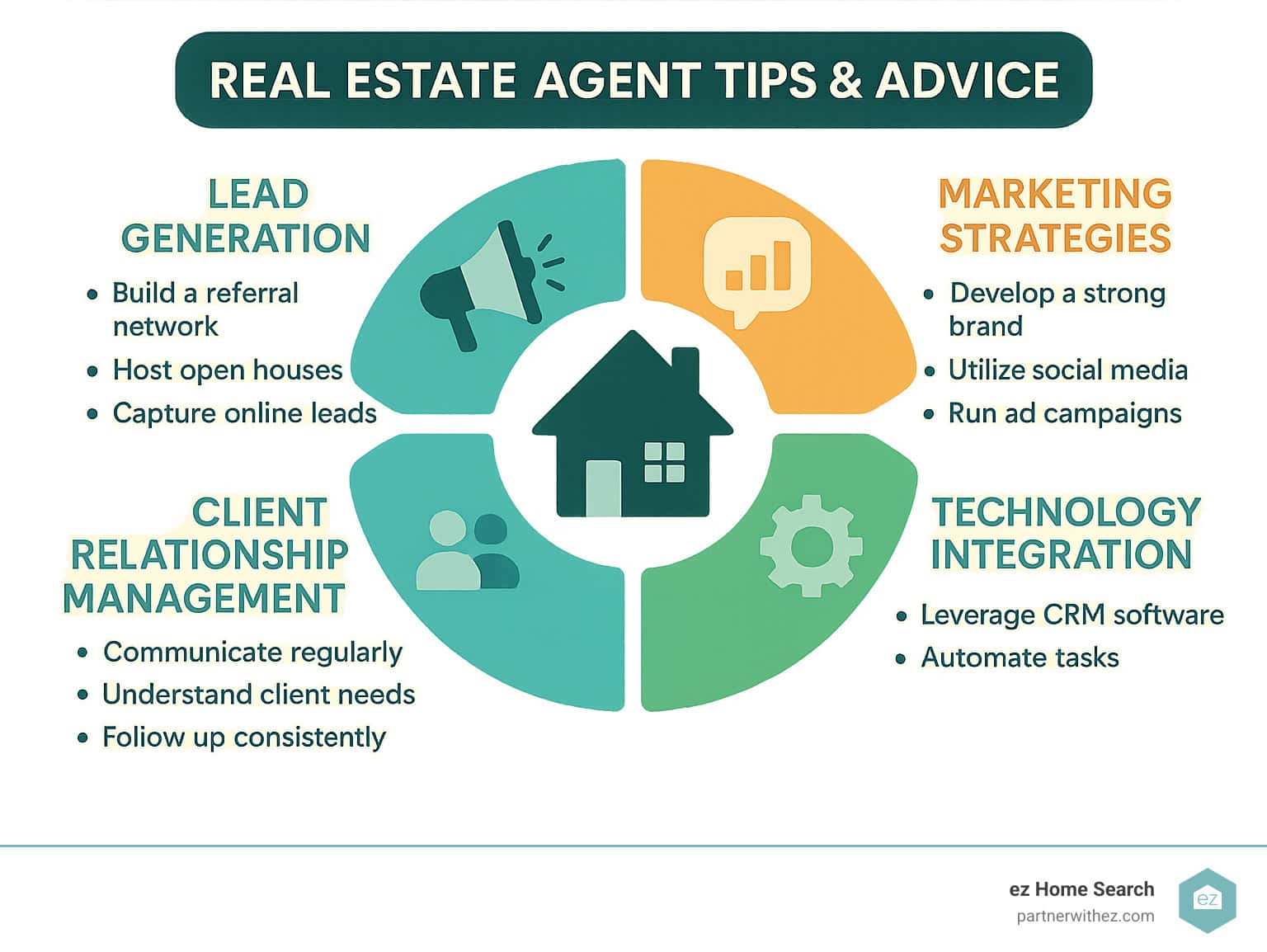
Comprehensive diagram showing the real estate agent success ecosystem including lead generation, client relationship management, marketing strategies, and technology integration with specific action items for each category - real estate agent tips and advice infographic  - real estate agent tips and advice infographic

Must-Have Skills and Qualities of Top Agents

The gap between average and exceptional real estate agents isn’t just about working harder—it’s about mastering specific skills that create compounding results. As Kurt Uhlir, Chief Marketing Officer at ez Home Search notes, “The agents who consistently outperform their peers aren’t just working harder—they’re working smarter by mastering fundamental skills that create compounding results.”

Market Knowledge

Top agents breathe local market data like oxygen. They review hot sheets daily, discuss neighborhood trends in detail, and recite recent comparable sales from memory. This deep knowledge builds instant credibility and positions you as a trusted advisor rather than just a transaction facilitator.

Communication Excellence

Over a third of customers expect responses within an hour. Top agents prioritize client communications and set clear expectations about response times. They’ve mastered translating complex real estate jargon into language that makes clients feel informed and comfortable.

Negotiation Prowess

Successful agents maintain an average list-to-sales price ratio of at least 95%. They prepare extensively for negotiations, understand both parties’ motivations, and focus on creating win-win scenarios. The best negotiators know that protecting their commission starts with demonstrating clear value throughout the relationship.

Ethical Standards

Trust is the currency of real estate. The most respected agents hold themselves to standards far beyond minimum requirements, choosing transparency even when it might temporarily complicate a deal. In an industry where referrals drive success, integrity is essential for sustainability.

Tech Savvy

Top producers leverage technology as a multiplier, not a replacement for personal connection. They automate mundane tasks while preserving time for meaningful client interactions, giving them back hours for relationship-building and strategic growth activities.

Adaptability

Successful agents pivot quickly when conditions change, viewing challenges as opportunities. This flexibility allows them to thrive in any market while competitors struggle to adjust.

Caucasian real estate agent wearing a light blue polo shirt sitting at a kitchen table with a black couple that are looking at an iPad - real estate agent tips and advice

Essential Soft Skills for “Real Estate Agent Tips and Advice”

Active Listening

Exceptional agents truly hear what clients are saying—and what they’re not saying. They ask thoughtful follow-up questions and remember personal details that show they care. When clients feel genuinely heard, they develop deeper trust and loyalty.

Body Language Awareness

Nonverbal communication shapes how we’re perceived more powerfully than words. Top agents maintain open posture, consistent eye contact, and mirror their clients’ communication style to build natural rapport.

Transparency

Only 11% of people feel they can completely trust a real estate agent. Breaking this stereotype requires radical transparency about both positive and challenging aspects of properties, neighborhoods, and processes.

Trust Building

Trust is built by consistently keeping small promises. Successful agents track every commitment made to clients and deliver without fail. This reliability becomes your reputation and sets you apart in a crowded marketplace.

Negotiation Tactics That Protect Your Commission

Win-Win Approach

Effective agents frame negotiations as collaborative problem-solving rather than competitions, focusing on identifying core needs and finding creative solutions that address these priorities.

Thorough Preparation

Top agents research all parties involved, understand true motivations, and prepare multiple scenarios before entering negotiations. This preparation allows for confident, flexible responses during high-pressure moments.

Objection Handling

Successful agents anticipate objections and prepare thoughtful responses in advance, viewing objections as opportunities to provide additional value and education.

Strategic Pricing

The best agents use precise comparable sales data to justify recommendations and set realistic expectations from the start, articulating clear value propositions that support their pricing strategy.

Research shows buyers expect quick responses to their inquiries, and if they have to wait over six hours, they’ll likely take their business elsewhere. This responsiveness isn’t just good service—it’s essential for capturing opportunities in today’s competitive market.

Real Estate Agent Tips and Advice for Lead Generation & Marketing

The heartbeat of any thriving real estate business is a steady, diversified pipeline. As Travis McClure, Chief Operating Officer at ez Home Search, says, “The agents who succeed long-term never rely on a single source for businessthey build ecosystems that survive market swings.” Below are streamlined, high-impact ideas you can deploy quickly.

Personal Branding

Clarify your specialty, create consistent visuals, and develop a recognizable voice. Your brand is the promise clients believe you will keep.

Sphere Database Management

  1. Segment contacts by relationship strength.
  2. Schedule regular, value-packed touches.
  3. Track responses to identify warm opportunities.

Video Marketing

Adding video to listings can increase inquiries by 403%. Use short clips for market updates, testimonials, and neighborhood highlightsall easily shot on a smartphone.

Social Media Strategy

Master 12 channels where your ideal clients spend time. Steady, conversational posts beat sporadic blasts of listings.

Direct Mail

Hyper-local, personalized mailers still convert when they showcase your market expertise and include a clear call to action.

Open Houses

Treat open houses as networking events: collect visitor info and follow up the same day.

SEO and Digital Presence

Your website should work 24/7 through: mobile-friendly IDX search, local keywords, fresh content, and fast load speeds.

Niche Expertise

Specialists convert at higher rates than generalists. Whether luxury condos or first-time buyers, plant your flag.

Referral Systems

Referrals convert 35 74x better than cold leads. Systematize requests, thank referrers publicly, and reward them meaningfully.

real estate agent marketing content calendar showing social media, email, and direct mail scheduling - real estate agent tips and advice

High-Conversion Lead Sources & Funnels

  • Optimized CRM: Automated sequences turn cold leads warm without extra effort.
  • Expired Listings: Call early with a clear plan to do what the last agent didnt.
  • FSBO Guides: Offer genuine help firstthe listing often follows.
  • Cash Offer Tools: ez Home Searchs instant-offer option attracts sellers who value certainty.
  • Targeted Landing Pages: Neighborhood-specific pages out-convert generic sites.

Statistics showing how video content increases engagement and conversion rates in real estate marketing by over 400%  - real estate agent tips and advice infographic

By deploying these real estate agent tips and advice consistentlyand tracking what worksyoull create a marketing machine resilient to any market shift.

Building Trust, Communication, and Long-Term Client Relationships

With only 11% of consumers fully trusting real estate agents, credibility is your most valuable asset. Nikki Pais of ez Home Search notes, “Trust isnt givenits earned through small, consistent promises kept.”

Proactive Communication

A simple weekly “quick update” text prevents anxiety. Silence kills deals; regular touchpoints build confidence.

Response Time Management

Set expectations on day one: when clients know how and when you reply, they stay calm and loyal.

Radical Honesty

Share the good and the bad. Transparent advice turns one-time clients into lifelong advocates.

Client Profiling & Journey Mapping

Document preferences, family details, and long-term goals. Then map follow-ups for years after closingnot just at the handshake.

Referral Generation

Ask for introductions at natural milestones (inspection, closing, post-move). Specific requests”Who at work needs more space?”—outperform vague ones.

A drone taking pictures of a neighborhood in northern Georgia in the United States - real estate agent tips and advice

“Real Estate Agent Tips and Advice” to Improve Communication

  • Open-Ended Questions: “What do you want to feel when you walk in the door?”
  • Preferred Channels: Log each clients favored mediumand use it.
  • Autoresponders: Let technology acknowledge messages instantly when you cant.
  • Empathy Statements: “I understand this inspection feels overwhelming.” Validation matters.

Systems to Wow Clients After the Sale

  1. Annual home-anniversary check-ins with updated valuations.
  2. Curated vendor list for every homeowner need.
  3. Quarterly market snapshots to keep you top-of-mind.

Research confirms honesty accelerates trustand in real estate, trusted agents win the referral game.

Productivity, Technology, and Continuous Learning

In real estate, your time is your most precious commodity. You don’t need to work 80-hour weeks to boost your GCI—you just need smarter systems.

“Most agents spend too much time on low-value activities that don’t directly contribute to closings,” says Travis Halverson of ez Home Search. “The breakthrough comes when you leverage technology or outsourced services such as ISA to handle the routine while you focus on relationship-building.”

CRM Automation

Your CRM should be working harder than you are. When properly set up, it orchestrates your entire follow-up strategy. The most successful agents have automated sequences that nurture leads based on specific behaviors, sending relevant listings and market updates without manual intervention.

Time Blocking

Top producers protect chunks of their calendar for specific activities. Schedule your most important revenue-generating activities—like prospecting calls and lead follow-up—during your peak energy hours (typically mornings). Save administrative tasks for after lunch when your focus naturally dips.

Micro-Goals

Break big annual targets into daily activities that move the needle. Instead of focusing solely on “I need to make $250,000 this year,” translate that into actionable micro-goals like adding five new contacts daily or scheduling two listing presentations weekly.

Analytics and Measurement

“The agents who track their numbers consistently know exactly where to focus their efforts for maximum ROI,” explains Travis Halverson. Key metrics include lead source conversion rates, cost per acquisition by channel, average days on market, list-to-sale price ratio, and client retention rates.

Virtual Tours and Remote Tools

Investing in quality virtual tour technology expands your reach and efficiency. Many agents have landed significant listings from out-of-state buyers who never physically visited properties before making offers.

real estate coaching session with agents reviewing performance metrics - real estate agent tips and advice

AI and Automation Tools

Smart agents accept tools that handle routine tasks like appointment scheduling, initial lead qualification, and basic client questions. The key is using these tools to improve the human elements of your service, not replace them.

Continuing Education

Beyond required CE credits, successful agents invest in specialized designations, attend industry conferences, and participate in mastermind groups. This continuous learning keeps them ahead of market shifts and emerging trends.

Tech Stack Every Growth-Focused Agent Needs

  • IDX Website: A 24/7 lead generation machine with integrated search functionality and strategic lead capture forms
  • Behavioral Data Tracking: Tools that monitor how prospects interact with your content for targeted follow-up
  • Mobile Optimization: Essential with over 80% of home searches starting on mobile devices
  • Video Creation Tools: User-friendly editing apps for professional-looking content
  • Lead Verification Systems: Tools like ezVerify.ai provide TCPA-compliant verification to focus on promising opportunities

Avoid Burnout While Scaling Your GCI

  • Clear Boundaries: Establish and communicate specific working hours to clients and colleagues
  • Strategic Delegation: Identify tasks that don’t require your unique expertise and delegate them
  • Calendar Batching: Group similar activities together to minimize the productivity drain of context switching
  • Wellness Habits: Prioritize sleep, exercise, and stress management as business investments

Real estate agent tips and advice are only valuable when implemented consistently. The difference between average and exceptional often comes down to execution, not information.

Thriving in Any Market: Mindset, Mentorship, and Resilience

The real estate market is constantly in motion with periods of calm and storms. The agents who succeed long-term have built vessels sturdy enough to steer any conditions. Your mindset, support systems, and adaptability will ultimately determine your success regardless of market conditions.

Mentorship

“Find the right mentor, observe their practices, and implement what works for your business,” advises Kurt Uhlir of ez Home Search. “The right mentor can help you avoid years of costly trial and error.”

Look for someone who has achieved the specific results you’re targeting, works in a comparable market, and demonstrates genuine teaching ability. Most importantly, their ethical standards should align with your values—because success without integrity isn’t success at all.

Mastermind Groups

While a mentor provides vertical guidance, mastermind groups offer horizontal support and accountability. The most effective masterminds include agents at various experience levels but with similar ambition and business models.

“My mastermind group saved my business during the 2008 recession,” shares one of our exclusivity partners in Tennessee. “When everyone was panicking, we collaborated on strategies that not only helped us survive but positioned us to thrive when the market recovered.”

Recession Playbook

Smart agents prepare for market downturns before they arrive. Develop contingency plans, diversify lead sources, and maintain financial reserves that can carry you through lean periods. Your recession playbook should include strategies for reducing non-essential expenses and doubling down on your most profitable activities.

Goal Tracking

Written goals with specific metrics and timelines dramatically increase achievement rates. Break annual targets down into quarterly, monthly, weekly, and daily activities. Reviewing these goals daily and tracking progress weekly maintains focus when distractions arise.

Team Structure Considerations

As your business grows, strategic team building becomes essential for scaling without sacrificing service quality. Consider starting with transaction coordination support, then adding buyer specialists, listing coordinators, and eventually developing a complete team structure. Add team members in alignment with your revenue growth—not hiring aspirationally before your production can support additional overhead.

Female real estate agent, speaking into a headset while looking at a laptop at a coffee shop - real estate agent tips and advice

Preparing for Downturns and Shifting Markets

  • Diversified lead sources provide stability when any single channel falters. Maintain at least 3-4 distinct lead generation methods with proven conversion histories.
  • Regular expense audits help you understand where your money is going and which expenditures truly drive results.
  • Maintaining reserve funds covering at least six months of essential expenses provides stability and the ability to capitalize on opportunities while competitors struggle.
  • Continuous skill development positions you to adapt as market needs evolve. During slower periods, invest in developing new capabilities that will differentiate you when activity increases.

Leveraging Teams and Coaching for Rapid Growth

  • Joining an established team provides immediate access to leads, systems, and mentorship—particularly valuable if you’re struggling with consistent lead generation.
  • Starting in specialized roles like Inside Sales Agent (ISA) or Outside Sales Agent (OSA) provides immersion in lead conversion and appointment setting—critical skills that accelerate your development.
  • Weekly coaching provides accountability, strategic guidance, and perspective that’s difficult to achieve alone. ez Home Search offers targeted coaching specifically designed for scaling teams.
  • Regular KPI reviews help identify both strengths to leverage and weaknesses to address. Focus on leading indicators (activities you control) rather than just lagging indicators (results).

When markets shift, these foundations of mindset, mentorship, and resilience don’t just help you survive—they position you to capture market share while others retreat. As Nikki Pais of ez Home Search often reminds partners, “The best agents don’t just react to the market; they create their own market through consistent value delivery regardless of conditions.”

Frequently Asked Questions about Real Estate Agent Success

How can seasoned agents reignite stagnant production?

Even the most experienced agents hit plateaus. Start by conducting an honest audit of your lead sources and conversion rates. Often, what worked brilliantly last year might be underperforming today.

Technology can be a game-changer when you’re stuck. Automating routine tasks frees up your time for high-value activities. Many agents find that implementing tools like ez Home Search’s automated nurture flows creates immediate breathing room in their schedule.

Your sphere of influence likely contains untapped potential. Instead of occasional check-ins, implement a systematic contact plan with specific touchpoints throughout the year.

“Sometimes the fastest way to break through a plateau is to revisit the fundamentals with fresh eyes and renewed commitment,” notes Travis McClure of ez Home Search.

Consider pursuing specialized designations that open doors to new market segments, and surround yourself with higher-producing peers through mastermind groups for fresh perspectives and accountability.

What is the fastest way to build a trustworthy personal brand?

In a profession where only 11% of consumers completely trust agents, building credibility is essential. While there’s no overnight solution, you can accelerate the process with strategic actions.

Consistent demonstration of market knowledge remains the foundation of trust-building. Share market updates, neighborhood insights, and trend analyses through content that genuinely helps your audience.

Transparency sets trustworthy agents apart. Don’t just showcase your successes – share challenges and how you overcame them. When you acknowledge that real estate isn’t always smooth sailing, clients appreciate your honesty.

Client testimonials and case studies carry more weight than any marketing claim you could make. Video testimonials are particularly powerful, as they convey authentic emotion that written reviews sometimes miss.

Community involvement demonstrates that you’re invested in more than just transactions, while consistent professional imagery and messaging across all platforms reinforces your professionalism at every touchpoint.

Which tech tools deliver the highest ROI without overwhelming me?

Technology should simplify your business, not complicate it. A focused tech stack delivers better results than trying to master dozens of platforms simultaneously.

A robust CRM with automated follow-up sequences tops the list of high-ROI tools. When properly configured, your CRM becomes a 24/7 assistant that nurtures leads and maintains client relationships.

An IDX website with lead capture functionality serves as your digital storefront, while video creation tools have become essential rather than optional. Today’s smartphone cameras and user-friendly editing apps make professional-quality video accessible without specialized training.

Electronic signature and transaction management software dramatically reduces paperwork while creating a more convenient experience for clients, and social media scheduling tools help maintain consistent presence without consuming your day.

Many agents find that ez Home Search’s integrated platform combines these functions in a single ecosystem, reducing the learning curve while maximizing effectiveness. The platform’s county-based exclusivity model also eliminates competing with multiple agents for the same leads – a significant advantage in competitive markets.

When evaluating any new technology, ask yourself: “Will this save me time, help me serve clients better, or generate more business?” If it doesn’t accomplish at least one of these goals, it may not be worth the investment.

Conclusion

Implementing these real estate agent tips and advice isn’t about overnight success—it’s about building sustainable practices that weather any market condition. The agents who thrive year after year understand that mastering fundamentals while strategically adopting innovations creates the perfect balance for long-term growth.

At ez Home Search, we’ve seen the challenges real estate professionals face in today’s increasingly competitive landscape. The constant pressure to generate leads, convert prospects, and maintain relationships can be overwhelming without the right systems in place.

That’s why we’ve built something different—the only national real estate platform that delivers exclusive opportunities to real estate teams while genuinely protecting consumer privacy. Our county-based exclusivity model means our partners receive sole access to intent-driven consumers who are matched with a single local expert rather than being sold as leads to multiple competing agents.

This approach not only generates significantly higher conversion rates but creates fundamentally better client experiences. As Kurt Uhlir, our Chief Marketing Officer, often reminds our partners: “Success in real estate isn’t about working harder than everyone else—it’s about working smarter with the right systems, support, and strategy.”

Our comprehensive ecosystem supports agents at every stage of their growth journey with tools like high-conversion landing pages, real-time behavioral tracking, CRM-integrated nurture flows, and TCPA-compliant verification through ezVerify.ai. We complement these technology solutions with done-for-you SEO, marketing support, and weekly coaching designed specifically for teams looking to scale.

Whether you’re an individual agent looking to break through a production plateau or a team leader aiming to create predictable growth, implementing these proven real estate agent tips and advice with the right technology and support will accelerate your journey toward sustainable success.

For more information about partnership opportunities and how ez Home Search can help implement these strategies in your business, visit our partner information page or explore our ez Connect accounts at https://www.ezconnect.info.

Your success isn’t just about working harder—it’s about working smarter with systems that multiply your effectiveness while allowing you to reclaim your time and enjoy the business you’ve built.

06.19.2025

The Ultimate Guide to Real Estate Marketing Materials


The Power of Strategic Marketing Materials in Real Estate

Real estate marketing materials are the essential tools that help agents promote properties, build their brand, and connect with potential clients. These materials range from traditional print items to cutting-edge digital assets.

Most popular real estate marketing materials:

  • Property flyers and brochures
  • Business cards and postcards
  • Yard signs and open house materials
  • Digital listing presentations
  • Social media graphics and templates
  • Email newsletters
  • Virtual tours and property videos
  • Single-property websites

In a rapidly growing real estate industry, standing out is more important than ever. With between 125,000 and 160,000 people entering real estate every year, effective marketing materials are essential for agents and teams who want to thrive—not just keep up.

The most successful agents understand that effective marketing materials aren’t just about promoting listings; they’re about building credibility, demonstrating expertise, and creating memorable touchpoints throughout the client journey. Whether it’s a professionally designed property brochure that captures a home’s essence or a compelling video tour that ranks on Google’s first page, quality marketing materials communicate professionalism and attention to detail.

As Bret Calltharp notes, “Real estate is a competitive industry, and only getting more so—here’s how the right materials can help you stand out.” This sentiment perfectly captures why top-producing agents invest in comprehensive marketing materials rather than relying solely on MLS listings.

What separates exceptional marketing materials from average ones? The strategic integration of both print and digital assets to create an omnichannel presence that meets clients wherever they are. While 60% of property searches happen on mobile devices, studies show that tangible items like high-quality brochures and custom door hangers still create powerful impressions during crucial decision-making moments.

I’m Preston Guyton EZP, with over 20 years of experience helping real estate professionals develop compelling real estate marketing materials that convert prospects into clients and listings into sales. My expertise in creating marketing systems that leverage both traditional and digital channels has helped hundreds of agents stand out in competitive markets.

Comprehensive overview of real estate marketing materials showing print and digital assets with their use cases and effectiveness metrics - real estate marketing materials infographic infographic-line-5-steps-neat_beige

Real Estate Marketing Materials 101: Why They Matter

In real estate, your first impression is everything—sometimes it’s the only shot you get. Real estate marketing materials are much more than pretty flyers or digital ads; they’re your handshake, your elevator pitch, and your “nice to meet you” all rolled into one. When over 156,000 new agents flooded the market in 2020 and 2021, standing out has become both an art and a science.

As Kurt Uhlir from ez Home Search puts it: “The explosion of new agents means your marketing materials need to work harder than ever. Quality materials aren’t just nice-to-haves—they’re essential differentiators in a crowded marketplace.” In today’s market, memorable, professional materials don’t just help—they’re the secret weapon for growth.

History & Definition

The story of real estate marketing materials starts long before social media hashtags and custom landing pages. Agents once relied on black-and-white flyers and local newspaper ads to get the word out. These humble beginnings laid the groundwork for today’s omnichannel approach.

Now, real estate marketing is an ecosystem. We’re talking yard signs, glossy brochures, personalized postcards, animated video tours, single-property websites, and interactive 3D experiences. The digital shift didn’t eliminate print—it just raised the bar. Savvy agents know: an omnichannel presence is key. Tangible print pieces create real-world impact during pivotal moments, while digital assets let you meet buyers and sellers where they are, on any device.

Travis McClure of ez Home Search says it perfectly: “The most successful agents know that every stage of the process calls for different materials. The real win? Making every touchpoint feel like it’s coming from the same trusted brand.”

Core Benefits for Agents & Teams

Investing in professional, cohesive real estate marketing materials brings huge advantages for agents and their teams. For starters, well-made materials naturally attract better leads. When a potential client flips through a polished brochure or clicks on a sleek virtual tour, they know you mean business.

Brand control is another superpower. Consistent, on-brand assets help you look sharp and stay memorable—no more mismatched colors or off-brand fonts. And let’s not forget local expertise: targeted materials let you showcase your insider knowledge, from neighborhood stats to school rankings, building trust before you ever shake hands.

There’s more. Great marketing materials keep working even after you hand them off. A friend passes your postcard to a neighbor, or a client forwards your digital open house invite—referrals just happen. And every time your name or face comes up, clients feel more confident because your materials spell out reliability, care, and expertise.

As Nikki Pais at ez Home Search explains: “When agents pair our county-based exclusivity and privacy-focused platform with premium marketing materials, they instantly become the go-to expert in their area. This isn’t just about looking good—it’s about claiming your space in the market with confidence.”

If you’re ready to become the trusted local expert, remember: real estate marketing materials aren’t optional. They’re your foundation for building trust, driving referrals, and winning the next listing. For more on how our exclusive platform and ez Connect accounts can help, visit ez Home Search partnerships or check out ez Connect.

Essential Print & Digital Assets

To truly stand out and make lasting connections, today’s real estate pros need a well-rounded mix of real estate marketing materials. The winning formula is a blend of tried-and-true print pieces and smart digital assets—meeting clients wherever they are, whether at the mailbox or on a smartphone.

Let’s start with print. Despite all the buzz around digital, tangible real estate marketing materials still carry real weight. There’s something memorable about a high-quality brochure in your hand, or a striking flyer on the kitchen counter. Property flyers are the backbone here—packed with clear, eye-catching photos, key details, and your contact info (don’t forget a clean, easy-to-read font). Brochures go a step further, letting you tell a fuller story about the home and the neighborhood. As the saying goes, “The first time a buyer dreams about their next home is usually flipping through a beautiful brochure.”

Postcards are perfect for those “just listed” or “just sold” moments, or even as seasonal nudges. Did you know over one in five buyers learn about an agent through direct-mail pieces? That’s the power of print. Door hangers are another secret weapon for getting hyperlocal—great for introducing yourself to a neighborhood (and, let’s be honest, hard to ignore when they’re literally hanging on the front door). Business cards are still networking gold, so make sure yours features your headshot, logo, and maybe even a clever quote or QR code for that digital bridge. And when it comes to open houses, a polished toolkit—think sign-in sheets, info packets, and local guides—leaves a professional impression. Don’t underestimate the humble yard sign either; the classic 18″x24″ format is still one of the most recognizable ways to announce a home is on the market.

Travis Halverson of ez Home Search says: “Print materials create a real, lasting connection. When we design custom collateral for our exclusive partners, we focus on pieces that complement their digital brand and give clients something to remember them by.”

They’re not outdated. They actually work incredibly well, when you know how to use them.

Of course, the digital world has changed the game for real estate marketing materials. Digital assets are how you reach the 60% (and growing) of buyers who start their home search on mobile devices. Think attention-grabbing social media graphics—custom for Facebook, Instagram, or LinkedIn, where you can target just the right audience. Email templates are your ongoing conversation starters, keeping your name top-of-mind with newsletters and listing updates. A modern listing shines with its own single-property website, complete with photo galleries and local info.

Video tours are a powerhouse—Forbes notes that YouTube isn’t just popular, it’s a major SEO booster (your videos can pop up on Google’s front page!). If you want prospects to walk through a home from miles away, 3D virtual tours are a must, especially for luxury or out-of-town buyers. Don’t forget blog content—SEO-friendly articles about home tips or local happenings help build your reputation as the neighborhood expert and improve your search rankings. And for those in-person or virtual client meetings, nothing beats a polished digital listing presentation loaded with stats and visuals.

Kurt Uhlir of ez Home Search sums it up: “Digital materials are powerful because they’re flexible and trackable. Our partners use automation to create custom digital assets that respond to what buyers do in real time—delivering the right content exactly when it’s needed.”

At ez Home Search, we help exclusive partners harness both print and digital assets, using tools like ez Connect accounts and the latest in automation and privacy-first tech. The result? A marketing ecosystem that builds trust, delivers real value, and helps you grow—on your terms.

Ready to level up your real estate marketing materials? Explore more about our partnership opportunities at ez Home Search.

Design, Branding & Technology Hacks

Creating professional real estate marketing materials doesn’t require an in-house design team or massive budget. With the right tools and strategies, agents can produce high-quality materials that maintain brand consistency and drive results.

Key Elements of a High-Converting Flyer/Brochure

The most effective real estate flyers and brochures share several critical elements:


  1. Compelling Headline: Use benefit-driven language that speaks directly to your target audience. For example, “Dream Home Downtown!” creates immediate emotional connection.


  2. High-Quality Imagery: Professional, well-lit photographs are non-negotiable. As one expert puts it, “It should go without saying, but we still have to say it: make sure you’re using high-quality, high-definition photos.”


  3. Feature Icons: Visual representations of key amenities make information scannable and memorable.


  4. Concise Copy: Keep descriptions under 200 words, focusing on unique selling points and emotional benefits rather than just features.


  5. Strong Call-to-Action: Every piece should include a clear next step, whether it’s “Schedule Your Viewing Today” or “Call for a Private Tour.”


  6. QR Code: Bridge the gap between print and digital by including a QR code that links to additional information, virtual tours, or online listing details.


  7. Contact Information: Make it easy for prospects to reach you with prominently displayed contact details.


Creating Materials Without Design Experience

You don’t need to be a graphic designer to create professional real estate marketing materials. Here are some accessible solutions:


  • Template Platforms: Services like Canva offer over 70 real estate-specific templates that can be customized in minutes. As one real estate marketing expert notes, “It doesn’t get any easier—a perfect low-tech flyer solution for real estate professionals.”


  • PDF Form-Fill Templates: Some providers offer pre-designed PDFs that can be edited in Adobe Reader without any special software. These templates can save “up to 90% of design time” by eliminating layout decisions.


  • Automated Marketing Platforms: Solutions that integrate with MLS data can automatically populate templates with listing information, saving significant time and ensuring accuracy.


  • AI Design Assistants: Emerging tools can generate custom designs based on simple text prompts, making professional-looking materials accessible to everyone.


Nikki Pais of ez Home Search shares, “Our partners leverage ezNurture’s automated templates to create consistent, branded materials without the design headache. The system pulls property data directly from the MLS, ensuring accuracy while maintaining the agent’s unique brand identity.”

Ensuring Brand Consistency Across Platforms

Brand consistency builds recognition and trust. Here’s how to maintain a cohesive look across all your real estate marketing materials:


  • Create a Style Guide: Document your brand colors, fonts, logo usage guidelines, and tone of voice to ensure consistency.


  • Use Brand Kits: Many design platforms allow you to save brand elements for one-click application across templates.


  • Implement Approval Workflows: For teams, establish a review process to ensure all materials meet brand standards before distribution.


  • Lock Brand Elements: Some template systems allow you to “lock” certain elements (logos, colors, fonts) to prevent unauthorized changes while still allowing customization of content.


  • Centralize Asset Management: Maintain a digital library of approved images, copy blocks, and design elements for team access.


“Consistency isn’t just about aesthetics—it’s about building recognition and trust,” explains Travis McClure. “We help our exclusive partners develop branded templates that maintain their unique identity while allowing for listing-specific customization.”

Distribution, Automation & ROI Tracking

Creating beautiful real estate marketing materials is only half the equation—getting them into the right hands at the right time and knowing what’s actually working are what drive true results. Smart agents focus just as much on distribution, automation, and tracking ROI as they do on design. Let’s walk through how today’s top performers do it.

Distributing your marketing materials has never been easier or more effective, thanks to automation and integrated tech stacks. No more scrambling to send out flyers or manually uploading new listings to every site. With MLS integrations, your property data flows right into your templates as soon as you add a new listing—so your flyers, brochures, and digital assets are always up to date with minimal effort. Email drip campaigns make sure your content reaches the right prospects at the right time, nudging them gently through their home search or sale journey.

On the digital side, social media scheduling tools let you plan posts in advance and hit peak engagement times—even while you’re out taking a client to coffee. Some systems can even create dynamic content, adjusting images or headlines based on who’s viewing them. And with CRM integration, you’ll always know which potential buyers or sellers received which pieces, and how they interacted with them.

As Kurt Uhlir explains, “Our partners love that ezNurture and our Follow Up Boss integration mean their marketing materials don’t just look great—they actually get delivered to the right leads at the best possible moment.”

But how do you know what’s working? This is where measurement comes in. Today’s real estate marketing materials should give you feedback, just like a good friend. For digital assets, this means tracking open rates, click-throughs, and time spent on each page. Print materials can be just as smart—QR codes let you see exactly how many people scanned to learn more about a listing, and unique phone numbers can reveal which postcard or flyer drove a call. You can even analyze which materials generate the most listing views or tracked inquiries.

Don’t forget about A/B testing—trying out small tweaks in your materials can reveal what language or imagery really resonates with your audience. Experts suggest checking email newsletter metrics at regular intervals (like three days, one week, and one month) so you can spot trends and adjust your strategy over time.

Looking to the future, real estate marketing materials are rapidly evolving. Augmented reality and virtual reality tours are starting to appear in print and digital assets, often activated by a QR code on a flyer or postcard. Interactive flipbooks bring listings to life online, with embedded videos and 3D tours. AI-generated content now helps agents personalize property descriptions and even videos, while sustainable printing options help keep your marketing efforts eco-friendly.

Perhaps the most exciting innovation is hyper-personalization. With tools like ez Home Search, agents will soon be able to deliver materials custom to each prospect’s unique interests and behavior—without spending hours customizing every piece. As Travis Halverson says, “The future is about personalization at scale. Our partners can already create custom, branded materials for every stage of the customer journey, all with just a few clicks.”

In short, it’s not enough to have great real estate marketing materials—you need to be smart about how you distribute them, automate where you can, and measure what actually drives results. This is how the best agents grow their business while saving time (and maybe even enjoying a little more of their weekends). For more information about how ez Home Search’s exclusive tech and automation give you an edge, explore partnership opportunities here.

Frequently Asked Questions about Real Estate Marketing Materials

Why use both print and digital assets?

If you’re wondering whether you really need both print and digital real estate marketing materials, here’s the simple truth: each brings unique value to your business, and together, they’re even more powerful. Digital materials help you reach a huge audience with just a few clicks—think social posts, video tours, and single-property websites. You can track who opens your emails or clicks your links, and you’ll never run out of virtual “brochures.”

But don’t count out print! Tangible items like flyers, postcards, and brochures create memorable, physical touchpoints. In fact, 53% of buyers say open house flyers are extremely or highly important—and plenty of people still appreciate being able to grab a high-quality printout when touring a home. There’s just something about holding a beautiful brochure or eye-catching postcard that feels real and builds trust.

The real magic happens when you blend both approaches. For example, you can hand out a professionally designed brochure at an open house that includes a QR code—letting buyers jump straight to a virtual tour or schedule a private showing on their phones. As Nikki Pais puts it, “A prospect might spot your home online, visit an open house, take a brochure, and then scan a QR code to book a tour—all thanks to your print and digital materials working together.”

How do I keep materials on-brand when multiple agents contribute?

When you have a team, it can be tough to keep all your real estate marketing materials looking consistent. The key is to set up some smart systems and simple rules everyone can follow—no design degree required.

Start with branded templates that lock in your logo, colors, and fonts. This way, agents can personalize property photos and details but can’t accidentally swap in Comic Sans or change your brand color to neon green. Having clear brand guidelines is a must—write down how and when to use your logo, what colors and photos are okay, and what tone your team should use.

It’s helpful to use an approval workflow—a quick review by a team leader before anything goes out makes all the difference. Keep all your approved graphics and content in one spot, so everyone’s pulling from the same image library and text.

Finally, don’t forget regular training. A short session once in a while helps everyone stay on track and understand why consistency matters so much.

As Travis McClure shares, “We give partners the tools and systems to keep their brand strong—even as their team grows. The done-for-you marketing materials and services our exclusivity partners get fill a missing gap in many of their growth plans.”

What metrics should I track to prove ROI?

If you’re investing in real estate marketing materials, you want to know what’s working—and what’s just pretty paper (or pixels). Tracking the right numbers will show which materials actually help you get more clients and close more deals.

Focus on cost per acquisition (how much you spend to get a new client), and conversion rates (what percent of people take action after seeing your flyer, email, or postcard). Don’t forget time to conversion—how quickly someone moves from interested to “let’s do this” after engaging with your materials.

It’s also smart to ask new clients how they first found you, so you know which materials made an impact. Track the performance of your listings—do homes with professional brochures or digital tours sell faster or for more money than those with basic marketing?

Check these numbers at several points: right after you send them, a week later, and again after a month. This way, you’ll see not just immediate results, but long-term trends.

Curious how ez Home Search can help you automate tracking and take your marketing to the next level? Learn more about partnership opportunities at partnerwithez.com or explore our ez Connect accounts at ezconnect.info.

With the right blend of real estate marketing materials—and the right strategy—you’ll be ready to stand out, build trust, and grow your business, no matter how crowded the market becomes.

Conclusion

Real estate marketing materials aren’t just nice-to-have—they’re a must for any agent or team wanting to get noticed, earn trust, and win clients. The agents who rise above the crowd are the ones who blend high-quality print pieces with attention-grabbing digital assets, creating a seamless experience for buyers and sellers at every stage.

We know what it takes to help professionals shine in their local market. Thanks to our county-based exclusivity, our partners never compete against each other for the same lead. Instead, each serious buyer or seller is matched with a single local expert, giving you the attention—and the edge—you deserve.

Our all-in-one, privacy-first platform offers everything you need to market smarter, not just harder. From high-conversion landing pages and branded IDX tools to automated nurture flows through systems like ezNurture and Follow Up Boss, we make sure your real estate marketing materials reach the right people at the right time. With real-time behavioral tracking, automated home valuations, and open house generators, you can focus on building relationships while our tech does the heavy lifting behind the scenes.

As Travis Halverson puts it, “The future belongs to agents who combine quality marketing materials with strategic distribution and exclusive market access. That’s the competitive advantage we deliver to our partners.” And as Nikki, Kurt, and Travis often say, it’s not just about beautiful flyers or slick videos—it’s about using the right mix of tools to connect with serious consumers and build lasting success.

Are you ready to transform your approach to real estate marketing materials and break free from the crowded lead marketplaces? Want to work in a system where you stand out as the local expert and get exclusive access to ready buyers and sellers—without the privacy headaches? Find how our partnership can change your growth trajectory. Learn more about partnership opportunities with ez Home Search today.

And if you’re looking for even more ways to connect and grow, don’t forget that ez Connect accounts are available at https://www.ezconnect.info.

The market is changing fast. With the right materials, the best tech, and true exclusivity, you’ll be ready to lead the way.


06.19.2025

7 Insider Tips for Success with Real Estate Content Ideas

The Power of Strategic Content in Real Estate Marketing

Real estate content ideas are essential tools for agents looking to build authority, generate leads, and establish trust with potential clients. Here are the top content types that drive results:

  1. Neighborhood guides – Showcase local expertise
  2. Market updates – Demonstrate market knowledge
  3. Property video tours – Engage visual learners
  4. Client success stories – Build social proof
  5. Home buying/selling guides – Educate prospects
  6. Local business spotlights – Connect with the community
  7. Seasonal maintenance tips – Provide ongoing value

In today’s digital-first real estate landscape, compelling content isn’t just nice to have—it’s a necessity. With 60% of the buyer journey complete before prospects reach out to vendors, the content you create serves as your digital handshake. Studies show that content marketing costs 62% less than traditional marketing while generating approximately three times as many leads.

The most successful real estate professionals understand that content isn’t about promoting listings alone. It’s about answering questions, solving problems, and positioning yourself as the trusted local expert before clients even pick up the phone.

I’m Preston Guyton, founder of ez Home Search with over 20 years of experience helping real estate teams maximize their growth through strategic real estate content ideas that convert prospects into clients. My expertise in developing content-driven lead generation strategies has empowered countless real estate professionals to build sustainable business growth without chasing cold leads.

The Content Marketing Flywheel for Real Estate showing how content creation leads to visibility, engagement, trust, leads, and sales in a continuous cycle - real estate content ideas infographic process-5-steps-informal

Build a Winning Real Estate Content Strategy

Before jumping into specific real estate content ideas, you need a thoughtful strategy that aligns with your unique business goals. At ez Home Search, we’ve watched countless agents transform their businesses through strategic content—and it always starts with knowing exactly who you’re talking to.

“The biggest mistake I see agents make is creating content for everyone,” shares Travis McClure, Chief Operating Officer at ez Home Search. “When you try to speak to everyone, you end up connecting with no one. Define your ideal client, understand their pain points, and create content that addresses their specific needs.”

Begin by sketching out your buyer and seller personas. Who are they really? Think beyond basic demographics—what keeps them up at night? Are they first-time buyers confused about mortgage pre-approval? Empty nesters wondering if downsizing makes financial sense?

Next, do some keyword research. What are your ideal clients actually typing into Google? Tools like Google Keyword Planner reveal these golden nuggets. Focus on local intent keywords—phrases like “homes for sale in Riverside neighborhood” typically convert better than generic terms.

When planning your content mix, consider what each format does best:

Content TypeBest ForTypical ROITime Investment
Blog ArticlesSEO, EducationMedium-HighMedium
Video ContentEngagement, TrustHighHigh
Social MediaBrand AwarenessMediumLow-Medium
Email NewslettersNurturingHighMedium

Consistency trumps perfection every time. A simple, helpful market update posted reliably each month builds more trust than a spectacular but random posting schedule.

Mapping Goals to Metrics

Every piece of content should earn its keep. Tie each piece to specific metrics that matter:

Traffic goals help you measure website visitors and time on site. Lead generation tracks email sign-ups and form submissions. Engagement looks at comments, shares, and interactions. SEO performance monitors your rankings for target keywords. And most importantly, conversion measures listing appointments and buyer consultations.

“The key is to track not just vanity metrics like page views, but conversion metrics that actually impact your bottom line,” notes Kurt Uhlir, Chief Marketing Officer at ez Home Search.

Content Calendar Essentials for Real Estate Content Ideas

Think of your content calendar as your roadmap to consistency. When building yours, weave in these essential elements:

Seasonality matters in real estate—plan content that aligns with market cycles. Local events give you natural connection points. Market trends keep you relevant. And don’t forget evergreen topics that remain useful year-round, balancing timely content with lasting value.

7 Insider Real Estate Content Ideas That Convert

Now let’s dive into the seven real estate content ideas that consistently deliver results for our partners at ez Home Search:

1. Hyper-Local Neighborhood Deep Dives (real estate content ideas)

Gone are the days when a basic neighborhood overview was enough to impress potential buyers. Today’s savvy home shoppers crave insider knowledge that goes beyond the surface-level information they can find on national real estate websites.

The most successful agents we work with at ez Home Search create neighborhood guides that feel like a virtual tour from a trusted local friend. These deep dives become valuable resources that continue generating leads long after publication.

“I’ve watched our partners who create detailed neighborhood guides consistently see 3-4x higher engagement compared to those who only post listings,” shares Nikki Pais, Director of Partner Success at ez Home Search. “The are great for sending after you (or your ISA) talks to afterwards too.”

What makes these neighborhood profiles convert so effectively? They go beyond the basics to include elements that truly matter to potential residents:

School information that parents actually care about – not just rankings, but parent reviews, special programs, and extracurricular offerings.

Walkability and transportation details that help people visualize daily life – walking routes to coffee shops, public transit options, and commute times to major employers.

Interactive neighborhood maps highlighting the amenities that make the area special – from hidden gem restaurants to the best parks for different activities.

Authentic resident perspectives through brief interviews where current neighbors share what they love most about living there.

Historical context and future plans that tell the neighborhood’s story – how it’s evolved and where it’s heading, including upcoming development projects.

Pro tip: Create a dedicated landing page for each neighborhood in your market area. This approach helps with search engine optimization and gives you a valuable resource to share with relocating buyers who are still learning about the area. Now, it will take time, but you do not have to do it all at once. You can simply set aside an hour every week to knock out a few more.

2. Monthly Market Snapshots

Real estate data can be overwhelming for most folks. That’s where your monthly market snapshots come in, turning complex statistics into information buyers and sellers can actually use (and that positions you as their go-to expert).

The most effective market snapshots balance hard numbers with thoughtful analysis. Think of yourself as a financial journalist interpreting the market, not just reporting it.

Include these key metrics in your reports:

  • Median sales price (with both month-over-month and year-over-year comparisons)
  • Average days on market (broken down by price point when possible)
  • Current inventory levels and absorption rates
  • Price per square foot trends
  • Percentage of list price received

The secret ingredient? Your expert interpretation. Anyone can pull statistics from the MLS, but your analysis of what these numbers mean for local buyers and sellers adds the real value. As Travis McClure often reminds our partners, “Data tells, but stories sell.”

Monthly real estate market report with key statistics and trends - real estate content ideas infographic checklist-light-blue-grey

Make these snapshots work harder by changing them into multiple content pieces. Turn the data into eye-catching infographics for social media, expand it into a blog post with your analysis, and include a condensed version in your email newsletter.

3. Story-Driven Listing Videos

The numbers don’t lie – NAR research shows listings with videos receive a whopping 403% more inquiries than those without. But not all real estate videos leave the same impression on potential buyers.

The magic happens when you create listing videos that tell a story about the lifestyle the property offers, rather than just rattling off features and square footage. Think of your video as a mini-movie where the home is the star.

“Video content doesn’t just showcase the property—it creates an emotional connection,” explains Travis Halverson, Head of Production at ez Home Search. “When buyers can envision themselves living in the home, they’re more likely to schedule a showing.”

Great listing videos typically include:

  • Opening with neighborhood context to set the scene
  • Showing a day-in-the-life sequence that helps buyers imagine their routine
  • Capturing seasonal benefits (that cozy fireplace in winter or the perfect backyard for summer)
  • Including authentic testimonials from sellers sharing what they loved about living there
  • Highlighting unique features with emotional benefits

Beyond the emotional appeal, professional production quality matters too. Good lighting, smooth camera movement, and clear audio can make even modest properties shine.

Pro tip: Don’t let that beautiful listing video gather digital dust after the property sells! Repurpose it into shorter clips for social media to maximize reach and showcase your marketing expertise to potential clients.

4. Step-by-Step Buyer & Seller Playbooks

Let’s face it – buying or selling a home can feel like navigating a maze blindfolded. That’s exactly why creating comprehensive playbooks has become one of our most powerful real estate content ideas for lead generation.

“Our partners who offer detailed guides consistently report higher quality consultations,” shares Nikki Pais from ez Home Search. “When clients download these resources, they come to meetings better prepared and more confident in your expertise.”

For buyers, the journey is filled with questions and uncertainties. Your playbook should explain the process by covering financial preparation essentials – explaining how mortgage pre-approval works in simple terms. Include neighborhood selection strategies that go beyond just price points, touching on lifestyle factors that buyers often overlook.

The offer-making section is where you can really shine. Break down how to craft a competitive offer in today’s market, with real examples of what works. Don’t forget to explain home inspections in plain English – many first-time buyers have no idea what to expect.

For sellers, the preparation phase is critical. Create a pre-listing checklist that helps them maximize their home’s value without overspending on improvements. Include a straightforward explanation of pricing strategy that helps them understand why strategic pricing beats aspirational pricing.

“The marketing section of your seller playbook shouldn’t just list what you do – it should explain why each element matters to their bottom line. Remember, your marketing should be about them (your client), not you,” advises Kurt Uhlir.

Package these playbooks as visually appealing PDFs with checklists, timelines, and callout boxes highlighting common pitfalls to avoid. Offer them as downloadable resources on your website in exchange for contact information – a fair trade that initiates the relationship on a helpful note.

5. Social Media Series & Reels

Social media can be overwhelming for busy real estate professionals. The secret? Create repeatable content series that your followers can count on, rather than scrambling for new ideas every day.

Think of your social media as your own TV channel, with regular “shows” your audience tunes in for:

“Market Monday” updates give followers a quick snapshot of what’s happening locally. One of our partners saw engagement triple after committing to this weekly ritual – people literally started asking, “Where’s the Market Monday post?” when she missed a week!

“This or That” polls spark conversation like nothing else. “Open concept or defined rooms?” “Bathtub or walk-in shower?” These simple questions regularly generate 5x the comments of standard listing posts.

“We had a partner whose ‘This or That’ poll about garage vs. extra bedroom space went viral locally,” shares Nikki Pais. “It sparked such a lively debate that three couples reached out asking to see homes that matched their preference from the poll.”

Behind-the-scenes glimpses of your listing prep work humanize your brand. Show the before-staging chaos, the photographer setting up, or you practicing your listing presentation.

Q&A Thursday sessions answer common questions, positioning you as the helpful expert. Pro tip: save these as highlights on your profile to create an always-available resource library.

“Short-form video content is dominating social algorithms in 2024,” notes Kurt Uhlir from ez Home Search. “Our partners who post consistent Reels or TikToks see up to 5x the engagement of those who stick to static images.”

6. Evergreen DIY & Home-Value Tips

There’s something magical about content that never goes out of style. That’s exactly what makes DIY and home value articles so powerful for real estate professionals. These pieces help current homeowners while quietly positioning you as their go-to expert when they’re ready to make a move.

“The beauty of evergreen content is that it continues driving traffic long after publication,” says Travis McClure. “We’ve seen partners get leads from DIY articles they published years ago because they address timeless homeowner concerns.”

Homeowners are constantly searching for ways to protect and improve their biggest investment. When you provide genuinely helpful guidance on maintaining or increasing property value, you’re building trust that can last for years.

Seasonal maintenance checklists resonate particularly well with homeowners. Break down essential tasks by season—spring gutter cleaning, fall furnace maintenance, winter pipe protection—and you’ve created a resource they’ll bookmark and return to repeatedly.

Energy-efficiency upgrades have become increasingly important to homeowners. Articles that highlight improvements with the best return on investment not only help readers save money but demonstrate your understanding of what matters in today’s market.

Curb appeal improvements that won’t break the bank make for highly shareable content. Before-and-after photos of simple projects like painting a front door or refreshing landscaping can inspire action while showcasing your eye for value-adding details.

Pro tip: Don’t let these valuable pieces gather digital dust. Update them annually with fresh statistics and current trends to maintain their search ranking. This refresh signals to search engines that your content remains relevant, helping it continue to perform well in results.

7. Success Stories & Testimonials

The most powerful marketing tool in your arsenal isn’t a fancy camera or AI software—it’s the genuine stories of clients whose lives you’ve changed. When potential clients see others like them achieving their real estate goals with your help, it creates an emotional connection that data simply can’t match.

“I’ve analyzed thousands of content pieces across our partner network, and nothing—absolutely nothing—converts like authentic client success stories,” says Nikki Pais, Director of Partner Success at ez Home Search.

The magic happens when testimonials feel genuine rather than scripted. The most effective success stories include specific challenges that you helped overcome. Maybe your client was relocating on a tight timeline, or perhaps they needed to sell their existing home before buying.

Before-and-after photos add tremendous value to your testimonials. Show the dated kitchen before your staging advice transformed it, or capture the joy on your buyers’ faces when they received their keys.

Always highlight measurable results in your success stories. Did you help sell a home for 15% above asking price? Did your negotiation skills save buyers $20,000? These concrete outcomes demonstrate your value in tangible terms.

Video testimonials deserve special attention in your real estate content ideas library. There’s something powerful about seeing and hearing a past client’s genuine enthusiasm that written reviews simply can’t replicate.

Remember to always obtain written permission before sharing client stories, and consider sending a small gift card as a token of appreciation.

Leveraging Video, Social, and AI Tools

Creating high-quality content consistently requires the right tools and processes. Here’s how to streamline your content production:

Choosing the Right Platforms

Not all platforms deserve equal attention. Focus your efforts based on where your target audience spends their time:

  • Instagram: Ideal for visual content like property photos, Reels, and Stories
  • YouTube: Best for longer-form videos like property tours and educational content
  • LinkedIn: Perfect for market insights and professional networking
  • Facebook: Good for community engagement and local event promotion
  • TikTok: Growing platform for reaching younger first-time buyers
  • Email: Essential for nurturing leads with personalized content

“The key is to create core content pieces that can be adapted for different platforms rather than creating entirely new content for each channel,” advises Kurt Uhlir.

At ez Home Search, our partners leverage ezNurture and Follow Up Boss integration to automatically deliver the right content to prospects based on their behavior and preferences.

Boosting Productivity With AI

AI tools have revolutionized content creation for real estate professionals. Here’s how our partners use them effectively:

  • Topic generation: Use ChatGPT to brainstorm content ideas based on seasonal trends
  • Content outlines: Generate structured outlines for blog posts or video scripts
  • Caption writing: Create engaging social media captions with appropriate hashtags
  • Content editing: Improve readability and fix grammar issues
  • Email personalization: Craft personalized follow-up messages at scale

“AI shouldn’t replace your voice, but it can dramatically reduce the time spent on content creation,” explains Travis McClure.

Measuring & Repurposing Content for Long-Term ROI

Smart real estate professionals don’t just create content—they measure its impact and make it work harder for them. Think of your content as assets that can deliver value for years, not just days.

KPIs That Matter

When tracking your content performance, focus on metrics that actually move the needle for your business:

“I tell our partners to look beyond vanity metrics,” says Kurt Uhlir. “A thousand likes is nice, but one closed deal is better. Remember the 10/90 rule—typically, 10% of your content drives 90% of your results.”

The most revealing metrics for real estate content include organic sessions (how many people find you naturally), cost per lead (what you’re paying to acquire each prospect), and video watch time (how engaging your visual content is).

Track your metrics consistently using Google Analytics for website performance, social media insights for engagement, and your CRM data for conversion tracking.

Smart Repurposing Workflows

The secret weapon of productive content creators isn’t working harder—it’s working smarter through strategic repurposing.

“Content repurposing isn’t just about efficiency,” explains Nikki Pais. “It’s about reaching people who consume information differently. Some folks prefer reading, others watching videos, and others listening while they commute.”

Here’s how our most successful partners extend the life of their content:

When you create a detailed blog-to-reel workflow, you can transform a 1,500-word neighborhood guide into five engaging Instagram Reels highlighting different aspects of the area.

The webinar-to-ebook approach turns your live presentations into downloadable guides that continue generating leads long after the event ends.

For data-focused content, the data-to-infographic method transforms complex market statistics into shareable visuals that tell a story at a glance.

Frequently Asked Questions about Real Estate Content Ideas

How often should real estate professionals publish new content?

Consistency trumps frequency every single time. You don’t need to post daily to see results—you just need a rhythm you can actually maintain.

For most real estate professionals, we’ve found this sweet spot works well:

  • Blog posts: 1-2 thoughtful articles monthly
  • Social media: 3-5 engaging posts weekly
  • Email newsletters: Weekly or bi-weekly updates
  • Video content: 2-4 videos monthly

It’s better to publish one amazing neighborhood guide a month than five rushed, thin pieces that don’t provide real value.

What role does SEO play in a real estate content strategy?

SEO isn’t just a nice-to-have—it’s the difference between your content being found or disappearing into the digital void. When done right, it brings motivated buyers and sellers directly to you while you sleep.

Focus your SEO efforts on what actually moves the needle. Local keywords like neighborhood names and community features help you rank for searches happening in your market. Long-tail keywords—those longer, question-based phrases prospects type when they’re closer to a decision—often convert better than broad terms.

Beyond keywords, pay attention to the technical stuff that impacts user experience. Is your site mobile responsive? It absolutely must be, considering over 60% of real estate searches happen on phones.

How can client testimonials be used effectively?

Client testimonials are your secret weapon—when used correctly. The most powerful testimonials don’t just say “Jane was great to work with.” They tell a story that addresses specific concerns your future clients might have.

The testimonials that actually convert include measurable results like “sold in 5 days at 8% above asking price” or “found us a home in our dream neighborhood when inventory was at historic lows.”

Conclusion: Building Your Real Estate Content Empire

Implementing these seven real estate content ideas consistently will transform your marketing from transaction-focused to relationship-driven. The goal isn’t just to create content—it’s to build a library of valuable resources that work for you 24/7, generating leads while you sleep.

“The agents who thrive in today’s market aren’t those with the biggest advertising budgets—they’re the ones who consistently provide value through strategic content,” says Travis McClure. “They become the obvious choice when it’s time to buy or sell because they’ve already established trust and expertise.”

At ez Home Search, we understand the challenges real estate professionals face in creating consistent, high-quality content while managing their core business. That’s why our platform delivers exclusive buyer, seller, and cash offer opportunities to real estate teams, while providing the tools and support needed to nurture these leads effectively.

Through our county-based exclusivity model, we give partners sole access to real, intent-driven consumers—matched with a single local expert rather than being sold as leads to multiple competing agents. This approach not only protects consumer privacy but also eliminates the frustration of competing for the same leads as other agents in your market.

Ready to leverage these real estate content ideas and transform your marketing strategy? Learn more about partnering with ez Home Search at https://partnerwithez.com or explore our ez Connect accounts at https://www.ezconnect.info.

In real estate marketing, consistency beats perfection. Start with one content type, master it, then expand. Your future clients are searching for answers right now—make sure they find you.


06.19.2025

How to Find Real Estate Clients the Right Way

Finding Real Estate Clients: The Complete Guide

How do real estate agents find clients? Most successful agents find clients through a mix of sphere of influence marketing, referrals, community involvement, online presence, and targeted prospecting. Here’s a quick overview:

  1. Sphere of Influence (SOI) – Leveraging personal and professional networks
  2. Referrals – From past clients, friends, family, and other agents
  3. Online Presence – Website, social media, and lead generation platforms
  4. Geographic Farming – Focusing on specific neighborhoods or communities
  5. Open Houses – Converting visitors into clients
  6. Community Involvement – Volunteering and local networking events
  7. Content Marketing – Blogs, videos, and educational resources
  8. Specialized Niche – Becoming an expert in a specific market segment

Finding clients in real estate isn’t just about collecting contact information—it’s about building relationships that lead to transactions and referrals. The most successful agents focus on strategies that generate high-quality, exclusive leads rather than competing for the same pool of prospects.

Consumers are increasingly protective of their privacy and wary of being bombarded by multiple agents. This means the old approach of buying shared leads and cold calling is becoming less effective. Instead, agents need to focus on building trust, demonstrating expertise, and creating value before asking for business.

I’m Preston Guyton, with over 20 years of experience helping real estate professionals solve the challenge of how do real estate agents find clients through consulting, coaching, and innovative lead generation systems. My work with ez Home Search and Digital Maverick has focused on creating exclusive client acquisition strategies that deliver higher conversion rates than traditional methods.

Real Estate Client Acquisition Funnel showing lead sources, nurturing process, and conversion rates with sphere of influence and referrals at the top with highest conversion rates, followed by internet leads, open houses, and cold prospecting with progressively lower conversion rates - how do real estate agents find clients infographic

Build a Client-Ready Foundation Before You Prospect

Ever tried filling a bucket with holes? That’s what prospecting for clients feels like when you don’t have the right foundation in place. As Kurt Uhlir, Chief Marketing Officer at ez Home Search, puts it: “Agents who try to generate leads before they’re ready to convert them are just wasting marketing dollars. You have to have a follow-up system and plan.”

real estate agent setting up CRM system on computer - how do real estate agents find clients

Step 1: Nail the Basics

Before you can confidently answer the question of how do real estate agents find clients, you need to ensure you have the proper credentials and knowledge in place.

Your license isn’t just a piece of paper—it’s your ticket to legally represent buyers and sellers. Complete your pre-licensing education and pass that state exam first. Find a mentor who can guide you through your early transactions, and develop deep market knowledge about local inventory, prices, and trends.

Your value proposition is what makes you memorable. As Travis McClure, Chief Operating Officer at ez Home Search, notes: “The difference between a struggling agent and a successful one often comes down to their ability to clearly articulate why a client should choose them over the competition.”

Step 2: Craft an Online Presence Clients Can Google

Your online presence is often your first impression. Most potential clients will Google you before reaching out, and what they find (or don’t find) can make or break your chances.

Your professional website serves as your 24/7 digital storefront. It should showcase your listings, highlight testimonials, and make it easy for visitors to search properties. Don’t overlook your Google Business Profile—this free tool helps you appear in local searches and maps. With nearly 50% of Google searches having local intent, this visibility is crucial.

Website SolutionBenefitsBest For
DIY Website BuildersLow initial cost, quick setupNew agents on a tight budget
Custom-Built WebsiteUnique design, full customizationEstablished agents with marketing budget
ez Home Search PlatformHigh-conversion landing pages, branded IDX tools, exclusive leadsGrowth-focused teams wanting predictable lead flow

Step 3: Prepare Your Follow-Up Infrastructure

The fortune truly is in the follow-up. Most real estate leads require 8-12 touchpoints before converting, yet many agents give up after just 1-2 attempts.

A robust CRM system is non-negotiable for serious agents. It helps you track leads, set follow-up reminders, and automate communication so no potential client falls through the cracks.

Create email and text templates that feel personal but save you time. Automated drip campaigns keep you top-of-mind with minimal effort. Text message marketing boasts an impressive 98% open rate, while email marketing generates $40 for every $1 spent when done correctly.

“The right follow-up infrastructure doesn’t just save time—it prevents leads from falling through the cracks,” explains Nikki Pais of ez Home Search. “Our partners who implement automated nurture flows see conversion rates 3-5 times higher than industry averages.”

How Do Real Estate Agents Find Clients? Sphere, Referrals & Beyond

When your foundation is solid, it’s time to tap into the most reliable sources of quality clients: your sphere of influence and referral networks. Industry data shows that successful agents typically generate over 40% of their business through referrals and repeat clients.

agent hosting client appreciation party with food and drinks - how do real estate agents find clients

Leverage Your Sphere of Influence—how do real estate agents find clients starts here

Your sphere of influence (SOI) is gold in real estate. These people already know and trust you, making them far more likely to work with you or send others your way.

Start by creating a comprehensive list of everyone in your life. Your inner circle includes family, close friends, and current or past colleagues. Your outer circle encompasses acquaintances, service providers, neighbors, and social connections. Don’t forget business contacts—professionals you regularly encounter who might need real estate services.

“I was hesitant to tell everyone about my new real estate career,” admits one client. “But when I finally announced it properly, three people immediately mentioned they were thinking about moving. Your network can’t help you if they don’t know what you do.”

The numbers don’t lie: a survey of 56,000 realtors revealed that 74% of their business came directly from their sphere of influence.

Ask for and Reward Referrals—using the exact phrase how do real estate agents find clients through referrals

Referrals drive sustainable real estate businesses. According to NAR research, 63% of sellers and 38% of buyers found their agent through a referral. So how do real estate agents find clients through referrals? By confidently asking and genuinely appreciating them.

Be confident when asking for referrals. Frame your request as a way to help others, not as asking for a favor. Timing matters enormously. The best moment to ask is right after a successful closing when your client is thrilled with your service.

Three key referral streams can fuel your business:

  • Client → Agent referrals happen when past or current clients recommend you to friends and family.
  • Agent → Agent referrals typically involve relocation clients being passed between agents in different markets.
  • Business → Agent referrals come from professional relationships with related businesses.

Tap Professional Referral Networks & Partnerships

Beyond your personal connections, strategic professional partnerships can become reliable sources of qualified leads:

  • Mortgage lenders work with pre-approved buyers who need an agent.
  • Real estate attorneys regularly encounter clients dealing with estate sales, divorces, or other situations requiring property transactions.
  • Home service providers like contractors, inspectors, and stagers interact with homeowners who may be preparing to sell.
  • Financial advisors frequently counsel clients through major life transitions that involve real estate.

“The strongest referral partnerships are built on mutual benefit and trust,” explains Travis Halverson. “We’ve seen our partners develop powerful referral networks by focusing on quality relationships rather than quantity.”

Digital Prospecting: Websites, SEO & Social Media That Convert

While your sphere and referrals might give you the highest-quality leads, digital marketing helps you cast a wider net. NAR research shows 96% of homebuyers use the internet during their home search journey.

smartphone displaying real estate listing video with high engagement stats - how do real estate agents find clients

Think of your website as your 24/7 digital storefront – it needs to impress both search engines and potential clients:

Mobile-friendly design is non-negotiable, especially since more than 60% of property searches happen on phones and tablets. Page speed matters tremendously – when your site takes more than 3 seconds to load, you’re losing 40% of visitors right off the bat.

Integrating IDX search functionality directly on your site keeps visitors engaged longer. Creating dedicated neighborhood pages with local insights helps you rank for local search terms while demonstrating your expertise in specific communities.

“Local SEO is particularly important for real estate agents,” explains Kurt Uhlir. “Nearly half of all Google searches have local intent, meaning people are looking for services near them.”

Master Social Media in Two Platforms—Not Ten

It’s tempting to try maintaining profiles on every social platform, but this approach often leads to burnout. Industry surveys show 77% of realtors use social media professionally, but the most successful ones focus their energy on just one or two platforms.

Facebook remains the workhorse for real estate professionals, with 90% of agents using it. Its robust targeting options for ads and group features make it ideal for community building and lead generation.

Instagram shines for visual storytelling – perfect for showcasing stunning property photos, virtual tours, and neighborhood highlights.

The golden rule for social media success is following the 80/20 content balance: 80% of your posts should provide genuine value, while only 20% should directly promote your listings or services.

“Live video has been a game-changer for our partners,” notes Nikki Pais. “Agents who regularly go live from open houses or neighborhood tours see engagement rates 3x higher than with standard posts.”

When building your online lead generation strategy, you’ll need to balance two complementary approaches:

Organic lead generation works like a garden – it requires consistent tending but yields results that improve over time. This includes creating valuable blog content, optimizing your site for search engines, and actively engaging in online communities.

Paid lead generation acts more like turning on a faucet – it can deliver immediate results but stops when you turn off the spending. This includes Google Ads targeting local real estate keywords and social media advertising.

What sets ez Home Search apart is its commitment to exclusivity. As Travis McClure explains: “Most lead generation platforms sell the same lead to multiple agents, creating a race to respond. Our county-based exclusivity model ensures that each lead is matched with a single local expert.”

Offline Prospecting & Niche Specialization

Traditional offline prospecting remains one of the most effective ways real estate agents find clients. These in-person strategies often create deeper relationships and higher conversion rates than their digital counterparts.

agent door knocking in a neighborhood farm area - how do real estate agents find clients

Geographic & Demographic Farming for Long-Term Payoff

Think of real estate farming as planting seeds that will eventually yield a harvest of clients. Whether you focus on a specific neighborhood (geographic farming) or a particular type of client (demographic farming), the goal is to become the recognized expert.

When choosing a geographic farm area, look for neighborhoods with that sweet spot of a 10-15% annual turnover rate. This means enough homes are selling to make your efforts worthwhile, but the market isn’t so hot that every agent in town is already working it.

Consistency is your best friend in farming. A monthly neighborhood newsletter, seasonal door hangers with market updates, or even a simple postcard campaign can keep you top-of-mind.

“Geographic farming is a marathon, not a sprint,” advises Travis Halverson of ez Home Search. “Our partners who commit to a farm area for at least 12 months before evaluating ROI typically see the strongest results.”

Host Events That Educate & Engage

There’s something powerful about bringing people together in person that digital marketing just can’t replicate. Hosting events gives you a chance to showcase your expertise while creating meaningful connections.

First-time homebuyer workshops can be goldmines for meeting motivated buyers. Many renters want to buy but feel overwhelmed by the process. For sellers, consider hosting home valuation clinics where you share tips on maximizing property value before listing.

Don’t underestimate the power of community involvement either. Sponsoring local little league teams, neighborhood block parties, or charity events increases your visibility while demonstrating your commitment to the area.

Specialize to Stand Out

In a sea of real estate agents all claiming to be the best, specialization gives clients a clear reason to choose you. When you focus on a specific niche, your marketing becomes more targeted, your expertise deepens faster, and you become the obvious choice for clients in that segment.

Luxury properties require specialized marketing strategies and negotiation skills that many agents don’t possess. First-time homebuyers need extra education and guidance—if you genuinely enjoy teaching, this could be your perfect niche.

Investment properties attract clients who often make multiple purchases and value data-driven advice. The 55+ market continues to grow and has unique considerations around downsizing, accessibility, and age-in-place features.

“Specialization accelerates authority-building,” explains Kurt Uhlir of ez Home Search. “When you focus on a specific niche, you can tailor your marketing message, build relevant expertise faster, and become the obvious choice for clients in that segment.”

Automate, Measure & Avoid Common Pitfalls

The difference between struggling agents and top producers often comes down to systems and measurement. The best real estate professionals don’t just generate leads—they track what works, automate repetitive tasks, and learn from common mistakes.

dashboard displaying real estate lead metrics and conversion rates - how do real estate agents find clients

Automation & AI That Free Up Your Time

Let’s be honest—you became a real estate agent to help people find homes, not to spend hours sending follow-up emails. Smart automation lets you maintain consistent communication while focusing on what matters most: building relationships.

“Our ezNurture system watches how leads interact with your properties and automatically responds at the perfect moment,” explains Travis McClure. “When someone views the same home three times, the system can send neighborhood information or similar listings without you lifting a finger.”

The beauty of modern automation tools is how they create a personalized experience while saving you time. You can set up systems that handle:

  • Behavioral triggers that respond when clients show interest in specific properties
  • SMS drip campaigns leverage the incredible 98% open rate of text messages
  • Client onboarding workflows that collect all necessary information from new clients

Key Metrics to Track What’s Working

“You can’t improve what you don’t measure” isn’t just a business cliché—it’s the secret to sustainable growth in real estate. The agents who consistently track their numbers can make data-driven decisions instead of guessing what works.

Start by measuring these critical numbers:

  • Cost per lead and cost per closing help you understand which lead sources deliver the best return
  • Conversion rates by lead source reveal where to focus your energy
  • Response time SLAs track how quickly you get back to new leads
  • A/B testing results from your email subject lines, landing pages, and ad copy

Mistakes New Agents Make & How to Dodge Them

Here are the most common pitfalls that derail new agents:

Being a “secret agent” is perhaps the most common mistake. Many new licensees feel awkward telling people they’re in real estate, so they miss countless opportunities. Solution: Proudly share your profession in every conversation.

Inconsistent follow-up kills more potential deals than almost anything else. Most leads require 8-12 touchpoints before converting, yet many agents give up after just 1-2 attempts. Solution: Create a systematic follow-up process.

Shiny object syndrome keeps agents jumping from one marketing tactic to another without giving any strategy enough time to work. Solution: Commit to each new approach for at least 90 days.

“The agents who avoid these common pitfalls aren’t necessarily working harder,” Travis Halverson points out. “They’re working smarter by leveraging automation, tracking their results, and focusing on high-probability activities.”

Frequently Asked Questions about How Real Estate Agents Find Clients

1. What’s the quickest way for a brand-new agent to land a first client?

When you’re just starting out with that fresh license in hand, your fastest path to finding your first client is hiding in plain sight—your sphere of influence. These are the people who already know and trust you, which means they’re more likely to give you a chance even without a track record.

Make a comprehensive list of everyone you know—family, friends, former colleagues, your dentist, your kid’s soccer coach—literally everyone. Then personally reach out to at least 100 of these contacts. Don’t just send a mass email announcing your new career; have actual conversations where you specifically explain how you can help them or people they know.

Another quick-win strategy is hosting open houses for more experienced agents in your brokerage. This gives you immediate access to active buyers while you’re still building your business.

2. Are paid lead platforms worth the money for small teams?

Paid lead platforms can absolutely be worth the investment for small teams—but only under the right conditions. Before spending your hard-earned dollars, make sure you have:

  • A solid follow-up system already in place
  • Sufficient budget to sustain the investment for at least 3-6 months
  • Ability to respond quickly, ideally within those critical first 5 minutes
  • Clear tracking of your cost per acquisition to evaluate ROI

“With ez Home Search, our partners receive all leads for their exclusive area, which typically results in conversion rates 3-5 times higher than shared lead platforms,” explains Kurt Uhlir. “Consumers appreciate not being bombarded, and agents appreciate not competing for the same prospect.”

3. How long before farming or SEO starts producing steady leads?

If you’re considering geographic farming or SEO, prepare yourself for a marathon, not a sprint. Both strategies require patience and consistency before they begin delivering reliable results:

For geographic farming, expect to invest 6-12 months of consistent presence before you start seeing steady leads flow in. The rule of thumb is that homeowners need to see your name and face at least 12 times before they start to recognize you as the neighborhood expert.

With SEO and content marketing, the timeline is typically 4-6 months before you gain meaningful traction in search engines. Google needs time to recognize your website as a reliable source of information.

Conclusion

Finding real estate clients doesn’t have to feel like an uphill battle. By establishing a solid foundation, tapping into your sphere of influence, balancing digital and traditional strategies, and consistently tracking your results, you can build a reliable pipeline of quality leads that keeps your business thriving year after year.

The most successful agents understand that client acquisition isn’t about collecting as many contacts as possible—it’s about forming genuine connections and providing exceptional value. In today’s privacy-conscious world, exclusivity and trust matter more than volume.

“The future of real estate lead generation isn’t about who can collect the most names—it’s about who can provide the most value and build the strongest relationships,” says Travis McClure. “At ez Home Search, we’re committed to helping agents grow through exclusive, privacy-first lead generation that respects both the consumer and the agent. It’s not about growing our business; we focus on growing your business. We serve you, so you can serve your clients.”

What makes the ez Home Search approach different is our county-based exclusivity model. This ensures our partners receive sole access to motivated, intent-driven consumers in their territory. No more competing with five other agents for the same lead. When combined with our high-conversion tools, weekly coaching sessions, and sophisticated nurture systems, agents have everything they need to find and convert clients consistently.

happy real estate agent shaking hands with new clients in front of sold home - how do real estate agents find clients

The journey to becoming a successful real estate agent isn’t about finding shortcuts—it’s about building systems that deliver predictable results. It’s about respecting consumer privacy while delivering exceptional service. And most importantly, it’s about creating relationships that lead to not just one transaction, but a lifetime of referrals and repeat business.

Ready to transform how you find and nurture real estate clients? Learn more about our county-based exclusivity model at partnerwithez.com or connect with us through ez Connect to find how we can help you grow your business the right way—with integrity, exclusivity, and systems that scale.

{“@context”: “https://schema.org”, “@graph”: [{“@type”: “Article”, “headline”: “How Real Estate Agents Find Clients | ez Home Search”, “description”: “Discover effective strategies for real estate client acquisition, from SOI marketing to online presence. Learn from experts at ez Home Search.”, “author”: {“@type”: “Person”, “name”: “EZ Team”}, “publisher”: {“@type”: “Organization”, “name”: “ez Home Search”, “logo”: {“@type”: “ImageObject”, “url”: “https://partnerwithez.com/images/favicon.png”}}, “datePublished”: “2025-06-17T16:36:34.921214”, “dateModified”: “2025-06-17T16:36:34.921214”, “mainEntityOfPage”: {“@type”: “WebPage”, “@id”: “https://partnerwithez.com/blog/?p=200”}}, {“@type”: “FAQPage”, “mainEntity”: [{“@type”: “Question”, “name”: “How do real estate agents find clients?”, “acceptedAnswer”: {“@type”: “Answer”, “text”: “Real estate agents find clients through sphere of influence marketing, referrals, community involvement, online presence, targeted prospecting, geographic farming, open houses, content marketing, and specializing in a niche.”}}, {“@type”: “Question”, “name”: “Why is building relationships important in real estate?”, “acceptedAnswer”: {“@type”: “Answer”, “text”: “Building relationships is crucial in real estate because it leads to transactions and referrals, focusing on generating high-quality, exclusive leads rather than competing for the same pool of prospects.”}}, {“@type”: “Question”, “name”: “What is becoming less effective in real estate client acquisition?”, “acceptedAnswer”: {“@type”: “Answer”, “text”: “Buying shared leads and cold calling are becoming less effective due to consumers being protective of their privacy and wary of being bombarded by multiple agents.”}}, {“@type”: “Question”, “name”: “What should real estate agents focus on before prospecting for clients?”, “acceptedAnswer”: {“@type”: “Answer”, “text”: “Before prospecting for clients, real estate agents should ensure they have a solid foundation, including the proper credentials, knowledge, a follow-up system, and a plan.”}}]}]}