

The Key to Lasting Success in Real Estate
If you’re wondering how to get more real estate listings, here are seven proven strategies that still work in every market:
- Leverage your sphere of influence – Call 10 contacts monthly, host social events, send anniversary cards with home valuations
- Target motivated sellers – FSBOs after 2 months, expired or withdrawn listings, divorce/probate leads
- Implement geographic farming – Consistent neighborhood mailings every 4-6 weeks
- Use digital marketing – Home-valuation landing pages, Facebook ads (as little as $5/day)
- Host strategic open houses – Pre-listing “happy hours,” mega open houses as community events
- Send “golden letters” – Handwritten, personalized mailers (roughly 1 appointment per 100 letters)
- Provide unsolicited value – Market updates, video CMAs, equity reports
Listings aren’t just another transaction—they’re the foundation of a sustainable business. When you control the listings, you control your time, your income, and your market presence. The math is simple: about 10 % of homeowners in your database will sell each year, so a well-nurtured sphere of 400 people can yield roughly 20 listings annually. Each of those listings then becomes its own marketing engine—spinning off referrals, attracting new buyers, and cementing your authority.
At ez Home Search we’ve spent two decades helping agents turn that math into predictable, stress-free growth. Our exclusive territory model and privacy-first tech stack let you focus on winning listings instead of fighting for shared leads.

Why Listings Are the Lifeblood of a Real Estate Career
“List to Last” isn’t just a catchy phrase thrown around at real estate conferences—it’s the beating heart of a sustainable business that can weather any market storm. When you control the listings in your market, you control your destiny. I was talking with Travis McClure, our Chief Operating Officer at ez Home Search, last week and he put it perfectly: “If the majority of your business comes from buyers, you’re a real estate salesperson. If it comes from listings, you’re running a real business.”
But why exactly are listings so valuable? Let me break it down in real terms:
First, they create predictable income. With roughly 10% of homeowners in your database selling each year, you can actually forecast your business. Imagine knowing in January approximately how many commission checks you’ll receive by December!
Listings also deliver a higher ROI for your time investment. While buyers might need 10+ showings before making a decision, a well-priced listing often requires just a few hours of prep work and then sells itself.
Perhaps most importantly, listings give you market control. When you’re the listing agent, you’re at the center of the transaction—the gatekeeper other agents must work through.
Each listing becomes a passive lead generation machine, marketing you 24/7 through yard signs, online listings, and open houses while you sleep.
And don’t forget the referral engine effect. A satisfied seller becomes your walking billboard, often generating 2-3 additional opportunities from their friends and family.
| Buyers vs. Sellers | Buyers | Sellers |
|---|---|---|
| Time investment | High | Moderate |
| Lead predictability | Low | High |
| Marketing value | None | Significant |
| Referral potential | Good | Excellent |
| Control of process | Limited | Substantial |
| Transaction sides | 1 | Often 2 |
The Compounding Value of One Listing
When you understand that a single listing isn’t just one transaction but a domino that can tip over multiple opportunities, your entire approach to business changes.
That “For Sale” sign in the yard doesn’t just market the house—it markets YOU. Each listing provides marketing leverage with fresh content for your social media, neighborhood mailers, and community events. One listing can fill your content calendar for weeks!
You also establish neighborhood authority with every sign. Homeowners notice which agent seems to have all the listings on their street, and that perception of dominance is powerful when they’re ready to sell.
Listings naturally attract buyer leads too. Some of these buyers will also need to sell their current homes, potentially doubling your opportunity from a single marketing effort.
The referral opportunities from a well-handled listing can multiply for years. I’ve seen agents get calls three years after selling a home because the neighbors finally decided to downsize and remembered that impressive open house.
Your database growth accelerates with each listing as open houses, sign calls, and neighborhood interactions continually feed new contacts into your sphere.
Kurt Uhlir, our Chief Marketing Officer at ez Home Search, puts it this way: “The most successful agents understand that each listing is actually a marketing platform that generates multiple opportunities beyond the immediate transaction.”
When you’re focused on how to get more real estate listings, you’re not just chasing individual deals—you’re building a sustainable business machine that will support you through every market cycle.
Building & Leveraging Your Sphere of Influence
Your sphere of influence (SOI) remains the most cost-effective way to generate listings. These are people who already know, like, and trust you—making them far more likely to work with you or refer business your way.
Here’s how to systematically leverage your SOI for listings:
- Build a robust database: Track every contact in your CRM, including past clients, friends, family, and acquaintances.
- Call 10 contacts daily: Set aside time each month to check in with key contacts, not to sell but to nurture relationships.
- Send a monthly eNewsletter: Share market updates, local news, and a gentle reminder that you welcome referrals.
- Host regular social gatherings: Quarterly events bring your sphere together and reinforce your professional identity.
- Mail anniversary cards: Send personalized notes with current home valuations to past clients on their purchase anniversary.
“The key to SOI marketing isn’t constant selling—it’s consistent presence,” notes Nikki Pais, Director of Partner Success at ez Home Search. “Your sphere isn’t responsible for remembering you’re in real estate. You’re responsible for staying top of mind when they’re ready to make a move.”
How to Get More Real Estate Listings from a Young SOI
New agents often struggle with a limited sphere of influence. If that’s you, here’s how to build and leverage a young SOI:
- Join your local Chamber of Commerce: Attend regular meetings and volunteer for committees to meet local business owners.
- Leverage LinkedIn: With a 2.74% conversion rate (three times higher than Facebook or Twitter) and 77% of users over 30, LinkedIn is perfect for connecting with potential sellers.
- Host first-time homebuyer seminars: These events attract people who often need to sell before buying.
- Volunteer strategically: Choose organizations aligned with homeownership, like Habitat for Humanity or neighborhood associations.
- Work open houses for other agents: Use these opportunities to meet neighbors who might be considering selling.
Expanding Your SOI Beyond Friends & Family
To grow beyond your immediate circle:
- Join community groups: Participate in local organizations, sports leagues, or parent associations.
- Partner with complementary vendors: Build relationships with home inspectors, contractors, and interior designers who can refer business.
- Connect with divorce and probate attorneys: Over 31% of people going through a divorce will list their home within 6 months of filing.
- Network with financial advisors: They often know when clients are planning life changes that involve real estate.
- Become active in Business Networking International (BNI): These structured networking groups focus on referral exchange.
“The most successful agents don’t just wait for their database to produce—they actively cultivate relationships with professionals who regularly encounter motivated sellers,” says Travis Halverson.
How to Get More Real Estate Listings from High-Motivation Niches
When you need listings quickly, targeting motivated seller niches can produce faster results than general marketing. These sellers have clear reasons to sell and often face time pressure.
How to Get More Real Estate Listings with FSBO & Expireds
For Sale By Owner (FSBO) and expired listings represent immediate opportunities:
FSBOs after 2+ months: These sellers have likely finded the challenges of selling without professional help. NAR reports the average FSBO home sold for $380,000 compared to $435,000 for agent-listed properties—a compelling statistic to share.
Expired listings: Focus on properties that expired 2-5 years ago rather than recent expireds. You’ll face less competition, and owners may now be more realistic about pricing.
Withdrawn listings: Many owners of withdrawn listings don’t realize market values have increased. A market update can reignite their interest in selling.
The key to success with these niches is offering value first, not immediately asking for the listing:
For FSBOs: “I noticed your home has been on the market for a while. I’ve put together some tips that might help you attract more buyers. Would you like me to email them to you?”
For expireds: “I’ve analyzed why your home might not have sold, and I’ve identified three specific marketing approaches that weren’t used. I’d be happy to share these insights with no obligation.”
How to Get More Real Estate Listings Using “Golden Letters”
“Golden letters” are one-page typed letters with handwritten addresses and signatures that invite homeowners to call you about selling. For every 100 golden letters mailed, you can typically expect one listing appointment.
What makes golden letters effective:
- Personalization: Hand-addressed envelopes achieve higher open rates.
- Specificity: Target homeowners in specific demographics (e.g., those who’ve owned 10+ years).
- Consistency: Most agents give up after one or two mailings. Success comes from persistence.
- Value proposition: Clearly explain what makes your service unique.
“The magic of golden letters isn’t just in the format—it’s in the follow-through and that no one else actually does these consistently,” explains Kurt Uhlir. “Most agents mail once and quit. The agents who send consistent mailings every 4-7 days stand out because they’re still there when the homeowner is finally ready to consider selling.”
Other high-motivation niches worth targeting:
- Divorcees: 31% list their homes within six months of filing.
- Inherited homes: Over 1 million people inherit homes annually.
- Vacant properties: Often indicate motivated sellers who’ve already moved.
- Tax-delinquent homeowners: 23% of homes sold annually have back taxes owed.
For more detailed statistics on FSBO sales and market trends, check out the National Association of Realtors Research.
Digital & Direct Marketing That Attracts Sellers
In today’s digital-first world, your online presence and marketing strategy are crucial for attracting listings. The right approach combines targeted digital campaigns with proven direct marketing tactics.
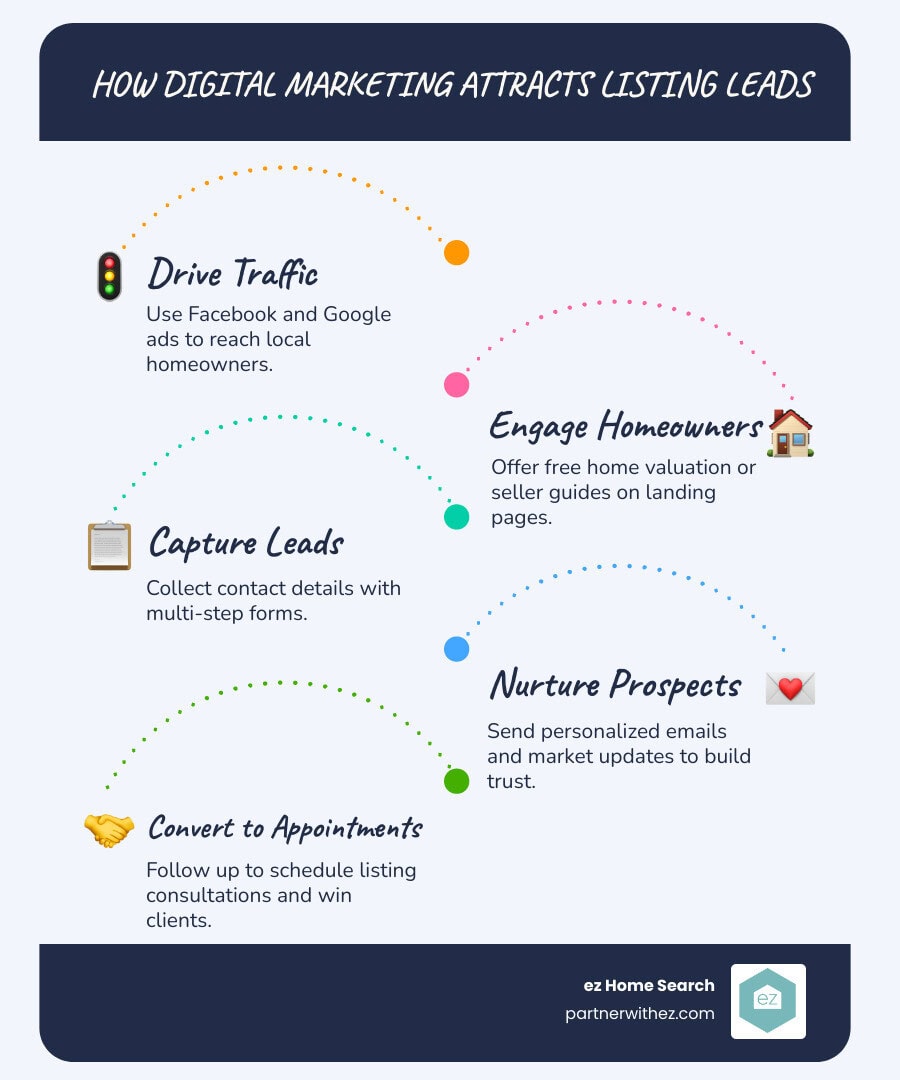
Let’s face it—today’s sellers are doing their homework online long before they ever pick up the phone to call an agent. That’s why your digital presence needs to be both compelling and strategic. The good news? You don’t need a massive budget to make an impact.
Home valuation landing pages have become the bread and butter of listing attraction. These dedicated pages offer homeowners something they genuinely want—insight into their property’s worth—while giving you a warm introduction. The most effective pages include benefit-driven headlines that speak to seller concerns, multi-step forms (which counter-intuitively increase completion rates by breaking the process into digestible chunks), and plenty of social proof from past clients.
Social media advertising delivers remarkable ROI when done right. Facebook ads for as little as $5 per day can target potential sellers based on geography, demographics, and even life events like marriage or retirement. As Kurt Uhlir at ez Home Search often says, “The beauty of Facebook targeting is that you’re reaching people at exactly the moment they’re considering life changes that typically involve real estate. Meta knows much more about their buying intent and stage of life than many platforms, and that information aids targeting ads.”
Instagram Story polls offer a surprisingly effective way to identify potential sellers hiding in plain sight. Simple questions like “Thinking of selling in the next 12 months?” or “Have you thought about what is happening in ____ today will impact what you can sell your home for in the Fall?” can spark conversations with followers who might not have volunteered this information otherwise.
One of the most innovative approaches I’ve seen gain traction is video CMAs. Rather than waiting for valuation requests, proactive agents are creating quick, personalized video market analyses for homeowners in target neighborhoods. One partner agent using this strategy generated over $11 million in listings within just six months—all from people who hadn’t initially expressed interest in selling.
Retargeting technology has revolutionized how we stay visible to potential sellers. Tools like Adwerx ensure that once someone visits your website, they’ll continue seeing your branding as they browse major news sites and social platforms. This consistent visibility builds familiarity and trust before you ever meet.
While digital strategies dominate conversations, traditional direct marketing still delivers powerful results when executed consistently. Just Sold postcards showcasing properties that sold above asking price or with minimal days on market create FOMO (fear of missing out) among neighbors. Market update mailers that share neighborhood-specific data demonstrate your local expertise in a tangible way that digital sometimes can’t match.
Precision Farming for Long-Term Dominance
Geographic farming—consistently marketing to a specific neighborhood—remains one of the most reliable paths to listing dominance. The key is selecting the right farm area using data, not just personal preference.
Start by calculating the turnover rate using this simple formula: (Homes sold in past 12 months ÷ Total homes) × 100. Look for neighborhoods with at least a 5% turnover rate to ensure sufficient listing opportunities. Then check the absorption rate: (Homes sold in past 12 months ÷ Homes currently on market) × 100. Target areas with rates above 20%, indicating strong buyer demand.
Finally, analyze the competition. The ideal farm has no agent capturing more than 20% of the listings. As Travis McClure of ez Home Search notes, “The best farm isn’t always the most prestigious neighborhood—it’s the one where you can realistically become the dominant agent within 12-18 months.”
Once you’ve selected your farm, consistency becomes your competitive advantage. Mail every 4-6 weeks without fail, including hyperlocal statistics, recent sales, and valuable neighborhood information. Make each piece worth keeping rather than immediately recycling.
Tech Stack to Stay Top-of-Mind
The right technology doesn’t replace personal connection—it amplifies it. A robust CRM with automation ensures no potential seller falls through the cracks. Video email tools like BombBomb help you stand out in crowded inboxes with personalized messages that convey your personality and expertise.
Home valuation tools like Homebot deliver monthly updates to homeowners in your database, keeping you connected through valuable information rather than sales pitches. For more sophisticated nurturing, ez Home Search’s ezNurture tool integrates with your CRM to deliver personalized content based on prospect behavior—sending different messages to empty nesters versus growing families.
With privacy regulations tightening, TCPA-compliant verification tools like ezVerify.ai ensure your outreach remains legal while enriching your contact data. As Nikki Pais at ez Home Search emphasizes, “Technology should improve your human connection, not replace it. The most successful agents use tech to scale their personal touch, not substitute for it.”
The agents who master both digital and direct marketing create a powerful ecosystem where potential sellers encounter their expertise across multiple channels. This consistent presence builds the trust and familiarity that ultimately leads homeowners to think of you first when they’re ready to list their most valuable asset.
Converting Leads to Signed Listings
Generating leads is only half the battle—converting them into signed listings requires strategic follow-up and presentation skills.
Leveraging Current Listings to Generate New Ones
Each active listing presents multiple opportunities to secure additional listings:
Pre-listing open house “happy hours”: Invite neighbors before the official listing to create buzz and identify potential sellers.
Door-knocking surrounding homes: Personally invite neighbors to your open house and use the opportunity to gauge their interest in selling.
Just Sold postcards: Mail 200-500 postcards to nearby homes highlighting successful sales statistics.
Neighbor calls: After listing a home, call 10-20 neighbors to share the news and ask if they know anyone else considering selling.
Sign riders with QR codes: Add riders to your yard signs that lead to neighborhood-specific valuation pages.
“Your current listings are your best marketing tool for getting future listings,” explains Kurt Uhlir. “Each listing should generate at least one additional listing opportunity if leveraged correctly.”
Building Instant Trust & Authority
New agents often struggle to build credibility with potential sellers. Here’s how to establish trust quickly:
Create a compelling listing presentation: Include:
- Market statistics and trends
- Your marketing plan and differentiators
- Testimonials from past clients
- Clear pricing strategy with data
Host educational events: Position yourself as an expert by hosting seminars on topics like:
- Downsizing strategies
- 1031 exchanges
- Renovation ROI
- Market trends
Develop professional referral relationships: Partner with:
- Divorce attorneys
- Estate planners
- Financial advisors
- Builders and contractors
Showcase your results: Create case studies of your successful listings, highlighting:
- Days on market compared to area average
- Sale price vs. list price
- Marketing strategies used
- Seller testimonials
Consistency is key in follow-up. It takes between 5 and 12 points of contact for someone to be interested in doing business with you. Create a systematic follow-up process that includes:
- Initial response within 5 minutes
- Personalized video or email within 24 hours
- Value-add content within 3 days
- Phone call within 1 week
- Regular check-ins every 2-3 weeks
Frequently Asked Questions About Getting Listings
Why are listings more profitable than working with buyers?
I often hear this question from newer agents wondering where to focus their energy. The truth is, listings create a foundation for long-term success in ways that buyer transactions simply can’t match.
When you work with sellers, you’re essentially running a business rather than chasing deals. Your time becomes your own again – listing appointments happen when you’re available, not when a buyer suddenly wants to see a home at 8 PM on a Saturday. This predictability allows you to build systems that scale your business.
“The agents who build sustainable careers focus on listings first,” explains Travis McClure from ez Home Search. “It’s not just about the transaction – it’s about the marketing leverage each listing provides.”
That leverage is powerful. Every yard sign, social media post, and open house markets you to potential clients. While your buyer transactions end when the keys are handed over, your listings continue generating opportunities long after closing. Plus, you’ll often capture the buyer side too, effectively doubling your commission without doubling your work.
Perhaps most valuable is the referral potential. Satisfied sellers become walking billboards for your business, often referring friends and family at a higher rate than buyer clients do.
How often should I mail my farm area?
Consistency trumps frequency every time when it comes to farm marketing. The magic number tends to be every 4-6 weeks – frequent enough to stay top of mind, but not so often that homeowners feel bombarded.
“I’d rather see an agent mail reliably every six weeks than sporadically every two weeks,” says Nikki Pais of ez Home Search. “Homeowners remember the agents who show up consistently over time.”
Your mailings should provide genuine value with each touch. Share hyperlocal market statistics that can’t be found on national websites. Highlight recent sales with specific details about marketing strategies that worked. Include neighborhood news that demonstrates your local expertise.
The goal isn’t just name recognition – it’s positioning yourself as the neighborhood authority. When homeowners receive thoughtful, valuable information from you month after month, you become the natural choice when they’re ready to sell.
Farming is a long game. Many agents give up too soon, but the real results typically appear after 12-18 months of consistent contact. Those who persist ultimately dominate their chosen neighborhoods.
What’s the best script for contacting an expired listing?
Expired listings represent immediate opportunities, but they also require a delicate touch. These homeowners are often frustrated, disappointed, and overwhelmed with agent calls. Standing out means leading with empathy rather than sales pressure.
The most effective approach focuses on problem-solving:
“Hi [Name], this is [Your Name] with [Your Brokerage]. I noticed your home at [Address] was recently on the market but didn’t sell. That can be frustrating, and I’m sure you’re getting a lot of calls from agents right now.
Rather than asking for a listing appointment, I’ve prepared an analysis of why your home might not have sold based on my review of the listing. It highlights three specific marketing strategies that weren’t used. I’d be happy to email this to you with no obligation whatsoever. Would that be helpful?”
This script works because it acknowledges their situation, differentiates you from other agents calling, and offers immediate value. You’re positioning yourself as a problem-solver rather than just another agent asking for business.
“The key is genuine curiosity about what happened,” explains Kurt Uhlir from ez Home Search. “When you approach expired listings with a desire to understand and help, rather than just to secure a listing, your conversion rates skyrocket.”
This approach also creates a natural reason for follow-up. After sending your analysis, you can check back to see if they have questions or want to discuss your findings further. Each conversation builds trust that can eventually lead to a listing appointment when the homeowner is ready.
For agents looking to systematize their expired listing approach, tools like ez Connect can help manage the follow-up process while maintaining that personal touch homeowners appreciate.
Conclusion
There’s no magic bullet for getting more real estate listings, but there is something better—a thoughtful, multi-layered approach that builds momentum over time. By implementing the seven strategies we’ve explored, you’ll create not just a temporary surge of listings but a sustainable pipeline that powers your business for years to come.
I’ve seen how agents transform their businesses when they shift from a scattershot approach to a systematic listing attraction strategy. The difference isn’t just in their income—it’s in their confidence, their work-life balance, and their ability to weather market shifts.
At ez Home Search, we built our platform specifically to solve the listings challenge that so many agents face. We recognized early on that the traditional lead model was fundamentally broken. When multiple agents are calling the same prospect who submitted their information on five different websites, nobody wins—not the agents racing to make contact, and certainly not the homeowner fielding a dozen calls.
“The traditional lead model creates a terrible experience for everyone involved,” says Travis Halverson. “We’ve completely reimagined how agents connect with potential sellers by providing exclusive territory rights. When you partner with us, you’re the only agent contacting these homeowners.”
Our county-based exclusivity model means you receive seller opportunities that aren’t being shopped to your competitors. This approach respects consumer privacy while dramatically increasing your conversion rates—because meaningful connections happen when conversations aren’t rushed by competition.
The platform combines everything you need to attract and convert listings: high-performance landing pages, behavior tracking that shows you exactly what properties prospects are viewing, nurture sequences that maintain contact without being pushy, and automated valuations that deliver ongoing value to homeowners.
Perhaps most importantly, we provide weekly coaching to help you implement the strategies we’ve covered in this guide. Because having the right tools is only half the equation—knowing how to use them effectively is what truly drives results.
Whether you’re just starting out or leading an established team, these approaches—paired with the right technology and support—can transform your listings challenge into your greatest opportunity for growth.
Ready to secure exclusive territory in your market and implement these strategies with our support? Visit partnerwithez.com to learn more about how we can help you get more real estate listings without the competition and frustration of traditional lead generation. For more information about our ez Connect accounts, visit ezconnect.info.

Preston Guyton has spent 20+ years helping people find the right home—and helping them avoid the costly mistakes that often come from not knowing their options. As the founder of ez Home Search, he’s leading the charge to build a better way to discover real estate—one that puts your privacy first, delivers accurate information, and gives you the confidence to make informed decisions. Preston has assembled a powerhouse team—made up of the innovators behind many of the technologies people use every day—to build the tools and transparency that deliver on a single mission: A Better Way To Discover Real Estate.