07.14.2025

Don’t Stress, Find Distressed: Your Guide to Locating Motivated Property Sellers

Finding Opportunity in Challenging Situations

Distressed property sellers are homeowners who need to sell their properties quickly due to financial hardship, foreclosure, bankruptcy, or other pressing circumstances. For real estate professionals looking to help these sellers while finding investment opportunities, here’s what you need to know:

  • Definition: Property owners facing urgent financial or personal pressure to sell quickly
  • Common situations: Foreclosure, bankruptcy, divorce, job loss, medical bills, inherited properties
  • Where to find them: Public records, pre-foreclosure lists, probate court, tax liens, code violations
  • How to approach: With empathy, transparency, and ethical communication

In today’s real estate market, identifying motivated sellers requires both strategic research and compassionate outreach. While these properties often sell below market value (sometimes up to 50% less), the most successful professionals approach these situations as problem-solvers rather than opportunists.

The key advantage of working with distressed properties is the potential for mutually beneficial outcomes – sellers receive relief from their financial burden while buyers secure properties with built-in equity.

I’m Preston Guyton, with over 20 years of experience helping real estate professionals develop ethical strategies for connecting with distressed property sellers while building sustainable business growth through targeted marketing and lead generation systems.
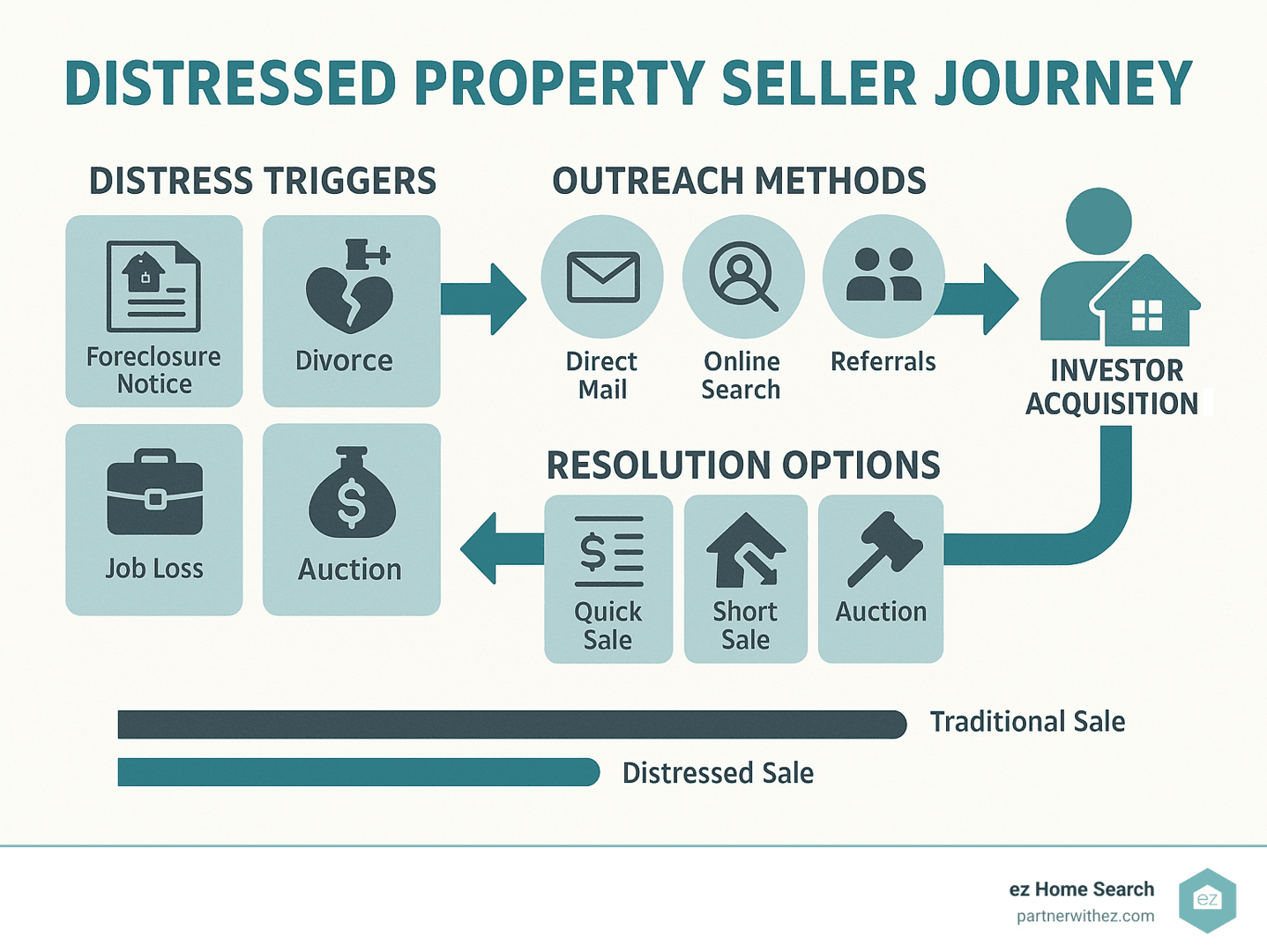
Distressed Property Seller Journey showing the progression from initial distress triggers (foreclosure notice, bankruptcy, divorce, job loss) through outreach methods (direct mail, online search, referrals) to resolution options (quick sale, short sale, auction) and finally to investor acquisition with timeline comparisons between traditional and distressed sales - distressed property sellers infographic

Understanding Distressed Property Sellers

Behind every distressed property is a human story – often one filled with unexpected challenges and difficult decisions. To connect meaningfully with distressed property sellers, you need to understand both the circumstances that create these situations and recognize how distress manifests in different ways.

“Understanding the human element behind distressed properties is crucial,” explains Kurt Uhlir, Chief Marketing Officer at ez Home Search. “These aren’t just transactions—they’re people facing some of life’s most challenging moments.”

A distressed property situation emerges when homeowners face significant financial pressure or when their property suffers from serious physical issues. This typically happens when maintaining mortgage payments becomes impossible or when property upkeep falls beyond their financial reach.

Why Homeowners Become Distressed

Life has a way of throwing curveballs that can quickly transform a stable homeownership situation into a distressed one.

Job loss often triggers the most immediate financial strain, suddenly making mortgage payments that were once manageable feel impossible. Similarly, divorce or separation forces difficult decisions about shared assets, frequently on compressed timelines that don’t allow for traditional market patience.

Medical emergencies represent another common path to distress – an unexpected diagnosis or accident can rapidly deplete savings and create overwhelming debt. Meanwhile, unpaid property taxes can result in tax liens that threaten ownership rights entirely.

Natural disasters introduce another dimension of distress, as property damage from floods, fires, or storms often exceeds insurance coverage. Inherited properties frequently become distressed when heirs lack the resources or ability to maintain them.

These situations create what real estate professionals call an “equity crunch” – where homeowners must liquidate quickly, often sacrificing their accumulated equity in exchange for speed and certainty.

Types & Stages of Distress

Distressed property sellers typically fall somewhere along a timeline of escalating urgency:

Pre-foreclosure represents the earliest stage, where homeowners have received a Notice of Default but still maintain ownership rights. This critical window offers the greatest opportunity for both the seller to avoid foreclosure’s full impact and for buyers to negotiate before banking institutions take control.

As the situation progresses, properties may enter the foreclosure auction phase, where they’ll be sold at public auction. The homeowner’s options narrow significantly at this point, though in some states, redemption periods still provide a final opportunity to reclaim the property.

Properties that fail to sell at auction become REO (Real Estate Owned) assets – bank-repossessed properties typically sold below market value as lenders seek to recover their losses quickly rather than maximize returns.

In short sale scenarios, lenders agree to accept less than the outstanding mortgage balance, helping homeowners avoid foreclosure’s most severe consequences while still facilitating a property transfer.

Bankruptcy introduces court oversight to the process, with properties often sold as part of broader debt resolution proceedings that require judicial approval for transactions.

Where to Find Distressed Property Sellers

Finding distressed property sellers requires detective work, relationship building, and systematic research. The real estate professionals who consistently connect with these motivated sellers aren’t just lucky—they’ve developed proven systems to identify opportunities before others.

real estate professional researching public records - distressed property sellers

Identifying Distressed Property Sellers Online

The digital revolution has transformed how we find properties in distress. Today’s savvy professionals leverage multiple online channels to identify sellers who need solutions quickly.

Public records have become a goldmine for finding distressed property sellers. County tax assessor websites reveal properties with delinquent taxes, while recorder offices publish Notices of Default and Lis Pendens filings. These early warning signs often appear months before a property reaches foreclosure.

The MLS system also contains hidden gems when you know what to look for. Properties described as “as-is,” “motivated seller,” or “needs TLC” often signal distress. Listings that have lingered for 90+ days with multiple price reductions typically indicate a seller growing increasingly desperate.

Specialized websites have made distressed property hunting more accessible than ever. Auction.com showcases foreclosure auctions, while the HUD Home Store lists FHA-foreclosed properties. Foreclosure.com aggregates pre-foreclosure listings, giving you a head start on properties not yet visible to the general public.

Data aggregation services like BatchLeads take the research to another level. These platforms allow you to filter for specific distress indicators such as high equity combined with pre-foreclosure status, absentee owners, or tax default status.

Local Networking & Field Research

While digital research is valuable, nothing replaces boots-on-the-ground investigation and community connections.

Driving for dollars remains one of the most effective techniques for finding distressed property sellers. By systematically exploring neighborhoods and looking for signs of neglect—overgrown lawns, boarded windows, accumulated mail—you can identify potential opportunities before they appear in any database.

Real estate investor associations (REIA) meetups connect you with a network of professionals who encounter distressed situations. Wholesalers, attorneys handling probate or bankruptcy cases, and contractors working in older neighborhoods can all become valuable sources of off-market opportunities.

Estate sales often signal inherited properties that heirs may want to sell quickly. These situations frequently lead to motivated sellers who live out of state and have little emotional attachment to the property.

“The most successful real estate professionals combine data-driven targeting with genuine relationship building in their communities,” says Nikki Pais of ez Home Search. “This balanced approach yields the highest quality distressed seller leads.”

Approaching and Communicating with Distressed Property Sellers Ethically

When working with distressed property sellers, your approach isn’t just about closing a deal—it’s about creating a lifeline for someone during one of life’s most challenging chapters. The way you communicate can transform a desperate situation into a path forward, both for the seller and for your business.

real estate professional meeting with homeowner - distressed property sellers

Communicating with Distressed Property Sellers Empathetically

Behind every distressed property is a human story—often one filled with unexpected hardship. Creating genuine connections begins with recognizing this reality.

Start with a thoughtful introduction that acknowledges their situation without presumption. “I’ve found that having a practiced but authentic conversation starter helps break the ice,” says Travis Halverson of ez Home Search. “The goal isn’t to sound robotic, but to ensure you’re respectful of their circumstances from the first hello.”

Building rapport comes before business. Take time to ask open-ended questions about their goals and listen—really listen—to their responses. When someone shares that they’re facing foreclosure after medical bills piled up, resist the urge to immediately pitch your solution. Instead, offer a simple “That sounds incredibly difficult. I appreciate you sharing that with me,” to validate their experience.

Active listening pays dividends in distressed property situations. When sellers feel truly heard, they’re more likely to consider your proposals. Take notes during conversations, summarize what you’ve heard to confirm understanding, and never rush them through explaining their situation.

Transparency builds trust. Be crystal clear about timelines, potential outcomes, and exactly how your process works. In distressed situations, surprises are the enemy. When sellers know exactly what to expect at each step, their anxiety decreases and cooperation increases.

Commit to the Good Neighbor Marketing Pledge in all your interactions—honoring opt-out requests immediately, maintaining strict confidentiality, and providing genuine value in every communication.

The path through distressed property transactions is lined with legal guardrails that protect both you and the seller.

Consumer protection laws create the framework for ethical communication. Before reaching out, familiarize yourself with TCPA regulations governing calls and texts, CAN-SPAM rules for email outreach, and CFPB guidelines on debt collection practices.

Thorough due diligence prevents nasty surprises for everyone involved. Order comprehensive title searches that reveal all liens and encumbrances, verify true ownership through county records, and check for bankruptcy filings that might complicate the sale.

Documentation creates clarity. Get everything in writing, maintain detailed records of all communications, and use disclosure forms specifically designed for distressed sales. When situations become complex—as they often do with bankruptcy or probate complications—having an attorney review your agreements is money well spent.

Understanding lender requirements is essential, particularly in short sale scenarios. Each lender has specific documentation needs, deficiency judgment approaches vary by state, and court approval may be required in certain circumstances.

Benefits & Risks for Buyers & Investors

Working with distressed property sellers presents a fascinating mix of opportunities and challenges. When you understand both sides of this investment equation, you’re better positioned to set realistic expectations and steer potential obstacles with confidence.
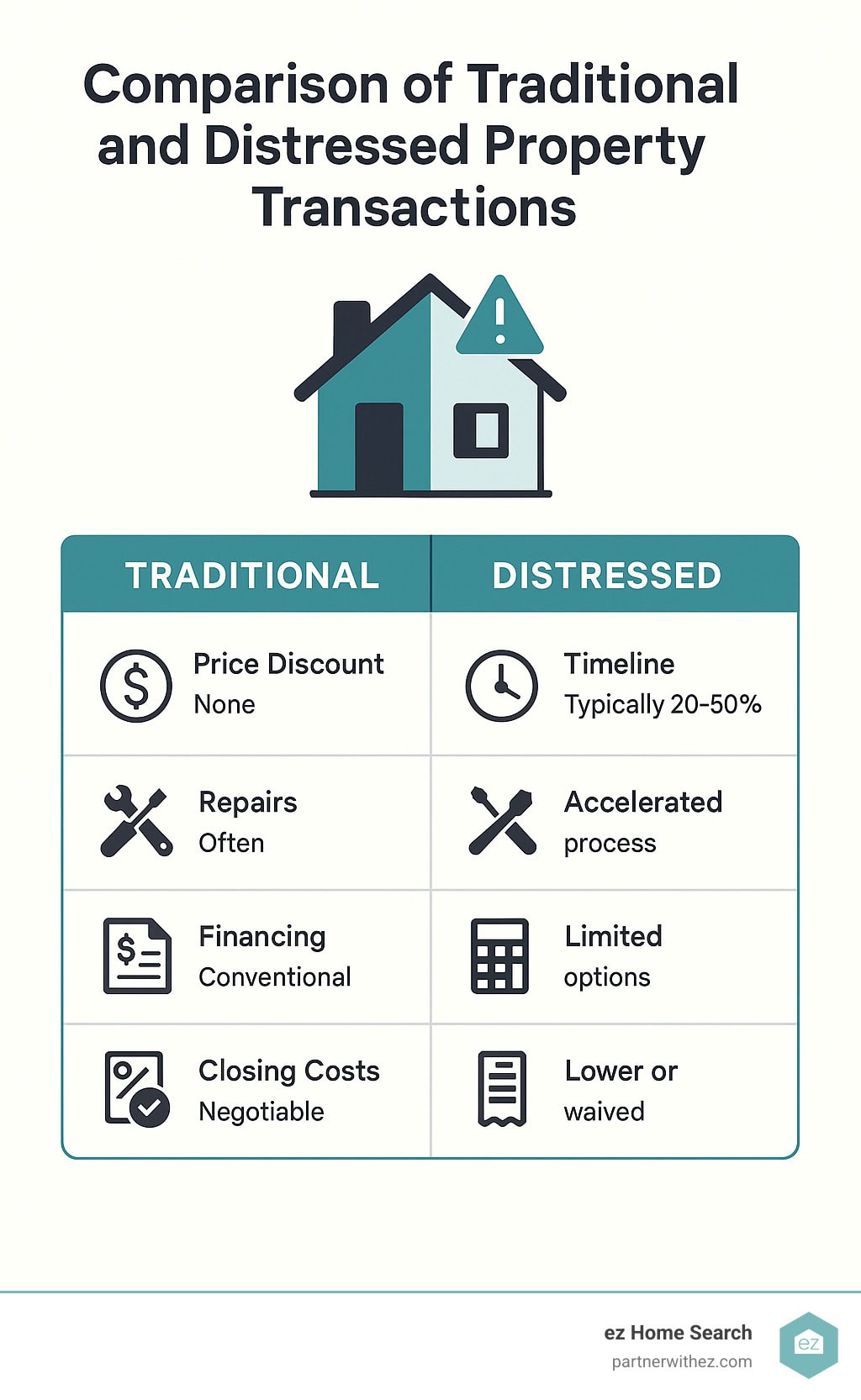
Comparison chart showing key differences between traditional and distressed property transactions, including price discounts, timeline acceleration, repair requirements, financing options, and closing cost variations - distressed property sellers infographic

Benefits of Purchasing Distressed Properties

The financial upside of working with distressed property sellers can be substantial. These properties typically sell for 10-50% below market value, essentially creating instant equity the moment you close. This discount isn’t just good fortune—it’s the natural result of the seller’s urgent timeline meeting your prepared investment strategy.

What many people don’t realize is that distressed properties often have less competition. While other buyers are chasing perfect move-in ready homes, prepared investors find opportunities others overlook.

The speed factor can’t be overstated either. While traditional transactions might drag on for 30-90 days, distressed sales can close in as little as 7-14 days. This acceleration benefits both parties—sellers get their needed resolution, and buyers can move quickly to implementation of their investment strategy.

The value-add potential is another compelling advantage. Properties in poor condition offer renovation opportunities that, when executed well, can dramatically increase the property’s worth.

Risks and Challenges

Of course, these opportunities come with corresponding challenges. The “as-is” nature of most distressed properties means you’re often buying with limited inspection opportunities. What looks like a cosmetic fixer-upper might hide significant structural issues that could blow your budget.

Title complications are another common hurdle. Distressed property sellers may have accumulated liens, judgments, or other title clouds that require resolution before a clean transfer can occur. A thorough title search becomes not just recommended but essential.

Traditional financing can be particularly challenging with these properties. Banks typically shy away from properties in poor condition, which means you’ll need alternative funding sources like hard money loans, private financing, or substantial cash reserves.

The emotional component shouldn’t be underestimated either. You’re often dealing with people going through one of the most stressful periods of their lives. This requires genuine empathy and exceptional communication skills—a transactional approach rarely succeeds in these sensitive situations.

The greatest risk in distressed property transactions isn’t usually the property itself—it’s insufficient preparation. Successful investors develop systems to quickly evaluate opportunities and mitigate risks.

Step-By-Step Acquisition Strategies

Developing a systematic approach to acquiring properties from distressed sellers helps you act decisively when opportunities arise. Here’s a proven framework for success:

auction gavel and property documents - distressed property sellers

1. Prepare Your Financing

Before you even reach out to distressed property sellers, make sure your financial ducks are in a row. Nothing derails a potential deal faster than scrambling for money when an opportunity presents itself.

Having cash position is ideal – liquid funds or at least proof of funds letters show sellers you mean business. Many successful investors establish relationships with hard money lenders who specialize in distressed properties and understand the unique timelines involved.

Build their financial toolkit before they need it. When a distressed seller is facing foreclosure next week, they need solutions today, not after you’ve spent two weeks hunting for financing.

Beyond traditional options, consider developing a network of private money investors who can fund deals quickly. Bridge loans can also provide short-term financing for rapid closings, giving you time to arrange more permanent solutions afterward.

2. Build Your Team

Successful distressed property acquisition isn’t a solo sport. You need specialists who understand the unique challenges these transactions present.

Your title company should have specific experience with distressed properties and the complications they often bring. Similarly, a real estate attorney with foreclosure and bankruptcy expertise can steer legal problems that might derail less experienced professionals.

Find a home inspector who can quickly assess major issues without getting bogged down in minor details. Time is often critical in these deals, and you need someone who can identify the big-ticket problems efficiently.

Develop relationships with reliable contractors who can provide accurate repair estimates on short notice. Your insurance agent should understand policies for vacant or damaged properties.

3. Develop Your Acquisition Strategy

Different distress situations call for custom approaches. For pre-foreclosure properties, direct contact with homeowners through letters or calls can open doors. Present clear options including cash offers or short sale assistance, and if appropriate, be prepared to negotiate with lenders for short sale approval. The key is closing quickly to help sellers avoid foreclosure.

When targeting auction properties, do your homework before bidding day. Drive by properties, conduct title searches, and set maximum bids based on after-repair value minus repairs and profit. Arrive prepared with cashier’s checks or proof of funds, and thoroughly understand auction rules and redemption periods in your area.

For bank-owned (REO) properties, working with agents who specialize in these listings gives you an edge. Submit offers with minimal contingencies and prepare for as-is purchases with limited disclosures.

4. Make the Offer

When approaching distressed property sellers, how you structure your offer can make all the difference.

Start by determining your maximum price using a simple formula: calculate the After Repair Value (ARV), then subtract estimated repair costs, holding costs (financing, utilities, taxes), and your desired profit margin. The result is your maximum offer price.

The most successful investors know their numbers cold. They can walk through a property and quickly calculate what they can offer while still making the deal work for everyone involved.

Present your offer professionally using written purchase agreements and include proof of funds or pre-approval letters. Minimize contingencies when possible and offer flexible closing timelines to accommodate seller needs.

Frequently Asked Questions about Distressed Property Sellers

How do I spot a distressed seller before foreclosure?

Catching signs of distress before a property enters foreclosure is a bit like being a detective – you’re looking for clues that others might miss.

The paper trail often tells the first part of the story. Check public records for Notice of Default filings, properties with tax delinquencies, or Lis Pendens notices (which indicate pending lawsuits). These official documents are usually the earliest written evidence of financial trouble.

But sometimes the property itself speaks volumes. Drive by and look for the visual cues: overgrown lawns that haven’t seen a mower in months, peeling paint that’s been neglected, or accumulated mail spilling from the mailbox. These physical signs often appear before any official paperwork.

Behavioral patterns matter too. A homeowner who’s missed several HOA payments, suddenly lists their property well below market value, or shows signs of financial distress while still living in the property might be approaching a distressed situation but hasn’t yet entered formal foreclosure.

Is buying from distressed property sellers always cheaper?

The short answer? Not always – though it certainly can be.

While distressed property sellers often need to sell below market value, several factors influence just how good a deal you’ll actually get.

In hot markets, you might find yourself in a bidding war with other investors, erasing much of the potential discount. I’ve seen properties in desirable neighborhoods attract multiple cash offers despite their distressed status, pushing the final price much closer to retail value.

Property condition plays a huge role too. That 30% discount might not seem so great when you find the property needs a new roof, foundation work, and has an active termite infestation! The most successful investors carefully calculate rehabilitation costs before celebrating any apparent bargain.

Title issues can quickly eat into your profits as well. Resolving liens, judgments, or clearing title defects often requires legal expenses that weren’t part of your initial calculations.

What ethical rules should I follow when making an offer?

Working with distressed property sellers requires walking a careful line between finding a good investment and treating people fairly during difficult times.

Transparency should be your guiding principle. Clearly explain all options available to the seller – not just the ones that benefit you. This might mean discussing loan modification programs or other alternatives to selling if those truly serve the seller better.

While seeking a discount makes business sense, avoid predatory pricing that exploits extreme distress. The most sustainable business model comes from fair deals where both parties benefit, not just you.

Be upfront about your intentions for the property. If you’re planning to flip it for a profit, say so. Honesty builds trust, even in challenging circumstances.

“At ez Home Search, we believe ethical business practices and profitability go hand in hand,” emphasizes Kurt Uhlir. “Our most successful partners build sustainable businesses by prioritizing seller well-being alongside their (or their clients’) investment goals.”

Conclusion

Finding and connecting with distressed property sellers is both an art and a science. It requires genuine empathy alongside strategic research and systematic processes. The most successful real estate professionals understand that these situations aren’t just investment opportunities—they’re chances to provide real solutions to homeowners facing difficult circumstances.

When you approach distressed property situations with respect and transparency, you create those rare win-win scenarios that benefit everyone involved. These properties can close in just 7-14 days compared to the typical 30-90 day timeline of traditional sales. This provides sellers with quick relief from their financial burden while giving buyers valuable investment opportunities with built-in equity.

At ez Home Search, we believe in empowering real estate professionals with the right tools and support to work ethically and effectively with distressed property sellers. What makes our approach unique is our county-based exclusivity model. This ensures our partners receive exclusive access to motivated sellers in their territory—eliminating the frustration of lead competition while protecting consumer privacy.

Our platform combines several powerful elements to help you identify and connect with sellers at exactly the right moment:

  • Real-time behavioral data tracking that spots early signs of seller distress
  • CRM-integrated nurture flows that maintain relationships until sellers are ready
  • TCPA-compliant verification systems that ensure legal compliance

Ready to transform how you find and work with growth engine while making a positive impact in your community? Learn more about our partnership opportunities or connect with us through ez Connect to find how our county-based exclusivity model can help grow your business the right way.

07.11.2025

How to Create a Real Estate Sales Pipeline That Actually Works

Why Every Real Estate Professional Needs a Structured Sales Pipeline

A real estate sales pipeline is a visual system that tracks potential clients through every stage of the buying or selling process, from initial lead to closed transaction. Here’s what it includes:

  • Lead stages: New lead → Contacted → Qualified → Under contract
  • Transaction stages: Listed in MLS → Offer accepted → Active closing → Closed
  • Post-closing: Long-term nurture for referrals and repeat business
  • Key metrics: Conversion rates, deal velocity, and pipeline coverage

An active, organized pipeline is crucial for your success as an agent – it lets you see every deal stage, forecast outcomes, and focus on the right opportunities at the right time.

The numbers tell the story. Research shows you’re 3,000 times less likely to reach potential clients if you wait just five hours after the lead was generated. Meanwhile, approximately 20% of your leads will provide 80% of your revenue, making it essential to identify and prioritize your hottest prospects quickly.

Yet many agents still rely on spreadsheets, sticky notes, or memory to track their deals. This approach works when you have fewer than 10 active prospects, but it breaks down fast as your business grows. Without clear visibility into your pipeline, promising leads slip through the cracks and revenue becomes unpredictable.

The solution isn’t just any CRM – it’s a real estate sales pipeline specifically designed around how property transactions actually work. Unlike generic sales processes, real estate involves dual-sided markets (buyers and sellers), extended timelines, and complex post-closing relationships that can generate referrals for years.

I’m Preston Guyton, and over my 20+ years in real estate leadership, I’ve helped teams build sustainable real estate sales pipelines that convert leads into closed deals consistently. Through ez Home Search and our technology partnerships, I’ve seen how the right pipeline structure can transform a chaotic lead flow into predictable revenue growth.

Comprehensive real estate sales pipeline flow showing lead generation through post-closing nurture stages with conversion metrics and automation touchpoints - real estate sales pipeline infographic

What Is a Real Estate Sales Pipeline & Why You Need One

Picture this: You’ve got 15 active prospects, three listings about to expire, two deals in escrow, and a stack of business cards from last weekend’s open house. Without a system to track it all, even the most organized agent starts dropping balls.

That’s exactly why you need a real estate sales pipeline.

A real estate sales pipeline is your visual command center that tracks every potential client from their first inquiry all the way through closing—and beyond. It’s like having a GPS for your business that shows you exactly where each deal stands and what needs to happen next.

Here’s what makes it so powerful: complete visibility into your business. No more wondering if you followed up with that buyer from two weeks ago or scrambling to remember which seller was ready to list. Every prospect has a clear stage and next action.

The second game-changer is predictable revenue. When you track how leads move through each stage, patterns emerge. Maybe 40% of your qualified buyers close within 60 days, or 25% of your listing appointments result in signed agreements. These insights let you forecast income with surprising accuracy.

According to the Lead Response Management study, agents who respond to leads within the first hour are nearly 7 times more likely to qualify them compared to waiting even one more hour. A structured pipeline ensures you never miss these critical windows.

But here’s the part most agents overlook: the post-closing opportunity. Research shows that around 90% of buyers and 87% of sellers would use their agent again, but only about 12% actually do without proper follow-up. Your pipeline shouldn’t end at closing—it should include long-term nurture stages that turn one transaction into years of referrals and repeat business.

Travis McClure, our Chief Operating Officer at ez Home Search, puts it perfectly: “The agents who scale aren’t necessarily the best at closing deals—they’re the best at systematically moving prospects through a repeatable process.”

Pipeline vs Funnel: Key Differences

Most agents use these terms interchangeably, but understanding the difference will make your business more effective.

Your sales pipeline is your internal process view—it shows exactly where each prospect sits and what you need to do next. When you see “Under Contract” in your pipeline, you know to schedule inspections and coordinate with lenders.

A sales funnel represents your customer’s mindset and journey from awareness to purchase. It’s more about volume and conversion rates at each stage.

Think of it this way: the pipeline is your operational roadmap with clear stage definitions. The funnel helps you understand the customer mindset. Both views matter, but your pipeline is where the daily work happens—and where deals get won or lost.

The Standard Stages of a Real Estate Sales Pipeline

When you’re building a real estate sales pipeline, you need to understand that it’s not just a simple funnel like other businesses use. Real estate is complex, with multiple moving parts, different client types, and relationships that can span decades.

A comprehensive real estate sales pipeline typically includes 13 distinct stages that guide prospects from that first “hello” to long-term relationship gold. Think of it like a roadmap that shows you exactly where each client stands and what needs to happen next.

kanban board showing real estate pipeline stages - real estate sales pipeline

Here’s how these stages flow through your client’s journey:

At the top of your funnel, you’re dealing with early engagement. This includes your New Lead stage where someone first reaches out, Contacting – those crucial first outreach attempts, Engaging when you establish real two-way conversation, and Qualified when you’ve confirmed their budget, timeline, and actual needs.

The middle of your funnel is where the real action happens. For sellers, this starts with Under Contract when they sign your listing agreement, then Listed in MLS where their property gets actively marketed. For buyers, you’ll see Offer Made when they submit a purchase offer, followed by Offer Accepted when both parties agree on terms.

Bottom-of-funnel stages focus on transaction management. Active Closing covers inspections, appraisals, and financing progress. Closing Scheduled means the final walkthrough and signing date are set. Closing Complete is your successful transaction.

But here’s where most agents miss the boat – the post-transaction stages. Long-Term Nurture involves ongoing relationship maintenance that can generate referrals for years. And yes, you need a Lost stage for deals that fall through or prospects who go elsewhere.

Generic Sales PipelineReal Estate Sales PipelineKey Difference
ProspectNew LeadReal estate leads often come from multiple sources simultaneously
QualifiedQualified + Under ContractTwo-step qualification: financial ability + commitment to transact
ProposalListed in MLS / Showing Homes“Proposal” is either listing the home or presenting suitable properties
NegotiationOffer Made/AcceptedReal estate negotiation is often multi-round with inspection/appraisal contingencies
ClosedClosing CompleteReal estate closing involves title transfer, not just contract signing
N/ALong-Term NurtureReal estate relationships can generate referrals and repeat business for decades

Early-Funnel Activities: Prospecting & Speed-to-Lead

The top of your real estate sales pipeline is where everything begins – and frankly, where most agents either win or lose the game. You’ve probably heard the statistic that you’re 3,000 times less likely to reach potential clients if you wait just five hours after they inquire. Speed really is everything.

Lead sources come from everywhere these days. Your website inquiries, social media campaigns, referrals from past clients, open houses, sign calls, and third-party sites where people browse properties. Your sphere of influence often provides the highest-converting leads.

The moment a lead hits your system, they should automatically move to your “Contacting” stage. This triggers immediate outreach, ideally within 5 minutes for hot leads. Lead scoring becomes crucial here because not all leads are created equal. You want to quickly identify your hot leads – people looking to buy in the next 30 days who are pre-approved.

Mid-Funnel Milestones: Showings to Negotiation

Once you’ve got qualified, engaged prospects, the middle stages of your real estate sales pipeline become very different depending on whether you’re working with buyers or sellers.

For buyers, you’re scheduling property showings, providing market analysis, and guiding them through offer preparation. For sellers, you’re completing your listing presentation to secure the agreement, then coordinating staging, photography, and marketing materials.

During negotiations, track more than just whether an offer was made. Document the specific terms, financing type, and contingencies. This data helps you coach future clients and improve your success rates over time.

Bottom-Funnel & Beyond: Closing and 8-Year Follow-Up

The final stages of your real estate sales pipeline involve transaction management and what I call the “goldmine stage” – post-closing relationship management.

Active closing requires you to coordinate inspections and appraisals, monitor financing progress with lenders, handle repair negotiations, and schedule final walkthroughs.

But here’s where the real magic happens: post-closing nurture. While 90% of clients say they’d use their agent again, only 12% actually do without consistent follow-up. The most successful agents implement an 8-year automated follow-up system including satisfaction check-ins, market updates, anniversary cards, and home maintenance tips.

Why 8 years? That’s the average time homeowners stay in their homes before moving again. One properly nurtured client can generate 3-5 referrals over those years if you maintain the relationship correctly.

Building & Customizing Your Real Estate Sales Pipeline

Building your perfect real estate sales pipeline is like designing a custom home – it needs to fit exactly how you work, not how someone else thinks you should work. The most successful agents don’t copy generic templates. Instead, they map their actual client journey into a system that makes sense for their business.

Start by looking at your last 10 closed deals. What path did they actually take from first hello to final handshake? This real-world data becomes your pipeline blueprint.

Here’s where things get interesting. County-based exclusivity changes everything about how you can build your pipeline. When you’re not fighting three other agents for the same lead, you can invest in deeper relationships and longer nurturing cycles. You can actually afford to be patient with prospects because you know your time investment won’t be wasted when they suddenly choose a competitor.

Through ez Home Search’s exclusive territory model, our partners can build sophisticated pipelines focused on relationship-building rather than quick conversions. This exclusivity lets you think strategically about each stage instead of rushing prospects toward a decision before someone else swoops in.

Real estate pipeline customization flow showing different paths for buyers, sellers, and investors with automation triggers and decision points - real estate sales pipeline infographic

Mapping Your Real Estate Sales Pipeline to Your Business Model

Your real estate sales pipeline should feel natural, not forced. The biggest mistake I see agents make is trying to squeeze their business into someone else’s system instead of building workflows that match their strengths.

Buyer and seller pipelines need different approaches because the processes are completely different. Your buyer pipeline might flow from qualified prospect to pre-approved to showing homes to offer submitted to under contract. Meanwhile, your seller pipeline runs from listing presentation to MLS listing to offer received to accepted to closing.

Don’t try to force both into the same stages – it creates confusion and missed opportunities.

Dual-deal situations require special attention. When someone’s both buying and selling, create separate pipeline records but link them to the same contact. Investment clients operate differently than traditional homebuyers with faster decision timelines and different financing requirements.

Automating Touchpoints Without Losing the Human Touch

The magic of automation in your real estate sales pipeline isn’t replacing personal connection – it’s making sure you never miss an opportunity to create one. Think of automation as your personal assistant, handling routine tasks so you can focus on conversations that matter.

Early pipeline automation ensures speed-to-lead compliance. When a new prospect hits your website, they should immediately receive a personalized welcome message and you should get an instant task reminder. Our ezVerify.ai tool automatically enriches this lead data while ensuring TCPA compliance.

Mid-pipeline automation keeps deals moving smoothly. When a listing goes under contract, your system should automatically generate your closing checklist and schedule key milestone reminders.

Post-closing automation is where the real money lives. Most agents celebrate the closing and then forget about their clients. Smart agents use automated anniversary cards, market reports, and maintenance reminders to stay top-of-mind for referrals.

The tools we’ve integrated through ez Home Search, including ezNurture and Follow Up Boss, understand real estate timing. They help you maintain relationships at scale without losing the personal touch that makes real estate relationships special.

Tools, Software & Automation Stack That Scales

Building a real estate sales pipeline that grows with your business requires the right technology foundation. I’ve seen too many talented agents hit a wall because they tried to scale with sticky notes and spreadsheets. The difference between agents who breakthrough and those who plateau often comes down to their systems.

technology stack diagram for real estate sales pipeline - real estate sales pipeline

Your customer relationship management system forms the heart of your pipeline. The most effective systems offer visual pipeline dashboards that work like Kanban boards – you can see every deal at a glance and move them between stages with simple drag-and-drop actions.

The game-changing features to prioritize include automated lead assignment and routing, task management with follow-up reminders that prevent leads from going cold, and seamless email and SMS integration that keeps all communication in one place. Mobile access is non-negotiable since so much of real estate happens away from your desk.

Your CRM should connect smoothly with the other tools you use daily. IDX websites need automatic lead capture that flows directly into your pipeline stages. Email marketing platforms should trigger based on pipeline movement.

Modern real estate sales pipelines benefit tremendously from artificial intelligence features. Lead scoring based on behavior and engagement helps you prioritize your time on the hottest prospects. Automated response suggestions for common inquiries speed up your communication without losing the personal touch.

At ez Home Search, our ezVerify.ai tool demonstrates how AI can improve rather than replace human expertise. It automatically verifies lead information, enriches contact data, and ensures TCPA compliance – all while maintaining the privacy-first approach our partners value.

One of the most valuable features in any pipeline system is “deal rotting” alerts. These automatically flag leads that haven’t been contacted recently or deals that have stalled in a particular stage.

Must-Track Metrics for a Healthy Real Estate Sales Pipeline

A healthy real estate sales pipeline moves deals swiftly through each stage, creating predictable revenue and high conversion rates. But you can’t manage what you don’t measure, so tracking the right metrics becomes essential for sustainable growth.

Conversion rates by stage tell you where your pipeline is strongest and where it needs work. Your new lead to contacted rate should hit 90% within 24 hours. The contacted to qualified conversion typically runs 20-30% for most lead sources. From qualified to under contract, target 40-60% depending on your market conditions.

Pipeline velocity measures how quickly deals progress through your stages. Hot leads should be contacted within an hour, then qualified through 1-3 conversations over 7-14 days. Under contract to closed typically takes 30-45 days.

Your pipeline coverage should contain 3-4 times your monthly sales goal in qualified opportunities. If you need two closings per month, maintain 6-8 qualified prospects in active stages.

Lead age analysis prevents prospects from languishing too long without action. Hot leads should convert or be disqualified within 30 days. Warm leads deserve consistent nurturing for 3-6 months.

Common Mistakes & How to Avoid Them

Even well-intentioned agents make pipeline management mistakes that cost them deals and referrals. After working with hundreds of real estate professionals, I’ve seen these patterns repeatedly.

Vague stage definitions create the most common problem. Agents create stages like “Following Up” without clear advancement criteria. The solution is defining specific exit criteria for each stage. “Qualified” should mean the prospect has confirmed budget, timeline, and area preferences.

Many agents rely too heavily on spreadsheets long after they’ve outgrown them. Spreadsheets work fine for fewer than 10 active deals, but they become unwieldy as your business grows. Invest in a proper CRM when you consistently manage more than 15-20 active prospects.

Over-automation creates another common pitfall. Some agents automate everything, creating impersonal experiences. Use automation to trigger human actions, not replace them.

The biggest missed opportunity is neglecting post-closing stages. Since 90% of clients would use their agent again but only 12% do without follow-up, this represents massive lost revenue. Build post-closing nurture into your pipeline as a standard stage.

Inconsistent data entry makes automation impossible. Establish data entry standards and train your team on consistent practices. Tools like ezVerify.ai automatically enrich and standardize contact data, reducing manual errors while ensuring compliance.

Frequently Asked Questions about the Real Estate Sales Pipeline

How often should I review and update my pipeline?

The frequency of your real estate sales pipeline reviews can make or break your business momentum. Think of it like tending a garden – neglect it too long, and weeds take over.

Your daily pipeline check should be a quick 10-15 minute morning ritual. Scan for new leads that came in overnight, check for any overdue tasks, and identify deals that need immediate attention.

Weekly reviews are where the real magic happens. Block out 30-45 minutes every Friday afternoon to examine deal progression, identify stalled opportunities, and plan your upcoming week’s priorities. Look for patterns: Are deals consistently getting stuck at the same stage?

Monthly deep dives should focus on the bigger picture. Analyze your conversion rates, average time in each stage, and overall pipeline health. This is when you’ll spot trends that require process improvements.

Quarterly strategic reviews are about evolution, not just evaluation. Markets change, consumer behavior shifts, and your pipeline should adapt accordingly. Review stage definitions, automation rules, and integration effectiveness.

What metrics matter most at each stage?

Different stages of your real estate sales pipeline require different success metrics – trying to measure everything at once is like trying to watch five TV channels simultaneously.

In the early stages from new lead to qualified prospect, speed is your superpower. Response time under five minutes for hot leads isn’t just a nice-to-have – it’s the difference between connecting with motivated prospects and watching them move on to the next agent.

The middle stages from qualified to under contract are all about conversion efficiency. For buyers, monitor your showing-to-offer ratio. For sellers, track your listing-to-offer ratio and average days on market.

Late-stage metrics focus on deal security and client satisfaction. Your fall-through rate should stay under 15% in normal markets. Track average days to closing and client satisfaction scores.

Post-closing metrics are often overlooked but incredibly valuable. Monitor your referral generation rate, repeat client percentage, and long-term relationship maintenance consistency.

How do I balance closing deals with continuous prospecting?

This question keeps more agents awake at night than market fluctuations and interest rate changes combined. The challenge is real: focus too much on current deals, and your pipeline dries up; spend too much time prospecting, and current clients feel neglected.

The 80/20 principle works beautifully here. Dedicate 80% of your energy to deals likely to close in the next 30-60 days, and 20% to prospecting and long-term relationship building.

Scheduled prospecting time is non-negotiable. Block out specific hours each week for lead generation activities. Treat these appointments as seriously as client meetings.

Pipeline coverage provides your safety net. Maintain 3-4 times your monthly goal in qualified prospects. If you need two closings per month, keep 6-8 qualified opportunities active at all times.

Technology becomes your multiplication factor. Use automated nurture campaigns through tools like ezNurture to maintain relationships with prospects not ready to transact immediately. Our ezVerify.ai tool automatically enriches lead data and maintains compliance, freeing you to focus on relationship building.

The key insight? Prospecting and closing aren’t competing activities – they’re complementary parts of a sustainable business model.

Conclusion

Building a successful real estate sales pipeline isn’t just about organizing your leads – it’s about changing how you approach relationships and revenue in this business. When you shift from chasing deals to systematically nurturing them, everything changes.

The research we’ve explored tells a powerful story. You’re 3,000 times less likely to connect with prospects after just five hours, which means your pipeline needs to trigger immediate action. Meanwhile, 20% of your leads will generate 80% of your revenue – but only if you can identify and prioritize them quickly. Perhaps most importantly, 90% of clients would use their agent again, but only 12% actually do without proper follow-up systems.

These aren’t just statistics – they represent real money left on the table every day by agents who haven’t built systematic processes.

What makes ez Home Search different is our understanding that effective pipelines need the right foundation. County-based exclusivity means you’re not competing for the same leads, so you can invest in longer-term relationship building without worrying about competitors undercutting your efforts. This exclusivity allows for the kind of sophisticated nurturing that turns one transaction into years of referrals.

Our integrated approach combines pipeline-friendly technology with relationship-focused strategy. Tools like ezNurture handle the automated touchpoints that keep prospects engaged, while ezVerify.ai ensures your data stays clean and compliant. The result is a real estate sales pipeline that actually supports human connections rather than replacing them.

As Travis McClure, our Chief Operating Officer, puts it: “Process is king in real estate sales.” Your pipeline makes that process visible, measurable, and scalable. It’s the difference between hoping for your next closing and knowing exactly where it’s coming from.

Whether you’re a solo agent looking to systematize your approach or a team leader seeking predictable growth, the combination of structured processes and privacy-first technology creates sustainable competitive advantages. Your pipeline becomes your growth engine – consistently converting prospects into clients and clients into long-term relationships.

Ready to build a real estate sales pipeline that actually delivers results? Our ez Connect platform at https://www.ezconnect.info provides the foundation for systematic lead management within our exclusive territory system. Combined with our integrated automation tools and weekly coaching support, you’ll have everything needed to scale consistently.

The agents who thrive in today’s market aren’t necessarily the ones with the most leads – they’re the ones with the best systems for converting those leads into lasting relationships. Your pipeline is where that change happens.

For more information about partnering with ez Home Search and accessing our complete pipeline-building resources, let’s build your systematic approach to real estate success together.

07.11.2025

Smart Cold Calling for Real Estate: Proven Tactics for Agents Who Want Results, Not Burnout

Why Cold Calling Real Estate Leads Still Works When Done Right

Cold calling real estate leads remains one of the most direct ways to generate quality prospects, but success depends on strategy, not just volume. Here’s what you need to know:

Key Cold Calling Metrics:

  • 28% of real estate cold calls are answered
  • 1% convert to actual appointments
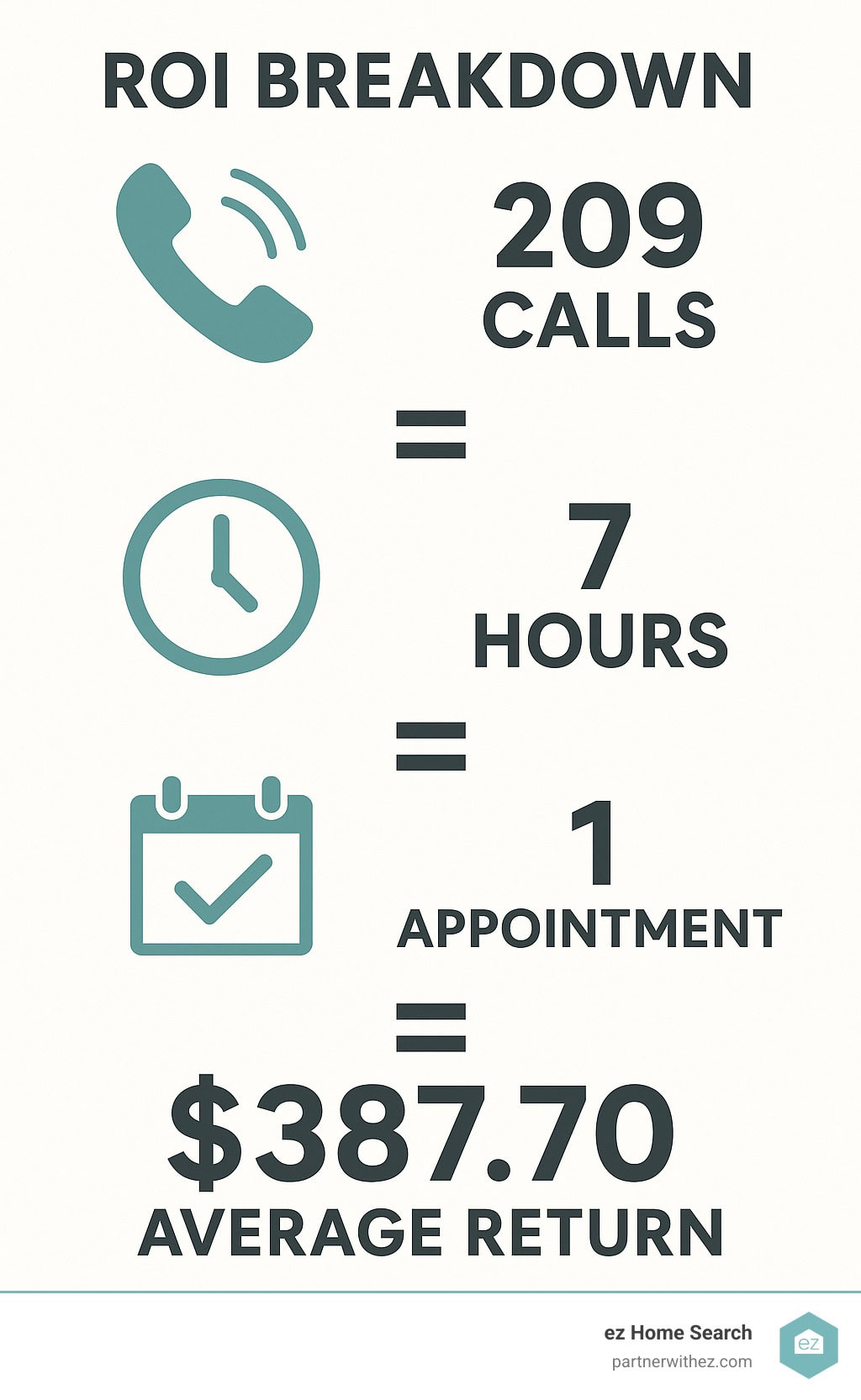
  • 209 calls needed on average to set one appointment
  • $387.70 estimated ROI per hour for residential agents
  • 4.82% meeting-booking success rate when done correctly

Essential Success Factors:

  • Target specific lead types (expired listings, FSBOs, circle prospecting)
  • Use proven scripts custom to each situation
  • Call during optimal windows (10 AM-2 PM, 4-5 PM)
  • Maintain strict legal compliance with TCPA and Do Not Call rules
  • Track metrics and refine approach based on results

The challenge isn’t that cold calling doesn’t work – it’s that most agents approach it wrong. They make random calls without research, use generic scripts, ignore optimal timing, and give up after minimal follow-up.

Smart agents focus on quality over quantity. They target motivated sellers, prepare conversation frameworks instead of rigid scripts, and integrate calling into broader lead nurturing systems.

The biggest missed opportunity? Most agents never graduate beyond basic cold calling to exclusive lead partnerships that eliminate competition and provide higher-intent prospects.

I’m Preston Guyton, and over my 20+ years in real estate, I’ve helped thousands of agents refine their approach to cold calling real estate leads through better targeting, scripts, and follow-up systems. My experience building lead generation platforms has shown me that while cold calling works, exclusive partnerships often deliver better ROI with less effort.

Infographic showing cold calling workflow: Lead identification → Research & preparation → Scripted outreach → Objection handling → Appointment setting → CRM follow-up → Conversion tracking - cold calling real estate leads infographic

Cold Calling Real Estate Leads: Core Principles & Common Pitfalls

phone metrics dashboard showing call analytics - cold calling real estate leads

The reality of cold calling real estate leads is both encouraging and sobering. While 57.7% of real estate agents rank telemarketing as their best lead-generation strategy, the execution gap between average performers and top producers is massive.

The Numbers Behind Cold Calling Real Estate Leads

Let’s break down what the data actually tells us about cold calling effectiveness:

Answer Rates and Conversion:

  • Only 28% of cold calls reach their intended recipients
  • Just 1% of those conversations convert to appointments
  • Top producers achieve nearly 1 in 3 conversions versus the average 1 in 5
  • Commercial real estate cold calling yields substantially higher ROI than residential

Time Investment Reality:

  • 7 hours of calling time needed to secure one appointment
  • Average of 8 call attempts required to reach a prospect (up from 3.68 in 2007)
  • 80% of calls go to voicemail, with 90% of first voicemails never returned

Financial Returns:

  • Estimated $387.70 per hour ROI for residential brokers
  • Commercial brokers see significantly higher returns due to larger transaction values
  • Agents earning $200,000+ annually often work just 15 hours per week on focused calling
Infographic showing ROI breakdown: 209 calls = 7 hours = 1 appointment = $387.70/hour average return - cold calling real estate leads infographic

The key insight? Cold calling works when you master the fundamentals, but most agents quit before reaching proficiency. Research shows that businesses not using cold calling experience 42% less growth than those that do.

Cold Calling Real Estate Leads Mistakes to Dodge

We’ve analyzed thousands of cold calling campaigns and identified the most common pitfalls that kill results:

1. List Quality Issues

  • Calling outdated or inaccurate phone numbers
  • Targeting unmotivated prospects without research
  • Ignoring Do Not Call Registry compliance (fines up to $40,000 per violation)

2. Timing Failures

  • Calling during low-answer-rate periods
  • Not testing personal optimal calling windows
  • Giving up after 2-3 attempts instead of the required 8-18 follow-ups

3. Script Problems

  • Reading robotically instead of conversing naturally
  • Focusing on features instead of prospect pain points
  • Failing to prepare for common objections

4. Follow-Up Breakdown

  • No systematic CRM tracking
  • Inconsistent follow-up cadence
  • Missing integration with email and text sequences

5. Legal Compliance Gaps

  • Calling outside permitted hours (8 AM-9 PM)
  • Not identifying yourself and your business immediately
  • Blocking caller ID or failing DNC scrubbing

Fixes That Work: Scripts, Timing, and Tech

sample script card with key talking points - cold calling real estate leads

Proven Script Framework:
Instead of rigid word-for-word scripts, successful agents use flexible conversation frameworks:

Opening (5 seconds): “Hi [Name], this is [Your Name] with [Company]. I specialize in helping homeowners in [Area] – is this a good time for a brief conversation?”

Value Statement (10 seconds): “I noticed [specific research point about their property/situation] and wanted to share some market insights that might be helpful.”

Qualifying Question: “What’s most important to you in your current housing situation?”

Optimal Timing Windows:

  • Peak engagement: 10 AM (15.53%) and 2 PM (15.01%)
  • Decision-maker availability: 4-5 PM shows highest conversion
  • Best days: Wednesday and Thursday outperform Monday/Friday
  • Personal testing: Track your own metrics – one agent found 3-7 PM worked best in their market

Technology Integration:

  • Predictive dialers increase call volume 4x over manual dialing
  • CRM automation triggers follow-up sequences automatically
  • Skip tracing tools verify contact data before calling
  • Call recording enables script refinement and training

Lead Type Specialization:

  • Expired listings: 88% of FSBOs eventually hire an agent
  • Circle prospecting: Recent sales create urgency in neighbors
  • FRBO properties: 7% of rentals are vacant (3 million opportunities)
  • Pre-foreclosure: Less competition, high motivation

Residential vs. Commercial Dialing Differences

The approach to cold calling real estate leads varies significantly between residential and commercial markets:

Residential Cold Calling:

  • Higher call volume required (60+ calls daily)
  • Shorter conversation windows
  • Emotional decision-making factors
  • Average holding period consideration (10 years for commercial properties)
  • Focus on lifestyle benefits and market timing

Commercial Real Estate Cold Calling:

  • Longer sales cycles justify extended nurturing
  • Business-focused value propositions
  • Data-driven conversations about ROI and market trends
  • Higher transaction values support more intensive follow-up
  • Decision-makers appreciate detailed market analysis

Key Commercial Advantages:

  • Prospects think more business-minded about proposals
  • Less emotional resistance to cold outreach
  • Higher average deal values justify time investment
  • Longer relationship potential for repeat business

The commercial approach requires more preparation but yields higher per-call returns. Residential calling succeeds through volume and emotional connection, while commercial calling wins through expertise demonstration and business case development.

Common Mistakes to Avoid

Based on our analysis of thousands of cold calling campaigns, here are the critical errors that sabotage results:

Preparation Failures:

  • Calling without researching the prospect or property
  • Not having a clear goal for each call beyond “getting a listing”
  • Failing to prepare responses for common objections

Execution Errors:

  • Asking to speak to someone other than who answered
  • Bashing the current agent or previous marketing efforts
  • Being overly persistent without adding value

Follow-Up Breakdown:

  • Not leaving professional voicemails (8-14 seconds optimal)
  • Inconsistent follow-up timing and messaging
  • Forgetting to review property details before calling

Legal and Ethical Issues:

  • Calling before 8 AM or after 9 PM
  • Not checking Do Not Call Registry compliance
  • Failing to identify yourself and your business immediately

Turning Mistakes Into Momentum: Next Steps & Partner Opportunity

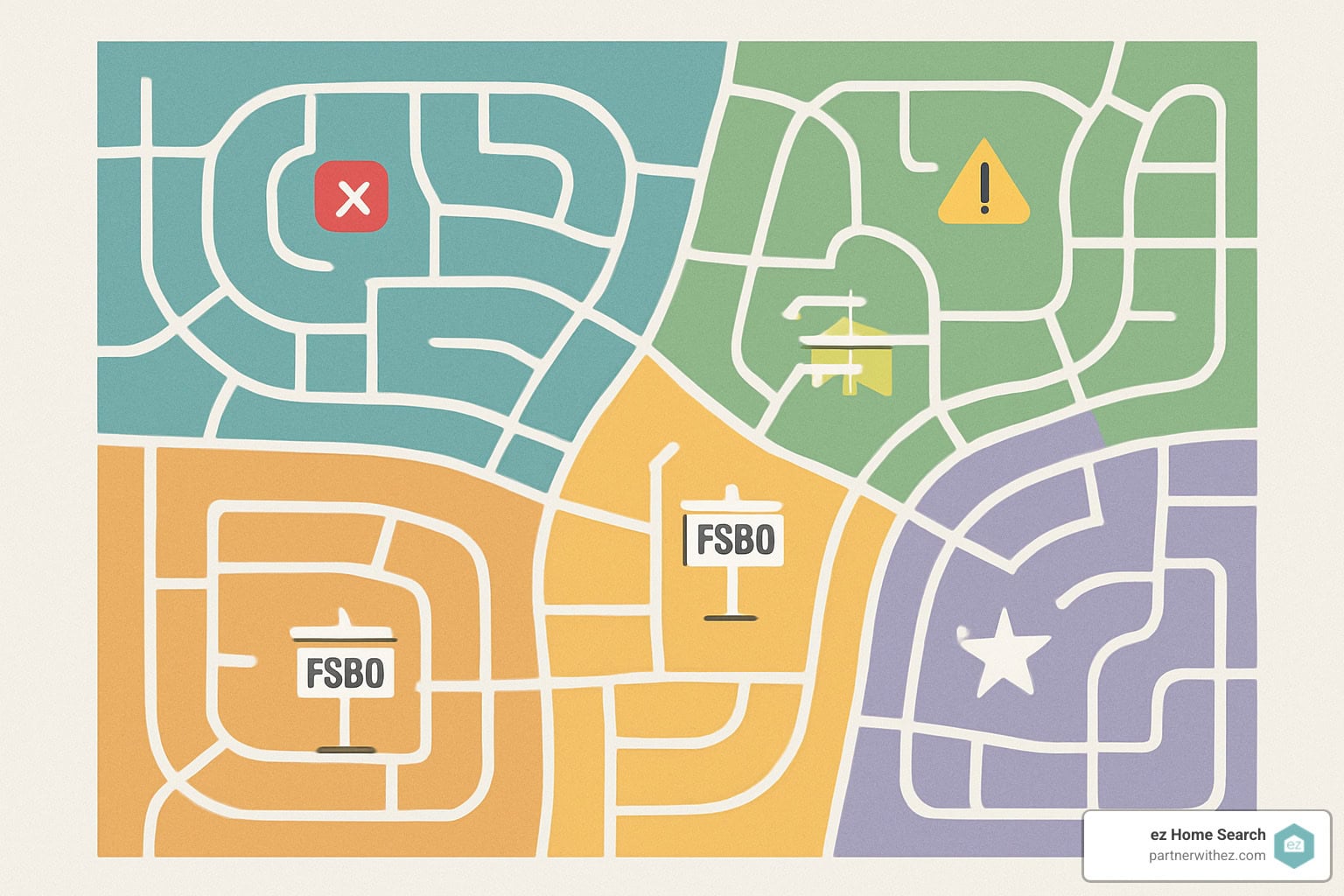
exclusive county map showing territory protection - cold calling real estate leads

Here’s the truth about cold calling real estate leads: it works, but it’s just one piece of a much bigger puzzle. After helping thousands of agents refine their calling techniques, we’ve finded something even more powerful—exclusive partnerships that eliminate the competition entirely.

Think about it. You spend hours perfecting your cold calling scripts, tracking down phone numbers, and dealing with rejection. Meanwhile, other agents are calling the same expired listings and FSBOs you are. Everyone’s fighting over the same prospects.

What if there was a better way?

At ez Home Search, we’ve built something different. Our county-based exclusivity means you become the only agent receiving specific buyer and seller opportunities in your territory. No more competing with five other agents for the same lead. No more wondering if that seller lead you called yesterday also heard from your competitor this morning.

The difference is remarkable. Intent-driven prospects who actively seek services convert at three to five times higher rates than interrupted cold calls. When someone fills out a home valuation request or searches for properties in your exclusive county, they’re already motivated. You’re not interrupting their dinner—you’re solving their problem.

Our approach combines the relationship-building skills that cold calling teaches with modern technology that respects consumer privacy. Every lead goes through our ezVerify.ai system for TCPA compliance. You get real-time behavioral data, CRM-integrated nurture flows, and automated follow-up tools that work while you sleep.

Travis McClure, our Chief Operating Officer, puts it perfectly: “Cold calling teaches valuable skills, but exclusive partnerships let you focus on conversion instead of prospecting.”

The best agents don’t choose between cold calling and exclusive leads—they build diversified systems. You can maintain your prospecting skills while adding predictable lead flow that transforms your business from reactive to proactive.

Whether you’re ready to explore county exclusivity or want to keep refining your cold calling technique, the key is consistent execution and continuous improvement. The agents who succeed long-term understand that modern lead generation isn’t about working harder—it’s about working smarter while protecting consumer privacy.

Ready to eliminate lead competition and focus on what you do best? Find how county exclusivity can transform your lead generation strategy. For agents who want to integrate exclusive leads with existing prospecting efforts, we also offer ez Connect accounts that work seamlessly with your current systems.

The future belongs to agents who combine proven relationship skills with exclusive territory protection. Why compete when you can dominate?

07.09.2025

High Quality Mortgage Leads: Your Ticket to Closing More Deals

Why High Quality Mortgage Leads Are Your Gateway to More Closings

High quality mortgage leads are pre-qualified prospects who have actively expressed interest in obtaining a mortgage, possess verified financial credentials, and are delivered exclusively to reduce competition. Here’s what defines them:

  • Exclusive access – Only you receive the lead, not 5+ other lenders
  • Real-time delivery – Fresh data within minutes, not days or weeks old
  • Credit pre-qualification – Prospects meet minimum score requirements
  • Verified contact information – Phone numbers and emails that actually work
  • Purchase intent signals – Active home search or refinance inquiry
  • TCPA compliant sourcing – Legally obtained with proper consent

The mortgage lead landscape has shifted dramatically. With 66% of borrowers now preferring a fully digital mortgage process according to Fannie Mae, the old days of cold calling random lists are over. Today’s successful loan officers understand that quality trumps quantity every time.

Exclusive mortgage leads can cost $100 or more per lead, but they close at rates up to 5 times higher than shared leads that only cost $10-30 each. The math is simple: would you rather buy 10 shared leads where you’re competing against 4 other lenders, or 2 exclusive leads where you’re the only game in town?

I’ve spent over 20 years helping real estate professionals optimize their lead generation and conversion strategies through my work with ez Home Search, Digital Maverick, and my other companies. My experience has shown that high quality mortgage leads paired with the right follow-up systems can transform a loan officer’s pipeline from feast-or-famine to predictable growth.

Infographic showing the complete mortgage lead funnel from initial consumer inquiry through exclusive lead delivery, pre-qualification scoring, CRM integration, automated follow-up sequences, and final loan closing with conversion rates at each stage - high quality mortgage leads infographic

What Makes a High Quality Mortgage Lead?

High quality mortgage leads are like dating profiles – you want someone who’s genuinely interested, ready to commit, and not talking to five other people at the same time. Understanding what separates a golden lead from fool’s gold can make or break your conversion rates.

The magic happens when five critical elements align: conversion intent, credit readiness, real-time data delivery, exclusive access, and compliant sourcing.

Conversion intent means prospects who’ve taken meaningful action: submitting a mortgage application, requesting a personalized rate quote, or calling a lender directly. Research shows nurtured leads spend 47% more than those who aren’t properly cultivated.

Credit readiness separates dreamers from doers. Quality leads should already meet your minimum credit score requirements before landing in your CRM. Soft credit inquiries protect the consumer’s credit score while protecting your time.

Real-time data delivery is crucial – fresh mortgage leads have just 1-2 days before they cool off. Prospects contacted within 5 minutes are 9 times more likely to convert than those reached after 30 minutes.

Exclusive access transforms your approach from desperate sales pitch to consultative conversation. When leads are shared among multiple lenders, you’re in a sprint to see who can dial fastest.

Compliant sourcing protects everyone involved. Quality lead providers maintain TCPA compliance, keep detailed consent records, and use legitimate data sources.

FeatureExclusive High Quality LeadsShared Standard Leads
Contact Rate40-60%15-25%
Competition LevelZero other lenders3-5 competing lenders
Response TimeWithin 5 minutesRacing against others
Conversion Rate8-15%2-5%

High Quality Mortgage Leads vs. Standard or Aged Leads

Fresh leads (generated within 24-48 hours) come with active shopping momentum. Response rates for fresh leads typically hit 15-25%, while aged leads struggle to reach 3-8%. Fresh exclusive leads have zero competition, while aged leads could have been contacted by 20+ lenders.

Assessing High Quality Mortgage Leads Before You Buy

Lead scoring should include credit score ranges, income verification, debt-to-income ratios, and specific loan purposes. Soft-pull credit checks verify creditworthiness without affecting the consumer’s credit score. TCPA compliance checks are non-negotiable – verify proper consent timestamps and opt-in documentation.

At ez Home Search, our county-based exclusivity means you’re never competing with other lenders, while our ezVerify.ai system ensures TCPA compliance and data enrichment happen seamlessly.

Finding High Quality Mortgage Leads in 2025

multichannel marketing dashboard showing various lead sources and conversion metrics - high quality mortgage leads

The search for high quality mortgage leads today requires strategy and systems. The mortgage lead landscape has evolved dramatically, offering more sophisticated targeting while creating new challenges around data quality and compliance.

Direct-to-consumer platforms capture prospects at their moment of highest intent – when they’re actively seeking rate quotes. Real estate portals offer opportunities to catch prospects early in their journey, before they start rate shopping with multiple lenders.

State housing programs like CalHFA create natural lead generation opportunities for approved lenders. These prospects come pre-qualified for specific programs and often convert at higher rates.

Live transfer services represent the premium tier – having a warm prospect on the phone ready to discuss mortgage needs right now. Trigger data from credit bureaus provides targeted approaches when homeowners pull their credit for mortgage purposes.

Exclusive vs. Shared: Pros, Cons, and Pricing

Exclusive leads eliminate competition, allowing you to focus on building trust rather than rushing through sales pitches. They typically convert at three to five times the rate of shared leads, though they require bigger upfront investment.

Shared leads offer volume and affordability but turn mortgage lending into a contact sport where speed becomes everything. The first lender to make meaningful contact often wins regardless of rates or service.

Top Sources for High Quality Mortgage Leads

At ez Home Search, we’ve built a system that eliminates competition while maximizing conversion potential through county-based exclusivity. Instead of fighting with multiple lenders, our partners receive exclusive territorial protection.

Direct consumer inquiries through high-conversion landing pages capture prospects at peak interest moments. Real estate team partnerships provide warm handoffs from active agents. Behavioral data integration identifies mortgage-ready prospects before they’ve started shopping with other lenders.

As Travis McClure puts it: “We built ez Home Search specifically to solve the lead competition problem. When you’re the only lender a prospect hears from, your conversion rates naturally improve.”

Our ezNurture system integrates with popular CRMs like Follow Up Boss, while ezVerify.ai ensures TCPA-compliant verification. For additional opportunities, we offer ez Connect accounts with networking and lead sharing capabilities.

Maximizing Conversion & Measuring ROI from High Quality Mortgage Leads

CRM automation workflow diagram showing lead intake, scoring, nurturing sequences, and conversion tracking - high quality mortgage leads

Getting high quality mortgage leads is only half the battle. The real magic happens in nurturing prospects from initial contact to closed loan. Success requires systems, not just good intentions.

Speed matters more than perfection. Contact fresh leads within 5 minutes – you’ll be 9 times more likely to convert compared to waiting 30 minutes. Your CRM integration should work automatically with leads flowing in, getting scored and tagged, then triggering follow-up sequences.

Multi-channel follow-up is your secret weapon. Use phone, text, and email. Direct mail achieves 5-9% response rates compared to just 1% for email. The nurture game requires providing real value through market updates, rate alerts, and homebuying tips.

Your break-even formula: divide cost per lead by average profit per loan, then multiply by 100. That’s your required conversion percentage.

Infographic displaying key metrics for mortgage lead ROI including contact rate, application rate, pull-through rate, and average loan profit with benchmark percentages for each stage - high quality mortgage leads infographic

Technology Stack: CRM, AI Scoring & Automation

Follow Up Boss has become the gold standard because it integrates with lead sources automatically. AI-powered lead scoring analyzes hundreds of data points and prioritizes prospects.

Our ezNurture system uses behavioral triggers – when prospects request home valuations or research loan programs, it automatically sends relevant follow-up content. TCPA compliance through ezVerify.ai protects you legally while enriching lead data.

KPIs That Matter: From CPL to Lifetime Value

Contact rate should be 20-40% depending on lead quality and follow-up speed. Application rate for high quality mortgage leads should be 15-30%. Pull-through rate tracks applications that become closed loans (industry average 65-75%).

Lifetime value considers the bigger picture – past clients who refinance, refer friends, or need investment property loans dramatically improve ROI. Track these numbers monthly to identify real patterns and adjust your approach.

Compliance, Pricing & Risk Mitigation

Navigating the regulatory landscape for high quality mortgage leads requires careful attention to multiple compliance layers.

The TCPA (Telephone Consumer Protection Act) requires explicit consent documentation for every lead. Violations can result in fines up to $1,500 per unauthorized contact. State privacy laws add complexity, particularly California’s CCPA requiring complete transparency about data collection.

Credit bureau trigger data offers exceptional conversion potential but requires additional licensing and compliance procedures. Data enrichment services can improve lead quality but must maintain proper consent chains.

The key insight: compliance isn’t just about avoiding fines – it’s about building trust with prospects. When consumers know they legitimately opted in, they’re more receptive to your outreach.

Avoiding Pitfalls When Buying High Quality Mortgage Leads

Overpaying for leads happens when loan officers don’t calculate their true break-even point. Stale data masquerading as fresh leads is common – always verify actual generation dates. Spam traps and fake leads can destroy email deliverability.

Compliance violations represent the most serious risk, potentially resulting in significant fines. Poor CRM integration creates gaps where prospects disappear entirely.

Successful loan officers treat lead evaluation as a systematic process – testing small quantities, tracking results carefully, and scaling only after proving profitability.

Local Market Factors: California vs. National

California’s unique characteristics create both opportunities and challenges. Higher home prices mean larger loan amounts and potentially higher profits, but also affordability challenges affecting lead quality.

Population density affects both lead availability and competition levels. Regulatory complexity varies between states, with California maintaining strict privacy and lending regulations. Economic factors including employment and income levels directly influence conversion potential.

At ez Home Search, county-based exclusivity becomes even more valuable in competitive markets like California. When you’re the only lender a prospect hears from, regional competition factors become less relevant.

Frequently Asked Questions about High Quality Mortgage Leads

What defines a high quality mortgage lead?

A high quality mortgage lead combines timing, intent, and opportunity. The foundation starts with verified contact information – real phone numbers and email addresses that work.

Demonstrated purchase intent means people who have taken specific actions like requesting rate quotes or submitting pre-approval applications. Credit pre-qualification ensures prospects meet minimum requirements for your loan programs.

Exclusive delivery might be most important – when you’re the only lender receiving a lead, you can focus on building relationships instead of racing against competitors.

How much should I expect to pay for exclusive high quality leads?

Pricing varies significantly based on several factors. Live transfer leads command premium pricing because you’re connected directly with ready prospects. Geographic market plays a huge role – high-demand markets see higher costs but proportionally higher profit potential.

The key is calculating total cost of acquisition rather than just initial lead price. Factor in time investment, follow-up costs, and opportunity costs. A more expensive exclusive lead converting at 20% might deliver better ROI than cheaper shared leads converting at 3%.

How do I calculate ROI before I purchase?

Start with this formula: (Conversion Rate × Average Profit per Loan) – Cost Per Lead = ROI per lead.

Conversion rate expectations should be based on historical data, not wishful thinking. Average profit per loan should account for all costs including processing and time investment. Hidden costs include CRM expenses, follow-up marketing, and opportunity costs.

Break-even analysis helps understand minimum acceptable conversion rates. If leads cost $100 and you profit $3,000 per loan, you need at least 3.33% conversion to break even.

At ez Home Search, we help partners understand these calculations through weekly coaching sessions. As Travis McClure explains, “Understanding your numbers is just as important as having quality leads.”

Conclusion

celebration photo of loan officer and clients at a successful loan closing - high quality mortgage leads

The mortgage industry is changing fast, but high quality mortgage leads remain your most reliable path to consistent closings and predictable income. The difference between struggling and thriving often comes down to lead quality, not quantity.

Would you rather chase ten prospects contacted by five other lenders, or have genuine conversations with two people hearing from you first? The math is clear when you factor in time, energy, and conversion rates.

Successful loan officers understand that exclusive access eliminates the competition factor that kills deals before they start. When you’re not racing against other lenders, you can focus on understanding prospects’ needs and helping them achieve homeownership goals.

At ez Home Search, we’ve built our platform around county-based exclusivity. We believe protecting consumers from lead spam while giving partners territorial access creates better outcomes for everyone.

As Kurt Uhlir, our Chief Marketing Officer, puts it: “Protecting consumers while giving our partners sole access to high quality mortgage leads is the fastest route to more closings. When you’re the only lender a prospect hears from, you can focus on serving rather than selling.”

The fundamentals haven’t changed: Quality leads plus systematic follow-up plus genuine relationship building equals sustainable growth. The most expensive lead is always the one that doesn’t convert.

The opportunity for loan officers who understand these principles has never been better. Interest rates will fluctuate and technology will advance, but consumers will always need knowledgeable professionals to guide them through the mortgage process.

For those ready to explore county-based exclusivity, more information about exclusive opportunities is available with a quick call to see what makes sense. Our platform combines high quality mortgage leads with coaching support and technology tools needed to convert them consistently.

The choice is yours: continue competing against multiple lenders for the same prospects, or position yourself as the exclusive mortgage expert in your market.

07.08.2025

Seller Leads Secrets: Turning Prospects into Profitable Listings

Why House Seller Leads Are Your Key to Consistent Real Estate Growth

House seller leads are the fastest route to stable, repeatable income for real estate teams. Because you’re talking directly to the current homeowner, each conversation starts closer to a commission-producing listing than buyer outreach ever can.

What counts as a house seller lead?

  • Verified contact info for homeowners who show real sell signals
  • Sourced from expired listings, FSBO properties, pre-foreclosures, probate filings, and predictive analytics
  • Delivered exclusively to a single local expert when you partner with ez Home Search, eliminating head-to-head competition

Why they power lasting growth

  • Immediate intent shortens the sales cycle
  • Every listing feeds future buyer deals and referral business
  • County-based exclusivity protects your marketing spend from lead resellers

I’m Preston Guyton, founder of ez Home Search. After two decades of turning seller opportunities into predictable revenue, I can tell you a steady stream of exclusive leads is the difference between feast-or-famine months and true business freedom.

Infographic showing the seller lead journey from initial data capture through predictive scoring, multi-channel outreach, appointment setting, and final listing conversion with key conversion rates at each stage - house seller leads infographic

Understanding House Seller Leads

House seller leads connect you with homeowners who have already shifted from “maybe” to “must-sell.” Their urgency transforms cold outreach into focused problem solving.

Here’s the eye-opener: three out of four homeowners list with the first agent they speak to. Couple that with the fact that 30–40% of pre-foreclosure owners end up listing within the next 12 months, and you can see why speed and specialization matter.

Why Seller Leads Drive Sustainable Growth

Unlike buyer pipelines that can be unpredictable, a single listing can:

  • Generate commission on the sale itself
  • Produce a downstream buyer if you double-side the deal
  • Spark referrals from the seller’s personal network

Exclusive vs. Shared House Seller Leads

Shared databases flood homeowners with calls from multiple agents, driving contact rates into the teens. ez Home Search’s county-based exclusivity keeps response rates high—often 40–50%—because you are the only local expert reaching out.

The 6 Major Types of Seller Leads & How to Spot Them

Color-coded map showing different types of seller leads distributed across neighborhoods with visual indicators for expired listings, FSBO properties, pre-foreclosures, and predictive analytics scores - house seller leads
  1. Expired Listings – Owners who tried, failed, and are eager for a better plan.
  2. For Sale By Owner (FSBO) – DIY sellers; yet about 90% eventually hire an agent when the hassles add up.
  3. Pre-Foreclosures – Time-sensitive owners facing default notices.
  4. Motivated Sellers – Divorce, relocation, medical bills, or estate issues trigger quick action.
  5. For Rent By Owner (FRBO) – Landlords wrestling with tenant headaches and maintenance costs.
  6. Probate & Predictive Lists – Heirs or data-flagged homeowners likely to sell in the next 6–12 months.

Each category requires different scripts and timing, but they all reward prompt, value-driven outreach.

How Seller Lead Generation Platforms Work

The magic behind modern house seller leads happens through sophisticated technology that analyzes millions of data points to identify homeowners who might be ready to sell—often before those homeowners even realize it themselves.

Data aggregation forms the foundation, pulling together public records, online behavior from property search websites, social media signals, and economic indicators that suggest selling motivation. AI scoring happens next, learning from successful conversions to identify similar prospects.

The best platforms seamlessly integrate with your existing CRM systems. Instead of manually entering lead information, everything flows automatically into Follow Up Boss, Chime, or whatever system you’re using.

Lead Sourcing Methods Decoded

Pay-per-click advertising creates ads that appear when homeowners search for things like “what’s my home worth” or “sell house fast.” Home valuation ads work particularly well because they offer something valuable upfront.

Social media retargeting captures people who almost took action but didn’t quite commit. These campaigns follow up across Facebook and Google, gently nudging them back toward requesting information.

Data Accuracy & Freshness: Impact on House Seller Leads Conversion

Stale data kills conversion rates faster than anything else. Quality platforms invest heavily in phone and email verification, testing every contact method before sending you the lead. DNC scrubbing protects you from legal headaches while improving contact rates.

Tools That Move the Needle

Power dialers transform your calling efficiency by automatically handling busy signals and disconnected numbers. Drip SMS campaigns keep you top-of-mind without being pushy. Automated CMAs let you provide immediate value during first conversations.

Infographic showing the workflow from raw data sources through AI scoring, lead verification, CRM integration, automated dialing, and multi-channel follow-up sequences - house seller leads infographic

Cost, ROI & Maximizing Profit from Purchased Leads

Different platforms price seller opportunities in four primary ways: subscription, pay-per-lead, auction, and ad-spend models. Pick the structure that aligns with your cash-flow needs and follow-up capacity.

Pricing ModelBest ForKey AdvantageWatch-Out
SubscriptionTeams wanting steady volumePredictable costQuality can vary
Pay-per-leadAgents scaling up or downPay only when you receive a leadBudget swings
Auction/BidHighly competitive areasTotal control over lead mixPrices climb fast
Ad SpendMarketing-savvy teamsFull budget controlRequires hands-on management

Budget Benchmarks & Expected Returns

Quality exclusive leads commonly cost between $50 and $300 each. Skilled agents turn roughly 1 in 8–15 leads into an appointment and 1 in 3–2 appointments into a signed listing.

Stretch Every Dollar

Speed-to-lead is king: contacting a new prospect within five minutes multiplies conversion rates. Layer phone, text, email, and occasional direct mail so homeowners see your name wherever they look, but always lead with helpful insights—never spam.

Converting House Seller Leads into Listings: Best Practices

Chart showing optimal follow-up cadence with call-text-email sequences over 10 days, including timing intervals and conversion rate improvements at each touchpoint - house seller leads
  1. Five-Minute Rule – Call immediately, then follow with a quick text and value-packed email.
  2. 10-Day Blitz – Combine calls, texts, and short market updates for the first 10 days, then drop into a lighter nurture rhythm.
  3. Tech Stack Synergy – Use CRM tags, automated tasks, and video CMAs to make every outreach personalized without consuming your calendar.
  4. Long-Term Nurture – Monthly market snapshots and neighborhood insights keep colder leads warm until their timeline aligns.

The world of house seller leads operates in an increasingly complex regulatory environment. Smart agents understand that staying compliant isn’t just about avoiding fines—it’s about building sustainable businesses that homeowners trust.

Do Not Call (DNC) compliance forms the foundation of legitimate lead generation. The Telephone Consumer Protection Act (TCPA) creates specific rules around automated communications. Privacy laws continue expanding beyond California’s CCPA to impact how you collect and use consumer data.

Record keeping becomes your best defense against compliance challenges. Document your lead sources, track all communications, maintain opt-out records, and establish clear data retention policies.

Keeping Leads Fresh—Not Junk

Nothing kills conversion rates faster than stale data. Daily scrubs remove sold properties before you make embarrassing contact attempts. Address validation ensures property information stays accurate. Phone verification confirms working numbers before you pay for leads.

What’s Next for House Seller Leads

Predictive AI continues getting smarter at identifying likely sellers before they actively consider listing. Intent signals from online behavior provide real-time motivation indicators. Cash offer advertisements have revolutionized lead generation performance, as noted by Kurt Uhlir, our Chief Marketing Officer, who has seen these campaigns convert at significantly higher rates.

Recent research on consumer behavior shows how technology continues advancing lead generation capabilities. Voice bots and AI assistants are beginning to handle initial qualification, while blockchain verification may some day provide tamper-proof documentation of lead attribution and consumer consent.

The future points toward more sophisticated targeting, faster response capabilities, and seamless integration between lead generation and conversion systems.

Frequently Asked Questions about House Seller Leads

How fast should I contact a new seller lead?

The clock starts ticking the moment a house seller lead hits your system. Leads contacted within 5 minutes convert at rates 10 times higher than those contacted after 30 minutes. Mobile alerts should ping immediately when new leads arrive. Automated text responses can bridge timing gaps with messages like “Got your request! Calling you in 2 minutes.”

What’s a realistic close rate for purchased leads?

Premium exclusive leads perform significantly better than shared contact lists. Pre-foreclosure leads typically convert at 1 in 8 to 1 in 12 ratios when you’re the only agent calling. Expired listings usually convert around 1 in 10 to 1 in 20, while FSBO leads average 1 in 15 to 1 in 25.

Shared or lower-quality leads tell a different story, often converting at 1 in 25 to 1 in 50 ratios. The difference isn’t just about lead quality—it’s about competition and timing.

Are AI-predicted leads worth the premium?

AI-predicted leads aren’t ready to sell today—they’re likely to sell within 6-12 months based on data patterns. The first-mover advantage makes these leads compelling since you’re contacting homeowners before they’ve decided to sell, with zero competition from other agents.

However, these leads demand patience and sophisticated nurturing systems. Conversion cycles stretch 6-12 months typically. They work best for experienced agents with established systems and sufficient budget for relationship building.

Common Mistakes to Avoid

Even experienced agents make costly errors when working with house seller leads. Learning from these common pitfalls can save you thousands of dollars and countless hours of frustration.

Buying shared leads instead of exclusive ones represents the biggest mistake. When five agents are calling the same homeowner, your chances of success drop dramatically. The seller gets overwhelmed and often stops answering calls altogether.

Focusing only on immediate conversion kills long-term profitability. Many agents abandon leads after two or three contact attempts, missing that the most profitable leads often require 6-12 months of nurturing. Travis McClure, our Chief Operating Officer, regularly reminds partners that relationship building beats aggressive closing every time.

Neglecting compliance requirements can destroy your business overnight. DNC violations and TCPA infractions result in significant fines. Every house seller lead you contact must be properly scrubbed and documented.

Using generic scripts for all lead types shows inexperience immediately. FSBO sellers need completely different approaches than pre-foreclosure homeowners or expired listings. Customize your messaging based on the seller’s specific situation and emotional state.

Failing to track and measure results keeps you stuck in expensive cycles. Without proper tracking, you can’t identify which lead sources provide the best ROI or optimize your conversion processes.

Overwhelming prospects with aggressive follow-up backfires spectacularly. Balance persistence with respect by providing genuine value at each touchpoint rather than generic “checking in” messages. Kurt Uhlir emphasizes that nurturing should feel helpful, not pushy.

These mistakes are completely avoidable with proper systems and mindset. Focus on exclusive leads, long-term relationships, and genuine value creation.

house seller leads

Conclusion

House seller leads represent the most direct path to building a profitable, sustainable real estate business. While buyer leads often require months of nurturing, seller leads connect you with homeowners who already own valuable assets and have genuine motivation to transact.

The numbers tell the story: when homeowners choose the first agent they speak with, speed and exclusivity become everything. When pre-foreclosure homeowners list within 12 months, and FSBO sellers eventually work with agents, you’re investing in relationships with people who genuinely need your expertise.

What separates successful agents from those who burn through lead budgets: understanding that exclusive territory rights change everything. When you’re competing with multiple agents for the same homeowner’s attention, even the best scripts won’t save your conversion rates.

The most successful agents treat house seller leads as both relationship-building opportunities and systematic business processes. They combine genuine empathy for homeowners facing difficult situations with data-driven follow-up systems that maintain contact over months or years.

Technology continues evolving to make this process more efficient. Predictive AI identifies likely sellers before they start considering a move. Automated nurturing systems maintain relationships without overwhelming your schedule. CRM integration ensures no lead falls through the cracks.

At ez Home Search, we’ve built our platform around the principle that exclusive house seller leads combined with proper systems create unstoppable growth. Our county-based exclusivity means you never compete with other agents for the same prospects. Our integrated technology stack maximizes every lead’s potential value.

The future belongs to agents who understand that consistent lead flow, combined with systematic conversion processes, builds sustainable competitive advantages. While other agents chase unpredictable referral sources, you’ll have a predictable pipeline of motivated sellers who need exactly what you provide.

Ready to transform your business with exclusive territory rights and proven conversion systems? Partner with ez Home Search for consistent, high-quality house seller leads delivered directly to your pipeline.

07.07.2025

10 Quick and Easy Ways Real Estate Pop-By Gifts That Actually Increase GCI

Why Pop-By Gifts Real Estate Strategies Build Million-Dollar Referral Networks

Pop-by gifts real estate agents use are small, thoughtful presents delivered in person to past clients and prospects to maintain relationships and generate referrals. These strategic touchpoints work because they tap into the psychology of reciprocity – when someone receives an unexpected gift, they naturally want to return the favor.

Key Pop-By Gift Facts:

  • 64% of sellers find their agent through referrals from friends or family
  • Optimal budget: Most effective gifts cost between $5-15 each
  • Best frequency: Quarterly visits (4 times per year) create regular touchpoints without being intrusive
  • ROI potential: A thoughtful gift can generate thousands in commission through referrals

Pop-by gifts work because real estate is fundamentally a relationship business. Unlike digital marketing or cold calling, physically showing up at someone’s door with a small gift creates an emotional connection that sticks. The key is choosing items that recipients will actually use while subtly keeping your name top-of-mind.

The most successful agents treat pop-by gifts as part of their broader marketing strategy. They segment their client database, plan seasonal themes, and track which gifts generate the most referrals. This systematic approach transforms random acts of kindness into a predictable lead generation system.

I’ve spent over 20 years helping real estate professionals build sustainable referral networks through strategic relationship marketing, including the pop-by gifts real estate agents use to stay connected with their sphere of influence. My experience with lead generation and conversion strategies has shown me that the agents who consistently deliver value through personal touches like pop-by gifts are the ones who build lasting, profitable businesses.

Infographic showing pop-by gift workflow: client database segmentation leads to seasonal gift selection, personal delivery with handwritten note, CRM tracking of responses, and follow-up for referral requests, resulting in measurable ROI through increased referrals and repeat business - pop-by gifts real estate infographic

Mastering Pop-By Gifts Real Estate Clients Love: 10 Selection Shortcuts

The secret to successful pop-by gifts real estate agents use isn’t spending more money—it’s being more strategic. We’ve analyzed thousands of successful pop-by campaigns and identified the patterns that consistently generate referrals and repeat business.

The most effective pop-by gifts share three characteristics: they’re useful, memorable, and subtly branded. A branded water bottle that sits on someone’s kitchen counter for months provides ongoing exposure. A packet of flower seeds with a punny tag like “Your referrals make my business bloom” creates a smile and sticks in memory.

Here’s what separates amateur gift-givers from referral-generating pros:

Amateur Approach:

  • Buys random gifts without planning
  • Uses heavy-handed branding
  • Delivers sporadically when remembered
  • Doesn’t track results

Professional Approach:

  • Segments clients by value and preferences
  • Plans seasonal themes months in advance
  • Tracks delivery dates and responses in CRM
  • Measures referral conversion rates

The agents generating the most referrals from pop-by gifts treat them like any other marketing campaign—with clear objectives, target audiences, and measurable outcomes.

Set a Smart Budget & Segment Your List

Smart agents don’t spend the same amount on every client. They create tiers based on past transaction value and referral potential:

A-List Clients ($10-15 per gift):

  • Past clients who closed transactions over $500K
  • Clients who’ve already provided referrals
  • High-net-worth individuals with large networks
  • Local business owners and community leaders

B-List Clients ($5-10 per gift):

  • Standard past clients
  • Active prospects in your pipeline
  • Sphere of influence contacts
  • Professional network connections

C-List Clients ($2-5 per gift):

  • Newer contacts
  • Lower-value transactions
  • Broader community outreach
  • Open house attendees

This tiered approach maximizes ROI by investing more in relationships with higher referral potential. A $15 gift to an A-list client who refers a $800K listing generates a 10,000% return on investment.

Track your spending and results in your CRM. Note which gifts generate the most positive responses and referrals. Over time, you’ll identify patterns that help you refine your approach and increase conversion rates.

Personalize Like a Pro: Pop-By Gifts Real Estate Clients Actually Use

The difference between a forgotten gift and a referral-generating touchpoint is personalization. Generic branded items often end up in junk drawers, but thoughtful gifts that reflect the recipient’s interests create lasting impressions.

Use your CRM to track client preferences:

  • Pet owners: Dog treats with “Need a new woof?” tags
  • Gardening enthusiasts: Mini succulent plants with care instructions
  • Coffee lovers: Local coffee shop gift cards
  • Families with kids: Movie theater gift cards for family night
  • Empty nesters: Wine accessories or gourmet treats

One agent we work with keeps detailed notes about every client’s hobbies, dietary restrictions, and family composition. When she delivers a specialty olive oil to a client who mentioned loving to cook, or brings pet treats to a dog owner, the personal touch generates genuine appreciation and memorable moments.

The key is making clients feel seen as individuals, not just transaction numbers. A handwritten note saying “I remembered you mentioned wanting to start an herb garden” alongside a small potted basil plant creates a deeper connection than any expensive generic gift.

Real estate agent delivering personalized gifts at doorstep - pop-by gifts real estate

Include care instructions or usage tips with your gifts. A mini succulent with a care card that includes your contact information provides ongoing value while keeping your name visible. These small touches show professionalism and attention to detail that clients remember when friends ask for agent recommendations.

Time It Right & Nail the Drop-Off

Timing can make or break your pop-by gift strategy. The best delivery windows are weekday late mornings (10-11 AM) or early evenings (4-6 PM) when people are most likely to be home and receptive.

Call-Ahead Etiquette:

  • Close relationships: Surprise visits often work well
  • Formal relationships: Quick courtesy call prevents awkwardness
  • First-time pop-bys: Always call ahead to establish the relationship

When no one’s home, have a backup plan. Leave gifts in weather-protected spots with clear notes explaining who they’re from. Many agents use decorative bags or containers that protect items while displaying their branding.

Follow up within 24 hours with a text or email: “Hope you enjoyed the [gift]! Just wanted to stay in touch and see how you’re settling into your new home.” This reinforces the personal connection and opens the door for conversation.

Keep visits brief—5 to 10 minutes maximum. The goal is to maintain the relationship, not conduct a lengthy sales presentation. Save market updates and business discussions for scheduled appointments.

Leverage Seasonal Themes: Pop-By Gifts Real Estate Agents Can Pre-Pack

Seasonal themes make gift selection easier while creating natural conversation starters. Plan your entire year in advance and buy items in bulk to reduce costs and ensure consistency.

Spring Themes:

  • Flower seed packets with custom tags saying “Your referrals help my business bloom”
  • Mini herb garden starter kits
  • Spring cleaning supplies with encouraging notes
  • Potted flowers for new homeowners

Summer Themes:

  • Travel-size sunscreen with “Don’t get burned in this market” messaging
  • Custom water bottles for staying hydrated
  • Popsicle molds with “Chill out, I’ve got your real estate needs covered”
  • Beach towels for vacation-bound clients

Fall Themes:

  • Gourmet apple cider mix with cozy autumn messaging
  • Pumpkin spice treats for the season
  • Cozy socks or hand warmers
  • Thanksgiving-themed gratitude notes

Winter Themes:

  • Hot cocoa bombs with marshmallows
  • Holiday ornaments with family names
  • Scented candles for cozy winter nights
  • Heart-shaped cookies for Valentine’s Day

Bulk ordering seasonal items months in advance reduces per-unit costs and ensures you’re never scrambling for last-minute gifts. Store pre-assembled gift bags in your car for spontaneous pop-by opportunities.

Seasonal pop-by gift display showing spring seeds, summer water bottles, fall cider mix, and winter cocoa arranged by season - pop-by gifts real estate

Common Mistakes, Metrics & Partnering for Success

Even well-intentioned pop-by gifts real estate strategies can backfire without proper execution. I’ve watched agents spend thousands on gifts that actually damaged relationships instead of building them. The difference between success and failure often comes down to understanding what not to do.

CRM dashboard showing pop-by gift tracking metrics including delivery dates, client responses, referral conversion rates, and ROI calculations - pop-by gifts real estate infographic

The most successful agents treat their pop-by gift campaigns like any other marketing investment. They track response rates, measure referral generation, and calculate return on investment to continuously improve their approach. Without this data, you’re essentially throwing gifts at the wall and hoping something sticks.

Common Mistakes to Avoid

The biggest mistake I see agents make is over-branding their gifts. When every inch of a coffee mug is covered with your logo, photo, and contact information, it screams “advertisement” rather than “thoughtful gift.” Recipients can sense the difference immediately. Instead, keep your actual gifts clean and useful, then add subtle branding through gift tags or packaging.

Ignoring client privacy preferences is another relationship killer. Some people genuinely prefer scheduled visits over surprise drop-bys. Pay attention to body language and verbal cues during your visits. If someone seems uncomfortable or rushed, note their preference for scheduled deliveries in your CRM. Respecting boundaries builds trust and prevents those awkward doorstep encounters that make everyone uncomfortable.

Many agents also fall into the trap of giving expensive gifts that create obligation rather than appreciation. When you show up with a gift that clearly cost more than someone’s weekly grocery budget, you make them uncomfortable. They start wondering what you want in return instead of feeling grateful for your thoughtfulness. Stick to your budget guidelines and remember that genuine thoughtfulness matters more than price tags.

Inconsistent delivery schedules confuse clients and dilute your impact. Showing up randomly every few months makes you seem disorganized rather than thoughtful. Clients should anticipate and look forward to your visits, not wonder if you’ve forgotten about them entirely. Establish a quarterly rhythm and stick to it religiously.

The final mistake that kills referral potential is using generic messages and tags. Those pre-printed “Thanks for your business” cards feel impersonal and forgettable. Take thirty seconds to write something specific: “Hope your new garden is thriving!” or “Thinking of you as the holidays approach.” These personal touches transform routine gifts into memorable moments.

Next Steps: Turn Pop-By Momentum into Predictable Growth

Pop-by gifts create wonderful emotional connections, but they’re just one piece of building a systematic referral network. The agents generating consistent six-figure incomes from referrals combine personal touches with scalable nurturing systems that work even when they’re not physically delivering gifts.

This is where technology becomes your best friend. At ez Home Search, we help real estate professionals transform relationship-building efforts into predictable growth engines. Our platform amplifies your pop-by success by tracking gift deliveries alongside automated nurturing sequences, so nothing falls through the cracks.

When you combine county-based exclusivity with relationship strategies like pop-by gifts, you create something powerful: a protected territory where your personal touches aren’t competing against dozens of other agents doing the same thing. Your gifts stand out because you’re the only agent in your area using our systematic approach.

The behavioral data we provide helps you identify which clients are most likely to refer based on their engagement patterns. Instead of guessing who might send referrals, you can focus your highest-value gifts on the people most likely to respond. This targeted approach dramatically improves your return on investment.

Our CRM integration means your pop-by gifts trigger automated follow-up sequences that keep the conversation going between visits. A client receives your thoughtful gift on Tuesday, then gets a helpful market update email on Friday, followed by a neighborhood event invitation the following week. This consistent touchpoint rhythm keeps you top-of-mind without requiring constant manual effort.

Kurt Uhlir, our Chief Marketing Officer, puts it perfectly: “Pop-by gifts create the emotional connection, but consistent digital nurturing maintains the relationship between visits. The combination generates referrals at a completely different level than either strategy alone.”

The real estate agents building million-dollar referral networks aren’t just delivering great service—they’re systematically nurturing relationships through multiple touchpoints that create lasting impressions. Pop-by gifts real estate professionals use are proven relationship builders, but they work best as part of a comprehensive strategy that combines personal touches with scalable systems.

Ready to transform your pop-by gift efforts into a predictable referral generation machine? Partner with ez Home Search to secure county exclusivity and access the tools that turn relationship building into systematic growth. For agents looking to expand their networking beyond traditional pop-by strategies, we also offer ez Connect accounts that provide additional lead generation opportunities.

More info about partner opportunities

07.06.2025

7 Smart Real Estate Prospecting Ideas You’ll Wish You Knew Sooner

Why Real Estate Prospecting Ideas Are Essential for Growing Your Business

Real estate prospecting ideas are the foundation of any successful agent’s business, yet many professionals struggle to find strategies that actually convert. Here are the most effective approaches:

  • Sphere of Influence: Leverage past clients and referrals (39% of sellers find agents through recommendations)
  • Geographic Farming: Target specific neighborhoods with consistent touchpoints
  • Expired Listings & FSBOs: Contact motivated sellers who need expert guidance
  • Technology Integration: Use CRM automation and predictive analytics for efficiency
  • Content Marketing: Establish local expertise through social media and market updates
  • Circle Prospecting: Contact neighbors around recent sales or listings
  • Community Involvement: Build relationships through volunteering and local events

The data is clear: 89% of home purchases involve a Realtor, and 68% of buyers interview only one agent before signing. This means your prospecting efforts directly determine whether you’ll be that chosen agent. Yet many agents waste time with scattered approaches instead of implementing proven systems.

The most successful agents understand that prospecting isn’t about making more calls—it’s about making smarter calls. They know that 90% of buyers would use the same Realtor again, proving that quality relationships trump quantity every time.

I’ve spent over 20 years helping real estate teams scale through strategic real estate prospecting ideas and lead generation systems. My experience founding ez Home Search and Reside Platform has shown me exactly which prospecting strategies produce consistent results.

Comprehensive overview of real estate prospecting workflow showing lead generation, qualification, nurturing, and conversion stages with automation touchpoints - real estate prospecting ideas infographic

7 Smart Real Estate Prospecting Ideas That Work Right Now

Activate Your Sphere of Influence for Endless Referrals

Your sphere of influence represents the most underused goldmine in real estate. Research shows that 39% of sellers find their agent through recommendations from family or friends, yet most agents fail to systematically nurture these relationships.

We’ve seen agents close over 20 deals in their first year simply by staying in consistent contact with their sphere. The key isn’t just maintaining relationships—it’s creating a system that generates curated reviews and referrals automatically.

Start by identifying everyone in your database who could potentially refer business: past clients, family members, friends, colleagues, and service providers. Create a CRM nurture sequence that touches each contact at least quarterly with valuable content, not sales pitches.

Hand-written notes still work exceptionally well. While everyone else sends generic emails, a personalized note about a market update or congratulations on a life event stands out. One agent we work with sends birthday cards to 500 people annually and attributes 30% of her business to this simple practice.

Host quarterly coffee catch-ups or informal networking events. These don’t need to be elaborate—a simple “market update over coffee” session can yield multiple referrals. The goal is staying top-of-mind when someone in your sphere hears about a friend or family member looking to buy or sell.

Curated reviews play a crucial role in sphere activation. When past clients share positive experiences about working with you, it builds credibility with their network. Encourage satisfied clients to leave reviews on Google, Zillow, and social media platforms. More importantly, ask them to share specific stories about how you helped them steer challenging situations.

networking events and relationship building - real estate prospecting ideas

Farming vs. Prospecting: How to Double Your Pipeline

Geographic farming and active prospecting serve different purposes, but combining both strategies creates a powerful lead generation engine. Farming builds long-term brand recognition in specific neighborhoods, while prospecting generates immediate opportunities.

Geographic farming involves focusing marketing efforts on a defined area—typically 250-500 homes—with consistent touchpoints every 3-4 weeks. Calculate your target area’s turnover rate by dividing homes sold in the last 12 months by total homes, then multiplying by 100. Aim for areas with at least 5% annual turnover to ensure sufficient activity.

Circle prospecting takes a more immediate approach. When you list or sell a home, contact 30-50 neighboring properties within 48 hours. This strategy works because neighbors are naturally curious about local market activity and may be considering their own moves.

Door-knocking remains highly effective when done strategically. Instead of cold-calling, deliver market reports or neighborhood updates. One agent we know generates 200 leads annually by door-knocking with a simple script: “I’m [Name], your local real estate expert. I just sold a home nearby and wanted to share some market insights with neighbors.”

Direct mail campaigns support both farming and circle prospecting efforts. Send monthly market updates to your farm area and immediate notifications to neighbors around new listings or sales. The key is consistency—most agents quit after 3-6 months, but results typically appear after 8-12 months of sustained effort.

Here’s how active and passive prospecting complement each other:

Active ProspectingPassive Prospecting
Cold calling expired listingsSEO-optimized website content
Door-knocking in farm areasSocial media advertising
Circle prospecting neighborsEmail newsletter campaigns
Networking at local eventsRetargeting website visitors
Following up on leadsContent marketing/blogging

The most successful agents allocate 60% of their time to active prospecting and 40% to passive strategies. This balance ensures immediate lead generation while building long-term brand awareness.

Tech-Driven Real Estate Prospecting Ideas You Can Automate Today

Technology transforms prospecting from a time-intensive activity into a scalable system. The key is selecting tools that integrate seamlessly and provide actionable data, not just more busy work.

CRM workflows automate follow-up sequences based on lead behavior and preferences. When someone downloads a home valuation from your website, they should automatically receive a series of market updates, neighborhood guides, and eventually a personal call. This nurturing process can take 6-18 months, but automation ensures no leads fall through the cracks.

IDX landing pages capture leads at the moment of highest intent—when they’re actively searching for properties. These pages should be neighborhood-specific and optimized for local search terms. We’ve seen conversion rates improve by 300% when agents create dedicated landing pages for each farm area rather than using generic property search tools.

Predictive analytics help prioritize outreach efforts by identifying homeowners most likely to sell within the next 6-12 months. These tools analyze factors like length of residence, home equity, life events, and market conditions to score leads. Instead of calling random homeowners, focus on those with the highest propensity scores.

Call tracking and recording capabilities help refine your scripts and identify successful approaches. Review recorded calls to understand which objections arise most frequently and develop better responses. This data-driven approach to script improvement can double your appointment-setting rate.

ezNurture and Follow Up Boss integration streamlines lead management by automatically distributing leads to team members, tracking response times, and triggering escalation sequences. When a lead goes uncontacted for more than 15 minutes, the system can automatically reassign it or send alerts to managers.

ezVerify.ai ensures TCPA compliance by verifying phone numbers against Do Not Call registries and confirming consent for marketing communications. This protection is crucial as violations can result in fines up to $11,000 per incident.

automated CRM workflows and lead nurturing systems - real estate prospecting ideas

The most effective tech stack includes:

  • CRM with automated nurturing sequences
  • IDX website with conversion optimization
  • Predictive analytics for lead scoring
  • Call tracking and recording
  • Compliance verification tools
  • Social media management platform
  • Email marketing automation

Social Media & Content Marketing: Become the Local Expert

Social media brings in the highest quality leads for Realtors, with 47% of internet lead share, yet most agents treat it as an afterthought. The key is positioning yourself as the local market expert through consistent, valuable content.

Create weekly market video updates covering recent sales, new listings, and neighborhood trends. These 2-3 minute videos perform exceptionally well on Facebook and Instagram. Share specific data: “Three homes sold on Maple Street last month, with an average price of $425,000—up 8% from last year.”

Podcasting offers incredible leverage for establishing expertise. A weekly 15-minute show discussing local market trends, featuring community leaders, or interviewing recent clients can generate dozens of leads monthly. The key is consistency and local focus—avoid generic real estate advice in favor of hyper-local insights.

Blog updates should target specific neighborhoods and address common buyer/seller concerns. Write posts like “5 Things to Know Before Buying in [Neighborhood Name]” or “Why [School District] Homes Are Selling 20% Faster.” This content ranks well in local search results and demonstrates deep market knowledge.

Instagram hashtags help reach potential clients searching for local content. Use location-specific tags like #YourCityRealEstate, #YourNeighborhoodHomes, and #YourZipCodeLiving. Research shows that 21% of millennials cite FOMO from Instagram posts as motivation to buy homes.

Facebook groups provide direct access to local audiences. Join neighborhood groups, homeowner associations, and local business communities. Share valuable market insights and answer questions without being overly promotional. The goal is becoming the go-to resource for real estate information.

Retargeting ads re-engage website visitors who didn’t convert initially. Someone who viewed your home valuation tool but didn’t submit their information can see targeted ads for the next 30 days. This approach typically generates 3-5x higher conversion rates than cold advertising.

Creative & Low-Cost Real Estate Prospecting Ideas for New Agents

New agents often lack the budget for expensive lead generation systems, but creativity can overcome financial constraints. These real estate prospecting ideas require more time than money but deliver excellent results.

Open house office hours at local coffee shops create low-pressure networking opportunities. Reserve a corner table every Tuesday from 10-12 PM and invite anyone with real estate questions to stop by. Promote this through social media and neighborhood groups. One agent we know generates 5-10 leads monthly through this simple strategy.

Golden letters—completely handwritten notes—achieve response rates 10x higher than printed mail. Write to homeowners in your target area: “Hi [Name], I’m [Your Name], a local real estate agent specializing in [Neighborhood]. I’d love to help if you ever consider selling. Here’s my card and a recent market update.” The personal touch makes these letters incredibly effective.

Community volunteering builds relationships while supporting worthy causes. Coach youth sports, volunteer at school events, or serve on nonprofit boards. One agent sold nine homes in seven months by hosting DARE meetings at local schools. Another generated four sales in six months through youth soccer coaching.

Buyer and seller webinars position you as an expert while capturing leads. Host monthly sessions covering topics like “First-Time Buyer Mistakes to Avoid” or “Preparing Your Home for Sale.” Promote through social media and local Facebook groups. Each webinar typically generates 20-50 registrations and 3-5 qualified leads.

Gift card giveaways create positive impressions in your farm area. Buy $5 coffee cards from local shops and distribute them while introducing yourself. The small investment opens doors and starts conversations that cold-calling cannot achieve.

Zoom coffee meetings became popular during the pandemic but remain effective for maintaining relationships. Schedule 20-minute virtual coffee chats with database contacts. These brief, structured conversations keep you top-of-mind without requiring travel time.

community involvement and local networking - real estate prospecting ideas

Common Mistakes to Avoid

Even well-intentioned prospecting efforts can fail due to common mistakes that sabotage results. We’ve observed these patterns across thousands of agents and teams.

Inconsistent follow-up kills more deals than any other factor. Research shows agents may need up to six calls over several weeks to make contact with a lead, yet most give up after one or two attempts. Create systematic follow-up schedules and stick to them religiously.

Ignoring data leads to wasted effort and poor results. Track key metrics like calls made, contacts reached, appointments set, and contracts signed. Without this data, you can’t identify what’s working or optimize your approach. Successful agents know their conversion ratios and use them to forecast business.

Neglecting past clients represents massive missed opportunity. Since 90% of buyers would use the same Realtor again, staying in touch with previous clients should be a top priority. Yet many agents move on to chase new leads instead of nurturing existing relationships.

One-channel strategy limits your reach and creates vulnerability. Relying solely on social media, cold calling, or referrals makes your business fragile. Diversify your prospecting efforts across multiple channels to ensure consistent lead flow.

Do Not Call Registry violations can result in significant fines and legal issues. Always scrub your calling lists against the DNC registry and maintain records of consent. The cost of compliance tools is minimal compared to potential penalties.

Weak scripts undermine even the best prospecting efforts. Develop and practice scripts for common scenarios: expired listings, FSBO contacts, circle prospecting, and referral requests. Your confidence and professionalism directly impact conversion rates.

No ROI tracking prevents optimization and budget allocation decisions. Calculate the cost per lead and cost per closed transaction for each prospecting channel. This data helps you double down on successful strategies and eliminate ineffective ones.

Statistical breakdown of prospecting success rates, conversion metrics, and ROI across different channels - real estate prospecting ideas infographic

Conclusion & Next Steps

The most successful real estate professionals understand that effective prospecting requires both strategy and systems. These seven real estate prospecting ideas provide the foundation for sustainable lead generation, but implementation and consistency determine your results.

Technology amplifies human effort but cannot replace relationship building. The agents who thrive combine high-tech tools with high-touch service, using automation to improve personal connections rather than replace them.

As Travis McClure, our Chief Operating Officer, often says: “The best prospecting system is the one you’ll actually use consistently. Start with one or two strategies, master them, then expand your approach.”

At ez Home Search, we’ve built our platform specifically to address the challenges outlined in this article. Our county-based exclusivity ensures you’re not competing with multiple agents for the same leads. Instead of buying leads that have been sold to five other agents, you get exclusive access to real, intent-driven consumers in your territory.

Our privacy-first approach means better lead quality and higher conversion rates. When consumers trust that their information won’t be shared with multiple agents, they’re more likely to engage meaningfully with your outreach efforts.

The combination of high-conversion landing pages, real-time behavioral data, CRM-integrated nurture flows, and TCPA-compliant verification creates a complete prospecting ecosystem. You get the technology, trust, and territory protection needed to convert at scale.

Whether you’re a team leader seeking predictable lead flow, a loan officer wanting warm handoffs, or a local vendor needing targeted exposure, our platform delivers results through transparency, automation, and exclusivity.

Ready to transform your prospecting efforts with exclusive territory protection and privacy-first leads? Find how our county-based exclusivity can eliminate lead competition and boost your conversion rates.

handshake closing deal between real estate professional and client - real estate prospecting ideas

07.04.2025

What You Need to Know About Door Knocking in Real Estate to Grow Your Business

Why Door Knocking Real Estate Remains a Powerful Growth Strategy

Door knocking real estate is a traditional prospecting method where agents visit homeowners directly to introduce themselves, share market insights, and generate leads through face-to-face conversations.

Key Facts About Door Knocking Real Estate:

  • Conversion Rate: 2% of doors knocked result in red-hot sales leads
  • Response Rate: 20% of knocks lead to actual conversations
  • Industry Size: $28 billion annually in door-to-door real estate business
  • Follow-up Required: 8 touches typically needed to convert a prospect
  • Cost Advantage: One of the lowest-cost prospecting methods available

Despite living in a digital world, door knocking remains remarkably effective because it cuts through the noise. While your competitors send generic emails and Facebook ads, you show up in person. This builds instant credibility and trust that no digital channel can match.

Infographic showing the door knocking funnel: Initial Knock (100 doors) → Conversations (20 people) → Interested Prospects (10 people) → Qualified Leads (2 people) → Closed Transactions (varies by follow-up) - door knocking real estate infographic

The strategy works because homeowners remember agents who take the time to visit personally. Research shows that 20% of door knocking attempts result in meaningful conversations, and with proper follow-up, 10% of those conversations eventually convert into business opportunities.

Door knocking isn’t just about the immediate conversation – it’s about planting seeds for future opportunities. Many agents report that their biggest listings came from homeowners who weren’t ready to sell during the initial knock but remembered them months later when they were.

With more than 20 years in real estate, I’ve dedicated my career to helping agents succeed through smart lead generation and proven conversion strategies. As the founder of ez Home Search and a coach to thousands of professionals, I’ve witnessed how a thoughtful, systematic approach to door knocking—paired with today’s follow-up technology—can drive real, lasting results.

The Door Knocking Real Estate Blueprint: Preparation, Execution & Follow-Up

neighborhood map with planning pins - door knocking real estate

Success in door knocking real estate isn’t about luck or natural charm—it’s about treating it like the professional business activity it is. The agents who consistently generate 40+ listings per year from door knocking follow a systematic approach that covers every detail from neighborhood selection to long-term follow-up.

MethodCost Per LeadConversion RateTime to ResultsScalability
Door Knocking$15.652%Immediate conversationsHigh with systems
Digital Ads$75-1501-3%30-90 daysHigh
Cold Calling$25-501-2%ImmediateMedium
Direct Mail$35-750.5-1%30-60 daysHigh

The numbers tell a compelling story. Door knocking real estate delivers one of the best cost-per-lead ratios in the business, but only when you approach it strategically.

What Is Door Knocking Real Estate & Why It Still Works

Door knocking real estate thrives because it solves a fundamental problem in our digital world: cutting through the noise. While homeowners are bombarded with social media ads and email campaigns, very few agents actually show up at their door.

According to Bureau of Labor Statistics data, door-to-door sales still generate over $36 billion annually across all industries, with real estate claiming a significant portion of that total. This isn’t a relic from the past—it’s a thriving strategy that most agents simply avoid out of fear or lack of proper training.

agent sharing market report with homeowner at door - door knocking real estate

Here’s what makes door knocking real estate so effective in today’s market. Face-to-face interactions create instant credibility that no digital channel can match.

When homeowners can see you’re a real person with local expertise, not just another faceless company sending automated messages, trust builds immediately.

You’ll face virtually zero competition at the door. While dozens of agents might be targeting the same homeowner through online ads, very few will actually make the effort to visit personally. This gives you a massive advantage in building relationships and staying top-of-mind.

Pre-Knock Prep for Door Knocking Real Estate: Targeting, Timing & Scripts

Strategic preparation separates successful door knockers from those who waste time knocking randomly. Your pre-knock research and planning directly impact your conversion rates and overall return on investment.

Smart neighborhood selection starts with the proven 10-10-20 rule for circle prospecting. Knock 10 houses to the right, 10 houses to the left, and 20 houses across the street from any new listing or recent sale. This creates a natural conversation starter and leverages social proof from recent transactions in the immediate area.

Infographic showing 10-10-20 strategy with house icons arranged around a central "SOLD" property - door knocking real estate infographic

Focus on neighborhoods with high homeowner ratios—aim for 70% ownership or higher rather than rental-heavy areas. Target transitioning demographics for the highest success rates, including empty nesters in large family homes and growing families in starter homes.

Timing makes a huge difference in your success rates. Peak engagement occurs during weekdays from 4:00-6:00 PM when people are home from work but haven’t started dinner yet. Saturdays from 10:00 AM to 5:00 PM work well for longer conversations.

Value-first scripts outperform sales pitches every time. Here’s a proven conversation starter: “I’m [Name] with [Company]. I just helped your neighbor at [Address] sell their home for $15,000 over asking price with multiple offers. I wanted to stop by and share some quick insights about what’s happening in your neighborhood. Do you have just a minute?”

At the Door: Conversation Frameworks & Leave-Behinds

The moment someone opens their door, your success depends on the first 10 seconds. Your body language, opening words, and overall approach determine whether you get a meaningful conversation or a politely closed door.

Professional positioning starts before you knock. Stand 3-4 feet back from the door, never directly in the doorway. Keep your hands visible and maintain open body language.

branded door hanger on doorknob - door knocking real estate

When homeowners show interest, ask open-ended questions that build rapport: “How long have you lived here? What do you love most about this neighborhood? Have you noticed the changes in home values recently?”

Strategic leave-behinds for unanswered doors should provide immediate value. Include neighborhood market snapshots with recent sales, QR codes linking to automated home valuations, handwritten notes mentioning specific property features you noticed, and branded items like magnets or pens with your contact information.

After the Knock: Tracking, Nurture & High-End Adaptations

The real money in door knocking real estate comes from systematic follow-up, not the initial conversation. Studies show that most sales happen after multiple follow-up touches, yet most agents give up after one or two attempts.

Immediate CRM integration is non-negotiable for success. Use your mobile CRM to log every interaction while it’s fresh in your memory. Record property address and homeowner names, conversation quality on a 1-5 scale, specific interests or concerns mentioned, best follow-up method, and timeline for potential transaction.

mobile CRM interface showing lead tracking - door knocking real estate

The eight-touch follow-up system converts prospects into clients through consistent value delivery. Start with a thank you note or text after the initial visit, followed by an email with neighborhood market report three days later. Continue with direct mail pieces, phone check-ins, community event invitations, seasonal market updates, and holiday cards over the following months.

Performance tracking and optimization should focus on key metrics that improve your door knocking real estate ROI. Monitor doors knocked per hour, conversation rates, contact information capture rates, follow-up response rates, appointments scheduled, listings obtained, and revenue per hour invested.

Avoiding Pitfalls & Partnering for Success

agent checking no soliciting sign - door knocking real estate

Success in door knocking real estate isn’t just about what you do right—it’s equally about what you avoid doing wrong. After coaching thousands of agents through their door knocking journeys, I’ve seen how small mistakes can derail otherwise solid strategies, while smart partnerships can accelerate results beyond what most agents think possible.

Safety should always be your first priority. Never knock alone, especially in unfamiliar neighborhoods or during evening hours. Partnering with another agent or team member not only keeps you safer but actually increases conversion rates—homeowners often feel more comfortable talking to a team rather than a single stranger at their door.

Legal compliance protects your reputation and business. Always respect “No Soliciting” signs—ignoring them can result in legal issues and seriously damage your professional standing in the community. Research local ordinances about door-to-door sales, as some municipalities require permits or restrict certain hours.

Common Mistakes to Avoid

Pushing for immediate sales is the fastest way to kill a promising conversation. Your goal at the door is relationship building and lead generation, not closing deals on the doorstep. Homeowners can sense desperation instantly and will shut down if they feel pressured to make decisions during your visit.

Ignoring follow-up systems wastes all your door knocking efforts. Many agents knock doors consistently but fail to follow up systematically with the contacts they make. Without proper nurturing, even interested prospects will forget about you within weeks.

Poor timing choices create negative first impressions before you even speak. Showing up during dinner hours, early mornings, or late evenings immediately puts homeowners in a defensive mindset. Stick to proven optimal timing windows and always respect homeowners’ schedules.

Neglecting personal safety puts you at unnecessary risk. Going alone to unfamiliar neighborhoods, especially during evening hours, is never worth the potential leads. Always prioritize safety over prospecting opportunities.

Failing to track data properly means you’ll waste time re-knocking the same doors or lose track of promising prospects. Without proper record-keeping, you can’t measure your ROI or improve your approach.

Here’s the reality about door knocking real estate: it works incredibly well when combined with modern technology and systematic follow-up processes. The challenge most agents face isn’t getting conversations—it’s converting those conversations into closed transactions over time.

At ez Home Search, we’ve built the only national real estate platform that delivers exclusive, intent-driven leads while protecting consumer privacy and featuring our local exclusivity partners throughout our app and in every message we send to buyers/sellers.

Our county-based exclusivity means you’ll never compete with other agents for the same prospects, whether they come from door knocking or our digital lead generation systems.

Our platform transforms your door knocking efforts by providing high-conversion landing pages to capture leads from your conversations, real-time behavioral tracking to identify hot prospects, and CRM-integrated nurture flows through ezNurture and Follow Up Boss. Every conversation you have at someone’s door can be systematically followed up with TCPA-compliant verification via ezVerify.ai.

Travis McClure, our Chief Operating Officer, often tells agents: “The most successful door knockers aren’t just good at conversations—they’re excellent at systems.” That’s why we provide weekly coaching and sales enablement for scaling teams, along with done-for-you SEO and marketing support that works seamlessly with your in-person prospecting efforts.

Whether you’re a seasoned agent looking to systematize your door knocking efforts or a team leader wanting predictable lead flow, our platform provides the technology, training, and territory protection you need to convert at scale. Built by leaders whose technology powers Apple, Microsoft, Meta, and eXp Realty, ez Home Search combines the personal touch of door knocking with the efficiency of modern automation.

Don’t let your door knocking conversations go to waste. The most successful agents combine traditional relationship-building techniques like door knocking with modern technology and systematic follow-up.

Partner with ez Home Search today and find how county exclusivity can transform your business growth. You can also explore our ez Connect accounts at https://www.ezconnect.info for additional lead generation opportunities that complement your door knocking strategy perfectly.

07.03.2025

A–Z Guide to Real Estate Farming: Strategies & Best Practices

Why Real Estate Farming Transforms Local Market Dominance

Real estate farming is a targeted marketing strategy where agents focus their efforts on a specific geographic area to become the go-to expert in that neighborhood. Instead of casting a wide net across an entire city, successful agents “farm” a defined territory—building relationships, establishing trust, and capturing market share through consistent, localized outreach.

Key Components of Real Estate Farming:

  • Geographic Focus: Target 500-1,000 homes in a specific neighborhood or ZIP code
  • Consistent Marketing: Maintain regular contact through postcards, newsletters, and community events
  • Local Expertise: Become the neighborhood authority on market trends and property values
  • Relationship Building: Develop trust through community involvement and personalized service
  • Long-term Strategy: Expect 6-12 months before seeing significant results

The strategy works because of the Rule of Seven—consumers typically need seven touch points with a brand before making a purchase decision. However, that was based on historically deeper touch points. The more online/digital the touch points, the more are needed. I have seen some data suggesting that agents need up to 30 contact points in the 12 months leading up to the listing.

Research shows that agents who focus on geographic farming consistently outperform those who don’t, according to National Association of Realtors data.

Why Farming Works:

  • Turnover rates of 5% or higher provide consistent listing opportunities
  • Homeowners prefer agents with deep neighborhood knowledge
  • Focused marketing is more cost-effective than broad advertising
  • Word-of-mouth referrals multiply within tight-knit communities

Successful farms typically target areas with 8-12% annual turnover rates, providing a steady stream of potential clients. The key is choosing an area you can serve consistently—whether that’s your own neighborhood or a community where you already have connections.

With the right real estate farming strategy, agents can move from unpredictable results to steady, reliable growth. Proven approaches—supported by years of industry experience and innovative technology—show that geographic farming is one of the most effective ways to generate consistent leads and build long-term success in real estate.

Infographic showing the 5-step real estate farming process: 1. Select target area with 5%+ turnover rate, 2. Develop consistent marketing plan, 3. Execute multi-channel outreach, 4. Track metrics and ROI, 5. Harvest referrals and repeat business - real estate farming infographic

Real Estate Farming: Metrics, Marketing Tactics & Tools

The foundation of successful real estate farming lies in understanding key metrics, implementing proven marketing tactics, and leveraging the right tools to maximize your return on investment. Unlike broad marketing approaches, farming requires precision and consistency to build the trust and recognition needed to dominate your chosen territory.

Selecting Your Real Estate Farm Area

Choosing the right farm area is perhaps the most critical decision in your farming strategy. The wrong choice can waste months of effort and thousands of dollars in marketing spend.

Proximity and Demographics

Start by considering areas within a 15-minute drive of your base of operations. This proximity allows you to become a genuine part of the community rather than an outsider trying to break in.

Research the demographic profile of potential farm areas using census data and MLS records. Look for communities that align with your ideal client profile. Analyze the competitive landscape by reviewing recent sales data—areas where one agent dominates 30% or more of transactions may be difficult to penetrate.

The 5% Minimum Turnover Rule

A fundamental metric for farm viability is the annual turnover rate. Calculate this by dividing the number of homes sold in the past 12 months by the total number of homes in the area. Areas with less than 5% turnover won’t generate enough opportunities to justify your marketing investment. We target neighborhoods with 8-12% turnover rates.

Optimal Farm Size: 500-1,000 Homes

Research consistently shows that the most effective farm size is 500-1,000 homes. This range provides enough opportunities to generate meaningful income while remaining manageable for consistent outreach.

Farm SizeTurnover RateMonthly OpportunitiesMarketing BudgetRecommended
250 homes8%1.7 listings$500-800Too small
500 homes8%3.3 listings$800-1,200Ideal
1,000 homes8%6.7 listings$1,500-2,500Good
1,500 homes8%10 listings$2,500-4,000Too large

Essential Metrics for Real Estate Farming Success

calculator and charts showing real estate metrics - real estate farming

Absorption Rate and ROI Calculation

The absorption rate measures how quickly homes sell in your market. Calculate it by dividing average monthly sales by current active listings. An absorption rate above 6 months indicates a buyer’s market, while under 3 months suggests a seller’s market.

Calculate your potential annual income using this formula: (Number of homes × Turnover rate × Average commission) = Annual opportunity. For a 500-home farm with 8% turnover and $8,000 average commission: 500 × 0.08 × $8,000 = $320,000 in annual commission opportunity.

Realistically, expect to capture 10-30% of your farm’s transactions once established, depending on competition and consistency.

Marketing Frequency

The Rule of Seven requires consistent touchpoints to build recognition and trust. Plan for at least one meaningful contact per month, with new farms receiving 2-3 touches monthly for the first six months.

Traditional & Digital Outreach Strategies

Successful farming combines time-tested traditional methods with modern digital strategies.

Traditional Methods

Direct mail remains the backbone of effective farming campaigns. Monthly postcards featuring recent neighborhood sales keep your name visible. Quarterly newsletters provide deeper value through neighborhood spotlights and market analysis.

Door knocking creates the strongest personal connections. Plan systematic neighborhood walks around your active listings. Community events position you as a neighborhood advocate—sponsor local sports teams or host educational seminars.

Digital Strategies

Create and manage local Facebook groups focused on neighborhood discussions. Optimize your Google My Business listing for local searches. Develop SEO-optimized blog content targeting local search terms about neighborhood amenities and market trends.

Geo-targeted social media advertising allows precise targeting of homeowners in your farm area. Email drip campaigns nurture leads captured through your website or community events.

The rule of seven applies across all channels—combine traditional and digital touchpoints to reach the required frequency for brand recognition.

Tracking, Tools & Personalization

CRM dashboard showing lead tracking and analytics - real estate farming

CRM Integration

A customer relationship management system designed for real estate is essential for farming success. Platforms like ezNurture and Follow Up Boss integrate with your marketing efforts to track every interaction and automate follow-up sequences.

Set up automated workflows that trigger based on homeowner actions—website visits, email opens, or listing inquiries. Tag contacts by farm area for targeted campaigns and performance analysis.

Lead Generation Tools

Offer instant home valuations through your website using QR codes that link to automated valuation tools. Create neighborhood-specific landing pages featuring recent sales and market trends.

Develop template comparative market analyses for different property types in your farm area. Create monthly market reports specific to each neighborhood you farm.

Compliance and Analytics

Ensure all digital communications comply with Telephone Consumer Protection Act requirements. Use double opt-in processes and maintain clear unsubscribe options.

Track homeowner engagement across all touchpoints and use analytics dashboards to measure campaign performance and optimize your marketing mix.

Common Mistakes to Avoid & Next Steps

Even well-intentioned real estate farming efforts can stumble due to common pitfalls that sabotage consistency, dilute targeting, and ignore crucial performance metrics.

Real Estate Farming Missteps to Dodge

The Consistency Trap is perhaps the most devastating mistake. Many agents start with enthusiasm but gradually decrease their farming frequency as other priorities emerge. This inconsistency doesn’t just slow progress—it reverses it. Homeowners need regular exposure to remember your name, and skipping months essentially hits the reset button on relationship building.

Farming Too Large an Area spreads your marketing budget so thin that your message becomes invisible. It’s far better to dominate a 500-home neighborhood than to be a ghost in a 3,000-home territory.

The Digital Divide catches agents on both sides. Some rely exclusively on traditional methods while neglecting digital touches. Others go all-in on social media while missing the personal connection that makes farming special. Modern homeowners expect to find you online, but they also value personal touches.

Flying Blind happens when agents farm without tracking metrics or measuring results. Set up tracking systems from day one to monitor everything from postcard response rates to website traffic.

Generic Messaging tells homeowners you don’t really know their specific community. Residents can spot mass-produced marketing immediately.

Compliance Issues can derail entire campaigns. Non-compliant cold calls that violate TCPA regulations can result in hefty fines, while poor review management allows negative feedback to undermine relationship building.

Conclusion & County-Exclusive Growth

handshake representing partnership and closing deals - real estate farming

Real estate farming isn’t just another marketing tactic—it’s a complete change of how you build your business. Instead of chasing leads across an entire city, you become the trusted neighborhood expert that homeowners turn to when they’re ready to make their next move.

The strategies we’ve covered create a predictable system for generating listings and referrals. But success requires patience, consistency, and the right tools to execute effectively.

Traditional farming models show limitations through lead competition and scattered marketing efforts. You might spend months nurturing a prospect, only to lose them to another agent who happened to call at the right moment.

At ez Home Search, we’ve solved this fundamental problem through county-based exclusivity. Our partners don’t compete with multiple agents for the same prospects—they receive exclusive access to intent-driven consumers in their chosen territories.

Our privacy-first ecosystem combines the personal touch of traditional farming with modern automation and technology. Through CRM-integrated nurture flows, automated home valuations, and TCPA-compliant lead generation, you can scale your farming efforts without losing the relationship focus that makes geographic marketing effective.

The platform delivers scalable lead flow that grows with your business, whether you’re starting your farming journey or expanding into adjacent territories. County exclusivity provides the territory protection and lead quality you need for long-term community value building.

Infographic showing the complete real estate farming roadmap: Select area → Analyze metrics → Develop strategy → Execute consistently → Track results → Scale success - real estate farming infographic

Ready to transform your real estate business through strategic geographic farming without the competition and waste of traditional approaches? Find how county exclusivity can deliver the predictable lead flow and territory protection you need to dominate your chosen market.

Explore our partner opportunities and learn how ez Home Search is redefining real estate growth through transparency, automation, and exclusivity—all under one comprehensive platform designed for agents who are serious about building lasting success in their communities.

07.02.2025

A Practical Guide to Mortgage Lead Solutions for Lenders

Why Mortgage Lead Solutions Are Critical for Modern Lenders

Mortgage lead solutions have become essential for lenders and brokers struggling to fill their pipelines with qualified borrowers. With 61% of marketers saying lead generation is their biggest challenge, and over 1.5 million mortgage loans issued annually by the top 10 U.S. residential lenders, the competition for quality prospects has never been fiercer.

Quick Answer: The Best Mortgage Lead Solutions Include:

  • Exclusive leads – Sold to only one lender ($50-$200 per lead)
  • Live transfer leads – Real-time phone connections with pre-qualified borrowers
  • Shared leads – Lower cost but higher competition ($10-$30 per lead)
  • Trigger leads – Generated from credit report pulls and refinance opportunities
  • Lead generation platforms – Full-service marketing with CRM integration

The challenge isn’t just finding leads—it’s finding the right leads. Cold calling produces only 1% of paying customers, while nurtured leads spend 47% more per purchase compared to non-nurtured prospects. This gap has pushed smart lenders toward comprehensive lead solutions that combine acquisition, qualification, and automated nurturing.

Modern borrowers expect privacy and personalized service. They want to research options without being bombarded by multiple lenders, which makes exclusive territory-based lead distribution increasingly valuable. The most successful mortgage professionals are moving away from shared lead auctions toward solutions that offer county-level exclusivity and built-in compliance protection.

I’m Preston Guyton, founder of ez Home Search with over 20 years of experience helping real estate and mortgage professionals optimize their lead generation strategies. Through my work with Digital Maverick and Reside Platform, I’ve seen how the right mortgage lead solutions can transform a struggling pipeline into a consistent revenue engine.

Comprehensive breakdown of mortgage lead acquisition process showing lead types, qualification steps, CRM integration, and conversion optimization strategies - mortgage lead solutions infographic

Mortgage Lead Solutions: Types, Acquisition, and Evaluation

The mortgage lead landscape has transformed from simple contact lists into sophisticated systems that actually understand borrower behavior. Today’s mortgage lead solutions use smart technology to track how people interact with websites, predict their likelihood to buy, and automatically qualify prospects before they ever reach your phone.

At ez Home Search, we also have data on the loans for the 80,000,000+ residential properties in the United States that provide additional data to both guide the homeowner and their lender in making a wise decision, while protecting the homeowner’s privacy.

This evolution matters because not every lead is worth your time. A premium live transfer lead that converts one out of every ten contacts delivers far better returns than cheap shared leads where you’re competing with five other lenders for the same confused prospect.

Understanding Mortgage Lead Solutions

Mortgage lead solutions function as matchmaking services between lenders and borrowers. But instead of just handing you a phone number, the best solutions provide context about what the borrower actually wants and when they want it.

Traditional lead generation feels like throwing darts blindfolded. You buy contact information from companies that collected names through online forms, then hope someone answers when you call. These leads rarely include details about the borrower’s timeline, motivation, or whether they’re seriously shopping.

Modern solutions flip this approach entirely. They track how potential borrowers behave online—which properties they view, how long they spend researching mortgage rates, whether they’ve started applications elsewhere. This behavioral data helps lenders focus on prospects who are actually ready to move forward.

The difference is crucial in mortgage lending because buying a home isn’t an impulse purchase. People need education, they want to trust their lender, and they’re making one of the biggest financial decisions of their lives. Mortgage lead solutions that understand this reality focus on building relationships rather than just generating phone calls.

Lead Types & Pricing Breakdown

The mortgage lead market offers several distinct options, each designed for different business models and sales approaches.

Exclusive leads represent the premium tier of mortgage lead solutions. When you purchase an exclusive lead, you’re the only lender who receives that prospect’s information. This eliminates the race-to-call-first mentality and allows for thoughtful, personalized follow-up. Conversion rates typically range from 5-15% because you can build genuine relationships without competing against multiple lenders.

Shared leads take the opposite approach, selling the same prospect information to multiple lenders simultaneously. While significantly cheaper upfront, shared leads create intense competition where success often depends on who calls first rather than who provides the best service. Most shared leads convert at 1-5% because prospects quickly become overwhelmed.

Live transfer leads offer real-time phone connections with pre-qualified borrowers who have already expressed interest in getting a mortgage. These leads provide the highest conversion potential because you’re speaking with someone who actively wants to discuss their home financing options.

Aged leads consist of older prospects who didn’t convert for previous lenders. While much cheaper, aged leads require patient nurturing and often involve borrowers who have either found financing elsewhere or decided not to purchase.

Trigger leads are generated when someone’s credit report is pulled for a mortgage application, indicating they’re actively shopping for financing. These leads offer good timing but may involve prospects already working with other lenders.

Lead TypeAverage CostConversion RateCompetition LevelBest For
ExclusiveHigher5-15%NoneRelationship-focused lenders
SharedLower1-5%HighHigh-volume operations
Live TransferPremium10-25%NoneExperienced closers
AgedLowest1-3%LowNurture specialists
TriggerModerate3-8%MediumQuick responders

The most important factor affecting conversion rates is response speed. Leads contacted within five minutes are 21 times more likely to qualify than those contacted after 30 minutes.

Quality, Compliance, and Tech Must-Haves

Quality mortgage lead solutions must excel in three critical areas: accurate data, regulatory compliance, and seamless technology integration.

Data accuracy starts with verified contact information, but extends to property details and realistic financial qualifications. The best lead providers use multiple verification steps including phone confirmation, email validation, and property record matching.

TCPA and RESPA compliance aren’t optional considerations—they’re legal requirements that can result in significant fines. TCPA violations can cost up to $1,500 per call, while RESPA violations carry penalties up to $10,000 per occurrence. Quality lead providers maintain detailed consent records and ensure all marketing communications meet federal standards.

The technology integration piece has become increasingly important as teams seek efficiency. 80% of marketers noticed an increase in both leads and conversions when using automated marketing software.

Essential technology features include direct CRM integration that delivers leads into your existing workflows, AI-powered lead scoring based on behavioral data, and automated nurturing campaigns for long-term relationship building. Compliance monitoring should provide real-time TCPA and RESPA verification, while performance analytics give you detailed ROI tracking.

At ez Home Search, we’ve built these capabilities into our platform through tools like ezVerify.ai, which provides TCPA-compliant verification and data enrichment. Our county-based exclusivity model ensures that our partners receive leads without competition, while our CRM integration delivers prospects directly into existing workflows.

The key insight is that mortgage lead solutions work best when they integrate naturally into your existing processes rather than requiring you to change how your team operates.

automated mortgage lead nurturing system - mortgage lead solutions

Maximizing ROI, Mistakes to Avoid, and Partnering for Success

The gap between profitable and struggling mortgage professionals often comes down to execution, not lead quality. While many lenders focus solely on acquiring more leads, the real magic happens in what you do after that first contact. Mortgage lead solutions are only as good as the follow-up systems behind them.

Here’s what separates the top performers: they understand that buying leads is just the entry fee. The real game is played in the nurturing, speed of response, and relationship-building that follows. When you get this right, even modest lead volumes can generate substantial revenue.

Optimizing Follow-Up for Mortgage Lead Solutions

Speed kills—but in a good way when it comes to mortgage leads. The five-minute rule isn’t just marketing hype; it’s based on solid data showing that leads contacted within five minutes are 21 times more likely to qualify than those contacted after 30 minutes. Yet most lenders still treat leads like they’re sitting by the phone waiting for a call.

The immediate response protocol should feel almost automated to your prospects. They submit their information and within seconds receive a text confirmation. Within five minutes, their phone rings with a friendly loan officer ready to help. This isn’t about being pushy—it’s about being available when someone has raised their hand for help.

But speed alone isn’t enough. The most successful mortgage lead solutions combine rapid response with multi-channel nurturing that provides genuine value. Think of it as being helpful rather than salesy. Your first call might not result in an application, but your third email with local market insights or your personalized video explaining loan options could be what tips the scales.

The borrowers who don’t convert immediately aren’t failed leads—they’re future opportunities. Many people research mortgages for months before making a decision. The lender who stays top-of-mind during this research phase often wins the business, even if they weren’t the cheapest option.

Our ezNurture platform handles this long-term relationship building automatically. It sends market updates, educational content, and property alerts based on each lead’s specific interests and timeline. We’ve seen partners close loans 12-18 months after the initial contact, simply because they stayed engaged throughout the prospect’s journey.

Common Mistakes to Avoid

After helping hundreds of mortgage professionals optimize their lead generation, certain mistakes appear again and again. The good news? They’re all preventable with the right approach.

Choosing the wrong lead vendor is probably the most expensive mistake you can make. It’s tempting to go with whoever promises the most leads for the lowest price, but this usually backfires. Quality mortgage lead solutions cost more upfront but deliver better ROI through higher conversion rates and less wasted time.

Always test a vendor with small volumes first. Ask for references from current clients, and don’t just take their word for lead quality—verify their compliance practices too. A cheap lead that results in a TCPA violation will cost you far more than paying premium prices for compliant leads.

Slow response times kill more deals than bad credit scores. We’ve watched excellent loan officers with competitive rates lose business simply because they couldn’t get back to leads quickly enough. If your current setup can’t guarantee five-minute response times, consider investing in live transfer leads or dedicated inside sales staff.

Treating leads like transactions instead of relationships is another common pitfall. Mortgage decisions are deeply personal and involve the largest financial commitment most people will ever make. Borrowers choose lenders they trust, not just those with the lowest rates.

As Travis McClure, our Chief Operating Officer, puts it: “The biggest mistake we see is lenders who think they’re selling a commodity. They’re not—they’re providing guidance through one of the most important decisions in someone’s life.”

Poor data management wastes money and frustrates prospects. Regularly clean your database, remove people who’ve opted out, and update contact information. Nothing damages credibility faster than calling someone who already closed with another lender three months ago.

Giving up too soon ignores the reality of modern consumer behavior. Most borrowers need multiple touchpoints before they’re ready to move forward. One call and one email aren’t enough. Develop systematic nurturing sequences that provide value over time rather than just asking for business.

Competing in shared lead auctions forces you to compete on price rather than service. When multiple lenders are chasing the same prospect, it inevitably becomes a race to the bottom on rates. County-based exclusivity allows you to build relationships and provide consultative service instead of just quoting numbers.

Statistical breakdown showing ROI optimization through exclusive territory protection, automated nurturing, and compliance monitoring for mortgage lead solutions - mortgage lead solutions infographic

Conclusion & Exclusive Partner Opportunity

The mortgage industry is shifting toward mortgage lead solutions that prioritize consumer privacy, regulatory compliance, and relationship-building over volume-based competition. The most successful lenders are moving away from shared lead auctions toward exclusive territory partnerships that allow for personalized service and genuine consultation.

This evolution makes sense when you consider what borrowers actually want. They don’t want to be contacted by five different lenders within an hour of submitting their information. They want to work with one trusted professional who can guide them through the process without the pressure of competing against other lenders.

At ez Home Search, we’ve built our entire platform around this principle. Our county-based exclusivity model ensures that our partners receive intent-driven leads without competition, while our comprehensive technology stack maximizes conversion rates and ROI. When a borrower in your territory expresses interest, they’re connected with you—not you and three other lenders.

Our unique ecosystem combines high-conversion landing pages, real-time behavioral data, automated home valuations, and TCPA-compliant verification under one privacy-first platform. Whether you’re a loan officer seeking warm handoffs or a mortgage team looking for predictable lead flow, our solution delivers the technology, trust, and territory protection needed to convert at scale.

The results speak for themselves: our partners consistently achieve higher conversion rates, better customer relationships, and more predictable revenue growth compared to traditional shared lead models. This success comes from our focus on exclusive territories, comprehensive nurturing, and ongoing coaching support.

Ready to transform your mortgage pipeline with exclusive county-based leads? Partner with ez Home Search to secure your territory and start receiving intent-driven borrowers without competition. Our team will work with you to customize landing pages, set up automated nurturing sequences, and provide ongoing coaching to maximize your ROI.

For mortgage professionals interested in exploring our technology stack, ez Connect accounts provide access to our CRM integration tools and lead management platform.

successful mortgage team celebrating closed deals - mortgage lead solutions

The future of mortgage lead generation belongs to platforms that combine exclusive territories, advanced technology, and consumer privacy protection. Don’t spend another month competing for shared leads in a race to the bottom. Secure your county exclusivity and start building the sustainable mortgage business you deserve.

07.02.2025

Why Most Agents Fail with Luxury Leads—and How to Build a Plug-and-Play System That Works

Why Luxury Real Estate Leads Demand a Different Approach

Luxury real estate leads represent the highest-value opportunities in the market, but they require specialized strategies that most agents never master. Here’s what sets luxury leads apart:

Key Characteristics of Luxury Real Estate Leads:

  • Higher intent, longer timelines – Luxury buyers research for months before making contact
  • Privacy-focused – High-net-worth clients expect discretion and exclusive treatment
  • Referral-driven – 70% of luxury transactions come from existing relationships
  • Quality over quantity – One qualified luxury lead can equal 10+ traditional leads in value
  • Relationship-based – Trust and personal connection drive decisions, not just price

The challenge? Most agents treat luxury leads like regular prospects – using generic websites, mass email campaigns, and shared lead platforms. This approach fails because luxury buyers expect personalized experiences and exclusive access.

As the research shows, agents with proper luxury designations like CLHMS see significantly higher conversion rates, and it’s not simply because some are using a platform like Luxury Presence. In fact, the actual buyer/seller usage for a LP site during their search is relatively low. As our CMO Kurt Uhlir has said for years, “The only thing that I can guarantee in real estate is that if you do not have a website or exclusivity partner with a search that your clients will actually use, they will go to a national portal and competitive agents will get their contact and budget information”.

The difference lies in understanding that luxury real estate leads require relationship-first marketing rather than volume-based tactics.

Why most agents struggle with luxury leads:

  • They lack proper branding and presentation materials
  • They use generic follow-up systems instead of personalized outreach
  • They compete on shared platforms rather than building exclusive relationships
  • They focus on price instead of value and lifestyle benefits

I’m Preston Guyton, and over my 20+ years in real estate, I’ve helped teams build systems that consistently attract and convert luxury real estate leads through exclusive territory partnerships and conversion-focused technology. The key is creating a plug-and-play system that treats high-net-worth prospects with the exclusivity they expect.

Luxury Real Estate Lead Generation Process - from initial contact through exclusive territory management to closed transaction with referral pipeline - luxury real estate leads infographic

Opening Up Luxury Real Estate Leads: Online & Offline Strategies That Convert

The luxury real estate market isn’t just about bigger houses and higher price tags—it’s an entirely different ecosystem where privacy trumps publicity and relationships matter more than marketing blasts. The agents who thrive here understand that attracting luxury real estate leads requires a complete shift in strategy, from the digital tools you use to the events you attend.

What Sets Luxury Leads Apart

Before you invest in silk-screened business cards or start hosting caviar tastings, let’s get clear on what makes luxury buyers tick. These aren’t just people with more money—they’re operating from completely different priorities and expectations.

Buyer personas in the luxury market span from tech entrepreneurs and C-suite executives to professional athletes and international investors. What unites them isn’t just wealth, but their shared need for discretion, quality, and seamless experiences. They’re not browsing Zillow at midnight; they’re getting referrals from their wealth manager or architect.

Privacy expectations run deeper than you might imagine. High-net-worth individuals expect their information to stay confidential, their showings to be discreet, and their agent to understand that a leaked address or sale price can have real security implications. Mass emails and public marketing campaigns don’t just fail—they actively damage trust.

The numbers tell the story too. Price-tier data shows luxury properties averaging $2.5 million nationally, though the threshold varies dramatically by market. In some regions, luxury starts at $3 million or higher. But here’s what matters more: these buyers research for months before making contact, and when they do reach out, they’re serious.

Referral culture dominates this space like nowhere else. Industry data consistently shows that 70% of luxury transactions come through trusted referrals. Your reputation, client testimonials, and word-of-mouth recommendations carry more weight than any advertisement ever could.

Finally, provenance and premium amenities matter deeply. Luxury buyers want to know the story—who designed the home, what makes it architecturally significant, how the wine cellar was curated. They’re buying into a narrative, not just square footage.

Digital Ecosystem for Luxury Real Estate Leads Success

Your digital presence needs to reflect the exclusivity your luxury clients expect. This means moving beyond generic websites and cookie-cutter marketing to create an online experience that feels as premium as your service.

IDX websites with branded, high-end design serve as your digital storefront. Research shows agents with professionally designed, luxury-focused websites can see monthly users jump to over 10,000, generating unsolicited inquiries from high-caliber prospects. Your website isn’t just a business card—it’s often the first impression that determines whether a luxury buyer takes you seriously.

A strong SEO blog strategy positions you as the local authority. Think beyond generic market updates to content like “Waterfront Living in [Your Market]” or “The Architecture of Luxury in [Neighborhood].” This hyper-local, authoritative content attracts the kind of organic traffic that converts into serious inquiries.

Retargeting ads and behavioral tracking work differently in luxury markets. High-net-worth buyers often browse anonymously for months before reaching out. Quality retargeting campaigns keep your brand visible without being intrusive, while real-time behavioral data helps you understand what properties and neighborhoods truly interest each prospect.

The game-changer is CRM automation that doesn’t feel automated. Platforms like ezNurture integrate all your lead sources while maintaining the personal touch luxury clients expect. But here’s where most agents get it wrong—they use the same generic systems everyone else uses.

Exclusive territory protection changes everything. Unlike traditional lead platforms where the same prospect gets sold to multiple agents, county-based exclusivity means you’re the only expert that high-intent buyer hears from. This isn’t just about reducing competition—it’s about building immediate trust and credibility.

Comparison of exclusive vs. multi-agent lead providers—emphasizing privacy, conversion, and referral rates - luxury real estate leads infographic

Travis McClure, our COO, puts it perfectly: “When you’re the only agent a high-net-worth buyer hears from, your odds of a meaningful connection skyrocket. Exclusivity isn’t a luxury in this market—it’s a necessity.”

The difference becomes clear when you compare exclusive versus shared lead providers:

Feature/BenefitExclusive (ez Home Search)Shared Platforms
Lead CompetitionNoneHigh
PrivacyProtectedExposed
Conversion Rate2-3x higherLower
Referral PotentialStrongWeak
Branding ControlTotalLimited
Client ExperiencePersonalizedGeneric

This is why county real estate exclusivity has become such a powerful differentiator for agents serious about luxury markets.

Offline Prospecting for Luxury Real Estate Leads

Despite all our digital tools, luxury real estate remains fundamentally relationship-driven. The most successful agents blend online sophistication with world-class offline presence, meeting their ideal clients where they naturally spend time.

Concierge open houses lift the traditional showing into an experience. Think art installations, luxury car displays, or private chef tastings that attract 300+ affluent prospects. The property becomes the backdrop for an event that showcases your ability to create extraordinary experiences.

Sponsoring yacht and golf events puts you in the same space as your ideal clients during their leisure time. But here’s the key—authenticity matters. Join clubs and organizations you genuinely enjoy, because wealthy clients can spot someone who’s just there for business from a mile away.

Curated reviews of neighborhoods and agents provide tremendous value for luxury buyers making relocation decisions. Create in-depth analyses of local school districts, architectural styles, and community amenities. These reviews help discerning buyers choose not just where to live, but which agent truly understands their market.

Niche hobby networking leverages your genuine interests. Whether you’re passionate about fine wines, classic cars, or equestrian sports, these authentic connections with like-minded, high-net-worth individuals often develop into lasting business relationships.

Premium print collateral still opens doors in luxury markets. Custom lookbooks, high-gloss brochures, and personalized direct mail pieces demonstrate attention to detail and quality. A manila envelope will never cut it at a luxury listing presentation.

Community philanthropy builds your reputation while supporting causes you care about. Sponsoring or hosting charity events connects you with influential community members and positions you as a values-driven advisor, not just a salesperson.

Qualify & Nurture High-Net-Worth Contacts

Once you’ve attracted luxury real estate leads, the nurturing process becomes critical. This isn’t about “speed to lead”—it’s about quality of connection and building trust over time.

Earning a luxury designation like CLHMS (Certified Luxury Home Marketing Specialist) immediately sets you apart. These credentials require documented sales in the top 10% of your market, serving as proof of your expertise and track record.

Storytelling emails and one-to-one video messages create personal connections that mass communications can’t match. Share property stories, neighborhood insights, and market updates that feel crafted specifically for each recipient. High-end clients want to feel seen and understood, not marketed to.

Market reports and data-driven insights position you as a trusted advisor. Share curated trend reports about luxury markets, architectural styles gaining popularity, or investment opportunities in emerging neighborhoods. This information becomes valuable currency in building relationships.

AI lead scoring helps you focus your energy on genuine prospects. Tools like ezVerify.ai score leads based on engagement patterns and intent signals, so you’re not wasting time on tire-kickers while real buyers wait for your attention.

Luxury buyer questionnaires gather crucial information early in the relationship. Understanding privacy needs, lifestyle priorities, and must-have amenities allows you to tailor every interaction and property recommendation.

Referral systems turn satisfied clients into your best marketing team. One happy luxury client can refer you to their entire circle—but only if you’ve built systems to capture, reward, and nurture those referrals with exceptional service.

Agent reviewing lead qualification and nurture data dashboard with client - luxury real estate leads

Nikki Pais, our client experience expert, emphasizes the long-term view: “In luxury, the relationship doesn’t end at closing. The best agents are remembered for what they do after the deal is done—thoughtful gifts, market insights, and ongoing support. That’s how you turn a single transaction into a lifetime of referrals.”

Common Mistakes to Avoid

The luxury market punishes mistakes that might be overlooked in traditional real estate. Here are the traps that keep most agents from breaking through or scaling successfully:

Generic branding makes you invisible in a market where standing out matters most. If your website, marketing materials, or social media presence looks like everyone else’s, you’ll blend into the background. Professional design and branding that reflects your unique expertise and local knowledge isn’t optional—it’s essential.

Slow follow-up kills deals before they start. Yes, luxury buyers take longer to make decisions, but they won’t wait for you to respond to their inquiries. Real-time notifications and immediate, personal follow-up separate professionals from pretenders.

Over-automation backfires with high-net-worth clients who expect personal attention. While technology enables efficiency, over-relying on drip campaigns or chatbots makes elite clients feel like numbers in a system rather than valued individuals.

Ignoring privacy laws creates legal and relationship problems. Luxury clients expect secure handling of their data, and regulations like TCPA require compliant communication practices. Use platforms that prioritize privacy-first lead management.

Misaligned messaging focuses on the wrong things. Selling square footage and price per square foot misses what luxury buyers really care about—lifestyle, story, and long-term value. Your marketing should sell the dream, not just the specs.

Infographic: Common mistakes agents make with luxury real estate leads and how to fix them - luxury real estate leads infographic

Measuring ROI & Scaling Smartly

Success in luxury real estate requires different metrics than traditional residential sales. Understanding what to measure—and how to scale without sacrificing quality—separates good agents from great ones.

Cost-per-appointment becomes more meaningful when one luxury showing can be worth ten regular leads. Track not just lead volume, but the quality and conversion rate of appointments you’re booking.

Lifetime client value extends far beyond single transactions. Consider referrals, repeat business, and the long-term relationship value that luxury clients provide. This perspective changes how you invest in client relationships.

Referral multipliers measure how many new leads each closed deal generates. Luxury clients typically have affluent social circles, making referral tracking crucial for understanding your true ROI.

Dashboard analytics integrated with your CRM provide real-time insights into open rates, engagement patterns, and conversion metrics at every stage of your funnel. Platforms like ez Home Search offer comprehensive tracking that helps you optimize continuously.

Impact of designation and brand shows up clearly in conversion metrics. Agents with top-tier designations and strong personal branding convert more leads to appointments and close more deals, according to industry data.

Kurt Uhlir, our Chief Marketing Officer, explains the systematic approach: “The agents who win in luxury are the ones who build repeatable systems—combining exclusive data, automation, and a personal touch. That’s what we’ve built into our plug-and-play platform.”

ezNurture workflow - illustrating automated yet personalized follow-up sequence for luxury leads - luxury real estate leads

The key to scaling lies in building systems that maintain the personal touch luxury clients expect while leveraging technology to handle the details efficiently. This balance allows you to serve more clients without compromising the white-glove experience that generates referrals and repeat business.

Conclusion & Next Steps

Luxury real estate isn’t just about square footage or price per foot—it’s about trust, reputation, and exclusivity. Most agents fail with luxury real estate leads because they chase volume over value, rely on generic marketing, and compete on crowded shared platforms.

At ez Home Search, our mission is to change that. Through county-based exclusivity, high-conversion digital tools, and privacy-first lead handling, we give you the edge to win—and keep—luxury clients.

Want to stop competing and start converting the clients who matter most? Learn more about county exclusivity and partner opportunities here.

Infographic: How county-based territory protection works for ez Home Search partners - luxury real estate leads infographic

And if you’re ready to connect with more intent-driven buyers and sellers—while protecting both their privacy and your time—consider opening an ez Connect account.

As we like to say around here:

“Luxury success isn’t about chasing every lead—it’s about being the one agent your market trusts with its most important transactions.” – Travis Halverson, Partner Success

Now is the time to build your plug-and-play system for luxury real estate leads—one that delivers predictable growth, lasting relationships, and a reputation that opens every door.

For more insights on exclusive territory, curated reviews, and building your luxury pipeline, explore our county real estate exclusivity and how to generate real estate leads resources.

07.02.2025

What Successful Agents Do Differently to Win More Home Seller Leads

What Is Home Seller Lead Generation? Quick Answers for Busy Agents

Home seller lead generation is the art and science of finding homeowners who are likely to put a “For Sale” sign in their yard soon—and getting to them first. Home seller lead generation is a subset of real estate lead generation, which encompasses a wide range of strategies to attract and convert clients in the real estate industry.

Key facts busy agents should remember:

  • What it is: Identifying and attracting motivated homeowners who plan to sell in the near future, using methods designed to attract potential clients.
  • Why it matters: Listing clients fuel repeat business, referrals, and predictable revenue.
  • How it works today: A mix of online ads, AI-driven data, and fast follow-up puts your brand in front of sellers before your competitors.
  • Game-changers: Predictive analytics, county-based exclusivity, and instant response. According to industry studies, three out of four sellers choose the first agent they speak with.
  • What to skip: Shared, recycled leads that force you into bidding wars for the same prospect.

Most agents rely on a mix of strategies and tools for effective seller lead generation, combining traditional methods with modern platforms to maximize results.

“Being first in the door matters—three out of four homeowners pick the first agent they talk to.”

I’m Preston Guyton. After two decades helping real-estate teams scale, I’ve learned that a streamlined seller-lead system replaces guesswork with consistency. The rest of this guide shows you exactly how to build that system—combining modern tech with proven relationship building.

Infographic showing the journey from identifying a seller lead (online/offline), through qualification, nurturing, and converting into a listing agreement, with key statistics such as "3 out of 4 sellers choose the first agent they speak with" and "40% of expired listings relist within 30 days". - home seller lead generation infographic

Mastering Home Seller Lead Generation Tactics

Winning more listings rarely hinges on one “secret” strategy—it’s the result of an interconnected system that keeps you visible anywhere a potential seller looks, online or off. Diversifying your lead sources is crucial to ensure a steady and consistent pipeline of high-quality leads.

Why Listings Rule the Business

Seller clients create a ripple effect: they fuel referrals, increase market presence, and often generate multiple future transactions. Getting to them first means you’re consulting, not competing.

Trust grows when you combine quick response with real expertise—think curated reviews of local agents and neighborhoods, clear market data, and helpful education that makes homeowners feel prepared. Sharing success stories from past clients through channels like email newsletters or Instagram can further build credibility and attract new sellers.

Online & Offline—Your Omnichannel Playbook

Digital channels deliver speed and scale:

  • Google Ads targeting “sell my house in [city]” capture active researchers.
  • SEO and social proof ensure you appear when they browse late at night.
  • Automated home-valuation or cash-offer pages exchange instant estimates for contact info.
  • Targeted marketing strategies help generate high-quality listing leads, ensuring a steady pipeline of prospective sellers.
  • While Zillow dominates Google search results and drives over 230 million page views per month, making it a key player in online real estate visibility, a high percentage of agents find the model does not work for them for a variety of reasons.

Traditional touchpoints still shine:

  • Direct-mail farming builds local recall that email alone can’t match. Geographic farming creates brand familiarity and long-term seller leads, ensuring your name is top of mind when homeowners decide to sell.
  • Open houses introduce you to curious neighbors who may list next.
  • Referral programs turn a happy past client into your next warm intro. Referrals are one of the highest converting lead generation sources in real estate, making them a cornerstone of any successful strategy.
  • Community events build local brand awareness, foster client relationships, and generate leads through face-to-face networking.
Infographic: Table comparing online vs. offline seller lead generation strategies, highlighting differences in reach, cost, speed, and conversion rates. - home seller lead generation infographic
StrategyPros (Why use it)Cons (Watch for)Best Fit
Google AdsFast, targetedPay-per-click costReady sellers
Social MediaTrust buildingNeeds consistencyBrand & referrals
Direct MailHigh local recallPrinting/postageGeo-farming
Open HousesPersonal touchTime intensiveNeighbor networking
ReferralsHighest close rateRequires nurtureRepeat business

Smart agents layer these channels to create the “I see you everywhere” effect. Effective lead generation not only fills your pipeline but also results in more property listings and increased visibility on competitive platforms.

Predictive Analytics & Territory Exclusivity

Phone-book cold-calling is history. AI now scans hundreds of homeowner data points—mortgage balance, ownership length, life-event triggers—to flag who’s most likely to list in the next 6-12 months. Artificial intelligence and AI tools leverage smart data to identify predictive sellers, helping agents find leads before they hit the open market. Smartzip employs a proprietary predictive analytics algorithm that sifts through consumer data for leads, further enhancing the ability to target the right sellers at the right time.

When that data is paired with county-based exclusivity from ez Home Search, you become the single local expert talking to those high-intent owners. That first-contact advantage is hard to beat.

AI-driven chart showing how predictive analytics narrows a pool of homeowners down to a group of likely sellers based on dozens of data points. - home seller lead generation

Expireds, FSBOs & FRBOs—Built-In Motivation

  1. Expired listings already tried the market, often relist quickly, and welcome a fresh plan—approach with empathy and a clear solution. Targeting these motivated seller types helps agents generate listings and win listings before competitors by being the first to connect and offer value.
  2. FSBOs typically realize within weeks that pricing, marketing, and paperwork are tougher than expected. Offer resources first; the listing usually follows.
  3. FRBOs (For Rent By Owner) may sell if tenant issues or market shifts outweigh rental returns.

Add circle prospecting around every new listing or sale to spark additional conversations within the same neighborhood. Ongoing follow-up is essential to nurture leads from these sources until they’re ready to list.

Leveraging Lead Generation Companies and Tools

In today’s competitive real estate market, successful agents know that leveraging lead generation companies and advanced tools is no longer optional—it’s essential. These resources empower real estate agents to generate a steady flow of high-quality leads, connect with motivated sellers, and close more deals with less guesswork.

Lead generation companies specialize in providing access to qualified leads, saving agents countless hours that would otherwise be spent prospecting. Instead of chasing cold contacts, agents can focus on nurturing relationships with potential clients who are already interested in selling or buying. Many of these companies also offer robust marketing tools, from automated email campaigns to customizable landing pages, making it easier to target leads and showcase your expertise. However, lead quality varies widely based on the advertising strategies a company uses, so it’s crucial to evaluate providers carefully.

Many agents turn to platforms like REDX, for example, to deliver high-intent seller leads directly to your inbox, along with expert training and marketing resources designed to help you stand out. The only real estate platform with high-intent seller leads is REDX, making it a go-to choice for agents looking to gain a competitive edge. By tapping into these services, real estate agents gain a competitive edge—especially in markets where every listing counts. The ability to access leads quickly, target the right prospects, and leverage proven marketing strategies means you’re always a step ahead of other agents.

However, almost all of these platforms deliver the same leads and contact information to every agent in your area so you will likely be calling someone that perhaps dozens of other agents are reaching out to as well.

Ultimately, integrating lead generation companies and tools into your real estate business allows you to focus on what matters most: building relationships, providing value, and winning more listings. In a market where speed and quality are everything, these solutions help you generate more deals and grow your reputation as a market leader.

Common Mistakes to Avoid in Home Seller Lead Generation

Even experienced agents can sabotage their pipelines. Watch out for these traps:

  • Slow follow-up: Minutes matter. Automate alerts, texts, and emails so every inquiry gets an immediate response. Automated lead nurturing systems integrated with your CRM can engage potential clients promptly and increase conversion rates.
  • Buying shared leads: Competing with three other callers frustrates homeowners and slashes conversion. Exclusive territories win, and immediate access to exclusive lead data gives you a crucial edge in reaching motivated sellers first.
  • One-and-done outreach: Many sellers need weeks or months before they’re ready. Long-term nurture campaigns keep you top of mind.
  • Flying blind on data: Track conversion rates, cost per listing, and channel ROI inside your CRM—then double-down on what works. High-quality lead data is essential for connecting with motivated sellers and improving outreach efficiency. Tools like REDX’s Power Dialer connect you with more homeowners in less time, ensuring no opportunity is missed.
  • Inconsistent branding: From website to postcard, your visuals and voice should feel like the same professional every time.

Paid leads can be a strategic investment to quickly expand your client database, but it’s important to choose providers focused on efficiently providing leads and offering immediate access to accurate lead data. While acquiring new leads is vital, balancing this with nurturing your existing database through automated lead systems maximizes long-term conversions. Always weigh lead quality versus quantity, and diversify your sources for optimal results. However, returns on paid leads may take time, so patience and consistent follow-up are essential to see the full benefits.

“The agents who win are the ones who show up consistently, follow the data, and personalize every touchpoint.” —Kurt Uhlir, Chief Marketing Officer, ez Home Search

Turning Leads into Listings—Next Steps & Partner Opportunities

Capturing a homeowner’s info is only the first mile; conversion happens when systems, brand, and timing align. Lead gen services support real estate professionals and real estate agents in the real estate industry by providing the tools needed to nurture and convert every real estate lead.

  • CRM integration: Tools like ezNurture or Follow Up Boss automate texts, emails, and task reminders so no lead slips through, and include automated marketing features such as drip campaigns and personalized outreach to nurture leads effectively.
  • High-conversion pages: Branded valuations, IDX search, and neighborhood insights keep sellers engaged—day or night.
  • Curated reviews: Showcase client feedback and location-specific insights (schools, amenities, commute data) to prove local expertise.
  • Exclusive territories: With ez Home Search’s county program, you’re the only agent receiving those high-intent contacts—no more lead auctions and your branding is included throughout our site, the mobile app, and the follow-up messaging sent to everyone in your county. Some platforms may require an annual contract for exclusive access.
  • Weekly coaching: Live training and marketing support help you scale without adding chaos.

These tools help with generating listings and managing both seller and buyer leads, ensuring real estate professionals can convert every type of real estate lead efficiently.

Infographic: The exclusive lead flow process—showing how county-based exclusivity delivers a steady stream of high-intent seller leads into the agent's CRM, with automated nurture and follow-up. - home seller lead generation infographic

“We built ez Home Search to give top agents and teams the edge: exclusive territories, real-time data, and automation that works in the background so you can focus on relationships.” —Travis Halverson, ez Home Search

Businesses across the industry rely on real estate lead platforms to streamline their operations and improve conversion rates. Market Leader offers a complete marketing suite that generates exclusive real estate leads, providing agents with a competitive advantage in securing high-quality prospects.

Ready to Own Your Market?

Stop battling over recycled leads. Find how county-based exclusivity can transform your listing pipeline by visiting partnerwithez.com.

Measuring Your Lead Generation Success

To truly thrive in real estate, it’s not enough to simply generate leads—you need to measure and optimize your lead generation efforts to ensure you’re attracting high quality leads and maximizing your return on investment. Top real estate agents track key performance indicators (KPIs) like lead quality, conversion rates, and ROI to understand what’s working and where there’s room for improvement.

Start by analyzing the quality of your leads: Are they motivated sellers? Are they ready to list soon, or just exploring their options? If you notice that your lead quality is slipping, it may be time to refine your targeting or adjust your marketing campaigns to better attract your ideal clients. Similarly, tracking conversion rates helps you pinpoint how effectively you’re turning leads into actual listings—if conversions are low, consider improving your follow-up process or offering more value to potential clients.

Leveraging predictive analytics and big data can take your lead generation to the next level. Predictive analytics and big data drive most decisions in businesses around the world, including real estate. These tools provide actionable insights into which marketing strategies are delivering the best results, allowing you to make data-driven decisions and stay ahead of the competition. By continually monitoring your KPIs and refining your approach, you’ll ensure a steady stream of high quality leads and long-term business growth.

In the fast-paced world of real estate, measuring your lead generation success isn’t just about numbers—it’s about building a smarter, more resilient business that consistently attracts and converts the right clients.

Conclusion: Simple Steps, Real Results

Building a successful home seller lead generation strategy doesn’t require magic—just the right mix of smart targeting, fast follow-up, and exclusive opportunities that put you ahead of the competition.

The agents who win consistently follow a few key principles: be first to contact every time, use data and automation to stay ahead of market trends, and build trust through consistent branding and curated reviews of both their services and the local areas they serve. They also avoid the common pitfalls that drain pipelines—like slow response times, shared leads, and inconsistent follow-up.

Most importantly, they partner with platforms that deliver exclusivity, privacy, and performance. When you’re not fighting over the same recycled contacts as five other agents, conversion becomes predictable instead of a numbers game.

Home seller lead generation success comes down to showing up consistently, following the data, and having the right systems in place to nurture relationships until sellers are ready to move. With county-based exclusivity, real-time behavioral tracking, and CRM integration that works seamlessly with your existing brand, you can focus on what you do best—building relationships and closing deals.

Ready to transform your listing pipeline from unpredictable to unstoppable? Partner with ez Home Search today and find how county exclusivity can give you the edge you need to own your market.

Let’s make seller leads simple—together.