

In New Hampshire, most of the people who will buy or sell a home over the next year or two are already searching listings, checking their home’s value, and researching neighborhoods, long before any agent hears from them. On a legacy portal, that early activity gets captured and sold as a cold lead, the same name handed to a crowd of agents at once. ez Home Search works the other way around. It is where those buyers and sellers research privately, co-branded to a single county partner, so the New Hampshire real estate leads it produces arrive warm, carry the person’s search history, and belong to one agent instead of five.
There are more of those people than most agents realize, and they sit on both sides of the move. New Hampshire’s growth is almost entirely inbound: between 2020 and 2024 deaths outran births by about 9,200, yet the state still added roughly 31,500 residents because net migration brought in around 40,100 people (Carsey Institute at the University of New Hampshire; U.S. Census). Underneath those arrivals is the far larger group of New Hampshire owners already here who will move over the years. ez Home Search surfaces both the moment their activity shows they are ready and hands them to the county partner as the trusted local name. Before you read further, it is worth checking whether your New Hampshire county is still open to a partner.
New Hampshire’s housing market is steady, expensive, and tight on supply
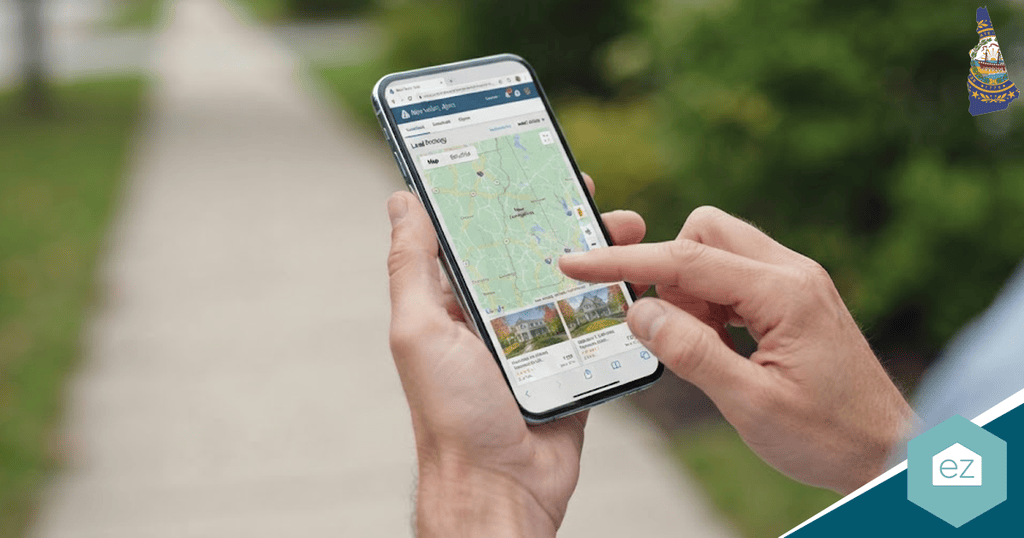
New Hampshire’s housing market is steady and still appreciating, and the numbers that matter for lead generation show up in both the sales counts and the prices. In 2025 the statewide median single-family price reached a record $535,000, up 3.9% over 2024, the smallest annual increase in a decade (New Hampshire REALTORS). Set against a ten-year average of about 8.5% a year, that tells you prices are still rising but the pace has cooled toward something sustainable, mostly because affordability finally caught up with buyers. Sales climbed across every product type. Single-family closings hit 12,529, up 4.5%. Condominium sales rose 6.6%, and manufactured-housing sales jumped 12.2%. Buyers and sellers are both active, which is exactly what a working market looks like.
The real pressure is on supply. New Hampshire carries roughly two months of inventory, well under the five to seven months a balanced market needs. The state Realtor association’s affordability index sat at 58 in 2025, meaning a typical household earns about 58% of the income needed to qualify for the median home, and the index last cleared 100 back in 2021. Rentals are just as tight. New Hampshire Housing’s 2024 survey put the two-bedroom vacancy rate near 0.6%, a sliver of the roughly 5% that signals a balanced rental market (New Hampshire Housing; New Hampshire Fiscal Policy Institute).
One distinction changes how an agent should read all of this. Transaction volume is the flow of deals closing, and it is steady and rising. Inventory is the stock of homes for sale at any given moment, and it is scarce. A low inventory number does not mean fewer people are selling. It means homes sell quickly and owners hold longer between moves. Scarce inventory at record prices is a supply story, and it is a very different thing from a market that is fading.
That supply story is the whole opportunity. When listings are scarce and every agent is fighting for them, the one who wins is the name an owner already knows before the home reaches the market. Record prices also mean owners are sitting on more equity than ever, so the seller who lists this year has real reason to move. You will not win those listings by buying the same shared leads everyone else buys. You win them by being the recognized local name a homeowner thinks of first, and that is what the rest of this piece is about, county by county.
New Hampshire’s demand is mostly local owners moving, with in-migration adding growth on top
Most New Hampshire buying and selling is local owners trading one home for another, and in-migration is the smaller piece that makes the state grow at all. Start with the base. New Hampshire has about 555,000 households, roughly 73% of them owners, which is on the order of 400,000 owner households (U.S. Census). The state closed about 12,500 single-family homes and 4,300 condominiums in 2025 (New Hampshire REALTORS), and with manufactured housing added in, total home sales run roughly 17,000 to 18,000 a year. That is only about 4% of owned homes changing hands in a given year. This steady turnover, not a wave of newcomers, is where most transactions come from, and it is why being the recognized local name matters more than chasing arrivals.
In-migration sits on top of that base, and it is real. Net migration added roughly 40,000 people from 2020 to 2024, about 10,000 a year, which pencils out to something like 4,000 new households annually (Carsey Institute at the University of New Hampshire; U.S. Census). Against 17,000 to 18,000 annual sales, arrivals drive very roughly one transaction in six. Migration matters less because it is large and more because it is the only reason the state grows: births have not kept up with deaths in years, so those newcomers are what keep New Hampshire from losing population. For an agent, the newcomer is a real and nameable opportunity, not the whole market.
Where those newcomers land is worth knowing. Massachusetts is the largest source, and the Seacoast is the marquee destination. That state’s 2022 surtax on very high incomes has pushed some earners north to establish New Hampshire residency, where there is no state income tax, no general sales tax, and no estate tax, while many keep their Boston-area jobs about an hour south (Boston Globe, July 2026, citing The Warren Group and New Hampshire REALTORS). Seacoast prices show it: the median single-family home runs around $867,000 in Portsmouth, about $650,000 in Exeter, and roughly $575,000 in Dover. Arrivals are buyers; owners who leave, whether they head to Maine or across the country, are listings and relocation business. A departure does not have to end the relationship. Caught early, it becomes a listing and a referral instead of a client the agent never sees again.
The jobs behind all of this are steady and diversified, which keeps demand from riding on any single employer. Unemployment sat at 3.0% in May 2026, among the lowest in the country, across roughly 700,000 nonfarm jobs (U.S. Bureau of Labor Statistics). Professional and business services and education and health care have been adding jobs, while manufacturing and trade softened slightly, so the base is broad. The anchors are concrete. BAE Systems employs 6,774 people in New Hampshire, most of them in Nashua, and is the state’s largest manufacturing employer, with an $85 million expansion of its Hudson campus announced in 2026 (New Hampshire Business Review). Around it, the Manchester and Nashua area is building a biofabrication cluster nicknamed ReGen Valley, backed by a $44 million federal Tech Hub grant (U.S. Economic Development Administration).

The people arriving are also younger than the state as a whole. New Hampshire’s median age is 43.4, the second-oldest in the country, and about one in five residents is 65 or older. Yet roughly 60% of recent in-migrants are between 18 and 44 (New Hampshire Fiscal Policy Institute). That gives an agent two live pools at once: long-tenured owners who will eventually downsize or sell, and younger move-up and first-time buyers arriving with jobs. An agent’s job is to serve both, and the platform they stand on decides whether they meet those people early or late.
New Hampshire’s regions, from the Seacoast to the North Country
New Hampshire is really several markets at once, and each region hands an agent a different way to generate business. The Seacoast, anchored by Portsmouth, Hampton, Exeter, Rye, and Dover, is the priciest corner of the state and the front door for Massachusetts buyers trading a Boston commute for New Hampshire residency. Those buyers arrive with budgets, and the owners already there sit on years of equity, so the region is thick with both listing and buyer opportunity for the agent who reaches people first.
Greater Manchester and Nashua, together with Concord and the rest of the Merrimack Valley, is the population and jobs core. About 74% of the state lives in the four southeastern counties, and the biotech and advanced-manufacturing growth around Manchester keeps move-up demand steady even as new construction lags the number of people arriving. The Lakes Region, from Laconia to Meredith, Wolfeboro, and Moultonborough, runs on second-home and waterfront demand around Lake Winnipesaukee and has posted some of the fastest town-level growth in the state. The White Mountains and North Country, including Conway, North Conway, Lincoln, and Littleton, draw recreation and lifestyle buyers, and Carroll County has been the fastest-growing county in New Hampshire.

The Upper Valley around Lebanon and Hanover is its own economy, anchored by Dartmouth College and Dartmouth Health, and it pulls a steady stream of relocating medical and academic buyers who need local guidance in a market they do not know. The Monadnock Region around Keene and Peterborough stays more affordable than the southern tier, which makes it a landing spot for buyers priced out closer to the border.
Prices moved differently by region in 2025. Carroll, Grafton, and Merrimack counties each posted gains above 6%, while Coos and Sullivan counties saw slightly lower prices. That spread is ordinary regional variation inside one steady market, not a sign that any part of the state has stopped selling. For an agent, it is a map of where equity is building fastest and where affordability is drawing the next wave of buyers.
| Region | Anchor markets | What is happening |
|---|---|---|
| Seacoast | Portsmouth, Hampton, Exeter, Rye, Dover | Priciest market in the state; Massachusetts tax-move demand; Portsmouth median around $867,000 (Warren Group; NHAR) |
| Greater Manchester–Nashua / Merrimack Valley | Manchester, Nashua, Concord | Population and jobs core; ~74% of the state in the four southeast counties; biotech growth; building lags arrivals (NHFPI; EDA) |
| Lakes Region | Laconia, Meredith, Wolfeboro, Moultonborough | Second-home and waterfront demand on Lake Winnipesaukee; among the fastest-growing towns 2020–2024 (Carsey; NHFPI) |
| White Mountains / North Country | Conway, North Conway, Lincoln, Littleton | Recreation and lifestyle buyers; Carroll the fastest-growing county at +5.0% (Carsey; NHFPI) |
| Dartmouth–Lake Sunapee / Upper Valley | Lebanon, Hanover, New London, Claremont | Dartmouth College and Dartmouth Health anchor; Grafton price gains above 6% in 2025 (NHAR) |
| Monadnock Region | Keene, Peterborough, Jaffrey | More affordable than the southern tier; steadier, flatter growth; Keene the regional anchor (NHFPI) |
New Hampshire counties and communities, from the metros to the North Country
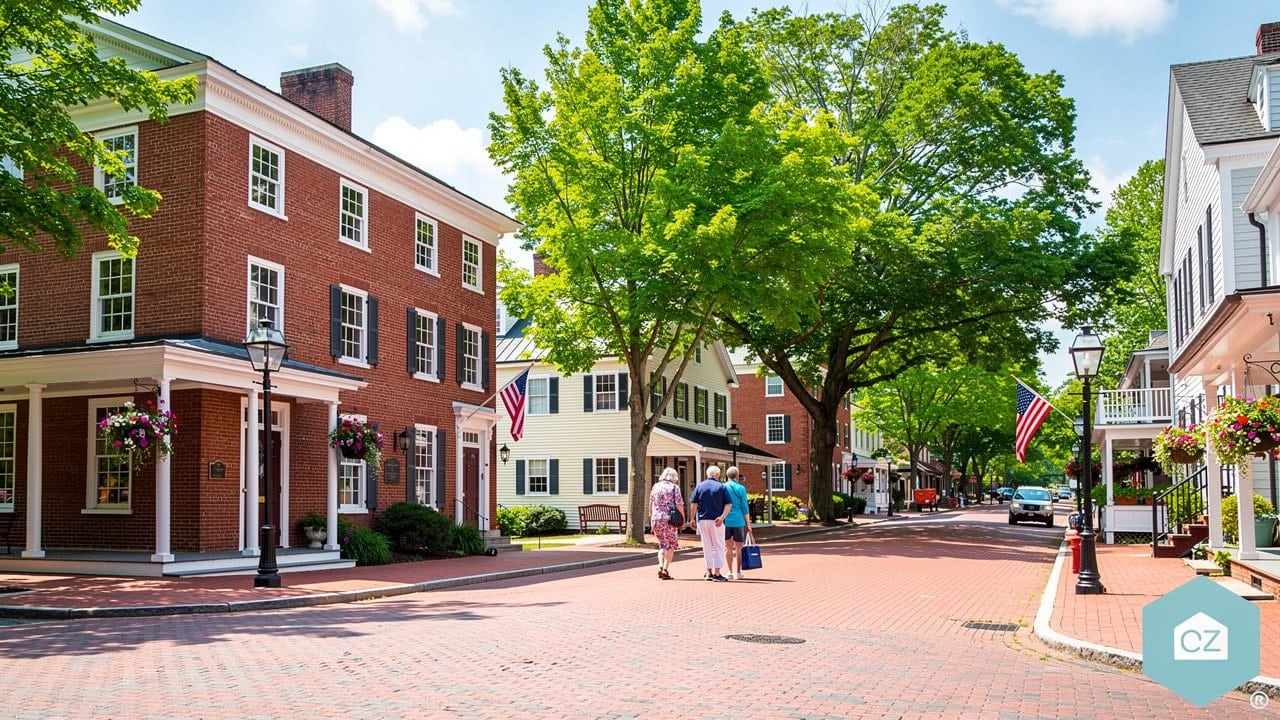
New Hampshire has just ten counties, and an agent who wants to own a market should know all of them, because the opportunity is not limited to the southern metros. The population core sits in the four southeastern counties, Hillsborough, Rockingham, Merrimack, and Strafford, where Manchester, Nashua, Concord, and Dover concentrate most of the state’s buyers and sellers. North and west of there, Belknap, Carroll, and Grafton carry the Lakes Region and White Mountain markets, where amenity demand and second homes drive activity. Cheshire, Sullivan, and Coos, along the western and northern edges, are the affordable end of the state, and they hold owner bases worth being the known name in even where prices sit lower.
Those price differences run through the rental market too. New Hampshire Housing’s 2024 survey put the median two-bedroom rent at about $2,069 in Rockingham County and roughly $1,161 in Coos, a gradient that mirrors where affordability pressure is highest and where buyers priced out of the south begin to look. Every county on the lists below has homeowners who will move eventually, and the agent who is the recognized name there captures that turnover instead of losing it to a portal.
| County | Population (2024) | Principal cities and towns |
|---|---|---|
| Hillsborough | 426,378 | Manchester, Nashua, Bedford, Merrimack |
| Rockingham | 319,082 | Derry, Salem, Londonderry, Portsmouth |
| Merrimack | 155,967 | Concord, Franklin, Hooksett, Bow |
| Strafford | 132,575 | Dover, Rochester, Somersworth, Durham |
| Grafton | 92,120 | Lebanon, Hanover, Littleton, Plymouth |
| Cheshire | 77,297 | Keene, Swanzey, Jaffrey, Winchester |
| Belknap | 64,659 | Laconia, Gilford, Meredith, Belmont |
| Carroll | 51,804 | Conway, Wolfeboro, Moultonborough, Ossipee |
| Sullivan | 43,715 | Claremont, Newport, Charlestown, Sunapee |
| Coos | 31,271 | Berlin, Gorham, Lancaster, Colebrook |
Beyond the big metros, the county map fills in with communities an agent can build a name around.
| County | Communities |
|---|---|
| Merrimack | Concord, Franklin, Hooksett, Bow |
| Strafford | Dover, Rochester, Somersworth, Durham |
| Grafton | Lebanon, Hanover, Littleton, Plymouth |
| Cheshire | Keene, Swanzey, Jaffrey, Winchester |
| Belknap | Laconia, Gilford, Meredith, Tilton |
| Carroll | Conway, Wolfeboro, Moultonborough, Ossipee |
| Sullivan | Claremont, Newport, Charlestown, Sunapee |
| Coos | Berlin, Gorham, Lancaster, Colebrook |
The remote and hybrid buyer most New Hampshire agents still overlook
The remote and hybrid buyer is a lasting source of New Hampshire demand, and most agents still treat them as a fad that already passed. The stories declaring remote work finished measure it against the spring-2020 spike, a moment no one expected to hold. Line it up against how work looked before the pandemic and the number sits about three times higher, and it has stayed there. In the fourth quarter of 2024, federal Bureau of Labor Statistics figures showed 36.7 million Americans working from home at least part of the week, up from 32.5 million twelve months before, with the telework share rising to 23.4%. On the employer side, the U.S. Census Bureau surveyed roughly 150,000 businesses in its Business Trends and Outlook Survey and found they expect about the same amount of remote work half a decade out. That is a national baseline settling in place, not one on the way out.
That national shift lands on specific New Hampshire ground. The USDA reports that rural counties across the country gained about 974,000 net migrants between 2020 and 2024, reversing more than a decade of decline, with the arrivals skewing toward working-age adults. In New Hampshire, that means the Lakes Region, the White Mountains, the Monadnock Region, and the North Country, the affordable and lifestyle markets a buyer can finally choose because they need to be in a Boston or Manchester office only a couple of days a week. It also feeds the Seacoast and the southern tier, where the hybrid commuter keeps a city salary and buys where the living is better. The state’s own numbers already show it. Carroll County has been the fastest-growing county in New Hampshire, and its amenity towns are leading the way.

For an agent, this is a buying signal worth naming out loud. Remote and hybrid buyers want a home that matches how they earn a living: a dedicated or closable office, an accessory dwelling unit (ADU) or separate structure when a spouse also works remotely, extra square footage, and broadband that genuinely keeps up. An agent who asks about a buyer’s work setup on the first call, and who knows which New Hampshire towns have both the space and the connectivity, reaches these people earlier and speaks to what they actually need. Most competitors are still treating them as a story that ended, and that gap is the opening.
Chasing only seller leads misses most of the New Hampshire market
An agent who chases only seller leads leaves most of the New Hampshire market on the table, because most buyers here are also sellers. The common mistake is to pick a lane. One agent markets “list with me” to sellers. Another buys cold buyer leads by the batch. Both handle the two sides of one move as though a different person sat on each, and both surrender the majority of clients who are doing both at the same time.
The numbers behind this are national and worth stating plainly. The National Association of Realtors’ 2025 profile put first-time buyers at just 21% of purchases, a record low, with the median first-time buyer now 40 years old. That leaves about four in five purchasers already sitting in a home they intend to sell so they can buy the next one. In New Hampshire that pattern runs even stronger, because the state is full of owners. About 73.3% of New Hampshire households own their home, among the highest rates in the country (U.S. Census, 2025). The equity gap is real too: the typical New Hampshire homeowner household earned about $114,853 in 2023, against $53,816 for renters, so the move-up seller sitting on years of appreciation is a deep and active pool.
Here is what that adds up to. Most people are buying and selling inside one move, so an agent who commits to a single side walks away from the bigger half of the client. The right platform reads which side is live at the moment. When someone runs a valuation or lands on a home-value page, the selling conversation has opened. When they build saved searches, open their alerts, and book a showing, the buying side is in motion. For most clients both are true, one after the other. ez Home Search tracks that activity rather than guessing, so a partner reaches the person on whatever side is moving right now.
This is also why reaching people early matters so much. A person dreams, then gathers information about what homes cost and what their own home is worth, then plans the financing and the timing, and only then acts. That path is often private and can run for months or years. Because every person on ez Home Search has one vetted local partner and an automated valuation model (AVM) tracking their equity, the partner stays present through the early stretch and is already the trusted name when the person is ready. The buyer they help today becomes the listing they earn next, and the whole move stays with one agent.
How New Hampshire agents try to win business today, and where it breaks
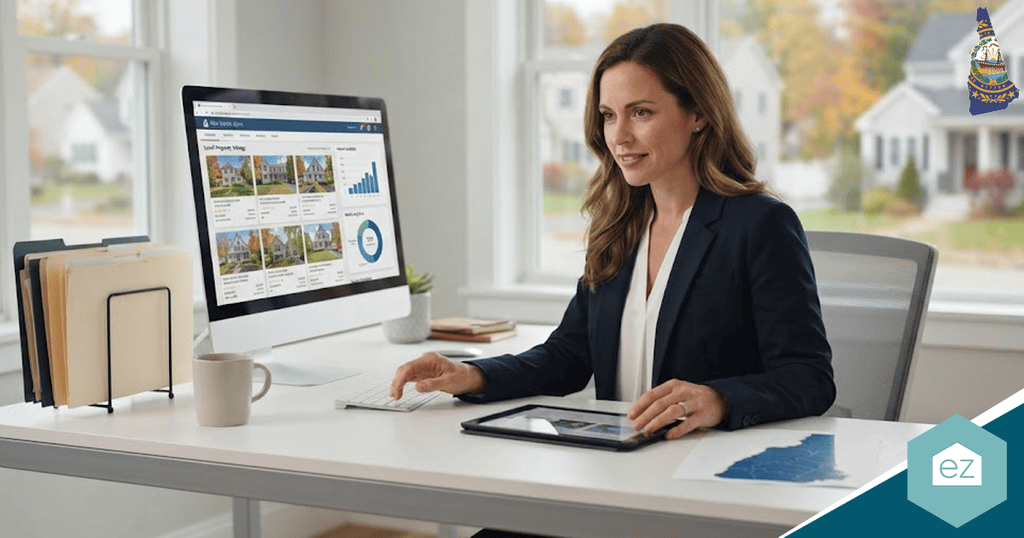
New Hampshire agents work hard for leads, and every method they use has a real use and a real ceiling. Shared buyer leads from legacy portals are the most common. They deliver contacts fast, which counts for something, but that same contact is resold to a handful of agents together, and in a market where Seacoast sellers field cash offers, a cold, over-shared lead rarely converts. The next move is usually an IDX website. A good site helps, yet it is a slow asset that shows the same listings as everyone else’s and falls out of date the moment the agent gets busy with clients, which is most of the time.
Disciplined agents still work cold calling, circle prospecting, and FSBO and expired farming, and those methods build real skill. The cost is time, and in New Hampshire’s scarce-inventory farms, where the same few owners get called by everyone, it is also compliance risk. The moment an agent picks up the phone or sends a text, the law files them under telemarketer, and proving consent becomes the caller’s job, not the recipient’s. Predictive-seller software promises to point at who will list next, and the scores can be a useful starting point, but a high score only flags a maybe, and the partner must still build the relationship that produces a listing. All-in-one CRMs and do-it-yourself content fill a need too, though each is one more system the agent has to run and pay for. Paid ads can produce a burst of leads, then go quiet the week the budget stops.
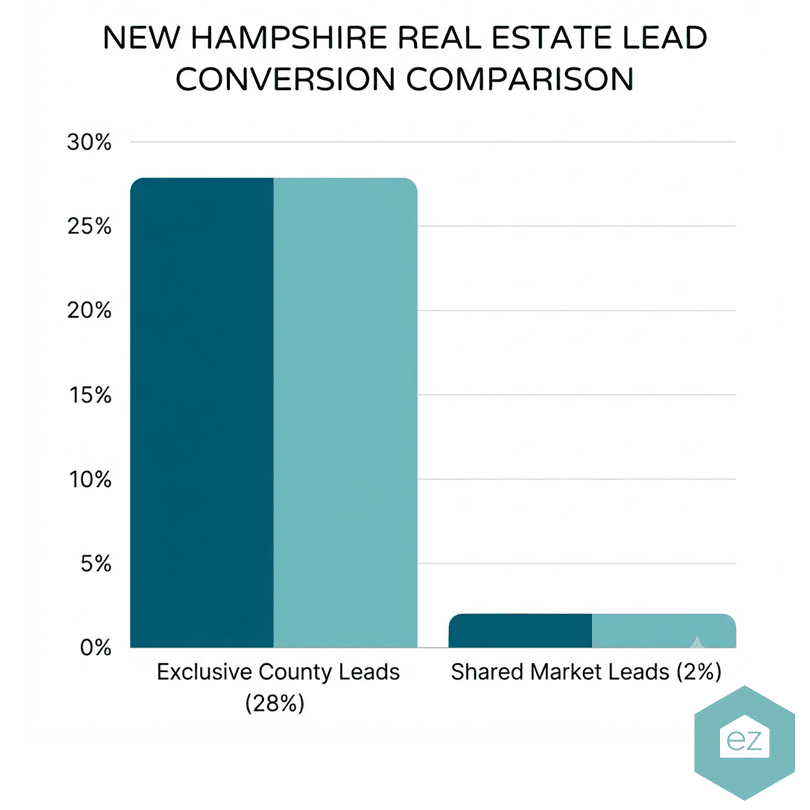
None of these is worthless, and ez Home Search is not a replacement for hard work. The difference is structural. Instead of buying shared names, an Exclusive County Partner owns a whole county on a consumer platform people already use and trust, and the connections arrive warm, from real activity, with the person’s search history attached. The intent signals land in whatever CRM the team already runs, so the agent calls the contact whose behavior shows they are close, while the interest is live. ezVerify.ai verifies that each person opted in, holds the recording that documents it, runs the number through a known-litigator database, and clears Do Not Call registrations before a single call goes out, so the riskiest stretch of prospecting is settled ahead of time.
What the Exclusive County Partnership delivers for a New Hampshire team
The Exclusive County Partnership puts one team, agent, or brokerage in sole command of a whole New Hampshire county, their brand across the consumer experience, and no rival partner working the same ground. The economics are deliberately plain. Leads belong to the partner, there is no per-lead fee, and no slice of the commission goes anywhere else. A busy month in Rockingham or the Lakes Region means a busy month for the partner, never a larger bill.
What makes those connections convert is the model behind them. A person who reaches an ez Home Search partner arrives warm. They came to a platform they trust, searched on their own terms, and showed real intent through real activity, so the partner meets someone who already knows the brand on the site. This is The Only Confidential Home Search in practice. It is the pillar ez Home Search stands on to deliver A Better Way To Discover Real Estate. A person can search, save, and watch a home’s value, and their contact details and budget are never sold off or blasted out to a long list of businesses they did not choose. Their information goes to one vetted local expert, and they know who that is. Privacy earns the trust, and the trust is what makes the relationship convert for the partner.
For a New Hampshire team, the largest return is often the database they already own. Most agents pour their effort into new business and leave past clients and sphere to go quiet, even when repeat and referral business is the cheapest work they will ever land. ez Home Search puts that database back to work, co-branded and done for the partner, with home-value updates, listing alerts, and market reports people actually open. Partners reactivate past clients, whether by repeat business or referral, running 2.5 to 5 times the market rate. Because New Hampshire owners hold their homes for years while equity keeps building, that reactivated base is the steadiest business a partner has.
Relocation is the New Hampshire pain ez Home Search was built to solve on both ends. Two moves show the pain. A Massachusetts buyer relocates to the Seacoast but keeps a Boston job. A longtime New Hampshire owner starts weighing a move to Maine or across the country. In the old pattern, the client drifts to a legacy portal and the local listing goes to a stranger. Since ez Home Search reaches every market in the country, that client keeps searching on the partner’s co-branded platform, and the searches they run in another market surface as an early signal. The partner reaches out before the listing is in play, wins the home they helped the client buy, and refers the far-end purchase for a fee. The relationship travels with the client through the move rather than stopping at the county border.
Compliance comes built in. ezVerify.ai confirms consent and stores the recording behind it, checks every number against a known-litigator database, filters out Do Not Call registrations, and rounds out each contact so the partner can see where the person stands in their move. Its job is documentation and screening, so it is best understood as proof of consent on every opportunity rather than a lead score. The conversion tools that turn interest into deals, the AVM widgets, home-value pages, open-house sign-in pages, and instant cash offers, are all built and already running as part of the platform, co-branded to the partner. There is nothing to assemble and nothing to maintain. The partner walks onto a platform that millions of people are already using, carrying their name, and it works from the first day, so their hours go to clients and closings.
Claiming a New Hampshire county before the next agent does
Only one partner holds a New Hampshire county, and that is the point. The position cannot be shared, so once a team holds Rockingham, Hillsborough, or a Lakes Region county, no other agent can claim that same co-branded ground. Many of the state’s counties are already spoken for, and more are claimed every month, so the honest move for an agent weighing this is to check whether their county is still open rather than assume it will be.
What a partner steps into is already built. The search, the valuations, the listing alerts, the home-value pages, and the follow-up all run on ez Home Search’s own national platform, wearing the partner’s brand, so there is no stack to assemble and no launch to wait on. It runs from the first day the county is theirs.
The scarcity that matters most is the recognized-name position, more than the software. New Hampshire runs on roughly two months of inventory, which means listings are won by the agent an owner already trusts, not the one who happens to call that week. The advantage that compounds is being the known name across a whole county, on the platform residents already use, and it is one a competitor cannot copy from the outside. The counties that are open will not stay open, so the first step is simply to find out whether yours is one of them.
The New Hampshire agent’s real choice

Every New Hampshire agent picks one of three ways to grow, whether they name it or not. The first is to keep buying shared portal leads, the same cold names handed to a batch of agents at the same time, and to accept the conversion that comes with them. The second is to build the whole machine yourself: the IDX site, the data, the valuations, the content, the compliance, and then spend every week keeping it alive instead of selling. The third is to hold one New Hampshire county on a platform residents already trust and let it deliver warm, owned relationships on both sides of the move.
The middle path is the one most teams land on once they see the other two clearly. It is worth being honest about the trade. Exclusivity means one partner per county, so a county is either open or already claimed, and turning a warm relationship into a closing takes 30 to 60 days of real follow-up, not a weekend. That is the cost of connections that convert and clients who stay for years.
Weigh it against a single number. Partners reactivate past clients, whether by repeat business or referral, running 2.5 to 5 times the market rate, working from a database the agent already owns. In a state full of long-tenured, equity-rich owners, that is the difference between starting every year from scratch and growing from a base that compounds. Counties get claimed one by one, and each goes to a single agent. The first move is the smallest one: find out whether yours is still open.
Frequently asked questions
Where are Massachusetts buyers landing on the New Hampshire Seacoast, and how does an agent reach them before they connect with a portal agent?
Massachusetts buyers are concentrating on the Seacoast, in and around Portsmouth, Exeter, Hampton, Rye, and Dover, drawn by New Hampshire’s lack of income and sales tax while many keep Boston-area jobs about an hour south. To reach them first, an agent has to be present while they are still researching, months before they raise a hand. On a legacy portal, that early research becomes a lead someone else buys. On the partner’s co-branded ez Home Search experience, the same activity surfaces to that single local partner, who reaches out while the interest stays warm.
How do New Hampshire’s high property taxes, with no income or sales tax, change what a buyer can actually afford from Concord to New Castle?
New Hampshire has no state income tax and no general sales tax, but it funds services through some of the highest effective property taxes in the country, and the rate swings widely by town. A buyer comparing Concord, near $29 per $1,000 of assessed value, to a low-rate town like New Castle at about $5, is looking at very different monthly costs on the same price. ez Home Search’s property-tax data and automated valuation model fold that into the true cost of owning, so an agent can steer a buyer to the town where the all-in number actually works.
Which New Hampshire counties are gaining residents fastest, and where is the seller opportunity as Lakes Region and White Mountains owners turn over?
Carroll County, spanning the White Mountains and northern Lakes Region, has been the fastest-growing county in New Hampshire, with amenity towns like Moultonborough and Tuftonboro leading. The seller opportunity is the turnover underneath that growth: second-home owners trading up or cashing out, and long-tenured owners aging into a move. An agent who is the recognized name in those towns, tracking each owner’s equity, wins the listing when the owner is ready instead of losing it to whoever runs an ad that week.
How do you generate seller leads in Rockingham County when supply is under two months and the median tops $670,000?
You generate seller leads in a tight county like Rockingham by being present with owners long before they list, not by fighting over the few active listings everyone else is chasing. With inventory near two months and a median around $670,000, owners hold real equity and move on their own timeline. A co-branded home-value tool that keeps an owner watching their number, plus automated follow-up when their activity picks up, puts the partner in the conversation first. Shared portal leads arrive only after the owner has already raised a hand somewhere else.
What is the best way to capture second-home and waterfront buyers around Lake Winnipesaukee and the Lakes Region?
The best way to capture second-home and waterfront buyers around Lake Winnipesaukee is to reach them while they are dreaming, which is where most of them spend months. These buyers browse from out of the area, save homes, and watch the market long before they act. ez Home Search treats that dreamer as a real user rather than a lead that failed to convert, and the partner in Belknap or Carroll County stays in front of them with saved-search alerts until the right property appears.
How can a southern New Hampshire team stay in front of clients who commute to Boston but buy in New Hampshire for the tax advantage?
A southern New Hampshire team stays in front of Boston commuters by owning the county-level relationship on a platform those buyers already use for search and home values. The commuter who buys in Salem, Nashua, or the Seacoast for the tax advantage keeps checking their home’s value and the market around them for years. Because the partner’s brand sits on that experience, the team stays top of mind for the next move, the refinance question, and the referral, instead of losing the client to a portal.
Where are the affordable New Hampshire markets, like Coos, Sullivan, and the Monadnock Region, for buyers priced out of the southern tier?
The affordable markets sit along the western and northern edges of the state: Coos County in the North Country, Sullivan County, and the Monadnock Region around Keene. Rents and prices there run well below the southern tier, which is why buyers priced out near the Massachusetts border increasingly look north and west. For an agent, these counties hold owner bases worth being the known name in, with far less competition for that position than in the metros.
How do Upper Valley agents around Lebanon and Hanover reach relocating Dartmouth and medical-center buyers?
Upper Valley agents reach relocating Dartmouth and Dartmouth Health buyers by being the trusted local guide before those buyers ever arrive. People relocating for a job at the college or the medical center research the Lebanon and Hanover market from a distance, often for months. A co-branded search experience they can use from anywhere, paired with one local expert who answers their questions, puts the partner in the relationship early, ahead of any agent they might otherwise meet through a portal listing.
With New Hampshire’s owner base aging while younger out-of-state buyers arrive, how should an agent balance downsizer listings and first-time-buyer demand?
An agent balances both by working them as two ends of the same market rather than two separate campaigns. New Hampshire’s median age is among the oldest in the country, so downsizer listings are a steady source of inventory, while roughly 60% of recent in-migrants are between 18 and 44 and need homes to buy. ez Home Search reads each contact’s behavior, so the same partner can serve the downsizing seller and the arriving buyer, and often match one to the other inside their own county.








Kurt Uhlir is a recognized leader in marketing, growth, and innovation, having helped scale companies and technologies used by millions every day—including at brands like eXp Realty, Sideqik, Vitrue, Oracle, Garmin, Facebook, Meta, Apple, and more. He’s trained tens of thousands of professionals on how to build trust, lead with service, and help clients make wise, informed decisions. At ez Home Search and Sure Send, his focus is on helping high-performing business owners, team leaders, and individual sales leaders grow their businesses through exclusive market access, privacy-first lead systems, and conversion-focused enablement tools.