

In a single recent year, 26 Pennsylvania counties grew while 41 lost population, and a home in suburban Bucks County sold in roughly a week while a comparable listing near Pittsburgh sat for close to 50 days. That gap is the first thing to understand about Pennsylvania real estate leads: there is no statewide market to win. There is a fast suburban belt outside Philadelphia, a slow-and-steady value market in the southwest, a Lehigh Valley filling up with New York and New Jersey transplants, a Poconos fed by relocation, an eds-and-meds and logistics core through the middle of the state, and an affordable Great Lakes anchor in Erie.
A lead product built for “Pennsylvania” treats all of that as one number. The agents and teams who win here do the opposite. They pick a market they can actually own and become the name buyers and sellers there already trust. This article lays out the trends shaping each region, the pains that make leads hard to convert, and the model that lets a team stop renting shared names and start owning the relationships in their county.
Pennsylvania is not one real estate market, it is at least six

The honest picture of Pennsylvania is a plural one, and that plurality is the opportunity. Statewide prices have climbed steadily, up about 57% over the five years through 2025 according to the Pennsylvania Association of Realtors, but the averages hide how differently each region behaves.
Inventory is the binding constraint almost everywhere. Statewide months of supply has hovered near two months, firmly a seller’s market, with active listings rebuilding only slowly off historic lows. The deeper cause is structural: Pennsylvania has built among the fewest homes per capita in the country. The Pew Charitable Trusts found that from 2017 through 2023, permits added only about 3.4% to the housing supply while households grew 5.1%. Sized in units, the shortage is large. One widely cited estimate from Up for Growth puts the state roughly 98,000 homes short, and the Commonwealth’s own housing planning projects a need for about 450,000 new units by 2035, with the state on track to fall short by nearly 185,000 at current building rates. For an agent, that single fact reframes the whole job: the scarce resource in Pennsylvania is not buyers, it is listings.
Migration is real here, but it is widely misread, so it is worth sizing. Against a population near 13 million and more than five million households, Pennsylvania’s net domestic out-migration runs in the low tens of thousands cumulatively since 2020, a modest figure next to the owner base and annual turnover. International migration more than offsets it, adding roughly 27,000 residents in a recent year and pushing overall population up. Treat departures and arrivals as two sides of the same opportunity. People leaving for another state are listings today and relocation referrals tomorrow. People arriving, whether from abroad, from New York and New Jersey, or from another Pennsylvania county, are buyers. A market with modest net out-migration still has a full, active two-sided business.
Employment is the other reason Pennsylvania holds up, and it does not rest on one industry. Healthcare and life sciences anchor both ends of the state, from the UPMC and Allegheny Health Network systems in the southwest to a major investment of up to $800 million by GSK in Lancaster County. The southwest has become a real technology and robotics center, with more than a hundred AI and robotics firms drawing young professionals into Pittsburgh, where over 23% of the city’s population is in its twenties. The natural gas industry across the northern and southwestern shale counties supports well over a hundred thousand jobs by industry estimates, at wages above the state average. And the I-78 and I-81 corridor has become one of the East Coast’s logistics engines, with millions of square feet of new warehouse space completed and under construction as distributors shift operations west out of northern New Jersey. New business formation is strong and, more telling, it lasts: Pennsylvania ranks among the top states for new-business survival, not just new-business starts.
The demographics split sharply by geography. Seniors make up close to 19% of the state, above the national share, and Pittsburgh is one of the oldest large metros in the country. At the same time, nearly half of the state’s young adults cluster in the Philadelphia and Pittsburgh metros. That divergence, an aging owner base in much of the state alongside young-professional density in the two big metros, is itself a lead-generation map. The table below grounds the scale of each major market.
| Rank | County | Population | Principal city |
|---|---|---|---|
| 1 | Philadelphia | 1,579,706 | Philadelphia (city and county) |
| 2 | Allegheny | 1,238,177 | Pittsburgh |
| 3 | Montgomery | 867,573 | Norristown (county seat) |
| 4 | Bucks | 647,461 | Doylestown (county seat) |
| 5 | Delaware | 579,222 | Media (county seat); Upper Darby is the largest municipality |
| 6 | Lancaster | 557,931 | Lancaster |
| 7 | Chester | 547,840 | West Chester (county seat) |
| 8 | York | 462,924 | York |
| 9 | Berks | 433,015 | Reading |
| 10 | Lehigh | 378,792 | Allentown |
County populations from U.S. Census Bureau American Community Survey estimates.
Six regions, six different lead problems
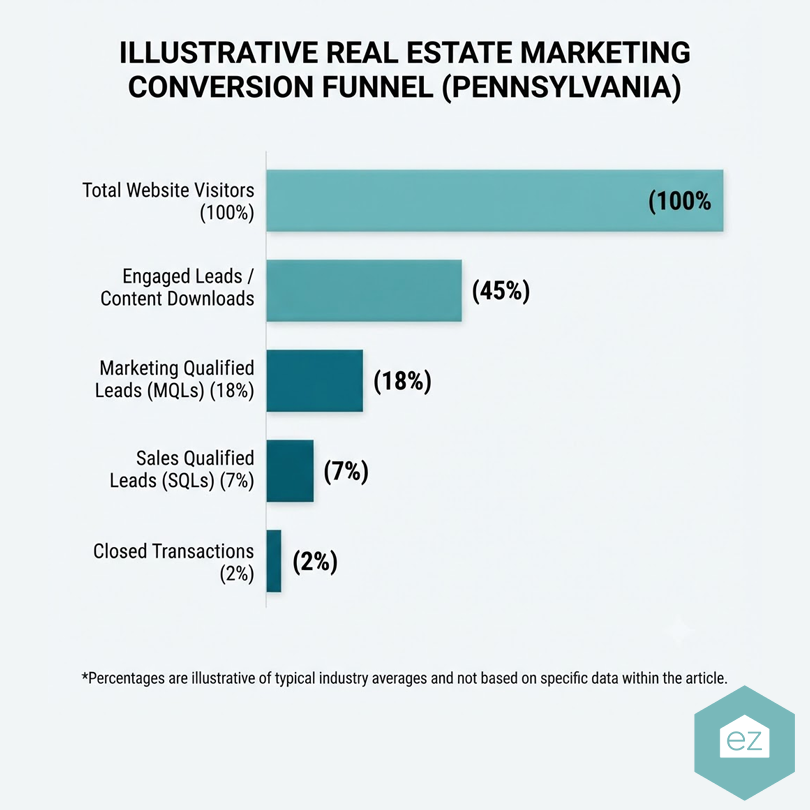
A lead strategy that works in one Pennsylvania region can fail completely in the next, because the underlying market behaves differently. Here is how the six major regions diverge, and what each one means for the leads worth chasing.
Philadelphia and the southeast is the state’s hottest market and its most expensive. The region ranked near the top of national big-metro outlooks for 2025, and the suburban counties move fast: Bucks County listings have turned in roughly a week in recent reporting, against about three weeks inside Philadelphia itself. The complication here is cost of ownership, not just price. Philadelphia carries one of the highest realty transfer taxes of any major U.S. city, around 4.3% to 4.6% of the sale price once the city and state portions are combined, compared with roughly 2% across most of the state. Add the highest school taxes in Pennsylvania in the surrounding suburbs, where median school tax bills in Chester, Montgomery, Delaware, and Bucks counties run well above the rest of the state, and the seller’s true net proceeds become a real conversation. Agents who can model that math win listings; agents working a generic price estimate do not.

Pittsburgh and the southwest is the value story, slower and more affordable, with homes taking around 50 days to sell. It is also where a specific piece of local knowledge separates the professionals from the lead buyers. Allegheny County has not reassessed property since its 2012 base year, and the county’s Common Level Ratio, the figure that converts today’s market value back to a 2012 assessment, fell to 50.14% for 2026 from about 52.7% a year earlier. A falling ratio widens the gap between assessed and market value and changes who should be appealing their taxes, and the county is now weighing a move to reassess every three years beginning in 2028. A team that understands this can open both sides of the conversation: sellers worried about tax exposure and buyers trying to estimate their real carrying cost. Layer on the region’s young-professional and eds-and-meds buyers against its large 65-plus owner base, and the southwest rewards an agent who can serve two very different clients.

The Lehigh Valley is Pennsylvania’s clearest growth magnet. The region pushed past 708,000 residents in 2025, drawing a net of roughly 17,000 international and 6,800 domestic in-migrants since 2020, with New York and New Jersey a major source as buyers trade big-metro costs for Allentown, Bethlehem, and Easton. Young-adult population has grown sharply. The lead opportunity here is relocation: buyers who do not know the market and need a local expert to guide them.

The South Central capital region of Harrisburg, York, Lancaster, Lebanon, and Cumberland is the logistics and life-sciences core, home to the I-81 distribution corridor and GSK’s Lancaster County investment. Harrisburg moved toward a more balanced market heading into 2026, which makes it a place where both buyer and seller leads can be worked without the bidding-war pace of the southeast.
Northeast Pennsylvania and the Poconos combine affordability pressure with relocation demand. Scranton and Wilkes-Barre have seen sharp price and rent growth on almost no new building, while Pike County grew 7.3% from 2020 to 2025, among the fastest in the state, fed by New York and New Jersey buyers moving to the lake and mountain communities of Monroe and Pike. The lead profile is part local move-up, part out-of-state relocation.
The northwest, anchored by Erie, is the affordable Great Lakes market, with Millcreek Township as the residential core around Presque Isle. It behaves less like a boom market and more like a steady, relationship-driven one, where word of mouth still decides who gets the call.
| Region | Anchor markets | What it means for leads |
|---|---|---|
| Philadelphia / Southeast | Philadelphia, Montgomery, Bucks, Chester, Delaware | Fast suburbs (Bucks near 7-day sales) vs a slower city; high transfer and school taxes make net-proceeds expertise the edge |
| Pittsburgh / Southwest | Allegheny, Westmoreland, Washington, Butler, Beaver | Value market near 50-day sales; frozen 2012 assessments and a falling Common Level Ratio drive tax-aware conversations |
| Lehigh Valley | Lehigh, Northampton | Surged past 708,000; heavy NY/NJ and international in-migration; relocation buyer leads |
| South Central / Capital | Dauphin, Cumberland, Lancaster, York, Lebanon | Logistics and life-sciences core; market moving toward balance; both buyer and seller leads workable |
| Northeast / Poconos | Lackawanna, Luzerne, Monroe, Pike, Wayne | Price and rent pressure on minimal new building; Pike up 7.3% on NY/NJ relocation |
| Northwest | Erie, Crawford, Mercer | Affordable Great Lakes anchor; steady, referral-driven business around Erie and Millcreek |
Counties and communities beyond Philadelphia and Pittsburgh
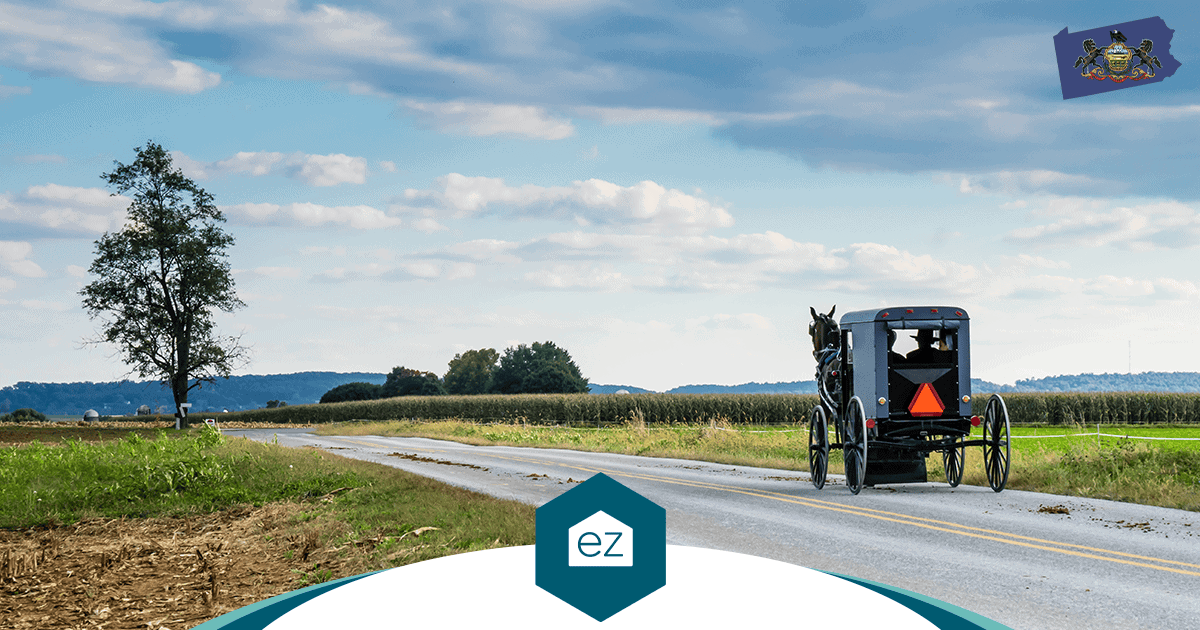
Most of Pennsylvania’s transactions happen outside the two largest metros, in mid-size counties and the towns that anchor them. Breadth matters for lead generation because a team that can speak to specific communities, not just a metro name, earns trust faster. The counties and communities below show how much market sits beyond the headline cities.
| County | Region | Communities |
|---|---|---|
| Dauphin | South Central | Harrisburg, Hershey, Hummelstown, Middletown |
| Cumberland | South Central | Carlisle, Mechanicsburg, Camp Hill, Shippensburg |
| Lebanon | South Central | Lebanon, Annville, Palmyra, Cornwall |
| Erie | Northwest | Erie, Millcreek Township, Edinboro, Harborcreek |
| Centre | Central | State College, Bellefonte, Boalsburg, Philipsburg |
| Monroe | Poconos | Stroudsburg, East Stroudsburg, Tannersville, Tobyhanna |
| Luzerne | Northeast | Wilkes-Barre, Hazleton, Kingston, Pittston |
| Lackawanna | Northeast | Scranton, Dunmore, Carbondale, Clarks Summit |
| Westmoreland | Southwest | Greensburg, Murrysville, Jeannette, Latrobe |
| Northampton | Lehigh Valley | Easton, Bethlehem, Nazareth, Bath |
Each of these counties has its own price level, its own buyer profile, and its own rhythm. State College moves with the university calendar. Hershey and Derry Township revolve around a single large employer. The Poconos towns trade on lifestyle and proximity to New York. A national lead vendor cannot tell those markets apart. A local partner who lives in them can.
Why Pennsylvania real estate leads are harder to win, and how agents chase them today
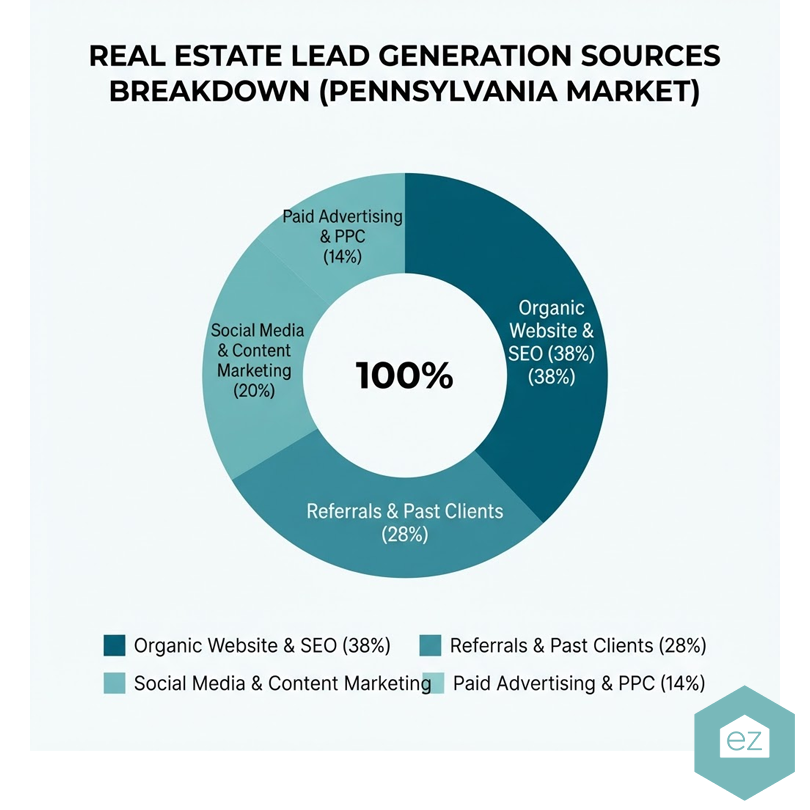
The hardest part of generating Pennsylvania real estate leads is that the listing, not the buyer, is the scarce side of the market. A structurally underbuilt state with two months of supply means more agents are competing for fewer sellers, so the team that consistently surfaces and converts listing opportunities is the team that grows. Three things make that harder here than the national playbooks assume.
First, the market divergence is severe. A circle-prospecting and open-house cadence that fills a pipeline in seven-day Bucks County will starve in a 50-day Pittsburgh submarket, and vice versa. Generic, statewide lead products misfire because they are not tuned to the county or the town. Second, the tax picture is genuinely complicated, from Allegheny’s frozen assessments and falling Common Level Ratio to Philadelphia’s transfer tax and the southeast suburbs’ school-tax burden, and buyers and sellers have real questions an agent is expected to answer. Third, the aging owner base across much of the state is a downsizing and life-event wave that most agents under-work, because staying in front of past clients for years is exactly the thing a busy agent does not have time to do.
So how do agents try to solve the lead problem today? Most start with shared portal leads. The value is obvious, they arrive quickly, but the structure works against the agent: a legacy portal sells the same contact’s details and budget to whoever pays, so an agent is often dialing a name that several competitors are dialing at the same moment, with no relationship and little intent behind it. Others build their own IDX website, which can become a real asset over years but is a slow, maintenance-heavy build that rarely outruns the national platforms. Cold calling, FSBO and expired outreach, circle prospecting, and farming all work, but they are time-heavy and carry rising compliance risk. Predictive-seller tools score a database and guess who might list, which is a probability, not a consented, interested person. Generic all-in-one CRMs are built for everyone and owned by no one locally. Paid social and search ads can produce volume, but quality swings widely and the follow-up structure has to be built and run by the agent.
Every one of those approaches solves a piece of the problem and leaves the core gap open: none of them gives the agent an exclusive, warm, intent-driven connection to a person who already trusts the place they came from. That gap is the mechanism worth fixing.
The remote-work demand most Pennsylvania agents still miss
Here is an edge most agents, teams, and brokers have talked themselves out of: remote and hybrid work did not collapse, and it is still moving buyers into Pennsylvania’s affordable and lifestyle markets. The headlines calling remote work dead are a measurement trick, comparing today against the spring-2020 emergency peak instead of the real pre-pandemic baseline. Measured correctly, work from home has settled at roughly three times its pre-pandemic level and held there.
The numbers come from the institutions that actually count this. Bureau of Labor Statistics figures for the fourth quarter of 2024 show 36.7 million Americans teleworking at least some of the time, a rise from 32.5 million the year before, with the telework rate reaching 23.4%. Gallup’s 2025 read on remote-capable workers puts about 51% in hybrid roles and 28% fully remote, a mix that has held steady since late 2022. And when the Census Bureau’s Business Trends and Outlook Survey asked roughly 150,000 firms where remote work would stand five years out, employers projected close to today’s level. This is a plateau, not a slide.
That stability is a buying signal, and it points straight at Pennsylvania’s smaller and mid-size markets. The USDA Economic Research Service found that rural counties reversed more than a decade of decline starting in 2020, gaining roughly 974,000 net migrants through 2024, concentrated in working-age adults in their late twenties to early forties, the remote-eligible group. In Pennsylvania, the geography positioned to capture that shift is exactly the affordable and lifestyle belt: Pike and Monroe in the Poconos, the Lehigh Valley within reach of New York, Erie on the lake, State College and the surrounding Centre County, the Laurel Highlands, and the Pennsylvania Wilds. A remote buyer can choose those places now in a way they could not a decade ago.
For an agent, this turns into specific guidance a client can use. Remote and hybrid buyers want a home office they can close the door on, and more and more of them want a second workspace in a detached structure or an accessory dwelling unit. They want more square footage and real high-speed broadband, which is not a given in rural Pennsylvania and is worth confirming before a buyer falls in love with a house. The agent who knows which townships have real broadband, and which listings have the space to work from home, is the agent a relocating remote worker keeps. That is local knowledge no shared lead carries.
What an Exclusive County Partnership gives a Pennsylvania team

The model that closes the gap is the Exclusive County Partnership from ez Home Search. A single agent, team, or brokerage takes one Pennsylvania county and runs it alone, their brand carried through the consumer home-search experience, and no other partner is allowed to operate on that same ground. The partner pays no fee for each lead and gives up no slice of a commission at closing, so a busy month rewards the partner instead of running up a bill. That one difference in structure, owning the territory rather than renting names off a shared list, is what turns these connections into closings.
It converts because of how the people arrive. ez Home Search is built consumer-first and privacy-first, so a person searching for a home does not have their contact details and budget put up for sale and handed to whoever pays the most. Each one is matched with a single vetted local expert, the partner, and because they trust the experience, they engage more openly. By the time that person reaches the partner, the agent can already read what they have done on the platform: the Lancaster or Lehigh Valley neighborhoods they returned to again and again, the budget band they kept circling, the saved listing they keep reopening. The opening conversation begins on what the person actually wants, so the trust that normally takes weeks is half there before anyone speaks. This is where The Only Confidential Home Search meets the Single Local Expert, and what it produces is the opposite of a cold name pulled off a shared list.
For a Pennsylvania team, several parts of the partnership line up directly with the pains above.
The biggest and least expensive opportunity is the database a partner has already built. With an aging, downsizing owner base across much of the state, the past clients and sphere a team has already earned are full of listings that have not happened yet, and ez Home Search keeps that database active with home-value updates, listing alerts, and a search experience people come back to on their own, all carrying the partner’s brand. Most agents know follow-up matters and still come up short because they lack the time and the material; the platform supplies both, and partners turn past clients back into repeat and referral business at well above the market rate.
A relocating client is worth more to a Pennsylvania agent than most realize. With 41 counties losing population and a steady stream of out-of-state moves, a past client who quietly starts searching another market on a legacy portal is a listing the agent never sees coming. Since ez Home Search reaches every market in the country, that client keeps their search on the partner’s branded platform, and the early signal lets the agent take the listing on the departing home and pass the buy side to an out-of-market agent for a referral fee.
The prize that compounds is recognition. The partner’s brand sits across the search, the alerts, and the market reports the county already uses, and because most sellers contact only one agent before listing, the recognized local name wins the client before any comparison happens.
The partnership also handles the parts of the job that create risk and overhead. Because Pennsylvania is a title-company closing state where the buyer chooses settlement rather than being assigned an attorney, the partner’s vetted network of professionals, the lender they bring in, title, and home services, becomes part of how clients experience the move, and that network runs co-branded inside the platform. On compliance, ezVerify.ai records the person’s opt-in, keeps the proof of it on file, runs each number against a known-litigator database, filters out Do Not Call registrations, and adds detail to every contact before a single call goes out. It handles consent and verification rather than scoring a lead, and it lifts the riskiest part of prospecting off the partner’s plate. The conversion tools, the AVM widget, the home-value pages, the open-house sign-in, all run on the same platform with the partner’s brand, with nothing for the team to build or operate.
Securing a Pennsylvania county before it is claimed
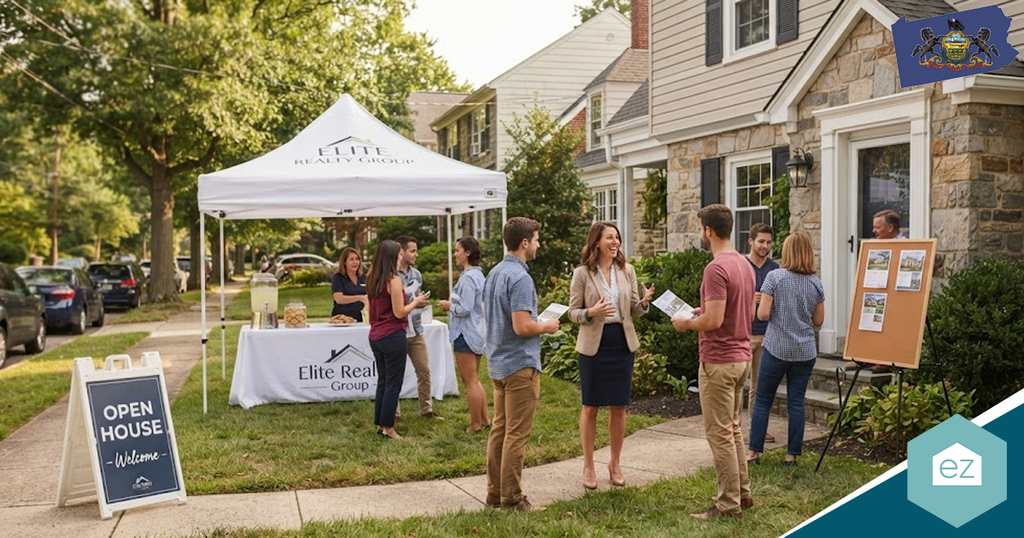
Each county belongs to one partner alone, which is both the appeal and the constraint. A good number of Pennsylvania counties have already been claimed, the count rises every month, and after a county is taken, no rival can buy the same branded position at any price. A populous metro county like Montgomery or Allegheny works the same way as a mid-size market like Dauphin, Lehigh, or Erie, because being the name people know counts for just as much in a smaller county as in a big one. The platform is live on day one, so a partner steps onto a national home-search experience millions of people already use with their own brand on it, instead of burning months building a stack. The one question that matters is whether the county a team wants is still open, and you can check that in a few minutes.
The choice a Pennsylvania team actually faces
Step back and the choice comes into focus. The first path is to leave things as they are: keep paying for shared leads that show up cold, land in several agents’ inboxes at once, and reset to zero at the start of every month. The third path is the far end: build and operate the whole machine yourself, the national-grade search, the data, the valuations, the compliance, the follow-up, at a cost in money and years no single team can carry. The second path is the sensible middle, and it is where most growth-minded Pennsylvania teams settle: take your county on a platform that already carries the whole load, with your brand on top.
Be honest about the trade-off. This partnership is not on offer in every county, since each one belongs to a single partner, and what it produces are relationships that grow rather than lead lists that spike and fade. Plan on new connections coming to a deal over roughly 30 to 60 days as trust becomes a transaction, not the same week. The payoff for that patience is ownership: the partners running this model bring past clients back into repeat and referral business at several times the market rate, because the relationships belong to them and the platform keeps them active.
If you want to find out whether your Pennsylvania county is still open, the next move is to check its status and talk through what holding it would mean for your team.
Frequently asked questions
With Pennsylvania building among the fewest homes per capita in the country, how do I generate enough seller and listing leads to keep a pipeline full?
Treat listings as the scarce resource and build your lead generation around the seller side. Pennsylvania’s structural underbuilding, roughly 98,000 units short by one estimate and a projected gap approaching 185,000 by 2035, means buyers chase too few homes, so the agents who grow are the ones who consistently surface sellers. The most reliable source is the database you already own, kept warm with home-value updates and a search experience past clients actually return to, which is exactly what an Exclusive County Partnership runs for you. That beats buying shared buyer leads into a market that does not have enough inventory for them.
Why do leads convert so differently in the Philadelphia suburbs than in the Pittsburgh metro, and how should my approach change between them?
Because the markets move at different speeds. Suburban Bucks, Chester, and Montgomery county listings can sell in about a week, so speed and immediate follow-up win, while the Pittsburgh metro sells closer to 50 days, so patient nurturing and value-driven conversations win. A lead tool that does not know the difference wastes effort in both. When you own a specific county, you can tune your cadence to that market instead of running a statewide average that fits neither.
How should Allegheny County’s frozen 2012 assessments and falling Common Level Ratio shape the conversations I prioritize?
They open both buyer and seller conversations if you understand them. Allegheny County still assesses to a 2012 base year, and its Common Level Ratio fell to 50.14% for 2026, which widens the gap between assessed and market value and changes who benefits from an assessment appeal. With the county weighing reassessment every three years starting in 2028, sellers worry about future tax exposure and buyers want to estimate real carrying cost. An agent who can speak to that is worth keeping, which is the kind of trust that turns a co-branded platform contact into a client.
How do I turn the Lehigh Valley’s and the Poconos’ New York and New Jersey in-migration into a steady buyer-lead pipeline?
Position yourself as the local expert these relocating buyers do not yet have. The Lehigh Valley pushed past 708,000 residents on heavy New York and New Jersey in-migration, and Pike County in the Poconos grew 7.3% on the same draw. These buyers do not know Allentown, Bethlehem, or the Monroe County lake communities, so they need guidance, not a cold call. A co-branded national search experience captures them while they are still researching from out of state and surfaces them to you as the one vetted local expert, with their search history already visible.
How do Philadelphia’s high realty transfer tax and the suburbs’ high school taxes change the seller leads I should chase and the net-proceeds story I tell?
They make true net-proceeds expertise your differentiator. Philadelphia’s combined realty transfer tax runs around 4.3% to 4.6% of the sale price, against roughly 2% across most of Pennsylvania, and the southeast suburbs carry the highest school taxes in the state. A seller who only sees a price estimate is missing what they will actually keep. The agent who walks them through the real number wins the listing, and a platform that brings an accurate automated valuation (AVM) together with a full comparative market analysis gives you the tools to tell that story credibly.
How do I reach Pittsburgh’s young-professional and eds-and-meds buyers while also serving the region’s large 65-plus, downsizing owner base?
Serve them as two distinct motions on one platform. Pittsburgh skews both young, with over 23% of the city in its twenties drawn by tech and the health systems, and old, as one of the nation’s oldest large metros. First-time and move-up buyers respond to fast, mobile, activity-driven follow-up, while the downsizing owner base responds to years of steady home-value updates that earn the listing when life changes. When you own the county, you can run both motions without buying two separate lead products.
What lead sources actually work in Pennsylvania’s smaller markets like Erie, State College, and Harrisburg, where word of mouth still drives business?
What works is recognition and relationships, not raw volume. In Erie, State College, and the Harrisburg capital region, buyers and sellers still choose the agent they know, and most contact only one before deciding. The lead source that works is becoming the recognized local name, which is what co-branding across the home-search experience the community already uses builds over time. It compounds in a smaller market faster than paid lead volume ever will, because reputation travels.
How can my team own buyer and seller leads for an entire Pennsylvania county instead of splitting shared leads with other agents?
That is exactly how the Exclusive County Partnership is built: one team holds the county, their brand runs through the consumer experience, no rival partner works inside it, and there is no per-lead charge. Instead of dialing a name that several agents bought at once, you own the relationships in your territory, and the platform keeps them engaged for years. Only one partner holds each county, so the practical first step is checking whether yours is still available.











Kurt Uhlir is a recognized leader in marketing, growth, and innovation, having helped scale companies and technologies used by millions every day—including at brands like eXp Realty, Sideqik, Vitrue, Oracle, Garmin, Facebook, Meta, Apple, and more. He’s trained tens of thousands of professionals on how to build trust, lead with service, and help clients make wise, informed decisions. At ez Home Search and Sure Send, his focus is on helping high-performing business owners, team leaders, and individual sales leaders grow their businesses through exclusive market access, privacy-first lead systems, and conversion-focused enablement tools.