

Most agents talk about “the DC market” as if it were one place run by one employer. It is not.
The District has pushed past 700,000 residents, lifted by international arrivals, while families keep moving out to Loudoun and Frederick for space and the condo and single-family markets pull in opposite directions. To generate real estate leads in Washington DC, you have to work a metro that is really three jurisdictions and a dozen sub-markets at once. A Navy Yard condo, a Capitol Hill rowhouse, an Ashburn new-build, and a military transfer into Stafford are four different lead problems wearing one area code.
The agent, team, or brokerage that wins here stops treating the DMV as a federal monoculture and starts working it as the plural market it is. This is a guide to where the leads actually are across the District, the Maryland suburbs, and Northern Virginia, how agents try to capture them today, and why an exclusive, confidential partnership beats buying the same shared names as everyone else on the block.
The DMV is a metro of many markets, not one federal town
The first thing to understand about lead generation here is that the region runs on far more than the federal government.
Home prices have held firm even as supply rebuilt. The metro median sits north of $600,000, and not long ago homes were going under contract in about 10 days; as inventory came back, that pace stretched toward a month, with the median still climbing (Bright MLS; Greater Capital Area Association of REALTORS). For an agent, the swing from a 10-day sprint to a month-long cycle changes everything about lead timing, seller expectations, and how long a nurture sequence has to keep working.
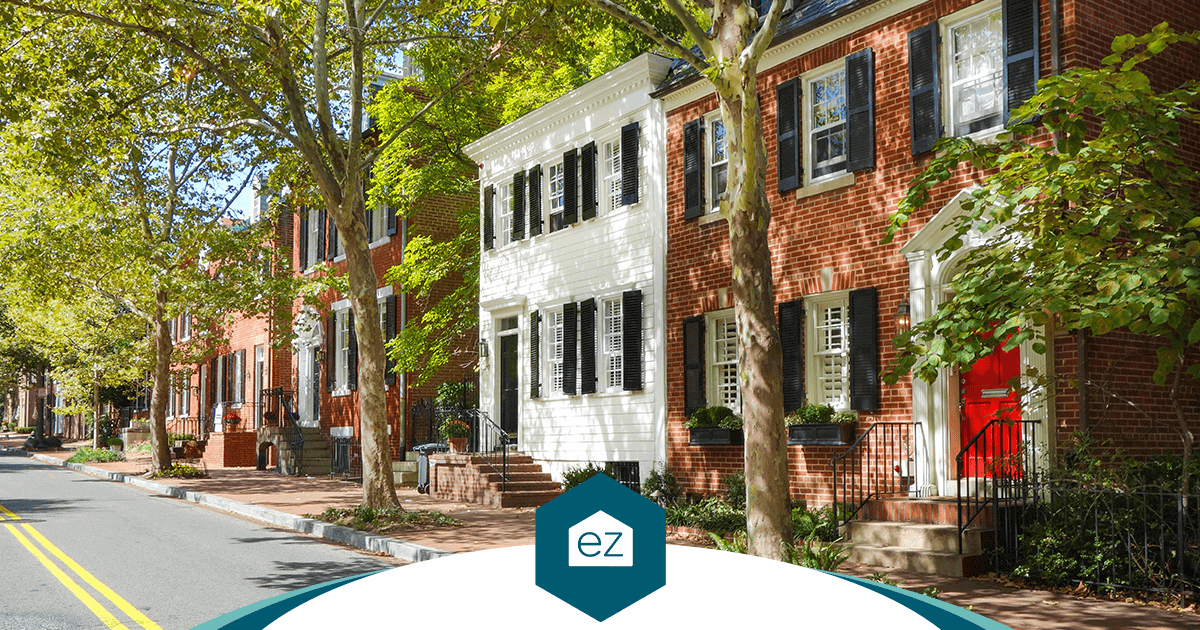
Underneath the metro average, the segments diverge sharply. The DC-area condominium median has run near $390,000 while single-family detached homes sit closer to $800,000, and condo inventory across the District, Arlington, and Alexandria has swelled well past its pre-2020 level (Bright MLS via WTOP). A buyer-friendlier condo segment and a tighter detached segment exist in the same city at the same time.
The employment base is just as plural. Federal work is the largest single supersector, but professional and business services is the second, and the private economy spans Northern Virginia’s data centers, Montgomery County‘s biotech corridor, defense contracting, hospitality, healthcare, and higher education. A lead strategy built for “government workers” misses most of the people actually buying.
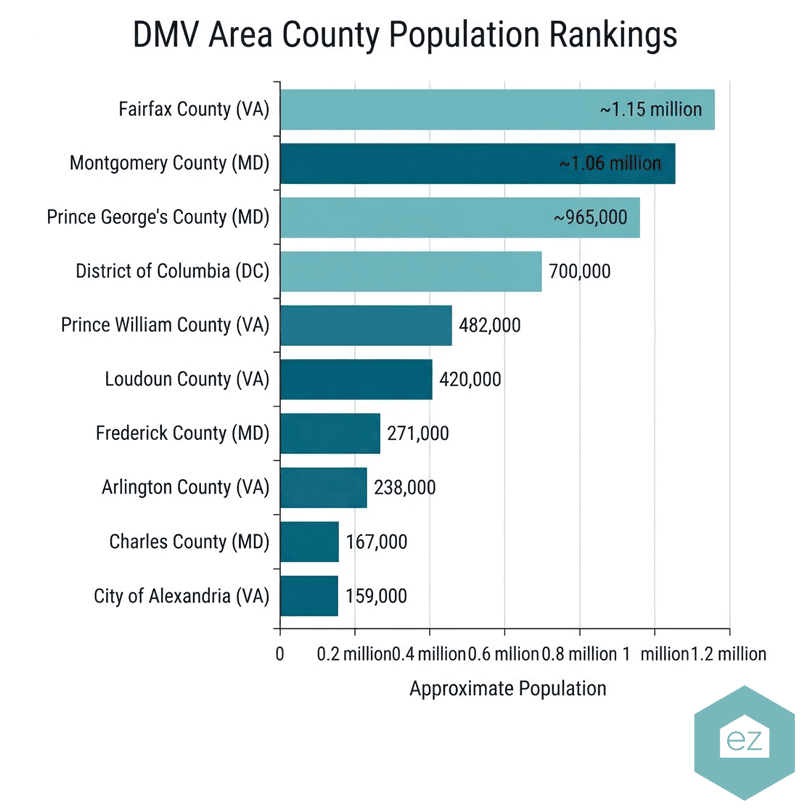
| Rank | County or county-equivalent | State | Approx. population | Principal city |
|---|---|---|---|---|
| 1 | Fairfax County | VA | ~1.15 million | Fairfax (independent city, county seat); large communities include Reston and McLean |
| 2 | Montgomery County | MD | ~1.06 million | Rockville (county seat) |
| 3 | Prince George’s County | MD | ~965,000 | Upper Marlboro (county seat); largest community Bowie |
| 4 | District of Columbia | DC | ~700,000 | Washington (the District is its own city; it has no counties) |
| 5 | Prince William County | VA | ~482,000 | Manassas area (independent city); largest community Woodbridge |
| 6 | Loudoun County | VA | ~420,000 | Leesburg (county seat) |
| 7 | Frederick County | MD | ~271,000 | Frederick (city and county seat) |
| 8 | Arlington County | VA | ~238,000 | Arlington (county-equivalent; no incorporated city) |
| 9 | Charles County | MD | ~167,000 | La Plata (county seat); largest community Waldorf |
| 10 | City of Alexandria | VA | ~159,000 | Alexandria (independent city, in no county) |
Population figures reflect the most recent census counts.
Where the DMV’s buyers and sellers are actually moving
Movement in this metro runs in several directions at once, and each direction is a lead if you can see it.
The Washington region is one of the country’s major international gateways. More than a quarter of Northern Virginia’s residents are foreign-born, and the District’s share sits above the national figure too (Northern Virginia Regional Commission; Census). Those arrivals are buyer demand, concentrated heavily in Northern Virginia.
At the same time, the District has been posting net domestic out-migration even while its total population grows, because international arrivals and a slowing domestic outflow more than offset it (DC Policy Center analysis of Census estimates). That is turnover, not decline, and turnover cuts both ways: every domestic departure is a listing and an outbound relocation referral, and the offsetting inflow is a buyer who needs a local expert.

The clearest flow is from the core outward. Loudoun County has been one of Virginia’s largest population gainers, and Frederick County has led Maryland’s growth rate, as households trade the close-in core for room and a payment that works. Loudoun, Frederick, Prince William, Stafford, and Charles are the metro’s space-and-affordability markets.
An agent who only farms the District is watching half the move. The seller leaving Capitol Hill and the buyer landing in Brambleton are often the same transaction, and national coverage is what lets one partner see both ends of it.
The demand signal most DMV agents misread: remote and hybrid work is here to stay

The headlines say remote work is dying, and that is the most useful misread an agent can correct, because the DMV is built to benefit from the opposite being true.
The “decline” story measures against the spring-2020 emergency peak, not against the pre-pandemic baseline. Measured correctly, work from home has settled at roughly three times its pre-pandemic level and stayed there. The Bureau of Labor Statistics puts the telework rate near a quarter of workers, with tens of millions doing at least some of their work remotely. In the Census Bureau’s Business Trends and Outlook Survey of about 150,000 firms, close to a third reported at least one employee working from home, and those firms expected nearly the same level five years out. Pew has found that three in four remote-capable employees still work from home at least some of the time. Researchers at Stanford and the NBER call this a new equilibrium, not a retreat. Those are national figures, and they are steady.
Here is why that matters more in the DMV than almost anywhere else. The region’s economy is unusually rich in exactly the knowledge work that stays remote-capable: federal and professional services, technology, biotech, and contracting. When that workforce gets to choose where it lives, the space-and-affordability counties are the ones positioned to capture it. Loudoun, Frederick, Prince William, Stafford, and Charles all sit within commuting reach on a hybrid schedule, and they offer the square footage the close-in core cannot.
Across the Exclusive County Partners serving those markets, one report comes back again and again: buyers landing there now want a home office they can close the door on, a separate structure or in-law unit that doubles as workspace, more square footage than they needed before, and broadband that genuinely works as a non-negotiable. An agent who frames listings and saved searches around those features, in those counties, is meeting a buying signal most of the competition has been told is dead. That edge lasts as long as the work pattern does, which the data says is a long time.
Why generating leads is harder in the DMV than agents expect
Three things make this metro genuinely harder to prospect than its size suggests, and naming them plainly is the start of solving them.
The first is cost and competition. Northern Virginia’s median sold price runs north of $720,000 (Northern Virginia Association of REALTORS), the District’s detached homes sit well into the high six figures, and jumbo financing is routine rather than exceptional. Every agent in the region is fishing the same expensive pond, and the biggest brokerages have the deepest advertising budgets.
The second is that one commute can cross three rulebooks. The District, Maryland, and Virginia each tax and document a sale differently. Maryland’s state transfer tax is 0.5% of price, halved for a first-time Maryland homebuyer, with recordation charged per $500 plus county rates, and the cost customarily split between buyer and seller on a resale. Virginia charges the seller a grantor’s tax of $0.25 per $100, and Northern Virginia jurisdictions add a regional $0.15 per $100 on top, with recordation paid by the buyer. The District has its own structure entirely. An agent who works across the line has to speak all three fluently, and the client expects it.
The third is the quiet cost of doing lead generation the old way. Many agents answer the competition by building an IDX website and feeding it ads, then discover they have bought a slow asset that needs constant money and maintenance to compete with platforms refreshing their data every minute.
The deeper problem sits one layer below that. Most paid lead channels in this region resell the same person to whoever keeps paying, which is the model behind the legacy real estate portals: a buyer or seller hands over their budget and contact details, and that information can then be sold or routed to whoever pays the most, often through fine print the consumer never fully reads. You are not buying a relationship. You are renting a name you share with strangers.
The lead tactics DMV agents lean on, and the ceiling on each one
Every common tactic in this market delivers something real, and every one has a ceiling worth seeing before you spend another dollar on it.
Shared portal leads arrive in volume and fill a pipeline fast, which is their genuine appeal. But that same lead is sold or routed to a handful of agents in parallel, so the job turns into a race to dial first rather than a relationship, and the cost per closed deal climbs as the shared names age.
Paid Google and Meta ads can produce strong DC seller and buyer inquiries, but the moment you stop funding them the flow stops, and in a metro this competitive the auction prices keep rising. Expired and FSBO subscription tools and cold calling still work for the disciplined, though they put the agent squarely in telemarketing-law territory, where the burden of proving consent falls on the caller. Predictive-seller software scores a database and guesses who is most likely to list soon, but a score is not a relationship, and the agent still has to build the one that turns the guess into a signed listing. All-in-one CRMs and self-produced content cover the gaps, at the price of yet another system to run and a newsletter most past clients send straight to the trash.
The mechanism that changes the math is not another lead source bolted onto the same model. It is a different model.
ez Home Search runs one national, privacy-first home search that consumers actually use and return to, co-branded to a single partner in a territory. Two pillars hold it together. The Only Confidential Home Search keeps a person’s details out of a crowd of businesses nobody asked for, and the Single Local Expert is the one vetted partner that person is matched with rather than auctioned to a field. The connection arrives warm and chosen instead of cold and shared.
The lead belongs to the one partner who holds the territory, charged no per-lead fee and giving up no slice of the commission at closing. And because the connection is driven by real intent and real activity, a search picked back up, a valuation run again, a saved home revisited, those opportunities convert in the range of 30 to 60 days rather than evaporating like a cold shared name. That is the difference between renting attention and owning a relationship.
Check whether your DMV territory, or the District itself, is still available, and book a call with the ez Home Search partnership team.
The DMV region by region
The metro divides into regions that behave differently enough to demand different lead plays, and a partner needs to read all of them. The table pairs each region with one dynamic; the sections below it go deeper.
| Region | Jurisdictions | What defines it |
|---|---|---|
| The District core | Washington, DC (8 wards, 4 quadrants) | Population past 700,000, led by international migration; condos far softer than rowhouses |
| Close-in Maryland | Montgomery, Prince George’s | Montgomery anchors the I-270 BioHealth corridor, with roughly two-thirds of Maryland’s biotech workforce |
| Outer Maryland | Frederick, Charles, Calvert | Frederick has led Maryland’s growth rate as households move outward for space and affordability |
| Inner Northern Virginia | Arlington, Alexandria, Falls Church | The close-in condo and townhome market; condo listings here have swelled past pre-2020 levels |
| Outer and western Northern Virginia | Loudoun, Fairfax | Loudoun holds the world’s largest data-center cluster; Northern Virginia’s median sold price runs north of $720,000 |
| Exurban Virginia | Prince William, Stafford | The I-95 military and contractor relocation corridor, with Quantico and Fort Belvoir within reach |
The District core is where the international growth and the downtown reinvention show up first. The city’s “Housing in Downtown” program offers a 20-year tax abatement to convert obsolete office space into housing, with a stated goal of roughly 8,400 new units from about 6.7 million sq ft of conversions (DC Office of the Deputy Mayor for Planning and Economic Development). Those are projections, not deliveries, but the direction is a growing downtown buyer pool and new inventory in wards that used to empty out at 6 p.m.
Outer and western Northern Virginia carries one of the most underappreciated ownership stories in the country. Loudoun County’s data centers occupy a small share of its commercial land yet produce a large share of its general-fund revenue, which has let the county cut its homeowner property-tax rate year after year, now the lowest residential rate of any Northern Virginia county (Loudoun County government). An independent analysis for the Northern Virginia Technology Council estimated that without that revenue the residential rate would have to jump sharply, an estimated several thousand dollars more a year on a typical home. For a buyer weighing Loudoun against a neighboring county, that carrying-cost gap is a real selling point, and an agent who can explain it converts better.
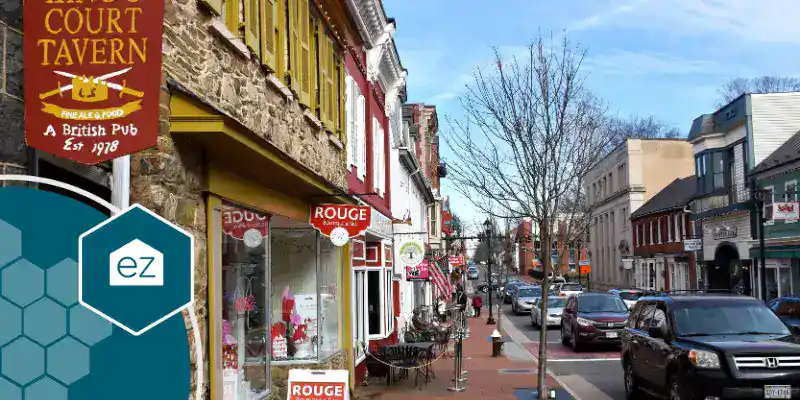
Counties and communities across the DMV
Breadth beyond the three biggest jurisdictions is where a lot of DMV business actually closes, and naming the communities credibly is part of earning the lead.

The counties below anchor the metro’s outer ring, each with the communities buyers search by name.
| County or area | State | Communities |
|---|---|---|
| Loudoun County | VA | Ashburn, Leesburg (county seat), Sterling, South Riding |
| Frederick County | MD | Frederick (city and county seat), Urbana, New Market, Mount Airy |
| Prince William County | VA | Woodbridge, Gainesville, Haymarket, Dale City |
| Charles County | MD | Waldorf, La Plata (county seat), White Plains |
| Stafford County | VA | Stafford, Falmouth, Aquia Harbour |
| Prince George’s County | MD | Bowie, Hyattsville, Laurel, College Park |
| Montgomery County | MD | Bethesda, Rockville (county seat), Silver Spring, Gaithersburg |
| Fairfax County | VA | Reston, McLean, Centreville, Springfield |
| Arlington County | VA | Clarendon, Ballston, Rosslyn, Crystal City (National Landing) |
| City of Alexandria | VA | Old Town, Del Ray, Eisenhower East, Arlandria |
Several of these are unincorporated communities or census-designated places rather than incorporated towns, and the Arlington and Alexandria entries are neighborhoods within those jurisdictions, which have no incorporated sub-towns. The practical point is that buyers search and talk in these names, so a partner’s saved searches, market reports, and listing alerts need to be tuned to them.
Affordability reads differently in each. A buyer priced out of Bethesda often lands in Frederick, and a buyer who cannot reach Arlington looks hard at Alexandria or Woodbridge. The work is to read that ladder for a client and to be in front of them while they climb it.
The buyer-side lead magnets unique to the DMV
Some of the strongest buyer-lead hooks in this metro are programs most agents never mention, and they are jurisdiction-specific in a way that rewards local fluency.
In the District, a qualified first-time homebuyer pays a reduced recordation tax of 0.725%, against a standard buyer rate of 1.1% under $400,000 and 1.45% at or above it, on purchases up to $753,000 and within tiered income limits (DC Office of Tax and Revenue). On top of that, the District’s Home Purchase Assistance Program offers income-eligible first-time buyers up to $202,000 in down-payment gap financing plus up to $4,000 toward closing costs, with no monthly payments for the lowest-income recipients (DC Department of Housing and Community Development). For an entry-level buyer in a metro this expensive, those two facts can be the difference between renting and owning, and the agent who leads with them earns the conversation.
The suburbs have their own. Virginia Housing, the state housing finance agency, funds thousands of home loans a year and pairs its fixed-rate mortgages with down-payment and closing-cost grants for first-time buyers, a steady pipeline feeding the Virginia side of the metro. Maryland’s Mortgage Program offers down-payment products with concrete dollar terms, from a flat $6,000 option to a second mortgage up to $25,000, across Montgomery, Prince George’s, Frederick, Charles, and Calvert.
These are buyer-lead magnets hiding in plain sight, and ez Home Search is built to capture the people they attract. A buyer can describe what they want to ez Match in plain words, see what they can actually afford once property taxes are counted, and get matched with a partner who knows which program fits, while ezNurture keeps the follow-up warm until they are ready to act.
Where your next DMV listings are already hiding
Most of the selling opportunity in the DMV is not on the market yet. It is sitting in two places most agents leave untouched: the home equity owners have quietly built, and the past clients an agent has already earned and stopped calling.
Start with equity, the difference between what a home is worth and what the owner still owes. ez Home Search answers the first question every owner asks, what is my home worth, through an automated valuation model (AVM) built for the highest accuracy available and covering any US residential property. An owner can watch their equity climb month to month on a partner’s co-branded home-value page. In a region where many owners locked in low rates and have stayed put, that running view of equity is what surfaces a seller before they call anyone, and the listing-alert newsletters keep them engaged while they decide.
The larger prize is the database. Most buyers say they would use their agent again, yet only about one in five actually do, and repeat and referral business accounts for a large share of an experienced agent’s deals. That gap is business already earned and then lost to silence, because following up well takes time and material most agents do not have.
ez Home Search runs that reactivation for the partner, co-branded and done for them, so past clients keep returning to a home search worth using and each outreach is triggered by a real signal of intent rather than a generic monthly blast. When a DMV client starts planning a move out of the area, a government transfer, a military rotation, a corporate relocation, the partner sees the out-of-market searches as an early signal, keeps the local listing they would otherwise lose to a stranger on a portal, and refers the client onward for a fee. National coverage is what keeps that relationship from ending at the county line.
See whether your county, or the District itself, is still open, and talk with the ez Home Search team about how the partnership works in the DMV.
What the Exclusive County Partnership gives a DMV partner
The offer underneath all of this is the Exclusive County Partnership, built to turn the region’s opportunities into closed business without the partner assembling a stack of tools.
One agent, team, or brokerage holds a territory, co-branded across a home search that millions of people across the country already rely on, with no competing partner inside that ground and nothing billed per lead or skimmed from a commission. The conversion tools come already built and running, the AVM widget, the open-house sign-in page, the home-value page, the instant cash offer, because they are part of ez Home Search’s own platform rather than something the partner has to configure.
The support is staffed by people, not just software. There is weekly coaching, there are Shut Up and Dial sessions, and there are sales-enablement playbooks aimed squarely at the partner’s numbers, because ez Home Search only wins when the partner wins.
In a metro that runs on phone and text prospecting and constant relocation churn, the compliance piece carries real weight. ezVerify.ai captures the opt-in and the recording that documents it, checks each number against a known-litigator database before the first dial goes out, drops anyone listed on Do Not Call, and adds contact detail an agent would normally have to dig up alone. That is not a lead score; it is proof of consent attached to every opportunity, in a category where one disputed call can carry $500 to $1,500 in exposure. For a DMV team running thousands of dials a month against a transient, heavily prospected population, that protection is the difference between confident outreach and a class-action risk.
The confidential edge that fits Washington especially well
Privacy is a stronger selling point in this metro than in almost any other, because of who lives here.
The District and its suburbs are full of security-cleared federal employees, contractors, high-profile residents, and privacy-minded professionals who have every reason to keep their contact details and budget out of the hands of businesses they never picked. The Only Confidential Home Search means exactly that: someone can browse, save, and compare listings without being broadcast to a long list of agents, lenders, and data brokers, and is instead paired with one vetted local expert they control.
That is the same shift that built some of the most recognizable names in technology. Apple, DuckDuckGo, Brave, Proton, 1Password, and Bitwarden all grew by making privacy the default while delivering a product people genuinely wanted to use. ez Home Search brought that model to real estate first and remains the only platform built around it, which in a town this attuned to confidentiality is not a feature footnote. It is a reason people choose the platform, and a reason they trust the partner behind it.
Only one partner holds the District
The structure of the offer in Washington is unusually clean, and that creates a real deadline.
The District of Columbia is a single Exclusive County Partnership. It is not divided by ward or quadrant, so one agent, team, or brokerage holds the entire city, and once the District is taken, it is taken. The surrounding DMV counties are each their own exclusive territory, and across this metro many are already claimed, with more taken every month.
The plug-and-play engine works from day one, because the platform behind it already runs at national scale, so a new partner steps onto a home search the region already uses with their name on it rather than building anything. The scarcity here is not a sales tactic; it is arithmetic. There is one District, and there are a finite number of counties around it.
Decide whether the DMV’s one confidential lead engine is yours
The choice in front of an agent who wants to generate real estate leads in Washington DC comes down to three roads.
The first is to keep buying shared portal leads and renting ads, paying to dial the same names as every other agent in one of the country’s most competitive metros, and starting over each month the spending stops. The third, at the other extreme, is to build the data, the national search, the valuations, and the martech yourself, which costs millions of dollars and years no single team can spare. The reasonable road runs between them: one exclusive, confidential partnership that owns the leads across your DMV territory, converts them through real intent rather than a race to dial, and keeps your past clients producing for as long as you hold the ground.
The honest trade-off is that exclusivity is a commitment, and the relationships it produces convert over 30 to 60 days rather than overnight, because warm and chosen takes a little longer than cold and shared and is worth far more. The proof is in the asset most agents already own and neglect: ez Home Search’s own data shows partners winning back repeat and referral business from past clients at a rate 2.5 to 5 times what the broader market manages.
The District goes to one partner, and the counties around it go to one each. The only question worth answering today is whether yours is still open.
Check whether your DMV territory, or the District of Columbia itself, is still available, and book a call with the ez Home Search partnership team.
Frequently asked questions
How do federal-workforce changes affect whether I should chase buyer or seller leads in the DC metro right now?
Both, and the changes have widened each side. A recent round of federal-workforce reductions and buyouts moved thousands of jobs in the metro, and a Bright MLS survey found nearly 40% of DC-area agents working with clients whose moves were tied to it, which added listings and relocation business. Even so, the metro median sale price has held up, so this is a turnover and timing story, not a downturn. The practical play is to treat federal change as a two-sided signal: more sellers needing to move on a timeline, and buyers, including international arrivals and private-sector hires, stepping into the inventory that opens up.
How do I generate leads across DC, Maryland, and Virginia when each has different transfer, recordation, and grantor taxes?
You make the three-rulebook reality part of your value rather than a back-office headache. Maryland splits transfer and recordation costs between buyer and seller and halves the state transfer tax for first-time Maryland buyers; Virginia charges the seller a grantor’s tax with an added regional levy in Northern Virginia and puts recordation on the buyer; the District has its own structure. Lead content that explains the real out-of-pocket difference between buying in Bethesda, Arlington, and Capitol Hill earns trust fast, because few competitors bother. A co-branded platform that shows true cost of ownership, taxes included, across all three jurisdictions turns that fluency into captured leads.
What’s the best way to capture international-buyer leads in Northern Virginia and the DC core?
Be present and useful before the transaction, because international buyers research carefully and value a trusted single point of contact. More than a quarter of Northern Virginia’s residents are foreign-born, so this is a large, steady buyer pool concentrated in specific communities. A confidential search that does not sell their information to a crowd matters more to this audience, not less, and matching them with one vetted local expert who can guide financing and process beats handing them to a rotating cast. Saved searches and listing alerts tuned to the communities where international buyers concentrate keep you in front of them through a longer decision window.
How do I win military and government-contractor relocation leads near Quantico, Fort Belvoir, and the Pentagon?
Build for the rhythm of the move, because the DMV’s installations generate constant transfer-driven turnover into places like Woodbridge, Stafford, Aquia Harbour, Springfield, and Alexandria. Military housing allowances in the Washington area are among the highest in the country, so budgets are real and the timelines are firm. The agents who win this work respond fast, know the installations and commutes, and stay connected across the next rotation. A platform that flags out-of-market search activity early lets a partner reach a transferring client before the listing on their current home goes to someone else.
Should my lead strategy differ for DC condos versus Northern Virginia single-family homes?
Yes, because the two segments move in opposite directions: the DC-area condo median sits well below single-family detached, and condo inventory has swelled while detached stays tighter. The condo segment rewards buyer-side lead generation and patient nurture, since buyers there have choice and time; the detached and rowhouse segments still reward fast, well-prepared seller and listing work. One generic campaign run across both wastes money. Segment your saved searches, market reports, and follow-up by property type and price band, and the same budget produces better-fit leads.
How do I generate listing leads from owners leaving the District for Loudoun, Frederick, Prince William, Stafford, and Charles?
Watch for the move before it becomes a listing, because the core-to-exurb flow is one of the metro’s most reliable patterns. An owner in the District who starts searching Ashburn or Urbana is telling you they will soon have a home to sell, and a co-branded search that follows their activity across the whole metro surfaces that intent early. The partner who sees it keeps the District listing instead of losing it to whoever the client finds in the new market, and can refer the buy side onward. The seller leaving and the buyer arriving are often one relationship, and national coverage is what lets you hold both ends.
Which first-time-buyer programs across the DMV actually help me convert buyer leads?
The ones worth leading with are jurisdiction-specific and generous. In the District, a qualified first-time buyer pays a reduced 0.725% recordation tax on purchases up to $753,000, and the Home Purchase Assistance Program offers up to $202,000 in down-payment gap financing plus up to $4,000 toward closing costs for income-eligible buyers. Virginia Housing pairs fixed-rate loans with down-payment and closing-cost grants, and the Maryland Mortgage Program offers down-payment products from a flat $6,000 up to a $25,000 second mortgage. The agent who knows which program fits which buyer, and says so early, holds a conversion advantage most leave on the table.
How can a small DC-area team compete for leads against the deep-pocketed brokerages in one of the country’s most expensive metros?
A small team competes by owning a territory instead of outbidding everyone in it. It cannot win an ad auction against the largest brokerages, but it can hold an exclusive county or the District itself, where no competing partner shares the co-branded home search, and amplify the brand it already has rather than buying reach by the click. The Exclusive County Partnership bills nothing per lead and takes no cut of a closing, so a strong month stays a strong month instead of becoming a bigger invoice, and the platform reactivates the database the team already owns at a multiple of what the broader market reaches. Scale stops being the deciding factor when the ground is yours alone.








Kurt Uhlir is a recognized leader in marketing, growth, and innovation, having helped scale companies and technologies used by millions every day—including at brands like eXp Realty, Sideqik, Vitrue, Oracle, Garmin, Facebook, Meta, Apple, and more. He’s trained tens of thousands of professionals on how to build trust, lead with service, and help clients make wise, informed decisions. At ez Home Search and Sure Send, his focus is on helping high-performing business owners, team leaders, and individual sales leaders grow their businesses through exclusive market access, privacy-first lead systems, and conversion-focused enablement tools.