

Missouri is not one real estate market. It is a handful of them, and they rarely move in the same direction at the same time. Kansas City and St. Louis run on their own clocks. Springfield and the Ozarks answer to another. Columbia behaves like the college town it is, the Lake of the Ozarks trades like a resort, and the Bootheel looks like none of them. An agent who runs the whole state as a single market, buying Missouri real estate leads in bulk to blanket it, ends up paying for names in places they will never close.
The agents and teams who win here did something different. They stopped competing everywhere at once and became the name buyers and sellers already know in the county they own. That shift is the whole game: reaching the buyers arriving in Missouri and the owners who will eventually list, in your county, before anyone else does, instead of renting the same shared names every other agent in the metro is already calling.
What is actually moving across Missouri’s markets
The state is growing and active on both sides of the deal, but the reasons differ sharply by region. Statewide, the median sale price sat around $280,000 in June 2024, up 7.3% year over year, in a market holding near two months of supply (Missouri REALTORS). That single number hides a wide spread. The affordable Bootheel and St. Joseph anchor the low end, Springfield and Kansas City sit in the middle, and Columbia set a record with a city median around $375,000 in June 2025, up about 11%, a jump the city manager publicly called a housing crisis (Columbia Board of Realtors data).
Population growth is real, and most of it arrives from outside the country. Missouri added roughly 27,000 residents in the year ending July 2025, reaching about 6.2 million, and more than 60% of the state’s growth this decade traces to international in-migration (US Census Bureau, Vintage 2025 estimates). Natural change has nearly flattened, with only 177 more births than deaths in that year. For an agent, the takeaway is two-sided: new arrivals form and relocate households that need homes, while an aging owner base and a slowing birth rate mean more estate and downsizing listings over time. This is not a state in decline. It is a state whose growth has changed shape.
The growth is not spread evenly. It concentrates in the exurban and recreation counties, St. Charles, Christian, Lincoln, Cass, Clay, and Platte, while many rural counties lose population (MU Extension and MERIC projections). The Midwest as a whole posted positive net domestic migration for the first time this decade in the 2024 to 2025 year, a turn from the losses earlier in the decade. Where people move inside Missouri tells you where buyer demand is heading next.
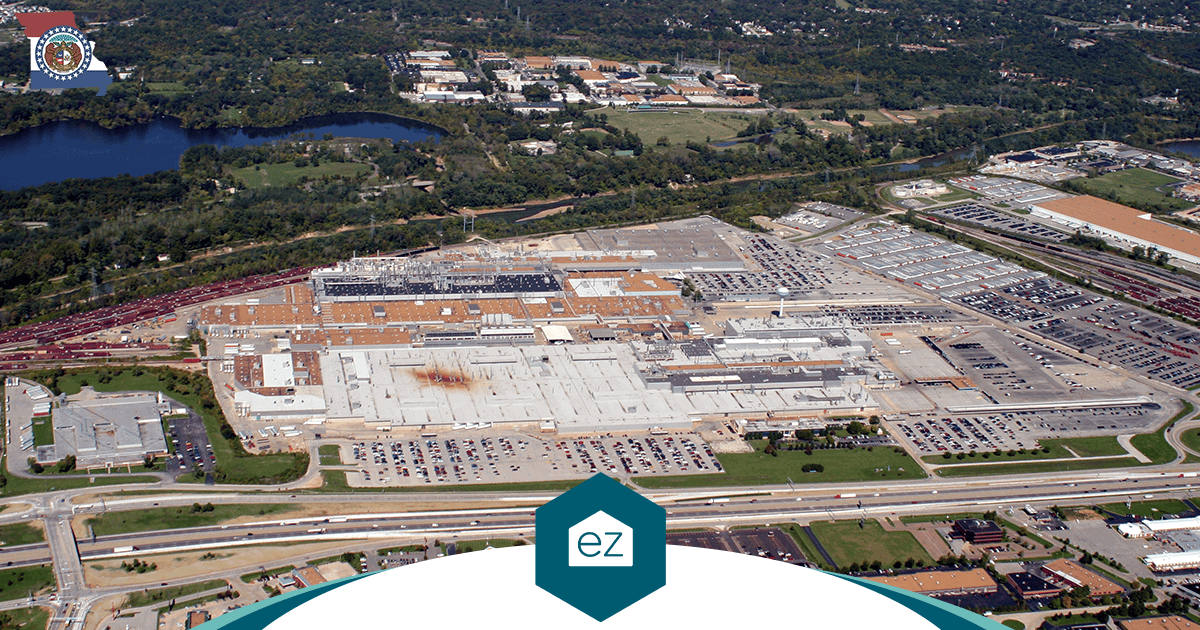
Missouri’s job base is broad, which keeps its housing demand steady. No single employer or sector carries the state. Health care and biosciences anchor St. Louis, where BJC Health System employs around 44,000 people. Financial services run deep, with Edward Jones employing roughly 54,000 associates in the Des Peres area and Centene headquartered in Clayton. Advanced manufacturing and aerospace hold the middle, from GM’s Wentzville assembly plant to Boeing’s large St. Louis defense operations. A distinctive geospatial cluster has formed in north St. Louis around the new NGA West campus, a $1.75 billion federal project that opened in 2025 and is expected to bring about 3,150 jobs on site. Two rural regions lean on the military, Whiteman Air Force Base near Knob Noster and Fort Leonard Wood. Agriculture and agtech run statewide, and tourism drew more than 42 million visitors in fiscal 2024, much of it to Branson and the Lake. A market with this many legs does not fall when one sector stumbles.
New construction is shifting between metros, and the permit data shows it. New private housing permits (US Census Bureau) tell an agent where builder relationships and new-build buyers are worth chasing. Jackson County, the Kansas City core, has held steady near 4,000 permits a year, about 4,036 in 2025. St. Charles County, long the engine of new construction around St. Louis, nearly halved from about 3,100 permits in 2021 to 1,661 in 2025. Greene County around Springfield cooled from 1,667 to 966 over the same span. New-construction lead flow is concentrating in Kansas City and pulling back in the St. Louis exurbs and Springfield, which changes where resale supply tightens too.
School enrollment traces where families are landing. Missouri public-school enrollment has held near 890,000 students and is projected to slip about 3.9% by 2031 (SLU PRiME Center; Missouri DESE data). The regional split is the useful part: the St. Louis city and county area lost 18.3% of its enrollment over the past decade, while Kansas City and Jackson County held essentially flat. For an agent working move-up buyers and families, district-level enrollment is a quiet map of where school-age households are forming and where they are thinning.
The ten most populous counties frame most of the state’s transaction volume. The City of St. Louis appears here as an independent city, not part of St. Louis County, a distinction that matters the moment you draw a farm or a market area.
| County | Population (2024) | Principal cities |
|---|---|---|
| St. Louis County | 995,569 | Florissant, Chesterfield, University City (seat: Clayton) |
| Jackson County | 719,976 | Kansas City, Independence, Lee’s Summit, Blue Springs |
| St. Charles County | 414,535 | O’Fallon, St. Charles, St. Peters, Wentzville |
| Greene County | 303,375 | Springfield, Republic, Willard |
| Clay County | 258,122 | Liberty, Gladstone, Kearney |
| Jefferson County | 229,458 | Arnold, Festus, De Soto (seat: Hillsboro) |
| Boone County | 188,043 | Columbia, Ashland, Centralia |
| Jasper County | 124,357 | Joplin, Carthage, Webb City |
| Cass County | 110,773 | Raymore, Belton, Harrisonville |
| Platte County | 110,371 | Parkville, Platte City, Riverside |
The City of St. Louis, about 288,500 residents, is a separate independent city and would rank near the middle of this list if counted on its own.
How Missouri’s regions diverge
The six major regions behave almost like six different markets, and a lead strategy that fits one can misfire in another. St. Louis has stayed a seller’s market, with prices up about 3.1% year over year as of June 2025 and only about 2.4 months of supply, even as its condo and townhome segment softened. Kansas City appreciated around 5.45% in 2024 on a federal home-price index basis, with homes selling near 96% of asking. A federal housing analysis put the Kansas City area at a 1.7% for-sale vacancy rate and about two months of supply entering 2024, and projected demand for roughly 16,050 new for-sale homes over the following three years, even as the metro’s homeownership rate slipped to 62.2% from 63.8% in 2020 (US Department of Housing and Urban Development). That combination, tight supply and a falling ownership rate, is a renter-to-owner opportunity for an agent who reaches those households early.
Farther out, the mid-size markets each carry their own signal. In the Springfield area, Christian County homes sold around $328,700 in June 2025 against roughly $284,900 in Greene County, an intra-metro gap that tells a seller exactly where the premium sits. Columbia set record highs in a supply-starved university market. At the Lake of the Ozarks, the 2024 condo market tightened in an unusual way: median condo prices rose even as new listings jumped more than 30% and sales fell, with insurance-carrier pullbacks and special assessments stalling deals. In the southeast, Cape Girardeau has run a construction boom while the rural Bootheel absorbed a single-employer shock when the New Madrid County aluminum smelter curtailed operations and cut more than 500 jobs. Sized against a metro, that is regional color; in a rural county, it moves the whole market.

| Region | What’s moving |
|---|---|
| St. Louis metro | Prices +3.1% YoY (June 2025), ~2.4 months of supply, days on market ~24; condos and townhomes softer |
| Kansas City metro | Values up ~5.45% in 2024 (federal index basis); homes selling ~96% of asking; ownership rate down to 62.2% |
| Springfield / Ozarks | Area median ~$290,000 (June 2025); Christian County (~$328,700) well above Greene (~$284,900) |
| Columbia / Mid-Missouri | Record-high city median ~$375,000 (+11%, June 2025) in a supply-starved university market |
| Lake of the Ozarks | 2024 condo squeeze: prices up while new listings rose 30%+ and sales fell; insurance and assessment pressure |
| Southeast / Cape Girardeau / Bootheel | Cape construction boom; New Madrid smelter curtailment cut 500+ rural jobs |
Where the opportunity sits beyond the metros

Most of Missouri’s counties sit outside a big metro, and several of them are where an agent can still become the obvious local name without outspending a metro team. University towns carry steady, renewing demand: Columbia around the University of Missouri, Rolla around Missouri S&T, Warrensburg around the University of Central Missouri, and Kirksville around Truman State. The Lake and Branson corridors run on second homes and retirees, from Osage Beach and Camdenton to Hollister. The northwest is drawing fresh investment, with a food-technology manufacturer announcing a St. Joseph plant backed by more than $22 million and about 138 jobs (Missouri Department of Economic Development, 2025). In a mid-size county, one recognized name can hold a position a metro would take years and a fortune to build.
| County | Communities |
|---|---|
| Cape Girardeau | Cape Girardeau, Jackson, Gordonville, Delta |
| Buchanan | St. Joseph, Agency, De Kalb, Easton |
| Cole | Jefferson City, St. Martins, Russellville, Wardsville |
| Camden | Osage Beach, Camdenton, Lake Ozark, Village of Four Seasons |
| Taney | Branson, Hollister, Forsyth, Rockaway Beach |
| Phelps | Rolla, St. James, Newburg, Edgar Springs |
| Franklin | Washington, Union, Pacific, Sullivan |
| Butler | Poplar Bluff, Qulin, Neelyville, Fisk |
| Pettis | Sedalia, La Monte, Green Ridge, Smithton |
| Callaway | Fulton, Holts Summit, Auxvasse, New Bloomfield |
How Missouri agents chase leads today, and where it falls short

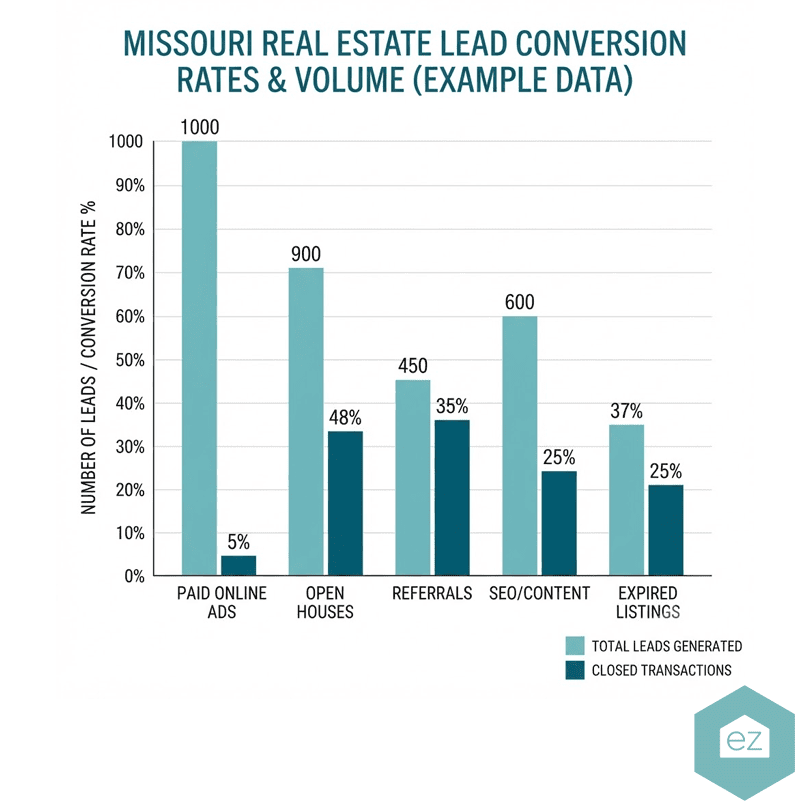
In a state spread across two metros and a dozen mid-size markets, most agents try to win leads by buying names, and the name is the weakest part of that model. The common path is a shared-lead marketplace: an agent pays for buyer or seller contacts in Kansas City, St. Louis, or Jefferson City, and so do several competitors, because the same name is sold or routed to whoever pays the most. That contact arrives cold, and it arrives for several agents at the same time, so the race goes to whoever dials first rather than whoever serves best. Brokerage pay-at-close programs and lender referral networks soften the upfront cost, but they still hand the agent a stranger, and often a slice of the deal.
An IDX site is a genuine asset, and a slow one to build. The team pays for it, feeds it, and maintains it alone, competing for search rank against national platforms with far deeper pockets. Predictive tools rank a database to flag who might sell next, but a ranking is not a relationship, and turning that name into a signed listing is still the agent’s job. Generic all-in-one systems, do-it-yourself content, and paid advertising each help up to a point, and every one of them asks the agent to run a marketing operation on top of serving clients.
None of these approaches is wrong, and none is enough on its own. Shared leads convert at low rates because they are shared. A do-it-yourself content calendar competes for the agent’s own time against actually serving clients. So many agents run five tools and still feel behind because the tools are disconnected, and the leads at the center of them are rented, not owned.
ez Home Search runs on the opposite design. Its Exclusive County Partnership gives a single agent, team, or brokerage a whole county, co-branded across a national home-search platform, with no rival partner working the same territory, no per-lead charge, and no commission taken out of a closing. The people who reach out are not shared names bought in a race to dial. They come through a confidential search experience that already carries the partner’s brand, and they arrive with a history the agent can read. That difference, owned relationships instead of rented names, is what makes the leads convert. If that is how you want to work, check whether your Missouri county is still open.
Turning Missouri owners into listings
The listings you want are already sitting in Missouri’s owner base, and the state hands agents two unusually concrete reasons to reach those owners now. Start with equity. The ez Home Search automated valuation model (AVM) is built to lead the market on accuracy, so an owner can follow their home’s worth month by month and know the equity they have to work with. The partner’s Single Local Expert turns that number into a full comparative market analysis and an honest read on timing, which is the difference between a real listing conversation and a cold guess.
The first Missouri-specific reason is the senior property-tax freeze. Under state laws passed in 2023 and 2024 (SB 190 and SB 756), counties can freeze eligible seniors’ real-property taxes at a base-year level, and adoption has been large and local. St. Louis County alone took in 82,132 applications for the first program year and froze roughly $30 million in senior taxes (St. Louis Public Radio, 2025). Jackson County has reported more than 19,000 applications, St. Charles County estimated around 38,000 eligible households, and Boone County voters approved the freeze in 2024 (Missouri Independent, 2024). The program is a county-by-county patchwork of deadlines, home-value caps, and annual reapplications, which is precisely the kind of local expertise a senior seller needs. Some of those owners will hold, which tightens resale supply; others will use the certainty to plan a downsizing move. Either way, the agent who can speak to the freeze accurately, without over-promising tax savings, earns the conversation.
The second reason is movement in the job market. County-level layoff notices, the WARN filings employers must submit, are an early signal of forced and relocation moves. Missouri recorded 4,783 WARN-affected workers in the 2025 filing year, concentrated in the St. Louis and Kansas City regions (Missouri Department of Higher Education and Workforce Development). A closing in Liberty or Wentzville, a contract lost in St. Louis County, is a set of households that may need to sell on a timeline. This is a signal to watch and serve with care, not a doom story; in a state with a broad job base, these are individual chances to help, county by county.
Most listings, though, come from the database an agent already owns: past clients and sphere. Many are rate-locked, sitting on a mortgage far below today’s rates and waiting for a reason to move. ez Home Search holds that database warm, sparing the agent from ever having to invent a fresh reason to reach out. The past client keeps returning to the co-branded home search to watch their value and their market, and as phone numbers and emails change, the platform captures the updates, so the list does not quietly rot. When one of them is ready, their own activity shows it.
Where Missouri’s buyers are, and reaching them first
Buyer demand in Missouri is moving to specific, nameable places, and getting there first is most of the game. The exurbs are where growth concentrates: O’Fallon, Wentzville, and Lake Saint Louis in St. Charles County; Nixa and Ozark in Christian County; Raymore and Belton in Cass County; Liberty and Kearney in Clay County; Parkville in Platte County. These are also where new construction is most active, so a buyer’s agent with builder relationships and fast alerts has a real edge. Affordability sorts buyers across the state, since the same budget that stretches in the Bootheel or around St. Joseph buys far less in Columbia or at the Lake, and an agent who knows that map can route a relocating buyer to the right county on the first call.
Speed is where the platform earns its place. ez Home Search refreshes listings every minute, so a new home or a price change reaches a buyer while it still matters, not after the tour is booked. Saved searches and on-platform behavior reveal which contacts are nearing a decision: an old search reopened, a listing saved and returned to more than once, an alert opened the same day it lands. Follow-up runs in the CRM the team already uses. It runs fullest in Follow Up Boss, where ezNurture handles automated outreach, and deepest in Sure Send. Because Missouri’s growth is tied to identifiable employers, an agent can meet relocating health care, geospatial, and defense workers, the people moving for jobs at the NGA West campus, the St. Louis hospital systems, Whiteman, and Fort Leonard Wood, as buyers with a real timeline rather than names on a list.
The remote-work edge most Missouri agents are missing
The trend the headlines keep declaring finished is quietly one of the steadiest sources of buyer demand across Missouri’s affordable and lifestyle counties. Every “the office won” headline measures today against the emergency peak of spring 2020, not against the way work was really organized in the years before the pandemic. Judged against that honest baseline, home-based and hybrid schedules have leveled off at close to triple the old share and stayed put. Bureau of Labor Statistics figures for the fourth quarter of 2024 put the count at 36.7 million Americans who spend at least part of the workweek at home, up from 32.5 million a year before. Stanford and National Bureau of Economic Research economists call the current level a new equilibrium, near one quarter of all paid workdays, and report that roughly 12% of executives overseeing remote or hybrid teams intend any return-to-office shift over the coming year. Those are national figures, and the direction is not turning back.
What it means for Missouri is specific. Remote and hybrid earners can live where their money goes further, and Missouri is where money goes further. The Ozarks and the southwest around Springfield, the Lake of the Ozarks, the St. Charles and Lincoln County exurbs, the Christian and Cass County suburbs, and mid-size college towns like Columbia and Rolla are exactly the kind of affordable, livable places this shift favors. Federal rural research confirms the pattern: nationwide, nonmetro counties took in a net 974,000 new residents over the 2020-to-2024 span, tilted toward working-age adults and undoing a decade-long slide (USDA Economic Research Service). Missouri’s mid-size and rural counties sit in position to capture that demand.
For the agent, this reshapes the buyer’s wish list and where the openings sit. A remote buyer wants a dedicated home office, or at least a room with a door that closes, and more of them now want a detached studio or backyard accessory dwelling unit for a second workspace or an aging parent. They want square footage and broadband that genuinely holds up, which no rural county guarantees and which is worth confirming before a showing is ever booked. Most agents, teams, and brokers chasing these buyers are still crowded into the metro cores, where the fight is fiercest. The insider move is to own one of the mid-size or lifestyle counties the remote shift favors, become its recognized name, and be there when a household in Chicago or Denver decides Missouri is where their paycheck finally buys the life they want.
What owning a Missouri county actually gives you

When a partner owns a Missouri county, one agent, team, or brokerage holds the full territory, co-branded across the buyer and seller experience, with nobody else partnered inside it, no per-lead charge, and no commission split. Every advantage below traces back to that single structural fact.
The database you already own becomes your best source
The largest return in the partnership is not fresh names; it is the database the partner already holds. Past clients and sphere are the least expensive business in real estate, and most agents leave that asset idle because keeping it warm costs time and material they do not have to spare. ez Home Search carries that load for them, co-branded and done for them. Our own partner data shows repeat and referral reactivation landing near 2.5 to 5 times the market rate for the partners who run it, sometimes well past that. Where the senior freeze is nudging many older owners to stay put, the agent who keeps turning up in front of their own past clients is the one who gets the call the moment a hold finally becomes a move.
You keep the listing when a client leaves Missouri
National coverage protects the listing an agent would otherwise lose. When a past client in Kansas City or St. Louis starts planning a move to another state, they typically open a legacy portal, meet a stranger on the far end, and the home being vacated ends up listed with whoever that stranger points to. With ez Home Search covering the whole country, that same client studies the destination market on the partner’s co-branded platform instead, and the searching itself becomes an early tip-off that a move is underway. Well before the listing hits the market, the partner reaches out, wins the home on their own turf, and passes the client onward for a referral fee. Given how many Missouri moves trace to a job change, that retention is worth real money every year.
You become the county’s recognized name
The partnership makes one agent the name a county associates with real estate. Reputation and referrals decide most listings, and the recognized local name wins the client before any comparison happens. Across Missouri’s many mid-size counties, that position is still open in a way it is not in a saturated metro core, and only one partner can hold it.
Every contact comes verified, which matters more when margins are tight
ez Home Search hands the partner proof of consent instead of legal risk. Through ezVerify.ai, each contact is confirmed to have opted in, with a recording that proves it, screened against a known-litigator database, and checked against the Do Not Call registry before anyone dials, plus enrichment that fills in detail the agent would otherwise chase. This is not a lead score; it is documentation that a person is real, opted in, and expecting the call. When every dial costs time and a wrong one can cost far more, that confidence changes how a partner works.
The conversion tools are already built and running
The partner never has to build or run the technology behind any of this. The home search, the valuations that feed it, the listing alerts, and the automated follow-up all run on ez Home Search’s national platform, co-branded and included in one flat fee. So do the tools a partner can stand up in a few clicks: a home-value page, an open-house sign-in page, an AVM widget, an instant cash offer. Nothing needs configuring, and nothing needs upkeep.
Beneath all of it sits the reason people trust the platform enough to use it this openly. The Only Confidential Home Search is the ez Home Search promise, and it is how the company delivers on its umbrella line, A Better Way To Discover Real Estate. Under that promise, a person’s phone number, email, and budget never get sold, recycled, or broadcast to a long roster of businesses they never picked. Instead they are matched with one Single Local Expert, the partner, and the rest of the vetted network is theirs to call on only if they choose. It is the same move toward privacy that names such as Apple, DuckDuckGo, Brave, Proton, 1Password, and Bitwarden turned into thriving businesses, carried into real estate. People open up more when they trust where they are, and that deeper engagement is what turns the partner’s leads and relationships into closings.
Claiming a Missouri county before someone else does
A county goes to one partner only, and Missouri’s are being spoken for one at a time. The same model that fits a large metro such as Jackson or St. Louis County fits Greene, Boone, or a mid-size county out along the Lake or down in the southeast, because holding the recognized local name is worth just as much across a small county as it is inside a major metro. Fresh counties get claimed every month, and the moment one is held, no competitor can occupy the same co-branded spot inside it. The partner walks onto a platform Missourians already use, wearing their own brand, live from day one, instead of trying to build a national search and data operation no single team could ever fund alone. If your county is still open, the only real question is whether you claim it before the agent across town beats you to it. See whether your county is still on the board.
The decision Missouri agents actually face
A Missouri agent really faces three paths. Path one is to go on buying shared leads, the same names sold to several agents at once, and keep winning them only by being fastest on the phone. Path two is to build the entire operation in-house, a national-grade search, live data, accurate valuations, and compliance, which no lone team can fund or keep running for long. Path three is the sensible one in the middle: own your county through ez Home Search, set your brand on the platform Missouri buyers and sellers already turn to, and work the relationships rather than renting the names.
The trade-off is stated plainly. Because exclusivity allows a single partner in each county, the opening in your market stays real only until someone else takes it. And this model pays off for an agent willing to work a database and a territory, not for one who only wants to buy names and wait. If that is not the way you want to operate, it is not the right fit.
One number captures the difference. Leads and reactivated relationships that come through ez Home Search convert into deals over about 30 to 60 days, because they start warm, with a person who already trusts the platform and the local name on it. Warm versus cold is the whole distance between renting names and owning a county. Find out whether your Missouri county is still unclaimed, and take it before the agent across town gets there.
Frequently asked questions
How do I reach relocation buyers moving into St. Charles, Christian, and Cass counties before they pick an agent?
Get in front of them while they are still searching, not after they have chosen someone. Missouri’s growth concentrates in these exurban counties, and many arrivals are relocating from out of state or forming new households. On ez Home Search, a buyer exploring O’Fallon, Nixa, or Raymore is searching on the partner’s co-branded platform, so the county’s exclusive partner sees that activity early and reaches out with the local knowledge a newcomer needs. Because the county has one partner, you are not racing a dozen other agents for the same name.
How do I reach relocating health care, geospatial, and defense workers moving into the St. Louis, Whiteman, and Fort Leonard Wood areas?
Tie your outreach to the employers driving the moves. Missouri’s job base is anchored by identifiable institutions: the St. Louis hospital systems, the new NGA West geospatial campus, Whiteman Air Force Base, and Fort Leonard Wood, and people relocating for those jobs are buyers with a real timeline. As the exclusive partner in those counties, you meet them through the co-branded search they are already using to learn the area, with their activity showing when they are close. That is a warm, chosen connection, not a cold name bought from a marketplace.
With the SB 190 and SB 756 senior property-tax freeze rolling out differently county by county, how do I turn senior homeowners into listing leads without over-promising on tax relief?
Lead with accurate local guidance, not a tax pitch. The freeze is a county-by-county program with different deadlines, home-value caps, and annual reapplication rules, and St. Louis County alone took in more than 82,000 applications in the first year. Seniors need someone who understands how it works in their county and what it means for a decision to hold or downsize. ez Home Search keeps you in front of that audience with home-value updates and a co-branded search, so when a senior owner is ready to move, you are the local expert they already trust. Never promise a specific tax outcome; the value you offer is clarity plus a real market read.
Should I focus on the City of St. Louis or St. Louis County, and how do their markets differ for buyers and sellers?
Treat them as two different markets, because legally and practically they are. The City of St. Louis is an independent city, not part of St. Louis County, with its own price points, neighborhoods, and buyer profile. St. Louis County is larger and more varied, from Clayton to Florissant to Chesterfield. The Exclusive County Partnership lets you own one of them and be its recognized name rather than spreading thin across both. With one partner per territory, you build depth where you compete instead of buying shared leads across the whole metro.
How do I generate second-home and condo leads at the Lake of the Ozarks when insurance pullbacks and special assessments are stalling condo sales?
Reach buyers and sellers with the specific facts the Lake market now turns on. In 2024, condo prices held or rose even as new listings jumped and sales slowed, with insurance-carrier pullbacks and special assessments stalling deals, so both sides need an agent who knows which buildings and which numbers actually work. As the exclusive partner for a Lake county like Camden, you serve second-home buyers searching from across the country on your co-branded platform, and you keep sellers informed with real valuations rather than a guess. The confidential search also suits buyers who would rather not have their second-home budget broadcast to a crowd.
How should I win seller listings across Springfield and the Ozarks when Christian County homes sell for far more than Greene County?
Use the price gap as your listing conversation. With Christian County homes selling well above Greene County, a seller’s decision about where and when to list depends on which side of that line they are on, and an accurate valuation is worth more than a generic estimate. ez Home Search gives owners a home value they can track and a Single Local Expert to turn it into a comparative market analysis. As the exclusive partner across those Ozarks counties, you are the name owners see on the search they already use, so the listing conversation starts before a competitor even knows the owner is thinking about it.
How can a Columbia or Boone County agent capture leads in a record-high, supply-starved university-town market?
Win on speed and on relationships, because inventory is the constraint. Columbia set record-high prices in a market with little supply, so the buyers who win are the ones who see a new listing first, and the sellers who win get an honest read on timing. ez Home Search refreshes listings every minute and shows you which of your contacts are actively looking, and as the county’s exclusive partner you own that flow rather than sharing it. In a university town with steady renewing demand, the recognized local name compounds year after year.
How do I get real estate leads in Missouri’s rural and Bootheel counties where a single employer can swing the local market?
Own the county and watch the local signals, because in a rural market one employer’s move changes everything. When a large employer expands or curtails, as the New Madrid County smelter did when it cut more than 500 jobs, the housing market moves quickly on both sides. As the exclusive ez Home Search partner in a rural county, you are the recognized name serving both the families affected and the buyers arriving for the next opportunity, with a national platform behind you that a small local brokerage could never build. The flat fee and no charge per lead also make the economics work where lead volume is thinner than in a metro.




Kurt Uhlir is a recognized leader in marketing, growth, and innovation, having helped scale companies and technologies used by millions every day—including at brands like eXp Realty, Sideqik, Vitrue, Oracle, Garmin, Facebook, Meta, Apple, and more. He’s trained tens of thousands of professionals on how to build trust, lead with service, and help clients make wise, informed decisions. At ez Home Search and Sure Send, his focus is on helping high-performing business owners, team leaders, and individual sales leaders grow their businesses through exclusive market access, privacy-first lead systems, and conversion-focused enablement tools.