

Most advice about generating real estate leads in Illinois treats the state as one market. That is the first mistake. Illinois carries one of the thinnest for-sale housing supplies in the country, a shortage built up over years of under-building and the rate lock-in effect that keeps owners in place, so the hard part is rarely finding buyers. It is finding listings, and knowing which of the state’s very different markets you are actually working: greater Chicago and Cook County, the collar counties, the central downstate metros from Rockford to Champaign-Urbana, the Metro East suburbs across the river from St. Louis, and the college and farm communities of southern Illinois.
Read the headlines and you would think everyone is leaving. The real picture is more useful to an agent: a hidden-inventory state, several distinct markets at once, with a full and active market on both the buy side and the sell side. This is a working read of those markets, the tactics that are quietly underperforming in them, and what to do instead.
Illinois is really a dozen markets, not one
The single most expensive assumption an Illinois agent can make is that a strategy built for one part of the state will carry to another. Price, inventory, migration, and the local job base all diverge sharply by region. Here is the honest, current picture across the state.
Supply is structurally tight, and the lock-in effect is the reason. When most owners hold a mortgage well below current rates, moving means giving up that rate, so they stay put and listings stay scarce. The Federal Housing Finance Agency has tied this lock-in effect to a large national drop in home sales since 2022, and Harvard’s Joint Center for Housing Studies has documented how it pushed prices up by holding supply down. Illinois feels it acutely. The State of Illinois’s 2024 Missing Middle Housing report, reading federal listing-data series, found active for-sale inventory had fallen by roughly two-thirds across the half-decade through 2024, among the steepest declines of any state, with only a slight recovery beginning. The takeaway for an agent is steady, not seasonal: the listing side is the prize, and it is scarce.
Prices have kept climbing on that tight supply. Illinois REALTORS data show the statewide median sale price rising year over year even as the number of annual sales eased, with the median moving from the high $200,000s into the $300,000s over recent years. A market can be slow on volume and still firm on price when there is almost nothing to buy.
Migration is real, bounded, and two-sided. This is where most coverage goes wrong. Per U.S. Census Bureau Vintage 2024 estimates, Illinois added population in 2024 for the first time in years, ending nearly a decade of decline. International migration added roughly 113,000 residents, natural increase (births over deaths) added about 11,000, and net domestic migration to other states was a loss of about 56,000. Set that domestic loss against a population near 12.6 million and roughly 4.9 million households, and it is under half a percent in a year, not an exodus. For an agent it cuts both ways: every departure is a listing and a relocation referral, and every arrival, international, intra-state, or returning, is a buyer. A state with net out-migration still has a deep market on both sides.
The job base is spread across many sectors, not one anchor. Bureau of Labor Statistics employment data show momentum rotating among education and health services, professional and business services, finance and insurance, manufacturing, logistics, and government from quarter to quarter. No single employer dictates the Illinois market, which means client demand is broad rather than tied to one company’s fortunes.

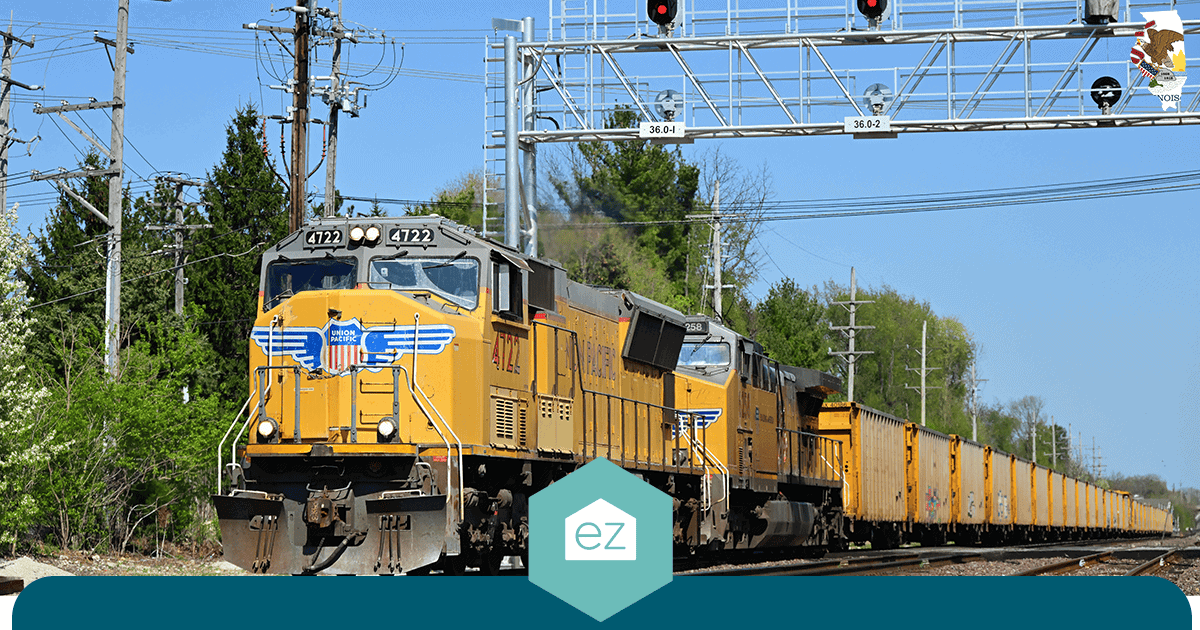
Will County is a national logistics engine. The Chicago Metropolitan Agency for Planning’s 2025 freight assessment counted more than 210,000 freight-industry jobs across the seven-county region in 2024, with warehousing and freight-support employment having nearly doubled since 2010. Will County is the standout: its transportation-sector output grew from about half a billion dollars in 2001 to roughly $2.4 billion by 2023, and it holds the region’s largest share of long-distance trucking operations. That engine, anchored by the CenterPoint intermodal hubs near Joliet and Elwood, underpins housing demand across Will and neighboring Kendall.
Agriculture still anchors downstate. The Illinois Department of Agriculture reports roughly 70,000 farms working about three-quarters of the state’s land, with Illinois among the top states for agricultural exports. University of Illinois farmdoc analysis flagged 2024 as one of the leaner income years for grain farms in decades, which presses on the ag-county economies of central and southern Illinois and shapes who is buying and selling land there.

Property taxes are a structural friction on every deal. Illinois’s effective property-tax burden ranks among the highest in the nation, close to double the national average by recent national analyses. The Civic Federation, computing effective rates from county-clerk and Illinois Department of Revenue data, shows how wide the spread runs: selected residential rates inside Cook County range from under 1.7% in parts of Chicago to well above 4% in some south-suburban municipalities, and collar-county effective rates vary widely by town. Notably, the Civic Federation found that effective rates in many collar-county municipalities actually eased over the decade through 2022 even as tax bills rose with home values. That distinction matters in a listing conversation: the bill can climb while the rate falls.
The senior share is rising, and household formation is shifting. Census figures put the 65-and-older share of Illinois near one in six residents and climbing. At the same time, National Center for Education Statistics data show Illinois K-12 public-school enrollment down about 10% over the decade through 2024. Read together, these are a household-formation signal, not a decline story: more downsizing, estate, and relocation listings on one end, and growth concentrating in specific metros and exurbs rather than spreading evenly.
The regions are diverging, not moving together. Illinois REALTORS forecast data show inventory and price moving in different directions across downstate metros in the same year, with some markets adding supply by double digits while others tightened. One statewide number hides more than it reveals.
That is nine distinct forces, and they do not point the same way in every county. The rest of this playbook works through where they land.
Where Illinois’s people and listings actually are
Before spending a dollar on lead generation, it helps to anchor on where the volume sits. Illinois has 102 counties, but a large majority of transactions cluster in the Chicago metro and a handful of downstate metros. These ten counties hold most of the state’s population.
| Rank | County | County seat | Other principal cities |
|---|---|---|---|
| 1 | Cook | Chicago | Cicero, Evanston, Schaumburg |
| 2 | DuPage | Wheaton | Naperville (shared with Will), Aurora (shared) |
| 3 | Lake | Waukegan | North Chicago, Gurnee, Highland Park |
| 4 | Will | Joliet | Naperville (shared), Bolingbrook, Plainfield |
| 5 | Kane | Geneva | Aurora (shared), Elgin (shared), St. Charles |
| 6 | McHenry | Woodstock | Crystal Lake (largest city), Algonquin |
| 7 | Winnebago | Rockford | Loves Park, Machesney Park |
| 8 | Madison | Edwardsville | Granite City (largest city), Alton, Collinsville |
| 9 | St. Clair | Belleville | East St. Louis, O’Fallon |
| 10 | Champaign | Urbana | Champaign (largest city), Rantoul |
A practical note that trips up agents and buyers alike: the county seat is not always the largest city. Naperville is bigger than Wheaton, Crystal Lake is bigger than Woodstock, Champaign is bigger than Urbana. Several of the busiest suburbs straddle county lines, so a single address search can pull listings governed by different county tax systems.
Why leads are harder to convert in Illinois than agents expect

A lead is only as good as the transaction behind it, and in Illinois three structural facts make conversion harder than a national playbook assumes.
The first is the listing shortage. When supply is this tight, buyer leads are comparatively easy to attract and hard to satisfy, while seller relationships are the genuine scarce asset. An agent flooding the top of the funnel with buyer inquiries can stay busy for months and still close very little, because there is almost nothing to show.
The second is the tax math. With effective property-tax bills among the country’s heaviest, the carrying cost of a home shapes every affordability conversation and every pricing decision. A seller who ignores it lists too high and watches the home sit; a buyer who ignores it makes an offer they cannot actually carry. An agent fluent in the local tax picture closes deals that a generic agent talks themselves out of.
The third is regional complexity. A Chicago condo playbook does not transfer to a Bloomington-Normal subdivision or a Carbondale rental near campus. The buyer profile, the pace, and the price points are different enough that copy-paste tactics underperform.
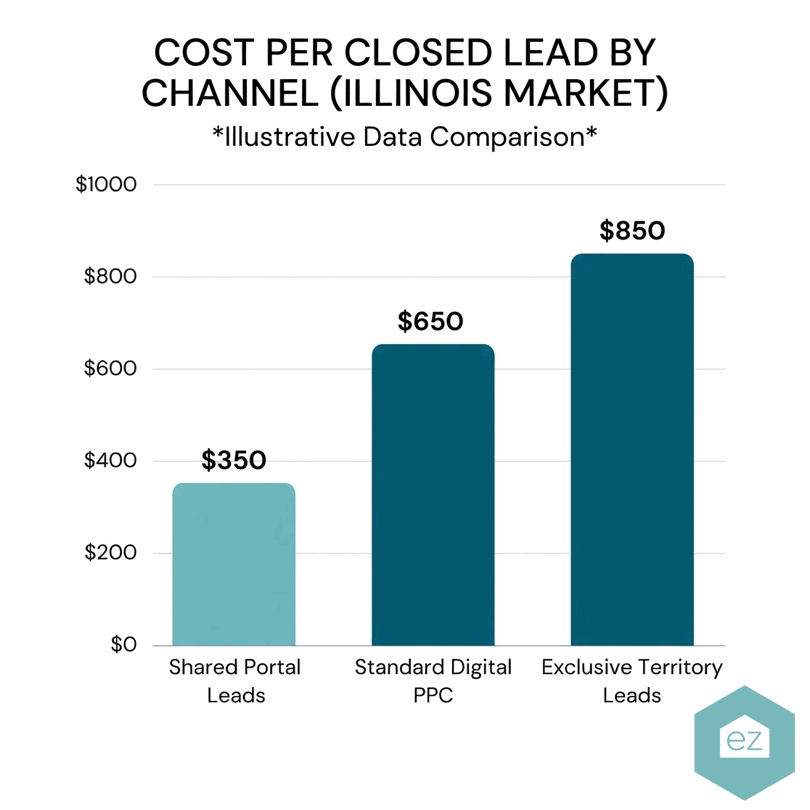
None of this is an argument against the common lead sources. It is an argument for being honest about their limits. Shared portal leads, the kind most agents buy, get sold and re-routed toward whichever business pays the most for them, so one name lands on several agents’ screens to be dialed in parallel. A self-built IDX website can work, but it is a slow, expensive asset that ages and demands constant feeding to stay competitive. Both can produce business. Neither, on its own, solves the Illinois problem of too few listings and too little trust at the point of contact. There is a model built specifically for that problem, the Exclusive County Partnership, and later in this playbook it is worth checking whether your Illinois county is still available under it.
The regions diverge sharply, so read them before you spend
Here is where a county-by-county read pays off. Each major region of Illinois has its own lead reality, and the tactic that wins in one can waste budget in another.
| Region | Core counties | What is actually happening |
|---|---|---|
| Chicago / Cook | Cook | Grew overall on strong international migration even as it lost residents to other states; sharp price divergence by neighborhood. |
| Collar counties | DuPage, Lake, Will, Kane, McHenry | Added population on family-suburb demand; McHenry and nearby Kendall led the state in domestic in-migration. |
| Rockford / northern | Winnebago, Boone | Tight inventory and relative affordability have made it one of the more talked-about recent markets in the state. |
| Central metros | Peoria, Sangamon, McLean, Champaign | University, healthcare, and government anchors steady demand; inventory and price trends split by metro. |
| Metro East | Madison, St. Clair | A tight, affordability-driven submarket tied to the St. Louis economy across the river. |
| Southern Illinois | Jackson, Williamson | Education and healthcare anchor Carbondale and the Williamson corridor; smaller, slower-turning, relationship-driven markets. |
Chicago and Cook County reward neighborhood-level knowledge. The Cook County Assessor’s 2024 reassessment of the city published sale-price detail for all 77 community areas, and the spread is enormous, from single-family medians around $70,000 on the far South Side to well over $1 million on the North Side. The steepest multi-year percentage gains were in historically lower-cost South and West Side neighborhoods such as West Englewood and Englewood, not the high-end areas. An agent who works Cook as one market misreads it; the opportunity and the pricing logic change block to block.
The Cook County tax shift is reshaping seller conversations. This is the detail most agents have not absorbed, and it is worth understanding precisely. In the 2024 city reassessment, the Cook County Assessor’s Office reported total assessed value rising 22% to $50.5 billion. After the Board of Review cut commercial assessments far more than residential ones on appeal, the homeowner share of the tax base rose. The Cook County Treasurer’s office, independently, documented roughly a $2 billion shift in tax burden from businesses onto homeowners across recent years, with bills rising for the large majority of Cook homeowners and the heaviest increases concentrated in South and West Side neighborhoods. For an agent, that is not a political point; it is a listing-pricing fact. A seller’s tax line may have jumped even though their home did not change, and a buyer needs that number before they make an offer.
The collar counties run on family-suburb demand and intra-state moves. DuPage, Lake, Will, Kane, and McHenry added population while the urban core shed domestic movers, and the strongest in-state migration ran to exurban communities in McHenry, Kendall, and Will, places like Crystal Lake, Yorkville, Oswego, and Plainfield, chosen for relative affordability and space. The lead opportunity here is the move-up and move-out buyer leaving Chicago, paired with the listing they leave behind.
Rockford and the north trade on affordability. With tight inventory and prices well below the Chicago metro, the Rockford region has drawn attention as an up-and-coming market. One state report described it as facing a multi-thousand-unit housing shortage against its growth, alongside significant recent public and private investment in the city center. Treat that figure as a single-source signal rather than a settled count, but the direction is clear: demand outrunning supply.

Central Illinois runs on institutions. Champaign-Urbana, Bloomington-Normal, Springfield, and Peoria are anchored by universities, healthcare systems, and state government, which steadies demand through cycles. Major employer investment adds to it: state economic-development figures cited in the Missing Middle report point to large manufacturing commitments around Bloomington-Normal and Decatur, including a multi-billion-dollar vehicle-manufacturing investment and hundreds of new jobs. Those are single-source figures worth confirming before quoting, but the pattern of institutional and manufacturing anchors is well established.
Metro East and southern Illinois are relationship markets. The Madison and St. Clair county suburbs across from St. Louis form a tight, affordability-driven submarket tied to the Missouri-side economy. Further south, Carbondale and the Williamson County corridor turn on Southern Illinois University and area healthcare. These are smaller, slower-turning markets where the recognized local name and a steady relationship matter more than ad spend.
Beyond the metros: the counties most agents overlook
The big metros get the attention, but several smaller counties carry real, winnable volume, often with less competition for the listing. These are worth a deliberate strategy rather than an afterthought.
| County | Region | Communities worth working |
|---|---|---|
| Kendall | Far southwest exurb | Yorkville, Oswego, Plano, Montgomery |
| Boone | North, Rockford area | Belvidere, Poplar Grove, Capron |
| Sangamon | Central, capital | Springfield, Chatham, Rochester, Sherman |
| McLean | Central | Bloomington, Normal, Lexington |
| Peoria | Central river | Peoria, Chillicothe, Bartonville, Peoria Heights |
| Tazewell | Central, Peoria metro | Pekin, East Peoria, Morton, Washington |
| Rock Island | Quad Cities | Rock Island, Moline, East Moline, Milan |
| Williamson | Southern | Marion, Herrin, Carterville, Johnston City |
| Jackson | Southern | Carbondale, Murphysboro, De Soto |
| Macon | Central | Decatur, Mount Zion, Forsyth, Maroa |
Kendall County, on the far edge of the Chicago exurbs, has been one of the state’s in-migration leaders, which makes Yorkville and Oswego unusually active for their size. The downstate farm-and-college counties move more slowly, but the lighter competition for listings can make a focused agent the obvious local choice.
The tactics Illinois agents lean on now, and where each one leaks

Every working agent in the state already uses some mix of the standard tactics, and each one has a real place. The point is to see clearly where each pays off and where it leaks.
Shared online leads load a pipeline with names fast, and that speed is why plenty of teams open there. What they trade away is quality and exclusivity: those names are commonly sold along or split across several agents at once, so closing them turns on dialing first and outlasting everyone else rather than on any genuine relationship. Cold calling and circle prospecting around expired and for-sale-by-owner listings still turn up motivated sellers, and in a low-inventory state that counts for something, but the work is heavy and the contact rate stays low. Predictive-seller tools that grade a database for likely movers can aim the effort, though a high grade is only a guess, never a relationship, and the agent is still the one who has to build whatever turns that guess into a signed listing. A self-built IDX site and DIY content on social can compound over time into genuine local presence, and many agents report more leads from social than anywhere else, but both demand constant attention that competes with actually serving clients. Paid search and social ads can fill the top of the funnel on demand, and the spend stops working the moment the budget does.
The common thread is that all of these chase attention or names. None of them, on its own, solves for the two things that actually decide an Illinois agent’s year: getting in front of the scarce listing, and staying genuinely close to the people who will transact later.
The bigger miss: the buyers and sellers who are not active yet
Here is the most valuable shift in thinking in this whole playbook, and it has nothing to do with any vendor.
At any given moment, only a small share of people, on the order of 5% to 10%, are actively buying or selling a home. Someone who moves every five years is in the market for only about six months across those five years, and most people move less often than that. Almost every lead source in real estate, including the ones above, is built to chase that thin active slice. So is almost every agent’s daily effort.
The much larger group is everyone else: the owner watching their equity, the family two years from a move, the past client who will absolutely transact again but not this quarter, the dreamer saving homes they cannot buy yet. That is where most of an agent’s future business actually lives. The reason most agents do not work it is not laziness. That group is expensive to serve well. It takes content worth opening, a home-search experience people return to on their own, value updates that stay relevant, and a level of follow-up that an individual agent, or even a strong team, rarely sustains while also closing today’s deals. So those relationships quietly cool, and when the person is finally ready, they start over on a portal and surface as someone else’s lead.
In Illinois, that leak costs more than it does almost anywhere. When listings are this thin, every future seller you are connected to is worth more, and a relationship that goes cold is a future listing walking out the door. The size of the gap is well documented: a large majority of buyers and sellers say they intend to return to their agent, while only a sliver ever follow through, and repeat plus referral work makes up a sizable chunk of a typical agent’s annual volume. The business you have already earned is the cheapest you will ever close, and most agents bleed away most of it.
The fix does not require any particular platform. Audit your database for the not-yet-active majority, build a real reason to stay in front of them every month, and start measuring repeat and referral share, not just new-lead volume. That said, the staying-current work is exactly the part most agents cannot sustain alone, and it is one of several places a platform built for it earns its keep. That is a reasonable place to talk about what ez Home Search does.
A different model: own the county, own the relationship

ez Home Search comes at the problem from the opposite end. Rather than reselling one name to a field of agents, it runs the Exclusive County Partnership, where one agent, team, or brokerage owns a whole county, carries its brand through the consumer side, faces no rival partner in that territory, pays nothing per lead, and surrenders no slice of the commission at closing. Heavy lead months read as good months for the partner, never as a heavier bill.
The reason those connections close comes down to how the platform is wired. ez Home Search puts the consumer and their privacy ahead of everything else, the promise it calls The Only Confidential Home Search: people browse, save, and weigh homes while their budget and contact information are kept off the resale market entirely, never passed to a crowd of businesses they did not choose. That privacy is what earns the trust, and trust is what makes people honest about what they actually need. By the time one of them lands with the partner, it is through a Single Local Expert match, the one vetted partner assigned to that person, not a number five agents are racing to dial. What arrives is a warm connection carrying a readable history: the neighborhoods they kept opening, the price band they circled, the homes they saved, the valuation they ran. Weeks of trust-building are mostly done before the phone rings.
A capable team could assemble pieces of this themselves. It is worth being honest about that. What is hard to replicate is the combination, and a few beats matter most for Illinois.
The first is valuation and tax intelligence, which lands harder here than almost anywhere. ez Home Search runs an automated valuation model (AVM) engineered for high accuracy across more than 80 million homes, then pairs it with property-tax detail resolved down to the local level. In a state where the tax bill can move independently of the home’s value, a partner can show a seller a defensible price and the true carrying cost behind it, and show a buyer what a home actually costs to own, not just to purchase. That is the difference between a listing that prices right and one that sits.
The second is relocation retention, which lines up directly with those 56,000 annual departures. Since ez Home Search reaches every market in the country, an Illinois client getting ready to leave goes right on searching inside the partner’s co-branded platform rather than vanishing onto a legacy portal. That out-of-state searching shows up as an early tell, giving the partner room to step in ahead of the move, take the listing on the Illinois home the client is about to vacate, and refer that client to a trusted agent where they are landing in exchange for a referral fee. The relationship outlives the move rather than dying at the state border.
The third is database reactivation, the fix for the not-yet-active problem laid out above. The home search the partner’s past clients already lean on wears the partner’s brand, so those clients keep coming back to track their value and watch the market move around them, and the outreach triggers on genuine activity instead of a blast newsletter. By ez Home Search’s own accounting, its partners pull past clients back into repeat business or referral at a rate well beyond the market norm. It handles the stay-in-front work no individual agent can keep up alone.
The fourth is consent and compliance, by way of ezVerify.ai. From the first prospecting call or text, an agent is a telemarketer in the eyes of the law, and when consent gets disputed the burden of proof lands on whoever placed the call. ezVerify.ai logs the opt-in, retains the recording as evidence, checks every number against a litigator-watch database, and removes Do Not Call registrations before a single dial goes out, then rounds out the record with detail the agent would otherwise have to track down. This is protection and a paper trail on the part of the job that carries the most legal exposure, not a lead score.
The fifth is that every conversion tool shows up already standing and already running under the partner’s brand: the search itself, the listing alerts, the recurring value updates, the open-house and home-value pages. No IDX site to stand up and feed, nothing to run. Day one it works, because ez Home Search operates the whole engine behind it.
Most clients see this build into real pipeline over a steady stretch rather than overnight, typically converting opportunities over 30 to 60 days as the relationship and the activity signals do their work. That is the honest pace, and it is why the model compounds for partners who stay with it.
The remote-work demand most Illinois agents are underestimating
There is a staying-power buyer trend that a lot of agents have quietly dismissed on the strength of a few headlines, and correcting the record is worth the effort, because it points right at Illinois’s affordable markets.
Remote and hybrid work never folded back into the office. The “decline” framing benchmarks against the spring 2020 spike, a level nobody ever called normal. Set it instead against the genuine pre-pandemic baseline and remote work has settled in at roughly triple its old footing and held there. In late 2024 the Bureau of Labor Statistics tallied around 36.7 million Americans who teleworked for at least some of their hours, a figure up from the year prior. The U.S. Census Bureau’s Business Trends and Outlook Survey, reaching some 150,000 firms, found about a third had at least one employee working from home and expected nearly the same share five years out. Pew Research Center found three-quarters of workers in remote-capable roles still log time at home each week. This is national evidence, and it is holding steady.
Map it onto Illinois geography and the opening is plain. The markets best placed to catch lasting remote and hybrid demand are the state’s more affordable ones: the exurbs of Kendall, McHenry, and Will, the Rockford region, and the central college and capital metros, Champaign-Urbana, Bloomington-Normal, and Springfield among them. A remote worker no longer chained to a Loop commute can swap a tight Chicago condo for more square footage and a lighter carrying cost two counties out, and the USDA has tracked a real, multi-year flow of working-age adults into smaller and rural counties across the country since 2020. The agent who reads this early works it on purpose.
The trend also reshapes the wish list. These buyers want a dedicated or door-closing home office, at times a detached structure or accessory dwelling unit for work or for visiting family, more room overall, and broadband that is genuinely fast, no sure thing in every downstate town. An agent who can talk to those features, and filter for them, holds an edge with a buyer pool most rivals are not even chasing.
Why the confidential model is the real edge
It is tempting to treat privacy as a soft feature. In real estate it is a business advantage, and ez Home Search is the only major platform built around it. The logic is simple: when people trust that their information will not be sold off to a crowd of strangers, they engage more openly, and that deeper engagement is exactly what makes a connection convert for the agent on the other end.
The pattern holds across industries. Apple, DuckDuckGo, Brave, Proton, 1Password, and Bitwarden all grew by making privacy a product rather than an afterthought, taking ground from far larger and better-funded rivals. ez Home Search brought the same idea to real estate first and still stands alone in it. For an Illinois agent, the payoff is concrete: tax and relocation conversations involve a family’s finances and plans, the kind of sensitive detail people share only with someone they trust. A platform that protects that trust produces warmer, more honest clients, which is the whole point of a lead.
One partner per Illinois county, and they are being claimed
The Exclusive County Partnership is structured so a single agent, team, or brokerage owns any given Illinois county. The scarcity is not a sales line. A large number of the state’s counties are spoken for already, and the count taken keeps climbing month to month, so a given market stays open only until someone claims it. The model holds up in Cook exactly as it does in a rural downstate county, because being the recognized local name pays off just as much where the population is small as where it runs into the millions.
An open county takes very little to step into. The partner walks onto a platform consumers are already using, brands it as theirs, and finds the whole apparatus, the search, the data, the follow-up, the compliance, live from day one. Nothing to construct. All that remains undecided is whether your target county is still unspoken for.
The decision: three ways to chase Illinois leads
Strip it down and an Illinois agent has three real options.
Option one is the status quo: go on purchasing shared names that a handful of other agents purchased too, and rebuild the top of the funnel from scratch every month. It keeps you busy, and it never accumulates, because the relationships were never yours to begin with and the not-yet-active majority keeps drifting off.
Option two, at the far end, is to assemble the entire thing on your own: the consumer search, the valuation and tax data, the national reach, the compliance machinery, the done-for-you content. On paper it is possible. In the real world it eats years and millions of dollars, and the data feeding the valuations by itself sits beyond what almost any single team can reach.
Between those two is the Exclusive County Partnership. You hold a county outright, the platform and the stay-in-front work are already standing and running under your name, and the connections come in warm and exclusive for one fee you can predict. It asks for real commitment, and the pipeline builds over a steady 30-to-60-day rhythm and outward rather than landing overnight. That is the honest trade-off, and it is exactly why the model rewards partners who give it room to work.
The proof point worth weighing above the rest is this: ez Home Search’s partners bring past clients back, through repeat business and referral, at a clip well past the market norm, turning the database an agent already holds into the most dependable book of business in their hands. In a state running this short on listings, that retained business is frequently what separates a flat year from a strong one.
If that fits how you want to build, the next step is simple. See whether your Illinois county is still available and schedule a call to talk through what holding it would look like for your market.
Frequently asked questions
How do Illinois’s heavy property taxes, and the burden shifting onto Cook County homeowners, change how I should generate and qualify seller leads?
Property taxes are not a side issue in Illinois; they are part of every pricing and affordability conversation. Effective bills are among the nation’s heaviest, and in Cook County the recent reassessment shifted a large share of the burden from commercial property onto homeowners, so a seller’s tax line may have risen even though their home did not change. Qualify seller leads by getting the current tax picture early and pricing against it, because a listing that ignores the tax math sits on the market. A lead source that hands you a defensible valuation and the local tax detail up front converts better here than a raw name, because you can have the real conversation on the first call.
Should my lead strategy differ across Chicago neighborhoods, the collar counties, and downstate markets like Peoria or Champaign-Urbana?
Yes, more than in most states. Chicago itself splits block by block, with single-family medians ranging from under $100,000 on parts of the South Side to well over $1 million on the North Side, so neighborhood-level knowledge beats a citywide approach. The collar counties run on move-up and move-out family demand. Downstate metros like Peoria and Champaign-Urbana are anchored by universities, healthcare, and government, which steadies demand but at lower price points and slower pace. A single statewide playbook underperforms; match the tactic and the price framing to the specific market.
How do I keep the listing when an Illinois client relocates out of state, while still serving the buyers moving in?
This is one of Illinois’s defining dynamics, with roughly 56,000 residents leaving for other states in a recent year, offset by international and in-state arrivals. The leak happens when a departing client starts searching the new market on a portal and connects with a stranger, and the home they are leaving lists with that new contact. The protection is national coverage on a platform the client keeps using, so their out-of-state search surfaces as an early signal and you reach out before the move, capture the listing on the home in your own market, and hand the client to a vetted agent in the new area for a referral fee. Meanwhile the arrivals, international and intra-state, are active buyers who need a local expert, so the same period of movement feeds both sides of your business.
Where are the strongest Illinois lead opportunities in the exurbs that gained the most in-state movers?
The exurban edge of the Chicago metro has been the in-state migration story, with McHenry and Kendall counties among the top gainers of domestic movers and communities like Crystal Lake, Yorkville, Oswego, and Plainfield drawing buyers priced out of the core. These markets reward an agent who works the move-up buyer leaving Chicago and captures the listing they leave behind. They are active for their size and often less saturated with competing agents than the inner suburbs.
How do I generate listing leads in Illinois when tight inventory has kept supply so low?
Tight supply means buyer interest is easy to attract and seller relationships are the scarce, valuable asset, so weight your effort toward listings. The owners who will eventually sell are mostly not active yet, which makes staying genuinely current with your database, by equity and value updates they actually open, the highest-return activity available. Reactivation of past clients and your sphere typically beats buying more buyer leads, because those relationships convert into the listings everyone else is short on. Measure repeat and referral share, not just new-lead count.
How should an agent in the Metro East counties across from St. Louis approach lead generation differently from Chicagoland?
The Madison and St. Clair county suburbs across the river from St. Louis are a separate market tied to the Missouri-side economy, with lower price points and an affordability-driven buyer. Lead generation there leans more on local relationships, referrals, and recognized presence than on the high-volume paid tactics that some Chicago teams run. Because it is a tighter, more relationship-driven submarket, becoming the known local name in a specific set of communities, places like Edwardsville, Belleville, and O’Fallon, pays off more than broad spend.
What is the right lead approach for Will County’s logistics-driven growth corridor around Joliet and Plainfield?
Will County’s economy is anchored by one of North America’s largest inland logistics hubs near Joliet and Elwood, which supports thousands of jobs and steady exurban housing demand in and around Joliet, Plainfield, and neighboring Kendall County. The buyer pool skews toward workers in transportation, warehousing, and the businesses that serve them, often looking for newer, affordable homes with space. An agent who understands the corridor’s employment base and works the steady move-in demand it generates, while capturing the listings as those owners eventually move up or out, is positioned well in one of the metro’s more reliably active markets.





Kurt Uhlir is a recognized leader in marketing, growth, and innovation, having helped scale companies and technologies used by millions every day—including at brands like eXp Realty, Sideqik, Vitrue, Oracle, Garmin, Facebook, Meta, Apple, and more. He’s trained tens of thousands of professionals on how to build trust, lead with service, and help clients make wise, informed decisions. At ez Home Search and Sure Send, his focus is on helping high-performing business owners, team leaders, and individual sales leaders grow their businesses through exclusive market access, privacy-first lead systems, and conversion-focused enablement tools.