

Lead bills keep climbing while your CRM fills with names who never picked up the phone. At the same time, your past clients quietly list with someone they met on a portal. No wonder many teams ask whether to keep buying new real estate leads or focus on database reactivation.
For most agents, working the database they already own beats buying cold leads on both cost and conversion. Database reactivation in real estate means reaching out to past clients and old prospects in a structured, helpful way so they start responding again. In this article, you will see what database reactivation really is, how the math compares to fresh lead spend, how to segment contacts, which messages and channels to use, and how ez Home Search turns all of that into a repeatable system.
If you want more closings from people who already know your name, keep reading. The next section starts with a clear, sharable definition.
Key Takeaways
Your dormant database can be your highest-producing source. Those contacts already cost you money or effort to win. Reactivation turns that sunk cost into fresh appointments and closings, without another big ad bill.
Most clients would use their agent again, but very few actually do. Research from the National Association of Realtors shows most buyers would happily use their agent again, yet only a small fraction return. This gap comes from silence, not bad service. Reactivation closes that gap by keeping your name present between moves.
Behavioral intent signals beat calling down a list. When you see who opened a home value report or started a new search this week, your follow-up feels timely. That focus makes every call feel warmer and more welcome.
Database decay feels normal, but it is not permanent. With ongoing search activity and updated contact details flowing in, your list can stay current instead of slipping out of date every year.
Reactivation usually wins against new leads on cost and trust. Compared with buying new leads, database reactivation usually wins on cost per deal, speed to trust, and long-term repeat and referral volume. The return only improves as your database grows.
What Is Database Reactivation In Real Estate?

Real estate database reactivation is the planned process of turning cold contacts in your CRM back into active conversations. Instead of chasing strangers from a portal, you reach back out to people who already know your name and once raised their hand. So when someone asks what database reactivation in real estate really means, the short answer is focused outreach to past clients and old leads, not another mass blast.
Those contacts can include:
Past buyers and sellers
Open house visitors
Long-range prospects who said they were a year or two out
Reactivation means you contact them with a clear reason, a helpful offer, and a simple question that invites a reply. The goal is a real conversation, not just a newsletter open.
This is very different from a random monthly email. It relies on timing, segments, and behavior. When your system highlights that a past client just opened a home value report three times in a week, that is your cue.
“Acquiring a new customer can cost five to twenty-five times more than retaining an existing one.” — Harvard Business Review
Database reactivation uses that cost gap in your favor by turning existing records back into active clients instead of constantly paying for more leads.
Why Real Estate Databases Go Cold In The First Place
Real estate databases usually go cold for structural reasons, not because the leads were bad. Most agents follow the same pattern: a few calls or texts after the lead arrives, some replies, then silence when life gets busy. Months later, that contact closes with a different agent.
Four drivers show up again and again:
Timing rarely matches your schedule. Many leads inquire long before they are ready. If you only focus on the “now” deals, everyone else drifts away.
There is no steady follow-up system. Without a clear plan, contacts slip down the list as new leads arrive, even if they were good fits.
Another agent keeps showing up. Someone else stays present with useful info and slowly wins loyalty, even if you had the first conversation.
Early outreach lacks a clear next step. If the contact never has a simple reason to respond, the thread dies early and feels awkward to restart.
The key mindset shift is simple: cold almost always means ignored, not dead.
The Business Case: What Is The ROI Of Database Reactivation?

The return on database reactivation comes from mining value inside relationships you already paid to start. An established team can easily have 10,000 to 20,000 contacts who are not in active conversations, and research on opportunity management for business-to-business organizations confirms that structured contact segmentation is critical to converting dormant pipeline stages into revenue. If only 3 to 5 percent of those contacts turn into transactions over time, that is 300 to 1,000 closings. At a 20,000 dollar average commission, that is 6 to 20 million dollars in potential revenue sitting inside your own data.
The repeat client gap makes the opportunity even larger. The National Association of Realtors reports that about 89 percent of recent buyers say they would use their agent again, yet only around 12 percent actually did on their latest move (National Association of Realtors). Internal data from ez Home Search lines up with that pattern, showing repeat and referral returns that jump 2.5 to 5 times when past clients stay active on a co-branded platform.
Reactivation also changes your cost structure. The contact record already exists, so the extra cost to reach out is tiny compared with a new ad campaign. As Harvard Business Review notes, keeping existing customers is far cheaper than winning new ones, and real estate is no exception.
How Database Reactivation Compares To Buying New Leads
Reactivation and new lead purchase can both have a place, but they are not equal in cost or effort. Reactivation works with people who know you; new leads start from zero and usually need far more touches before a real appointment.
“If people like you they’ll listen to you, but if they trust you they’ll do business with you.” — Zig Ziglar
Reactivation leans on that trust you already earned.
This simple table shows the contrast:
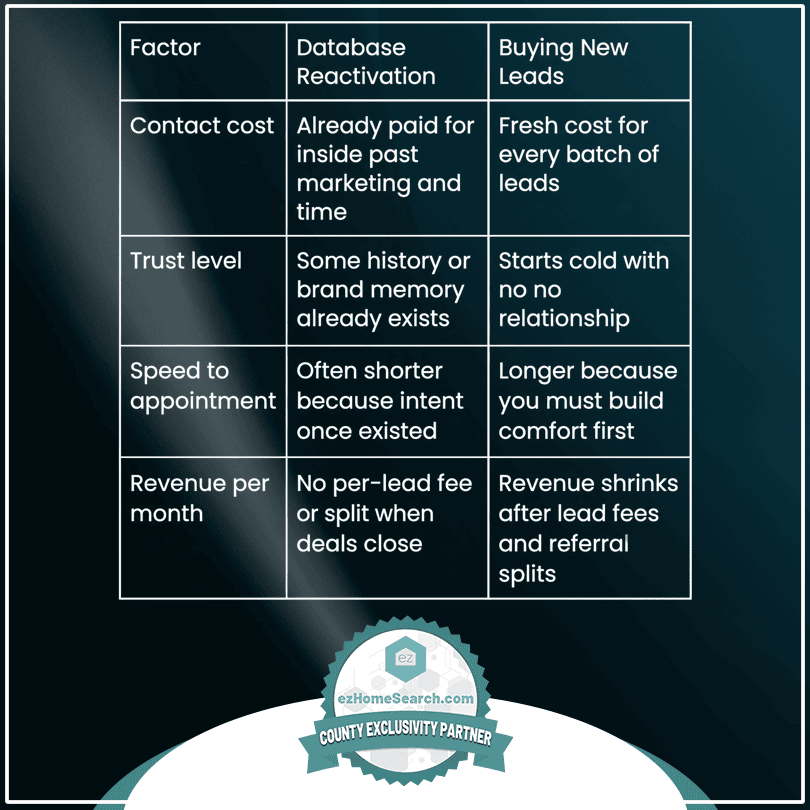
For most broker-owners and team leaders, the smart order is clear. First, make the database you own productive. Then, layer on new lead channels only when your base is performing.
Who Belongs In Your Reactivation Pool — And How To Segment Them

Your reactivation pool is every contact in your CRM who is not in an active conversation today. That does not mean everyone should receive the same message. Segmenting by relationship type and timing makes your outreach feel personal instead of spammy.
Start by separating past clients from prospects who never closed. Then, note:
How long it has been since the last contact
Whether they were buyers, sellers, or investors
Where they came from (open houses, Facebook ads, referrals, sign calls, portals)
This structure helps you match the right offer and timing to each group.
Segmentation also protects your time, and machine learning based predictions of sales leads demonstrate that behavioral tagging and contact classification can dramatically increase the accuracy of identifying which dormant contacts are most likely to convert. Broker-owners and ISAs can point calling and texting efforts toward the highest-value groups instead of dialing every name in order. Platforms like ez Home Search take this further by layering behavioral data on top of those tags, so the contacts who just showed fresh activity bubble to the top first.
The Six Segments Every Agent Should Prioritize
Past buyers deserve first attention. They already trusted you with a life-changing purchase. As families grow, jobs change, or retirement nears, these owners often start thinking about their next place. A quick home value check-in can restart that relationship before another agent steps in.
Past sellers are proven movers. They know how the listing process works and often think about buying again once plans settle. Some become investors or second-home buyers. Regular market updates and equity reports can keep you in their thoughts for both their own moves and the referrals they send.
Unconverted recent leads (within the last six months) showed real interest but hit a timing wall. Maybe rates spiked, or they lost a bidding war. Their plans often restart when conditions feel better. A timely message that references their earlier search can catch them as they re-enter the market.
Long-term nurture leads from six to twenty-four months ago often get labeled as dead. In reality, many were always on a longer path. If you stay present with light, useful touches, they are far more likely to reply when life events make a move possible. The agent who stayed present usually wins.
Open house attendees took time to walk through a property and share contact info. That physical effort shows strong intent, even if they disappeared afterward. Checking in with updated listings that match what they toured can quickly show whether they are still active.
Old seller leads who inquired three to six months ago sit right on the edge of acting. Market changes such as small rate drops or rising neighborhood prices often flip their math. A quick update on what their home could sell for now can be the nudge that gets a listing appointment.
How To Reactivate Your Database: Messaging, Channels, And Timing

Reactivating your database starts with the right message, delivered through the right mix of channels, at a moment that feels natural to the contact. Effective real estate database reactivation is not a generic newsletter or a random “just checking in” text. It is a short, personal note tied to a clear reason to talk today.
A practical process looks like this:
Clean and segment your list. Remove obvious bad data, tag contact types, and group by recency.
Choose one segment to work this week. For example, past buyers from three to seven years ago.
Write one or two short templates that reference past contact, offer something useful, and end with a simple question.
Send those messages using a mix of email, text, and voicemail over several days instead of one blast.
Track replies and conversations so responsive contacts move back into an active nurture plan.
Multi-channel outreach matters, and sales analytics and demand forecasting research confirms that combining multiple communication channels significantly improves engagement rates compared to single-channel campaigns. Research from Omnisend found that campaigns using three or more channels see purchase rates nearly three times higher than those using only one channel. In real estate, that same pattern shows up as higher reply rates and more booked appointments when you blend email, SMS, and voice rather than relying only on your inbox.
Platforms such as ez Home Search help by automatically watching for new activity, sending co-branded alerts, and flagging contacts who are likely ready for a personal call.
What Effective Reactivation Messaging Looks Like
Good reactivation messages share three traits:
They remind the person how they know you.
They give real value tied to the market or the contact’s own home.
They close with an easy question that makes it simple to reply.
For example, you might write to a past seller:
“We spoke last spring about your plans to sell in Oak Ridge when your kids finished school. Prices in that area have moved quite a bit since then, and your equity may look very different today. Would you like a quick, no-cost update on what your place could sell for right now?”
For a buyer lead, a message might sound like:
“You were looking at three-bedroom homes in North Hills last summer. A few new listings just hit that match what you saved back then. Want me to send over the best ones so you can see how the options look now?”
This structure works because it feels specific, not generic. It shows you remember their timeline and situation. It offers something useful instead of asking for a favor. It gives them a simple yes-or-no path.
Avoid lines like “just following up” or long apologies for being out of touch, since those phrases add no value and only draw attention to the gap.
Multi-Channel Outreach And Campaign Timing
Your contacts read and reply in different places, so your plan should meet them where they are — a principle backed by innovation in customer reactivation studies showing that constraint-aware, multi-touch outreach in service sectors consistently outperforms broadcast-style communication:
Email works well for market reports, detailed home value breakdowns, and curated listing sets. It feels professional and gives space for charts or links.
SMS shines for short nudges, such as “Rates dropped this week, want to see what that does to your buying power?” Texts tend to be opened far more often than emails; average SMS open rates can reach around 98 percent, while email averages hover near 20 percent (Campaign Monitor).
Ringless voicemail adds a human voice without forcing a live answer. A warm, thirty-second message from you can remind a past client why they liked working with you.
Social direct messages on Facebook or Instagram can supplement these channels for contacts you already connect with there.
Timing also matters. Many teams:
Run a reactivation push once each quarter
Add extra waves when clear hooks appear, such as rate moves or big inventory shifts
Use closing anniversaries and equity milestones as personal triggers
Platforms like ez Home Search can track those signals and tee up the right touch at the right moment so you are not guessing when to reach out.
How ez Home Search Turns Database Reactivation Into A Systematic Engine
ez Home Search focuses on turning database reactivation from a one-time project into a constant engine that runs behind the scenes. Instead of asking agents to remember who to call, the platform watches how contacts behave and then highlights who is closest to a decision. That approach fits how busy broker-owners, team leaders, and ISAs actually work.
The co-branded home search experience keeps past clients and sphere contacts using your site long after closing. They browse properties, save searches, and watch price changes with your name on every screen. Those actions feed into behavioral tracking, so when a contact:
Starts a new search
Sets up alerts in a new county
Opens three home value emails in a week
ez Home Search flags that contact for you.
The platform also handles much of the content and outreach work. Co-branded listing alerts, home value updates, and newsletters go out without you writing them one by one. For Follow Up Boss users, ezNurture sends and logs those touches inside the CRM you already use. For teams that want a single hub, Sure Send provides a native CRM with landing pages, CMAs, and automation tied directly to ez Home Search data. ezVerify.ai cleans and enriches aging records and confirms consent, so you can reactivate old contacts without guessing about TCPA risk.
What Makes ez Home Search Different From A Standard CRM
Standard CRMs store information and send basic drip campaigns. ez Home Search behaves more like an intent radar for your database. It tracks property views, saved searches, alert clicks, and visit patterns, then bubbles up contacts whose behavior looks like a move is coming soon.
The platform also brings in data on roughly 80 million residential properties across the United States, reflecting the kind of unified revenue platform architecture that integrates property data, behavioral signals, and decision support into a single, cohesive system for B2B enterprises. By looking at equity, loan rates, and time in home, ez Home Search helps partners spot likely sellers even before those owners start browsing public portals. That lets you start a friendly value conversation early instead of chasing a listing once the sign is already in the yard.
Compliance and protection matter as much as more appointments. ezVerify.ai confirms consent and screens out known litigators before calls and texts go out. The Exclusive County Partner program then guarantees that all of this activity benefits one agent, team, or brokerage in that county, not a pool of competitors racing each other to the same lead.
How To Measure Whether Your Reactivation Campaign Is Working

Measuring database reactivation starts with a simple question: are more of your old contacts turning into real conversations and signed agreements? To answer that, you need clear numbers at a few levels, from first reply through closed transaction. Without tracking, it is easy for a campaign to feel busy while actual revenue stays flat — a challenge that democratizing data through self-service analytics research addresses by showing how enterprise-wide adoption of accessible analytics platforms enables teams to connect activity metrics directly to measurable business outcomes.
At the top, watch basic engagement metrics, such as:
Email opens and clicks
SMS reply rates and opt-outs
Callbacks or returned texts from voicemail
According to HubSpot, average email open rates often sit near twenty percent, so higher numbers from your reactivation list are a good sign that your subject lines and hooks make sense.
Next, follow how many of those replies turn into pipeline activity. Track:
Booked appointments
CMAs requested
Contacts moved from cold into warm or hot stages in your CRM
If your team runs a database of 5,000 or more contacts, a solid reactivation plan can easily create dozens of listing or buyer consultations every month. Internal ez Home Search data points to reactivation sequences that bring roughly a quarter of dormant contacts back into some level of active engagement over time.
The Three-Tier Metrics Framework
A simple three-tier framework keeps your tracking clean:
Engagement metrics. These include email opens and clicks, SMS replies, and any callbacks from voicemail or social messages. When these numbers are weak, you usually need better subject lines, stronger offers, or clearer copy.
Pipeline metrics. Here you count reactivated contacts who booked a meeting, requested a CMA, or moved from cold to warm or hot status in your CRM. If engagement looks fine but pipeline numbers lag, the issue often lies in your follow-up speed or how you handle the first reply.
Business outcomes. These metrics cover listings taken, buyer agreements signed, deals closed, and actual commission dollars traced back to reactivated contacts. You can also compare cost per appointment from reactivation against cost per appointment from new paid leads.
Broker-owners who watch all three tiers can adjust messages, channels, and budget with confidence instead of guessing.
The Bottom Line
The most expensive mistake many real estate teams make is easy to describe. They pour money into new lead sources while the database they already own sits untouched. That database holds past clients who liked working with them, prospects who inquired years ago, and owners who are quietly reaching equity points that support a move.
When you reactivate and then keep nurturing that asset, it starts to behave like a compounding bank account. Each reactivated contact who closes, gives a referral, or returns for a second or third move adds value without adding fresh acquisition cost. ez Home Search is built around that idea, combining co-branded consumer tools, behavioral tracking, property data, and compliance into one system that keeps your name in front of your market.
The decision in front of you is simple. Audit the database you have, apply the segments from this guide, and choose whether you want to build the outreach and tracking yourself or plug into a platform that already runs it at scale. Either way, your next growth stage is far more likely to come from reactivation than from another batch of cold internet leads.
Frequently Asked Questions
Question: How long does it take to see results from a database reactivation campaign?
The first replies from a well-planned reactivation campaign often arrive within days, sometimes within hours. Actual closings take longer and depend on where contacts are in their decision cycle. Recent unconverted leads may move in a few weeks or months. Long-range nurture contacts might need six to twelve months of steady, light communication before they are ready.
Question: What is the difference between database reactivation and database nurture?
Database nurture means low-pressure contact that keeps someone warm before they show clear intent. Database reactivation means a focused push toward contacts who already went quiet, with more touches over a shorter period. Reactivation aims to restart replies and then move those contacts back into an ongoing nurture track. Both approaches work together inside a healthy CRM.
Question: How often should I reactivate my database?
Most high-producing teams run at least two focused reactivation pushes per year, with quarterly campaigns as a common standard. Extra rounds happen when strong hooks appear, such as major rate changes or sharp local price moves. With platforms like ez Home Search, much of this runs in the background, so reactivation feels like a steady habit instead of a one-time project.
Question: Is database reactivation TCPA-compliant?
Database reactivation can be compliant when you have proof of consent and honor opt-outs across all channels. The risk comes from calling or texting old numbers without clear records of how that contact entered your system. ezVerify.ai inside ez Home Search checks consent status and screens out known litigators before outreach, so your team can work a dormant list with far less legal risk.
Question: What should I do when a reactivated contact responds?
Reply quickly, ideally within a few minutes, while their interest is fresh. Start by delivering on the value you offered, such as sending the market update or home value report you mentioned. Ask one or two simple questions to understand their timeline and motivation. Then suggest a clear next step, like a quick call, a meeting, or a tour, and offer specific times.

Preston Guyton has spent 20+ years helping people find the right home—and helping them avoid the costly mistakes that often come from not knowing their options. As the founder of ez Home Search, he’s leading the charge to build a better way to discover real estate—one that puts your privacy first, delivers accurate information, and gives you the confidence to make informed decisions. Preston has assembled a powerhouse team—made up of the innovators behind many of the technologies people use every day—to build the tools and transparency that deliver on a single mission: A Better Way To Discover Real Estate.