

Most agents should work the leads already sitting in their CRM before they spend on more. When you understand how to reactivate old real estate leads, you usually find cheaper, warmer deals than any new portal campaign can bring in.
The pain shows up when that database turns into a graveyard of half-finished conversations. New leads feel exciting, while old ones feel messy, slow, and hard to sort.
The fix is simple to describe and harder to run. You focus on old leads first, build a system that surfaces the right contacts each day, and protect yourself with clean compliance. In this guide, you’ll see practical steps for segmentation, message scripts, timing, legal guardrails, and how ez Home Search turns reactivation into a steady growth engine.
Keep reading to see how you can win business from old leads before a competitor even spots the opportunity.
Key Takeaways
Database decay silently erases money from your pipeline. When emails bounce and numbers fail, you lose real commission checks. Understanding decay explains why old leads feel unresponsive and why a living, updated database makes every reactivation touch more profitable.
Behavioral signals reveal who is ready right now. When a contact suddenly saves homes, requests a valuation, or logs into your site again, that visit matters. Reacting during that window is far more effective than working a list in date order. ez Home Search pushes those signals into your CRM so timing stops being a guess.
Compliance rules sit behind every text to an old lead. Prior consent, quiet hours, Do Not Call checks, and known litigators all matter. ezVerify.ai checks those boxes before anyone dials, so your team can move faster without turning reactivation into legal risk.
Exclusivity changes the math of reactivation work. With ez Home Search, one partner holds the county, so no other agent sees the same consumer activity. Every reactivated contact in that territory belongs to one team instead of a race among four portal buyers.
Long-term revenue lives after the closing table. Post-closing nurture with home value updates, local reports, and helpful check-ins keeps people from drifting to another brand. ez Home Search runs that content automatically so your reactivated clients keep repeating and referring without you writing every message by hand.
Why Your Old Leads Are Not Dead – They’re Just Waiting

Old real estate leads stay useful because most went quiet after follow up broke, not because intent disappeared. When agents learn how to reactivate old real estate leads with a simple, steady plan, they often find active buyers and sellers hiding in plain sight.
Real campaign data backs this up. A reactivation project run by CallAction on 2,920 old Zillow contacts produced 1,229 conversations in thirty days, a 42 percent response rate, plus four contracts in four weeks — consistent with what research on Proposals That Actually Win identifies as the core mechanics behind high-conversion outreach in service businesses. Those people did not become good only when the campaign started. They were already thinking about real estate.
“The fortune is in the follow-up.”
That line shows up in sales trainings for a reason: most lost deals are lost to silence, not rejection.
The breakdown came from the original follow up pattern. Tasks showed as complete, but real conversations never took place. Emails were opened, links were clicked, searches were run, yet nobody actually talked. Activity in the log is not the same as a live human reply.
This is why the mindset shift matters so much. When a broker, ISA manager, or solo agent treats old leads as bad leads, they keep pushing money into new list sources. When that same person accepts that follow up broke, they start asking a better question: how to reach those people again with a better offer, better timing, and a system that can actually keep up.
Many buyers and sellers also work on much longer timelines than agents expect. A lead who clicked homes eighteen months ago might only now be in a position to move. If you keep your name in front of them, you capture that long timeline instead of donating it to a stranger.
Which Contacts In Your Database Deserve Priority Attention
The contacts worth your time first are the ones with clear past intent and lower present competition. When you decide how to reactivate old real estate leads, this order matters more than the sheer number of texts or emails you send.
Not every older contact holds the same value. Some came from quick website forms that never replied even once. Others took time off work to walk through an open house or sign a listing agreement. Starting with the second group usually gives faster wins and more motivation for your team.
Here are the categories that deserve the top of your call sheet:
Aged expired and cancelled listings have already raised their hand to sell. Once twenty to thirty days pass after the expiration, the field of competing callers shrinks. Services like All The Leads gather these records along with Do Not Call status. A simple, respectful check-in at that point can feel calm and helpful instead of like the storm they saw in the first week.
Open house sign-ins showed up in person and took time to tour. Even if they never answered your early follow up, that visit still signals real interest. Many paused for financing or timing reasons, not from lack of desire. A fresh message with a better offer often pulls them back into motion.
Old portal and PPC leads from Zillow, Realtor.com, Facebook, or Google Ads filled out a form on purpose. You paid for that chance. Many of them needed months, not weeks, before they were ready. Reactivation gives you a second shot at that sunk cost instead of starting over.
Sphere and past clients often hold the highest lifetime value of all. Research gathered by ez Home Search shows 88 to 92 percent of past clients say they would use their agent again, yet only about 18 percent actually do. That gap exists mostly because the agent stopped reaching out and another brand appeared first.
You can think about these segments with a simple cheat sheet:
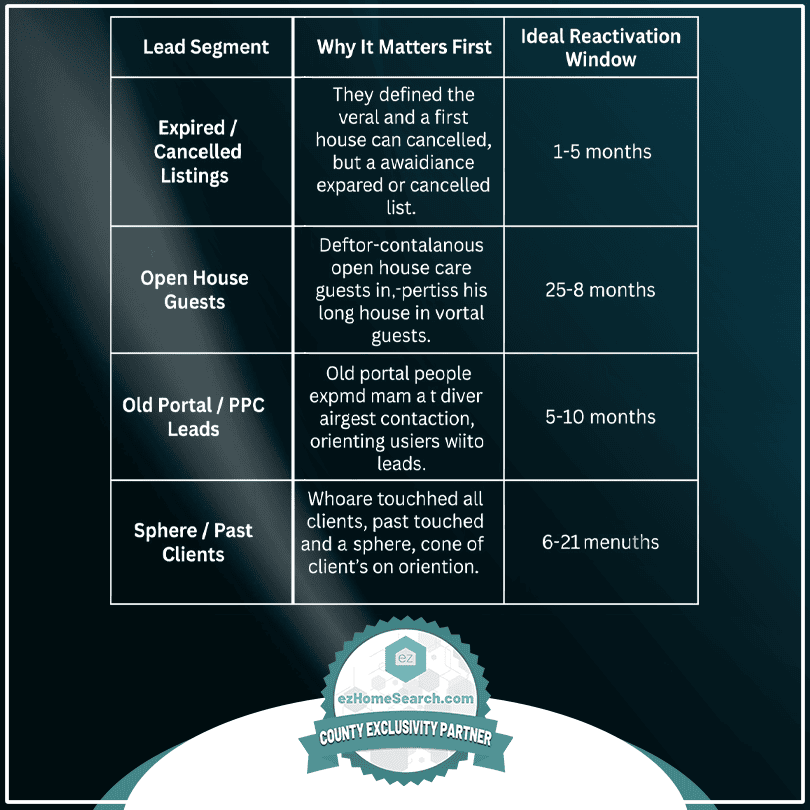
When you combine these segments with live behavior data from your CRM, your team stops guessing and starts calling the few dozen people each week who are most likely to say yes.
How To Use CRM Data To Surface Behavioral Signals
Behavioral signals turn a static contact list into a live radar screen. Instead of asking how to reactivate old real estate leads in theory, you watch actual activity and reach out during the right hour.
Some of the most useful signals include:
Repeated home searches in a short span
New or updated saved listings
Fresh home value requests
A spike in return visits to your site or portal
When a past client in Raleigh suddenly starts checking condos in Denver, that tells you more than any static tag. Industry research, including data from Ylopo and similar platforms, shows contacts who click and view multiple listings within a short window convert at far higher rates when called quickly — a pattern also documented in work on AI-Powered Real Estate Lead intelligence systems that track behavioral engagement signals in real time.
ez Home Search sends those signals straight into the CRM many teams already run, including Follow Up Boss. You do not need another login or extra tab. A lead that starts saving homes on your co-branded ez Home Search portal pushes an alert into your dashboard so you can text or call in the same hour. That flow makes behavioral timing something your whole team can use, not just a few tech-savvy agents.
A simple rule of thumb: if someone has viewed or saved several homes in the past 24–48 hours, they belong at the very top of your call list that day.
What A High-Converting Reactivation Message Actually Looks Like
A high-converting reactivation message focuses on getting a reply, not closing a deal in one text. When you think about how to reactivate old real estate leads, the first goal is a simple two-way conversation. Everything else comes later.
Three rules guide the best messages:
End with a clear question. Questions invite replies; statements do not.
Lead with a real value offer. Give them a reason to respond that helps them, not you.
Keep the pressure low. Frame around a future time window so it feels safe to answer honestly.
A simple script that has worked across many markets looks like this, with your own details filled in:
Hey, it is [Name] here in [City]. I can finally get access to homes for sale before they hit the open market. Are you still planning to shop next year? [Brokerage Name]
According to CallAction, real estate text message scripts built on this pattern pull higher reply rates than long branded messages packed with slogans and links (CallAction). The reason is simple. People answer questions that feel personal and useful. They ignore lectures.
The value line about homes before the open market matters just as much as the question. It tells the buyer they can see something they could not see on a giant portal. Agents who tie that line to a real pre-market strategy, instead of empty words, keep trust once the conversation starts.
If you prefer email, the same structure works in a slightly longer format with a clear subject line such as “Still Thinking About Buying Next Year?” and one or two short paragraphs that mirror the text.
The Text Message Script That Works And Why Each Line Earns Its Place
Breaking this script into its parts makes it easy to adapt while keeping what works. It also makes how to reactivate old real estate leads feel a lot less mysterious.
The opening line: “Hey, it is [Name] here in [City].”
This feels like a normal text from a person, not a bot. It names who you are and where you work in a friendly tone. This simple start lowers the wall many people put up when they sense a mass blast. It also reminds them which market you know best.The middle line: “I can finally get access to homes for sale before they hit the open market.”
This delivers the hook. The word “finally” suggests something new changed in their favor. exclusive real estate opportunities speaks to the fear of missing out that buyers feel when homes sell fast. When you back this promise with a real plan to find off-market or just-listed homes, you become the agent with an edge instead of one more person forwarding MLS links.The question: “Are you still planning to shop next year?”
This keeps pressure low while nudging a reply. People can answer yes, no, or “we actually want to buy sooner” without feeling boxed in. The focus on next year makes the message feel safe, yet many will reveal they are ready much earlier. That simple line turns a dead record into a live thread in your CRM.The closing tag: “[Brokerage Name]”.
This handles your disclosure needs. It signals that this is a licensed professional, not a random texter. That clarity helps with trust and with compliance checks from your broker or state guidelines.
You can create variations for other segments while keeping the same skeleton. For example, for an old seller lead:
Hi [Name], it is [You] with [Brokerage] in [City]. I have buyers looking in your neighborhood again. Are you still thinking about selling in the next year or two?
How To Build A Reactivation System That Doesn’t Collapse Under Its Own Replies

A reactivation effort fails when replies arrive faster than your team can answer. The real key to how to reactivate old real estate leads is not just message wording, it is matching outreach volume to reply capacity.
If you blast two thousand texts at once, you may feel busy for a day, then burned out, then behind again. Contacts who reply and then hear nothing for hours often feel ignored and pull back. That repeats the same follow up failure that made the database cold in the first place.
A better pattern sends a steady, controlled batch each workday. Many ISA teams see strong results at around fifty contacts per day, Monday through Friday, during local business hours. That pace keeps the phone ringing without burying your staff. Research from InsideSales.com shows leads contacted within five minutes of their reply are far more likely to qualify for a real appointment than those reached later in the day, a principle that aligns with findings on INNOVATION IN CUSTOMER REACTIVATION in service sectors, where speed of response is the primary lever for re-engagement success.
Every reply needs to land in one place. That means your CRM, not a private phone thread on an agent’s device. Status tags should tell you who is hot, who is warm, who already bought, and who asked to stop messages. The conversations, notes, and updated numbers all belong to your business, not to a vendor.
It helps to think in waves instead of one giant push:
Run one wave on aged expireds.
Run another on portal leads from the past year.
Run another on open house lists.
As each wave settles, your team can clean the data, review the pipeline, and then move to the next group with more confidence.
A simple daily rhythm for an agent or ISA might look like this:
Start the day by calling or texting yesterday’s replies first.
Work through that day’s new behavioral alerts from ez Home Search.
Send a fresh batch of reactivation messages to the next segment on your list.
End the day by updating tags, notes, and next steps for anyone who responded.
How ez Home Search’s ezNurture And Sure Send Automate Reactivation Without Losing The Human Touch
Automation lets you follow these rhythms without living inside your CRM all day, and platforms that connect behavioral triggers to CRM workflows — like those examined in research on AI-Enhanced CRM With Chatbots for real estate — demonstrate measurably higher lead conversion compared to manual-only follow-up processes. ez Home Search designed ezNurture and Sure Send to support how to reactivate old real estate leads at scale while still feeling human on the other end.
ezNurture runs automated follow up flows inside the CRM you already use, including Follow Up Boss. Instead of a simple calendar drip, messages fire when the contact behaves in a certain way, such as saving a home or viewing a value estimate. That means your text or email matches what the person just did, which feels far more helpful than a generic marketing blast.
Sure Send connects at the API level so data moves in real time rather than through slow, brittle connector tools. When a past client logs into your co-branded ez Home Search portal, their behavior can trigger a task, a message, or a tag update inside your CRM within moments. Because ez Home Search runs on a county-based exclusivity model, every one of those triggers goes to a single partner in that county, not to a group of agents chasing the same prospect.
In practice, a typical sequence might look like this:
A past client logs into your ez Home Search portal and saves three new homes.
Sure Send updates the contact record in your CRM and fires an ezNurture step.
You receive a task and a suggested script that references the exact homes they saved.
You send a short, personal text within minutes, starting a real conversation.
The tech does the watching and routing; your team handles the part that still needs a human voice.
What Compliance Requires Before You Text A Single Old Lead

Before you send even one message, you need to know which contacts you are legally allowed to reach. Any serious plan for how to reactivate old real estate leads starts with TCPA rules, not with scripts.
The core idea is simple: you may text people who gave clear, written permission to be contacted. That usually includes leads from Zillow, Realtor.com, your own IDX site, and landing pages where the form spelled out that you might call or text. It does not include random lists scraped from the internet or cold data bought from unclear sources.
According to the Federal Communications Commission, businesses must honor Do Not Call rules, provide clear opt-out options, and avoid calling or texting before 8 AM or after 9 PM in the recipient’s time zone (Federal Communications Commission). Those quiet hours apply even when you have consent.
Database decay adds another wrinkle, and Weekly Contract Rhythm: A diagnostic approach to monitoring contact list health shows that systematic weekly audits can catch data degradation signals before they become compliance liabilities — an important consideration given that 15 to 22 percent of email addresses go bad each year. Industry estimates also suggest roughly one in ten people change their mobile number in a given year, which means a five-year-old list may hold many reassigned numbers. That raises the chance that you text someone who never opted in.
You also face a smaller group of professional plaintiffs who watch for TCPA mistakes. Some reactivation platforms keep private lists of these known litigators and suppress them before any campaign runs. This kind of protection matters more as your volume grows.
In short, you protect your team by:
Working only with opted-in records
Honoring opt-outs immediately
Scrubbing data for reassigned numbers
Using tools that keep proof of consent you can show later if needed
How ezVerify.ai Handles Compliance Before Anyone Dials
ezVerify.ai sits at the front of the ez Home Search system so you can think about how to reactivate old real estate leads without guessing about risk. It treats compliance as a standard step, not an afterthought.
When you load a list, ezVerify.ai checks each contact for past consent language, Do Not Call status, and known litigator flags. Numbers that fall into a danger zone are quietly removed from any call or text queue. This protects broker owners and team leaders who might not have perfect records for older portal leads or events.
The tool also stores proof that the person opted in, along with the date and method. That record can be critical if a consumer or regulator ever questions a specific call. As an extra bonus, ezVerify.ai can enrich some records with missing details such as email or updated phone numbers, which saves your staff from hours of manual research before they begin a reactivation sprint.
How To Keep Reactivated Leads From Going Cold Again

The sad pattern for many teams looks like this. They learn how to reactivate old real estate leads, run a strong thirty-day push, close a few deals, then slowly slip back into silence. Within a year, the database feels dead again.
To break that cycle, you treat reactivation as the start of a long relationship, not a one-time rescue. Every contact who replies, whether they are ready now or a year from now, should move into a clear nurture path. That path sets expectations about how often they hear from you and what kind of value they receive.
Monthly touches work well when they feel useful, short, and personal. Examples include:
A quick text about a price change in their neighborhood
A short video explaining a rate shift
A check-in about their plans for the next season
A simple question such as, “Is your current place still working for you?”
Research from NAR shows that almost 90 percent of buyers and sellers say they would use their agent again, yet fewer than 20 percent actually do — a disconnect that studies on The Effect of Real estate brokerage service quality on customer trust confirm is driven primarily by post-transaction communication gaps rather than dissatisfaction with the original transaction. Most of that gap comes from agents who disappear after closing.
client appreciation events may be the single highest return activity you can build. Home anniversary messages, equity updates, and local owner tips keep you present without feeling pushy. For broker owners and team leaders, systematizing this work means a steady stream of repeat and referral deals that do not require daily manual effort from every agent.
Automation helps, but it should always make messages feel more personal, not more robotic. That is why ez Home Search focuses its tools on behavior-based timing and high-quality content rather than simple count-based drips.
How ez Home Search Prevents Database Decay Passively
ez Home Search takes a different view of how to reactivate old real estate leads by keeping contacts active before they ever feel cold again. The platform does this by giving consumers reasons to return on their own.
Partners receive a fully co-branded home search site that ties directly to their county. Past clients and sphere contacts log in to watch listings, see price changes, and explore new areas when life events pop up. The system also sends home value updates, market reports, and newsletters under the partner’s name, all written and managed by ez Home Search.
Every time a contact returns, the platform quietly captures updated email addresses, phone numbers, and behavior patterns. That turns database decay into something closer to database growth. Instead of chasing people for fresh contact details, you learn them naturally as they use tools they actually like. Research summarized by ez Home Search shows that partners often reactivate past clients at 2.5 to 5 times the market rate because their names never fade between moves.
National coverage means those benefits follow clients when they move out of your area. Roughly one in twenty Americans moves to a different county or state each year, according to analysis of Census mobility data, and research on Heterogeneous Real Estate Agents and the housing cycle shows that agent market share is heavily influenced by how well teams maintain relationships with mobile client segments across different housing market phases. Because your past client searches the new market on your co-branded ez Home Search site, you see that move early, can win the local listing at home, and earn the referral on the other end.
The Bottom Line
The most valuable source of business you have this year already sits inside your CRM. The real opportunity is not a new batch of shared portal leads. It is learning how to reactivate old real estate leads with messages, timing, and systems that your team can run every week.
Each dormant contact represents money you already spent to acquire, plus intent that may have only shifted, not vanished. When you combine behavior-based outreach, proven scripts, and real compliance checks, that sunk cost starts to return as closings instead of clutter. ez Home Search exists to support that model, from county-based exclusivity to ezNurture, Sure Send, and ezVerify.ai.
When you treat reactivation as a permanent system rather than a quick tactic, your database stops shrinking and starts compounding. The agents and teams who make that shift now will be the ones who win listings and buyers while others keep paying for the same crowded leads.
Conclusion
Your choice is simple. You can keep paying for strangers who also appear in three other agents’ inboxes, or you can turn back to the people who already raised their hand once. Start with a small, controlled reactivation sprint, learn from the replies, then lock in a monthly rhythm that your team can maintain. With the right partner platform beside you, your database becomes a living asset instead of a forgotten list.
Frequently Asked Questions
Question 1: How long should I wait before trying to reactivate an old real estate lead?
You can reattempt contact after about thirty days of silence and even years later. The better trigger is behavior, not time. A lead who opens emails and starts searching again after eighteen months is hotter than a silent one from sixty days ago. Aged expired listings often respond best around twenty to thirty days after the prior listing ends.
Question 2: Is it legal to text real estate leads from years ago?
It is legal when the person originally gave clear written permission to be called or texted. That usually covers portal forms, IDX registrations, and landing page opt-ins. Age alone does not cancel consent. Cold lists without documented opt-in stay off limits. You must still respect quiet hours between 8 AM and 9 PM in the consumer’s local time.
Question 3: What response rate should I realistically expect from a reactivation campaign?
Many opted-in databases see around a thirty percent response rate when the outreach message is short, friendly, and ends with a question — a figure supported by Fig. 1: Response and success rates data from npj Climate Action’s analysis of outreach campaign performance, which illustrates how message design and targeting precision drive measurable reply rate differences across audience segments. CallAction’s documented campaign on 2,920 old Zillow leads achieved a forty-two percent reply rate with four contracts in four weeks. Segments like aged expireds and open house visitors often respond better than generic online leads.
Question 4: What should I do with leads who say they already bought or sold?
Move those contacts out of active buyer or seller follow up and tag them as past purchasers in your CRM. They still matter. They can refer friends and family and will likely move again someday. Place them into a light, long-term homeowner nurture path with value updates and friendly check-ins instead of deleting them.
Question 5: How does database exclusivity affect reactivation results?
Exclusivity means no other agent receives the same contact from the same source at the same time. That removes the race to call first and lets you focus on value. ez Home Search’s county-based model sends every consumer action in that area to one partner only, which data from the company shows can lift conversion three to five times above shared lead platforms.

Preston Guyton has spent 20+ years helping people find the right home—and helping them avoid the costly mistakes that often come from not knowing their options. As the founder of ez Home Search, he’s leading the charge to build a better way to discover real estate—one that puts your privacy first, delivers accurate information, and gives you the confidence to make informed decisions. Preston has assembled a powerhouse team—made up of the innovators behind many of the technologies people use every day—to build the tools and transparency that deliver on a single mission: A Better Way To Discover Real Estate.